Thank you for visiting SNEWPapers!
Sign up free
Story
September 23, 1953
Tabor City Tribune
Tabor City, Columbus County, North Carolina
What is this article about?
Sgt. Roland Watts, Tabor City's returning Korean POW, details his 37-month captivity: capture in 1950, forced marches, starvation, executions, torture by North Koreans and Chinese, survival tactics, and joyful homecoming with family in 1953.
Clipping
OCR Quality
98%
Excellent
Full Text
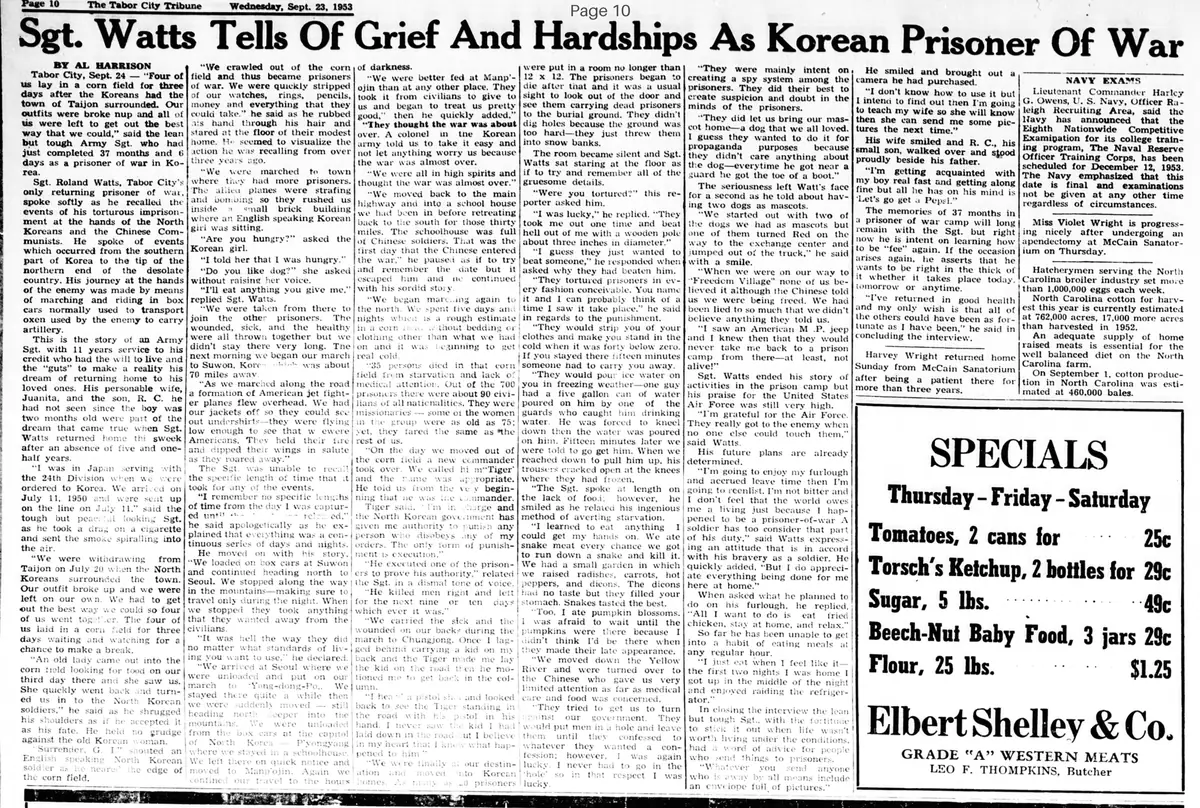
Sgt. Watts Tells Of Grief And Hardships As Korean Prisoner Of War
BY AL HARRISON
Tabor City, Sept. 24— "Four of us lay in a corn field for three days after the Koreans had the town of Taijon surrounded. Our outfits were broken up and all of us were left to get out the best way that we could," said the lean but tough Army Sgt. who had just completed 37 months and 6 days as a prisoner of war in Korea.
Sgt. Roland Watts, Tabor City's only returning prisoner of war, spoke softly as he recalled the events of his torturous imprisonment at the hands of the North Koreans and the Chinese Communists.
He spoke of events which occurred from the southern part of Korea to the tip of the northern end of the desolate country. His journey at the hands of the enemy was made by means of marching and riding in box cars normally used to transport oxen used by the enemy to carry artillery.
This is the story of an Army Sgt. with 11 years service to his credit who had the will to live and the "guts" to make a reality his dream of returning home to his loved ones. His personable wife, Juanita, and the son, R. C. he had not seen since the boy was two months old were part of the dream that came true when Sgt. Watts returned home this week after an absence of five and one-half years.
"I was in Japan serving with the 24th Division when we were ordered to Korea. We arrived on July 1, 1950 and were sent up on the line on July 1," said the tough but peaceful looking Sgt. as he took a drag on a cigarette and sent the smoke spiralling into the air.
"We were withdrawing from Taijon on July 20 when the North Koreans surrounded the town. Our outfit broke up and we were left on our own. We had to get out the best way we could so four of us went together. The four of us laid in a corn field for three days waiting and watching for a chance to make a break.
"An old lady came out into the corn field looking for food on our third day there and she saw us. She quickly went back and turned us in to the North Korean soldiers," he said as he shrugged his shoulders as if he accepted it as his fate. He held no grudge against the old Korean woman.
"Surrender, G. I!" shouted an English speaking North Korean soldier as he neared the edge of the corn field.
"We crawled out of the corn field and thus became prisoners of war. We were quickly stripped of our watches, rings, pencils, money and everything that they could take," he said as he rubbed his hand through his hair and stared at the floor of their modest home. He seemed to visualize the action he was recalling from over three years ago.
"We were marched to town where they had more prisoners. The allied planes were strafing and bombing so they rushed us inside 2 small brick building where an English speaking Korean girl was sitting.
"Are you hungry?" asked the Korean girl.
"I told her that I was hungry."
"Do you like dog?" she asked without raising her voice.
"I'll eat anything you give me," replied Sgt. Watts.
We were taken from there to join the other prisoners. The wounded, sick, and the healthy were all thrown together but we didn't stay there very long. The next morning we began our march to Suwon. I think was about 70 miles away.
"As we marched along the road a formation of American jet fighter planes flew overhead. We had our jackets off so they could see our undershirts—they were flying low enough to see that we were Americans. They held their fire and dipped their wings in salute as they roared away."
The Sgt was unable to recall the specific length of time that it took for any of the events.
"I remember no specific lengths of time from the day I was captured until I was released," he said apologetically as he explained that everything was a continuous series of days and nights. He moved on with his story.
"We loaded on box cars at Suwon and continued heading north to Seoul. We stopped along the way in the mountains making sure to travel only during the night. When we stopped they took anything that they wanted away from the civilians.
"It was hell the way they did no matter what standards of living you want to use," he declared.
"We arrived at Seoul where we were unloaded and put on our march to Yong-dong-Po. We stayed there quite a while then we were suddenly moved -- still heading north deeper into the mountains. We were unloaded from the box cars at the capitol of North Korea, P'yongyang where we stayed in a schoolhouse. We left there on quick notice and moved to Manp'ojin. Again we continued our travel to the hours of darkness.
"We were better fed at Manp'ojin than at any other place. They took it from civilians to give to us and began to treat us pretty good," then he quickly added. "They thought the war was about over. A colonel in the Korean army told us to take it easy and not let anything worry us because the war was almost over.
"We were all in high spirits and thought the war was almost over."
"We moved back to the main highway and into a school house we had been in before retreating back to the south for those thirty miles. The schoolhouse was full of Chinese soldiers. That was the first day that the Chinese entered the war," he paused as if to try and remember the date but it escaped him and he continued with his sordid story.
"We began marching again to the north. We spent five days and nights which is a rough estimate in a corn tent without bedding or clothing other than what we had on and it was beginning to get real cold.
"35 persons died in that corn field from starvation and lack of medical attention. Out of the 100 prisoners there were about 90 civilians of all nationalities. They were missionaries -- some of the women in the group were as old as 75 yet they fared the same as the rest of us.
"On the day we moved out of the corn field a new commander took over. We called him 'Tiger' and the name was appropriate. He told us from time to time beginning that he was the commander. Tiger said, 'I'm in charge and the North Korean government has given me authority to punish any person who disobeys any of my orders. The only form of punishment is execution.'
"He executed one of the prisoners to prove his authority," related the Sgt. in a dismal tone of voice.
"He killed men right and left for the next nine or ten days whichever it was."
We carried the sick and the wounded on our backs during the march to Chungjong. Once I lagged behind carrying a kid on my back and the Tiger made me lay the kid on the road then he motioned me to get back in the column.
"I heard a pistol shot, and looked back to see the Tiger standing in the road with his pistol in his hand. I never saw the kid I had laid down in the road but I believe in my heart that I know what happened to him."
"We were finally at our destination and moved into Korean homes. As many as 40 prisoners were put in a room no longer than 12 x 12. The prisoners began to die after that and it was a usual sight to look out of the door and see them carrying dead prisoners to the burial ground. They didn't dig holes because the ground was too hard—they just threw them into snow banks.
The room became silent and Sgt. Watts sat staring at the floor as if to try and remember all of the gruesome details.
"Were you tortured?" this reporter asked him.
"I was lucky," he replied. "They took me out one time and beat hell out of me with a wooden pole about three inches in diameter."
"I guess they just wanted to beat someone," he responded when asked why they had beaten him.
"They tortured prisoners in every fashion conceivable. You name it and I can probably think of a time I saw it take place," he said in regards to the punishment.
"They would strip you of your clothes and make you stand in the cold when it was forty below zero. If you stayed there fifteen minutes someone had to carry you away.
"They would pour ice water on you in freezing weather—one guy had a five gallon can of water poured on him by one of the guards who caught him drinking water. He was forced to kneel down then the water was poured on him. Fifteen minutes later we were told to go get him. When we reached down to pull him up, his trousers cracked open at the knees where they had frozen.
"The Sgt. spoke at length on the lack of food however. He smiled as he related his ingenious method of averting starvation.
"I learned to eat anything I could get my hands on. We ate snake meat every chance we got to run down a snake and kill it. We had a small garden in which we raised radishes, carrots, hot peppers, and dicons. The dicons had no taste but they filled your stomach. Snakes tasted the best. Too, I ate pumpkin blossoms. I was afraid to wait until the pumpkins were there because I didn't think I'd be there when they made their late appearance.
"We moved down the Yellow River and were turned over to the Chinese who gave us very limited attention as far as medical care and food was concerned. They tried to get us to turn against our government. They would put men in a hole and leave them until they confessed to whatever they wanted a confession; however, I was again lucky. I never had to go in the 'hole' so in that respect I was lucky.
"They were mainly intent on creating a spy system among the prisoners. They did their best to create suspicion and doubt in the minds of the prisoners.
"They did let us bring our mascot home—a dog that we all loved. I guess they wanted to do it for propaganda purposes because they didn't care anything about the dog—every time he got near a guard he got the toe of a boot."
The seriousness left Watt's face for a second as he told about having two dogs as mascots.
"We started out with two of the dogs we had as mascots but one of them turned Red on the way to the exchange center and jumped out of the truck," he said with a smile.
"When we were on our way to 'Freedom Village' none of us believed it although the Chinese told us we were being freed. We had been lied to so much that we didn't believe anything they told us.
"I saw an American M.P. jeep and I knew then that they would never take me back to a prison camp from there—at least, not alive!"
Sgt. Watts ended his story of activities in the prison camp but his praise for the United States Air Force was still very high.
"I'm grateful for the Air Force. They really got to the enemy when no one else could touch them," said Watts.
His future plans are already determined.
"I'm going to enjoy my furlough and accrued leave time then I'm going to reenlist. I'm not bitter and I don't feel that the world owes me a living just because I happened to be a prisoner-of-war. A soldier has to consider that part of his duty," said Watts expressing an attitude that is in accord with his bravery as a soldier. He quickly added, "But I do appreciate everything being done for me here at home."
When asked what he planned to do on his furlough, he replied, "All I want to do is eat fried chicken, stay at home, and relax."
So far he has been unable to get into a habit of eating meals at any regular hour.
"I just eat when I feel like it—the first two nights I was home I got up in the middle of the night and enjoyed raiding the refrigerator."
In closing the interview the lean but tough Sgt., with the fortitude to stick it out when life wasn't worth living under the conditions, had a word of advice for people who send things to prisoners.
"Whatever you send anyone who is away by all means include an envelope full of pictures."
He smiled and brought out a camera he had purchased.
"I don't know how to use it but I intend to find out then I'm going to teach my wife so she will know then she can send me some pictures the next time."
His wife smiled and R. C., his small son, walked over and stood proudly beside his father.
"I'm getting acquainted with my boy real fast and getting along fine but all he has on his mind is 'Let's go get a Pepsi.'"
The memories of 37 months in a prisoner of war camp will long remain with the Sgt. but right now he is intent on learning how to be 'free' again. If the occasion arises again, he asserts that he wants to be right in the thick of it whether it takes place today, tomorrow or anytime.
"I've returned in good health and my only wish is that all of the others could have been as fortunate as I have been," he said in concluding the interview.
BY AL HARRISON
Tabor City, Sept. 24— "Four of us lay in a corn field for three days after the Koreans had the town of Taijon surrounded. Our outfits were broken up and all of us were left to get out the best way that we could," said the lean but tough Army Sgt. who had just completed 37 months and 6 days as a prisoner of war in Korea.
Sgt. Roland Watts, Tabor City's only returning prisoner of war, spoke softly as he recalled the events of his torturous imprisonment at the hands of the North Koreans and the Chinese Communists.
He spoke of events which occurred from the southern part of Korea to the tip of the northern end of the desolate country. His journey at the hands of the enemy was made by means of marching and riding in box cars normally used to transport oxen used by the enemy to carry artillery.
This is the story of an Army Sgt. with 11 years service to his credit who had the will to live and the "guts" to make a reality his dream of returning home to his loved ones. His personable wife, Juanita, and the son, R. C. he had not seen since the boy was two months old were part of the dream that came true when Sgt. Watts returned home this week after an absence of five and one-half years.
"I was in Japan serving with the 24th Division when we were ordered to Korea. We arrived on July 1, 1950 and were sent up on the line on July 1," said the tough but peaceful looking Sgt. as he took a drag on a cigarette and sent the smoke spiralling into the air.
"We were withdrawing from Taijon on July 20 when the North Koreans surrounded the town. Our outfit broke up and we were left on our own. We had to get out the best way we could so four of us went together. The four of us laid in a corn field for three days waiting and watching for a chance to make a break.
"An old lady came out into the corn field looking for food on our third day there and she saw us. She quickly went back and turned us in to the North Korean soldiers," he said as he shrugged his shoulders as if he accepted it as his fate. He held no grudge against the old Korean woman.
"Surrender, G. I!" shouted an English speaking North Korean soldier as he neared the edge of the corn field.
"We crawled out of the corn field and thus became prisoners of war. We were quickly stripped of our watches, rings, pencils, money and everything that they could take," he said as he rubbed his hand through his hair and stared at the floor of their modest home. He seemed to visualize the action he was recalling from over three years ago.
"We were marched to town where they had more prisoners. The allied planes were strafing and bombing so they rushed us inside 2 small brick building where an English speaking Korean girl was sitting.
"Are you hungry?" asked the Korean girl.
"I told her that I was hungry."
"Do you like dog?" she asked without raising her voice.
"I'll eat anything you give me," replied Sgt. Watts.
We were taken from there to join the other prisoners. The wounded, sick, and the healthy were all thrown together but we didn't stay there very long. The next morning we began our march to Suwon. I think was about 70 miles away.
"As we marched along the road a formation of American jet fighter planes flew overhead. We had our jackets off so they could see our undershirts—they were flying low enough to see that we were Americans. They held their fire and dipped their wings in salute as they roared away."
The Sgt was unable to recall the specific length of time that it took for any of the events.
"I remember no specific lengths of time from the day I was captured until I was released," he said apologetically as he explained that everything was a continuous series of days and nights. He moved on with his story.
"We loaded on box cars at Suwon and continued heading north to Seoul. We stopped along the way in the mountains making sure to travel only during the night. When we stopped they took anything that they wanted away from the civilians.
"It was hell the way they did no matter what standards of living you want to use," he declared.
"We arrived at Seoul where we were unloaded and put on our march to Yong-dong-Po. We stayed there quite a while then we were suddenly moved -- still heading north deeper into the mountains. We were unloaded from the box cars at the capitol of North Korea, P'yongyang where we stayed in a schoolhouse. We left there on quick notice and moved to Manp'ojin. Again we continued our travel to the hours of darkness.
"We were better fed at Manp'ojin than at any other place. They took it from civilians to give to us and began to treat us pretty good," then he quickly added. "They thought the war was about over. A colonel in the Korean army told us to take it easy and not let anything worry us because the war was almost over.
"We were all in high spirits and thought the war was almost over."
"We moved back to the main highway and into a school house we had been in before retreating back to the south for those thirty miles. The schoolhouse was full of Chinese soldiers. That was the first day that the Chinese entered the war," he paused as if to try and remember the date but it escaped him and he continued with his sordid story.
"We began marching again to the north. We spent five days and nights which is a rough estimate in a corn tent without bedding or clothing other than what we had on and it was beginning to get real cold.
"35 persons died in that corn field from starvation and lack of medical attention. Out of the 100 prisoners there were about 90 civilians of all nationalities. They were missionaries -- some of the women in the group were as old as 75 yet they fared the same as the rest of us.
"On the day we moved out of the corn field a new commander took over. We called him 'Tiger' and the name was appropriate. He told us from time to time beginning that he was the commander. Tiger said, 'I'm in charge and the North Korean government has given me authority to punish any person who disobeys any of my orders. The only form of punishment is execution.'
"He executed one of the prisoners to prove his authority," related the Sgt. in a dismal tone of voice.
"He killed men right and left for the next nine or ten days whichever it was."
We carried the sick and the wounded on our backs during the march to Chungjong. Once I lagged behind carrying a kid on my back and the Tiger made me lay the kid on the road then he motioned me to get back in the column.
"I heard a pistol shot, and looked back to see the Tiger standing in the road with his pistol in his hand. I never saw the kid I had laid down in the road but I believe in my heart that I know what happened to him."
"We were finally at our destination and moved into Korean homes. As many as 40 prisoners were put in a room no longer than 12 x 12. The prisoners began to die after that and it was a usual sight to look out of the door and see them carrying dead prisoners to the burial ground. They didn't dig holes because the ground was too hard—they just threw them into snow banks.
The room became silent and Sgt. Watts sat staring at the floor as if to try and remember all of the gruesome details.
"Were you tortured?" this reporter asked him.
"I was lucky," he replied. "They took me out one time and beat hell out of me with a wooden pole about three inches in diameter."
"I guess they just wanted to beat someone," he responded when asked why they had beaten him.
"They tortured prisoners in every fashion conceivable. You name it and I can probably think of a time I saw it take place," he said in regards to the punishment.
"They would strip you of your clothes and make you stand in the cold when it was forty below zero. If you stayed there fifteen minutes someone had to carry you away.
"They would pour ice water on you in freezing weather—one guy had a five gallon can of water poured on him by one of the guards who caught him drinking water. He was forced to kneel down then the water was poured on him. Fifteen minutes later we were told to go get him. When we reached down to pull him up, his trousers cracked open at the knees where they had frozen.
"The Sgt. spoke at length on the lack of food however. He smiled as he related his ingenious method of averting starvation.
"I learned to eat anything I could get my hands on. We ate snake meat every chance we got to run down a snake and kill it. We had a small garden in which we raised radishes, carrots, hot peppers, and dicons. The dicons had no taste but they filled your stomach. Snakes tasted the best. Too, I ate pumpkin blossoms. I was afraid to wait until the pumpkins were there because I didn't think I'd be there when they made their late appearance.
"We moved down the Yellow River and were turned over to the Chinese who gave us very limited attention as far as medical care and food was concerned. They tried to get us to turn against our government. They would put men in a hole and leave them until they confessed to whatever they wanted a confession; however, I was again lucky. I never had to go in the 'hole' so in that respect I was lucky.
"They were mainly intent on creating a spy system among the prisoners. They did their best to create suspicion and doubt in the minds of the prisoners.
"They did let us bring our mascot home—a dog that we all loved. I guess they wanted to do it for propaganda purposes because they didn't care anything about the dog—every time he got near a guard he got the toe of a boot."
The seriousness left Watt's face for a second as he told about having two dogs as mascots.
"We started out with two of the dogs we had as mascots but one of them turned Red on the way to the exchange center and jumped out of the truck," he said with a smile.
"When we were on our way to 'Freedom Village' none of us believed it although the Chinese told us we were being freed. We had been lied to so much that we didn't believe anything they told us.
"I saw an American M.P. jeep and I knew then that they would never take me back to a prison camp from there—at least, not alive!"
Sgt. Watts ended his story of activities in the prison camp but his praise for the United States Air Force was still very high.
"I'm grateful for the Air Force. They really got to the enemy when no one else could touch them," said Watts.
His future plans are already determined.
"I'm going to enjoy my furlough and accrued leave time then I'm going to reenlist. I'm not bitter and I don't feel that the world owes me a living just because I happened to be a prisoner-of-war. A soldier has to consider that part of his duty," said Watts expressing an attitude that is in accord with his bravery as a soldier. He quickly added, "But I do appreciate everything being done for me here at home."
When asked what he planned to do on his furlough, he replied, "All I want to do is eat fried chicken, stay at home, and relax."
So far he has been unable to get into a habit of eating meals at any regular hour.
"I just eat when I feel like it—the first two nights I was home I got up in the middle of the night and enjoyed raiding the refrigerator."
In closing the interview the lean but tough Sgt., with the fortitude to stick it out when life wasn't worth living under the conditions, had a word of advice for people who send things to prisoners.
"Whatever you send anyone who is away by all means include an envelope full of pictures."
He smiled and brought out a camera he had purchased.
"I don't know how to use it but I intend to find out then I'm going to teach my wife so she will know then she can send me some pictures the next time."
His wife smiled and R. C., his small son, walked over and stood proudly beside his father.
"I'm getting acquainted with my boy real fast and getting along fine but all he has on his mind is 'Let's go get a Pepsi.'"
The memories of 37 months in a prisoner of war camp will long remain with the Sgt. but right now he is intent on learning how to be 'free' again. If the occasion arises again, he asserts that he wants to be right in the thick of it whether it takes place today, tomorrow or anytime.
"I've returned in good health and my only wish is that all of the others could have been as fortunate as I have been," he said in concluding the interview.
What sub-type of article is it?
Biography
Survival
Historical Event
What themes does it cover?
Survival
Misfortune
Bravery Heroism
What keywords are associated?
Korean War
Prisoner Of War
Capture
March
Starvation
Torture
Survival
Release
What entities or persons were involved?
Sgt. Roland Watts
Juanita Watts
R. C. Watts
Where did it happen?
Korea
Story Details
Key Persons
Sgt. Roland Watts
Juanita Watts
R. C. Watts
Location
Korea
Event Date
July 1950 To 1953
Story Details
Sgt. Roland Watts recounts his capture near Taijon in July 1950, grueling marches and boxcar transports north through Korea, harsh imprisonment with starvation, executions by commander 'Tiger', torture, and survival by eating snakes and garden produce, turnover to Chinese, and release after 37 months and 6 days.