Thank you for visiting SNEWPapers!
Sign up free
Literary
June 17, 1909
Event 1 of 2
Mexico Missouri Message
Mexico, Audrain County, Missouri
What is this article about?
Short story 'A Diplomat from Chicago' by Caroline Lockhart about a mother visiting her unhappy daughter, exposing the son-in-law's stinginess through a disastrous dinner party. Followed by a brief humorous anecdote 'Not In That Line' about a persistent photographer's proposal.
Clipping
OCR Quality
98%
Excellent
Full Text
This is Event 1 of 2. The full text below covers all events in this component.
A Diplomat from Chicago
By CAROLINE LOCKHART
Something was wrong with Lily; she was not happy, and it crept out in the sorrowful tone of her letters. So mother came on from Chicago to see about it.
When mother started out to see about anything, something was bound to happen. Mother was a majestic lady, with a high white pompadour and impressive embonpoint. She had great executive ability and prided herself upon her willpower. Lily was the apple of her eye, and Lily was unhappy, she meant to know the reason why—and promptly, too.
Whipple, who was small and nervous, to his own great disgust, always found himself cowed by the cold, penetrating eyes and bland voice of his mother-in-law. Therefore he was not crazed with joy when the telegram announcing her coming reached him; but he met her at the station and kissed her on the cheek that she offered him with all the warmth that he could muster.
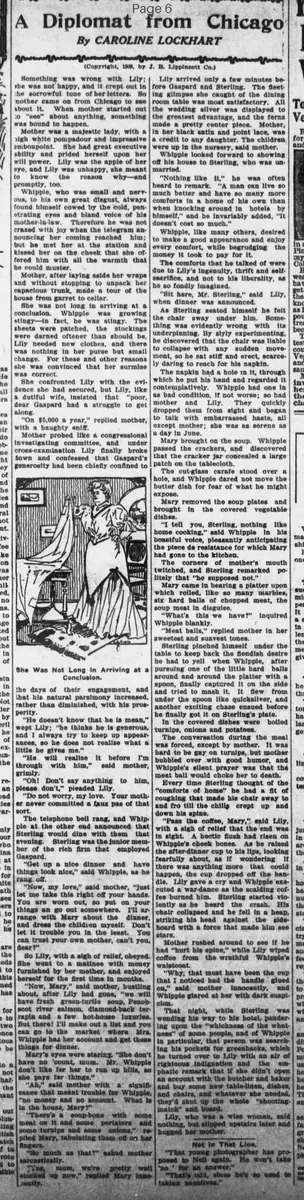
Mother, after laying aside her wraps and without stopping to unpack her capacious trunk, made a tour of the house from garret to cellar. She was not long in arriving at a conclusion. Whipple was growing stingy—in fact, he was stingy. The sheets were patched, the stockings were darned oftener than should be, Lily needed new clothes, and there was nothing in her purse but small change. For these and other reasons she was convinced that her surmise was correct.
She confronted Lily with the evidence she had secured, but Lily, like a dutiful wife, insisted that poor, dear Gaspard had a struggle to get along.
"On $5,000 a year," replied mother, with a haughty sniff.
Mother probed like a congressional investigating committee, and under cross-examination Lily finally broke down and confessed that Gaspard's generosity had been chiefly confined to the days of their engagement, and that his natural parsimony increased, rather than diminished, with his prosperity.
"He doesn't know that he is mean," wept Lily; "he thinks he is generous, and I always try to keep up appearances, so he does not realize what a little he gives me."
"He will realize it before I'm through with him," said mother, grimly.
"Oh! Don't say anything to him, please don't," pleaded Lily.
"Do not worry, my love. Your mother never committed a faux pas of that sort."
The telephone bell rang, and Whipple at the other end announced that Sterling would dine with them that evening. Sterling was the junior member of the rich firm that employed Gaspard.
"Get up a nice dinner and have things look nice," said Whipple, as he rang off.
"Now, my love," said mother, "just let me take this right off your hands. You are worn out, so put on your things and go out somewhere. I'll arrange with Mary about the dinner, and dress the children myself. Don't let it trouble you in the least. You can trust your own mother, can't you, dear?"
So Lily, with a sigh of relief, obeyed. She went to a matinee with money furnished by her mother, and enjoyed herself for the first time in months.
"Now, Mary," said mother, bustling about, after Lily had gone, "we will have fresh green-turtle soup, Penobscot river salmon, diamond-back terrapin and a few hot-house luxuries. But there! I'll make out a list and you can go to the market where Mrs. Whipple has her account and get these things for dinner."
Mary's eyes were staring. "She don't have no 'count, mum. Mr. Whipple don't like fer her to run up bills, so she pays fer things."
"Ah," said mother with a significance that meant trouble for Whipple, "no money and no account. What is in the house, Mary?"
"There's a soup-bone with some meat on it and some pertaters and some turnips and some onions," replied Mary, tabulating them off on her fingers.
"So much as that?" asked mother sarcastically.
"Yes, man, we're pretty well stocked up now," replied Mary innocently.
Lily arrived only a few minutes before Gaspard and Sterling. The fleeting glimpse she caught of the dining room table was most satisfactory. All the wedding silver was displayed to the greatest advantage, and the ferns made a pretty center piece. Mother, in her black satin and point lace, was a credit to any daughter. The children were up in the nursery, said mother.
Whipple looked forward to showing off his house to Sterling, who was unmarried.
"Nothing like it," he was often heard to remark. "A man can live so much better and have so many more comforts in a home of his own than when knocking around in hotels by himself," and he invariably added, "It doesn't cost so much."
Whipple, like many others, desired to make a good appearance and enjoy every comfort, while begrudging the money it took to pay for it. The comforts that he talked of were due to Lily's ingenuity, thrift and self-sacrifice, and not to his liberality, as he so fondly imagined.
"Sit here, Mr. Sterling," said Lily, when dinner was announced.
As Sterling seated himself he felt the chair sway under him. Something was evidently wrong with its underpinning. By slyly experimenting he discovered that the chair was liable to collapse with any sudden movement, so he sat stiff and erect, scarcely daring to reach for his napkin.
The napkin had a hole in it, through which he put his hand and regarded it contemplatively. Whipple had one in as bad condition, if not worse; so had mother and Lily. They quickly dropped them from sight and began to talk with embarrassed haste, all except mother; she was as serene as a day in June.
Mary brought on the soup. Whipple passed the crackers, and discovered that the cracker jar concealed a large patch on the tablecloth.
The cut-glass carafe stood over a hole, and Whipple dared not move the butter dish for fear of what he might expose.
Mary removed the soup plates and brought in the covered vegetable dishes.
"I tell you, Sterling, nothing like home cooking," said Whipple in his boastful voice, pleasantly anticipating the piece de resistance for which Mary had gone to the kitchen.
The corners of mother's mouth twitched, and Sterling remarked politely that "he supposed not."
Mary came in bearing a platter upon which rolled, like so many marbles, six hard balls of chopped meat, the soup meat in disguise.
"What's this we have?" inquired Whipple blankly.
"Meat balls," replied mother in her sweetest and suavest tones.
Sterling pinched himself under the table to keep back the fiendish desire he had to yell when Whipple, after pursuing one of the little hard balls around and around the platter with a spoon, finally captured it on the side and tried to mash it. It flew from under the spoon like quicksilver, and another exciting chase ensued before he finally got it on Sterling's plate.
In the covered dishes were boiled turnips, onions and potatoes.
The conversation during the meal was forced, except by mother. It was hard to be gay on turnips, but mother bubbled over with good humor, and Whipple's silent prayer was that the meat ball would choke her to death.
Every time Sterling thought of the "comforts of home" he had a fit of coughing that made his chair sway to and fro till the chills crept up and down his spine.
"Pass the coffee, Mary," said Lily with a sigh of relief that the end was in sight. A hectic flush had risen on Whipple's cheek bones. As he raised the after-dinner cup to his lips, looking fearfully about, as if wondering if there was anything more that could happen, the cup dropped off the handle. Lily gave a cry and Whipple executed a war-dance as the scalding coffee burned him. Sterling started violently as he heard the crash. His chair collapsed and he fell in a heap, striking his head against the sideboard with a force that made him see stars.
Mother rushed around to see if he had "hurt his spine," while Lily wiped coffee from the wrathful Whipple's waistcoat.
"Why, that must have been the cup that I noticed had the handle glued on," said mother innocently, and Whipple glared at her with dark suspicion.
That night, while Sterling was wending his way to his hotel, pondering upon the "whichess of the whatness" of some people, and of Whipple in particular, that person was searching his pockets for greenbacks, which he turned over to Lily with an air of righteous indignation and the emphatic remark that if she didn't open an account with the butcher and baker and buy some new table-linen, dishes, and chairs, and whatever she needed, they'd shut up the whole "shooting-match" and board.
Lily, who was a wise woman, said nothing, but slipped upstairs later and hugged her mother.
Not In That Line.
"That young photographer has proposed to Neil again. He won't take 'no' for an answer."
That's odd, since he's so used to taking negatives.
By CAROLINE LOCKHART
Something was wrong with Lily; she was not happy, and it crept out in the sorrowful tone of her letters. So mother came on from Chicago to see about it.
When mother started out to see about anything, something was bound to happen. Mother was a majestic lady, with a high white pompadour and impressive embonpoint. She had great executive ability and prided herself upon her willpower. Lily was the apple of her eye, and Lily was unhappy, she meant to know the reason why—and promptly, too.
Whipple, who was small and nervous, to his own great disgust, always found himself cowed by the cold, penetrating eyes and bland voice of his mother-in-law. Therefore he was not crazed with joy when the telegram announcing her coming reached him; but he met her at the station and kissed her on the cheek that she offered him with all the warmth that he could muster.
Mother, after laying aside her wraps and without stopping to unpack her capacious trunk, made a tour of the house from garret to cellar. She was not long in arriving at a conclusion. Whipple was growing stingy—in fact, he was stingy. The sheets were patched, the stockings were darned oftener than should be, Lily needed new clothes, and there was nothing in her purse but small change. For these and other reasons she was convinced that her surmise was correct.
She confronted Lily with the evidence she had secured, but Lily, like a dutiful wife, insisted that poor, dear Gaspard had a struggle to get along.
"On $5,000 a year," replied mother, with a haughty sniff.
Mother probed like a congressional investigating committee, and under cross-examination Lily finally broke down and confessed that Gaspard's generosity had been chiefly confined to the days of their engagement, and that his natural parsimony increased, rather than diminished, with his prosperity.
"He doesn't know that he is mean," wept Lily; "he thinks he is generous, and I always try to keep up appearances, so he does not realize what a little he gives me."
"He will realize it before I'm through with him," said mother, grimly.
"Oh! Don't say anything to him, please don't," pleaded Lily.
"Do not worry, my love. Your mother never committed a faux pas of that sort."
The telephone bell rang, and Whipple at the other end announced that Sterling would dine with them that evening. Sterling was the junior member of the rich firm that employed Gaspard.
"Get up a nice dinner and have things look nice," said Whipple, as he rang off.
"Now, my love," said mother, "just let me take this right off your hands. You are worn out, so put on your things and go out somewhere. I'll arrange with Mary about the dinner, and dress the children myself. Don't let it trouble you in the least. You can trust your own mother, can't you, dear?"
So Lily, with a sigh of relief, obeyed. She went to a matinee with money furnished by her mother, and enjoyed herself for the first time in months.
"Now, Mary," said mother, bustling about, after Lily had gone, "we will have fresh green-turtle soup, Penobscot river salmon, diamond-back terrapin and a few hot-house luxuries. But there! I'll make out a list and you can go to the market where Mrs. Whipple has her account and get these things for dinner."
Mary's eyes were staring. "She don't have no 'count, mum. Mr. Whipple don't like fer her to run up bills, so she pays fer things."
"Ah," said mother with a significance that meant trouble for Whipple, "no money and no account. What is in the house, Mary?"
"There's a soup-bone with some meat on it and some pertaters and some turnips and some onions," replied Mary, tabulating them off on her fingers.
"So much as that?" asked mother sarcastically.
"Yes, man, we're pretty well stocked up now," replied Mary innocently.
Lily arrived only a few minutes before Gaspard and Sterling. The fleeting glimpse she caught of the dining room table was most satisfactory. All the wedding silver was displayed to the greatest advantage, and the ferns made a pretty center piece. Mother, in her black satin and point lace, was a credit to any daughter. The children were up in the nursery, said mother.
Whipple looked forward to showing off his house to Sterling, who was unmarried.
"Nothing like it," he was often heard to remark. "A man can live so much better and have so many more comforts in a home of his own than when knocking around in hotels by himself," and he invariably added, "It doesn't cost so much."
Whipple, like many others, desired to make a good appearance and enjoy every comfort, while begrudging the money it took to pay for it. The comforts that he talked of were due to Lily's ingenuity, thrift and self-sacrifice, and not to his liberality, as he so fondly imagined.
"Sit here, Mr. Sterling," said Lily, when dinner was announced.
As Sterling seated himself he felt the chair sway under him. Something was evidently wrong with its underpinning. By slyly experimenting he discovered that the chair was liable to collapse with any sudden movement, so he sat stiff and erect, scarcely daring to reach for his napkin.
The napkin had a hole in it, through which he put his hand and regarded it contemplatively. Whipple had one in as bad condition, if not worse; so had mother and Lily. They quickly dropped them from sight and began to talk with embarrassed haste, all except mother; she was as serene as a day in June.
Mary brought on the soup. Whipple passed the crackers, and discovered that the cracker jar concealed a large patch on the tablecloth.
The cut-glass carafe stood over a hole, and Whipple dared not move the butter dish for fear of what he might expose.
Mary removed the soup plates and brought in the covered vegetable dishes.
"I tell you, Sterling, nothing like home cooking," said Whipple in his boastful voice, pleasantly anticipating the piece de resistance for which Mary had gone to the kitchen.
The corners of mother's mouth twitched, and Sterling remarked politely that "he supposed not."
Mary came in bearing a platter upon which rolled, like so many marbles, six hard balls of chopped meat, the soup meat in disguise.
"What's this we have?" inquired Whipple blankly.
"Meat balls," replied mother in her sweetest and suavest tones.
Sterling pinched himself under the table to keep back the fiendish desire he had to yell when Whipple, after pursuing one of the little hard balls around and around the platter with a spoon, finally captured it on the side and tried to mash it. It flew from under the spoon like quicksilver, and another exciting chase ensued before he finally got it on Sterling's plate.
In the covered dishes were boiled turnips, onions and potatoes.
The conversation during the meal was forced, except by mother. It was hard to be gay on turnips, but mother bubbled over with good humor, and Whipple's silent prayer was that the meat ball would choke her to death.
Every time Sterling thought of the "comforts of home" he had a fit of coughing that made his chair sway to and fro till the chills crept up and down his spine.
"Pass the coffee, Mary," said Lily with a sigh of relief that the end was in sight. A hectic flush had risen on Whipple's cheek bones. As he raised the after-dinner cup to his lips, looking fearfully about, as if wondering if there was anything more that could happen, the cup dropped off the handle. Lily gave a cry and Whipple executed a war-dance as the scalding coffee burned him. Sterling started violently as he heard the crash. His chair collapsed and he fell in a heap, striking his head against the sideboard with a force that made him see stars.
Mother rushed around to see if he had "hurt his spine," while Lily wiped coffee from the wrathful Whipple's waistcoat.
"Why, that must have been the cup that I noticed had the handle glued on," said mother innocently, and Whipple glared at her with dark suspicion.
That night, while Sterling was wending his way to his hotel, pondering upon the "whichess of the whatness" of some people, and of Whipple in particular, that person was searching his pockets for greenbacks, which he turned over to Lily with an air of righteous indignation and the emphatic remark that if she didn't open an account with the butcher and baker and buy some new table-linen, dishes, and chairs, and whatever she needed, they'd shut up the whole "shooting-match" and board.
Lily, who was a wise woman, said nothing, but slipped upstairs later and hugged her mother.
Not In That Line.
"That young photographer has proposed to Neil again. He won't take 'no' for an answer."
That's odd, since he's so used to taking negatives.
What sub-type of article is it?
Prose Fiction
What themes does it cover?
Social Manners
Moral Virtue
Commerce Trade
What keywords are associated?
Mother In Law
Stingy Husband
Dinner Party
Family Dynamics
Humor
Parsimony
What entities or persons were involved?
By Caroline Lockhart
Literary Details
Title
A Diplomat From Chicago
Author
By Caroline Lockhart
Key Lines
"He Will Realize It Before I'm Through With Him," Said Mother, Grimly.
"Meat Balls," Replied Mother In Her Sweetest And Suavest Tones.
"Why, That Must Have Been The Cup That I Noticed Had The Handle Glued On," Said Mother Innocently, And Whipple Glared At Her With Dark Suspicion.