Thank you for visiting SNEWPapers!
Sign up free
The Enquirer
Richmond, Henrico County, Virginia
What is this article about?
U.S. Congress sessions November 9-11, 1812: Senate appoints committees on foreign, military, naval, import, and militia matters; refers President's messages. House refers merchant petitions on British imports; passes document postage bill; agrees to Mississippi statehood inquiry and mounted volunteer expedition against hostile Indians, per Mr. Johnson's speech on frontier atrocities.
Merged-components note: Continuation of congressional proceedings across page boundary.
Clippings
1 of 2
OCR Quality
Full Text
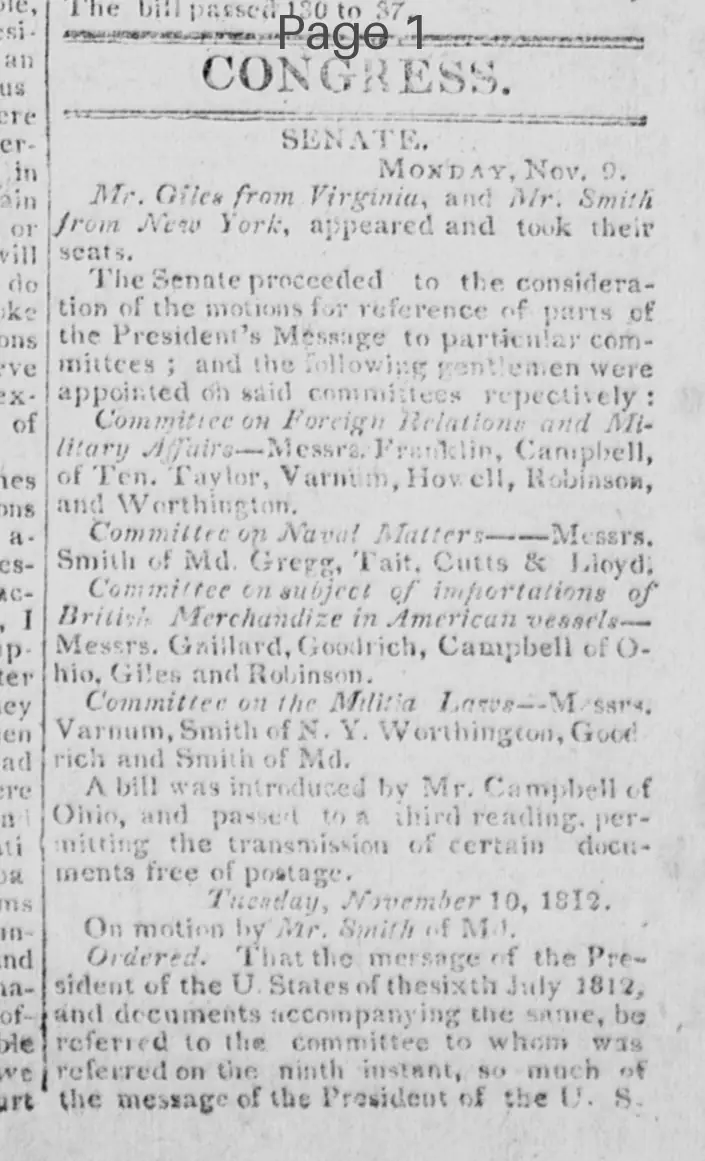
SENATE.
MONDAY, NOV. 9.
Mr. Giles from Virginia, and Mr. Smith from New York, appeared and took their seats.
The Senate proceeded to the consideration of the motions for reference of parts of the President's Message to particular committees; and the following gentlemen were appointed on said committees respectively:
Committee on Foreign Relations and Military Affairs—Messrs. Franklin, Campbell, of Tenn. Taylor, Varnum, Howell, Robinson, and Worthington.
Committee on Naval Affairs—Messrs. Smith of Md. Gregg, Tait, Cutts & Lloyd.
Committee on subject of importations of British Merchandize in American vessels—Messrs. Gaillard, Goodrich, Campbell of Ohio, Giles and Robinson.
Committee on the Militia Laws—Messrs. Varnum, Smith of N. Y. Worthington, Goodrich and Smith of Md.
A bill was introduced by Mr. Campbell of Ohio, and passed its third reading, permitting the transmission of certain documents free of postage.
Tuesday, November 10, 1812.
On motion by Mr. Smith of Md.
Ordered. That the message of the President of the U States of the sixth July 1812, and documents accompanying the same, be referred to the committee to whom was referred on the ninth instant, so much of the message of the President of the U. S.
Senate.
Wednesday, November 11.
On motion of Mr. Varnum, the message of the President, transmitting the correspondence between the Governors of Connecticut and Massachusetts, and the Department of War, relative to calling out the Militia, was referred to the committee appointed on so much of the President's Message as relates to the Militia.
HOUSE OF REPRESENTATIVES.
Tuesday, November 10.
Mr. Mitchill presented the petition of sundry merchants of the city of New-York, praying to be released from the penalties incurred by recent importations of British goods into the United States—Referred to the Committee of Ways & Means.
Mr. Pleasants presented a petition of a similar tenor from Tompkins and Murray, of Richmond, in Virginia; which was referred in the same manner.
Mr. Poindexter observed that a bill had last session passed this House for erecting Mississippi territory into a state, but had been rejected in the Senate from a particular objection, which it was now understood would be soon removed by the consent of the State of Georgia to the measure. He therefore proposed that a bill for that purpose should be again originated in this House; and therefore moved the following resolution:
Resolved, That a committee be appointed to enquire into the expediency of authorising the people of the Mississippi territory to form a constitution and state government, and of admitting them into the Union on an equal footing with the original states; and that the committee have leave to report thereon by bill or otherwise.
The resolution was agreed to, and Messrs. Poindexter, B. Hall, Grundy, Taliaferro & Goodwyn appointed a committee accordingly.
MOUNTED TROOPS.
Mr. Johnson observed that he had drafted a resolution for the consideration of the House, the object of which was to authorise an expedition of mounted volunteers against the several Indian tribes hostile to the U. States. He said the people of the United States had the power and the will to break up and to extirpate those hostile savages, to desolate their country, or compel them to surrender at discretion, as the Miamies had done lately when they beheld the strong arm of the government uplifted and ready to fall upon them heavily. And it was the imperious duty of Congress so to organize this power, and so to direct this will as to make it effectual and most destructive to the enemy in the line of its operation. Mr. J. said a winter campaign of mounted men well selected, well organized and well conducted for sixty days, would close an Indian war, which was restrained on their part by no ties of religion, by no rules of morality, by no suggestions of mercy, by no principles of humanity. Sir, said he, you well know that we cannot so guard any part of our extended line of frontier as to prevent entirely the incursions of the savages, so long as they have a place of safety or a hiding place upon our borders; by reason of which a few desperate savages, well armed with their rifles, tomahawks and scalping knives, & paid for the scalps of our citizens, may travel in the night, watch their place of assassination undiscovered, & fall upon our infant settlements thus exposed & massacre them without distinction of age or sex, & not leave an infant to lisp the sad tale of sorrow to the passing stranger. Such has been the fact in many places on our frontier since the battle of Tippecanoe: & such was the melancholy fact near the Ohio river, in Indiana, when upwards of twenty persons were horridly murdered in cold blood, without the opportunity of resistance; the most of these unfortunate victims were women and children, whose heads were roasted by the fire, & in this cruel mode tortured to death, & under circumstances which would blacken & dye with deeper disgrace the most infamous and abandoned set of beings on earth.
Since the defeat of Braddock, Mr. J. observed, the conflict with the Indians had always been an unequal one, and the United States had never carried on such a campaign against them as would bring them to their reason. He observed, that a winter campaign of mounted men would place us on an equality in our contest with the Indians; and he pledged himself for the efficacy of such an expedition, if sanctioned and authorised by Congress, and left to the Executive of Kent'y. so far as the forces were taken from that state. On such a campaign they must meet us in battle, or surrender at discretion; they could not avoid our search nor evade our pursuit—the season would furnish certain means of discovery; their strong holds would be broken up; their squaws and children would fall into our hands, and remain sure pledges against savage ferocity and barbarity. Nothing do they so much fear as to have their squaws taken prisoners. Their winter quarters would be discovered & their stock of winter provisions would be destroyed; & once during the revolution the friend to his country would enjoy the satisfaction of seeing our savage enemies humbled in the dust and solely at our mercy, notwithstanding all the arts of British intrigue to the contrary. On the Contrary, we want no additional evidence, no train of reasoning nor a particular detail of facts to convince us that any other kind of force, and at any other period, will only give us a partial remedy. Upon any other principle we give the savage foe every advantage. When threatened and pursued by a force sufficient to chastise them, no warriors can be found—they scatter through the woods like the wild-beasts of the forest. Send a small party, and they are immediately surrounded and cut off by superior numbers. In fact, sir, they will not meet at their own doors & firesides equal numbers in honorable combat—they must always have some great and decided advantage. In the several attacks made upon fort Wayne, from fort Harrison and Bellevue, at which place our officers and soldiers acted with a firmness and gallantry deserving the highest praises of their country; the Indians retreated at the approach of assistance, and could not be found. We witnessed the same scene when our army penetrated their Country from fort Wayne, who burnt their towns and destroyed their crops. In short, sir, late in the spring, in the summer and in the fall, every thicket, every swamp—nay, every brush heap surrounded with weeds furnishes a hiding place: and it is in vain to search after Indians at such a time, if they are not disposed to be seen.
Mr. J. said, with this imperfect picture before us, which, however, contained undeniable facts, Congress could not reconcile it to its duty not to take such steps as would speedily terminate the war with the savages. Such steps had been taken as to produce much temporary distress among the Pottawatamies and other tribes, and the destruction of their villages and crops would employ many of their warriors in procuring subsistence for their squaws and children, which consequently gave a correspondent relief to our frontier settlements; that a winter campaign well conducted was indispensable to complete the work which was begun with so much zeal, but which could produce all the benefit that might be expected from a regular authorized expedition—for it would be recollected that the mounted men had gone out suddenly upon the spur of the occasion, without compensation, with a view to relieve the frontiers from the disasters of Hull's humiliating surrender; and in such voluntary associations many men would consider themselves under less obligations than if employed by government, although the party with whom he had the honor to act served beyond the time for which they enrolled themselves, and never quitted the service until honorably discharged. Mr. J. observed, if the savages are unmindful of the many acts of benevolence, of justice and friendship exercised towards them by the U. S.; if British influence, British gold or any other consideration could influence them to continue the savage practice of embruing their hands alike in the blood of the warrior in the field, and the infant in its mother's arms; if they will be bound by no obligation however sacred—by no treaty however solemnly made—by no dictate of nature, no matter how self evident: the U. States are absolved from acts of further forbearance—and we are called upon by every feeling of duty and honor to disarm them of their butchery and put them beyond the power of injury. Mr. J. said he had not intended to trouble the House with so many preliminary remarks but he had seen in his place the chairman of the committee to whom the resolution was to be referred, and he was anxious that the design and object of the motion should be known, that the committee might act with dispatch if it met their views.
Resolved, That the select committee to whom was referred so much of the President's message as relates to military affairs, be instructed to enquire into the expediency of authorising an expedition of mounted volunteers against the Indian tribes hostile to the United States.
The resolution was agreed to nem. con. without debate.
The bill authorising the transportation of certain documents free of postage, was read three times and passed.
Wednesday, Nov. 11.
Mr. Pitkin, presented a petition from sundry merchants of Connecticut of a like tenor with those yesterday presented by Messrs. Mitchill & Pleasants.
What sub-type of article is it?
What keywords are associated?
What entities or persons were involved?
Domestic News Details
Event Date
November 9 11, 1812
Key Persons
Outcome
resolution on mounted volunteers against hostile indian tribes agreed to nemine contradicente; bill authorizing transportation of certain documents free of postage passed; committees appointed; petitions referred; resolution on mississippi statehood agreed to.
Event Details
Proceedings in the U.S. Senate and House of Representatives from November 9 to 11, 1812, including appointments to committees on foreign relations, military affairs, naval affairs, importations of British merchandise, and militia laws; referral of President's messages; introduction and passage of a bill permitting transmission of certain documents free of postage; petitions from merchants regarding penalties on British goods importations referred to Committee of Ways & Means; resolution for committee to inquire into admitting Mississippi territory as a state agreed to; Mr. Johnson's speech advocating for a winter expedition of mounted volunteers against hostile Indian tribes, highlighting past atrocities and the need for decisive action; resolution instructing committee on military affairs to inquire into authorizing such an expedition agreed to without debate; additional petition from Connecticut merchants presented.