Thank you for visiting SNEWPapers!
Sign up free
Editorial
August 26, 1883
Daily Globe
Saint Paul, Ramsey County, Minnesota
What is this article about?
Melville E. Stone argues that editors wield significant influence and must uphold ethical responsibilities, respecting public rights while exercising press privileges. He condemns reckless journalism and advocates for fearless yet fair reporting, emphasizing apologies for errors.
Clipping
OCR Quality
95%
Excellent
Full Text
The Editor's Responsibility.
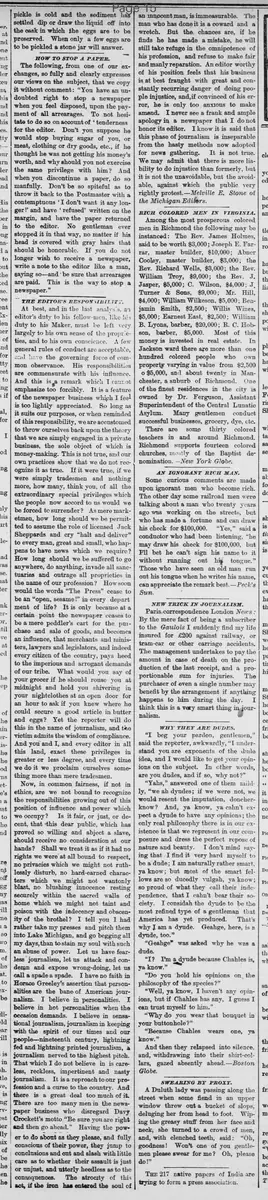
At best, and in the last analysis, an editor's duty to his fellow-men, like his duty to his Maker, must be left very largely to his own sense of the proprieties, and to his own conscience. A few general rules of conduct are acceptable, and have the governing force of common observance. His responsibilities are commensurate with his influence. And this is a remark which I cannot emphasize too forcibly. It is a feature of the newspaper business which I feel is too lightly appreciated. So long as it suits our purposes, or when reminded of this responsibility, we are accustomed to throw ourselves back upon the theory that we are simply engaged in a private business, the sole object of which is money-making. This is not true, and our own practices show that we do not recognize it as true. If it were true, if we were simply tradesmen and nothing more, how many, think you, of all the extraordinary special privileges which the people now accord to us would we be forced to surrender? As mere market-men, how long should we be permitted to assume the role of licensed Jack Sheppards and cry "halt and deliver" to every man, great and small, who happens to have news which we require?
How long should we be suffered to go anywhere, do anything, invade all sanctuaries and outrage all proprieties in the name of our profession? How soon would the words "The Press" cease to be an "open, sesame!" in every department of life? It is only because at a certain point the newspaper ceases to be a mere peddler's cart for the purchase and sale of goods, and becomes an influence, that merchants and ministers, lawyers and legislators, and indeed every citizen of the country, pays heed to the imperious and arrogant demands of our tribe. What would you say of your grocer if he should rouse you at midnight and hold you shivering in your nightclothes at an open door for an hour to ask if you knew where he could secure a good article in butter and eggs? Yet the reporter will do this in the name of journalism, and the victim admits the wisdom of compliance.
And you and I, and every editor in all this land, exact these privileges in greater or less degree, and every time we do it we proclaim ourselves something more than mere tradesmen.
Now, in common fairness, if not in ethics, are we not bound to recognize the responsibilities growing out of this position of influence and power which we occupy? Is it fair, or just, or decent, that this dear public, which has proved so willing and abject a slave, should receive no consideration at our hands? Shall we treat it as if it had no rights we were at all bound to respect, no privacies which we might not ruthlessly disturb, no hard-earned characters which we might not wantonly blast, no blushing innocence resting securely within the sacred walls of home which we might not taint and poison with the indecency and obscenity of the brothel? I tell you I had rather take my presses and pitch them into Lake Michigan, and go begging all my days, than to stain my soul with such an abuse of power. Let us have fearless journalism, let us attack and condemn and expose wrong-doing, let us call a spade a spade. I have no faith in Horace Greeley's assertion that personalities are the bane of American journalism. I believe in personalities. I believe in hot personalities when the occasion demands. I believe in sensational journalism, journalism in keeping with the spirit of our times and our people-nineteenth century, lightning fed and lightning printed journalism, a journalism nerved to the highest pitch.
That which I do not believe in is careless, reckless, impertinent and nasty journalism. It is a reproach to our profession and a curse to the country. And there is a great deal too much of it. There are too many men in the newspaper business who disregard Davy Crockett's motto "Be sure you are right and then go ahead." Having the power to do about as they please, and fully conscious of their power, they jump to conclusions and cut and slash with little care as to whether their assault is just or unjust, and utterly heedless as to the consequences.
The atrocity of this act, if the iron has entered the soul of an innocent man, is immeasurable. The man who has done it is a coward and a wretch. But the chances are, if he finds he has made a mistake, he will still take refuge in the omnipotence of his profession, and refuse to make fair and manly reparation. An editor worthy of his position feels that his business is at best fraught with great and constantly recurring danger of doing people injustice, and, if convinced of his error, he is only too anxious to make amend. I never see a frank and ample apology in a newspaper that I do not honor its editor. I know it is said that this phase of journalism is inseparable from the hasty methods now adopted for news gathering. It is not true. We may admit that there is more liability to do injustice than formerly, but it is not the unavoidable, but the avoidable, against which the public very rightly protest. -Melville E. Stone of the Michigan Editors.
At best, and in the last analysis, an editor's duty to his fellow-men, like his duty to his Maker, must be left very largely to his own sense of the proprieties, and to his own conscience. A few general rules of conduct are acceptable, and have the governing force of common observance. His responsibilities are commensurate with his influence. And this is a remark which I cannot emphasize too forcibly. It is a feature of the newspaper business which I feel is too lightly appreciated. So long as it suits our purposes, or when reminded of this responsibility, we are accustomed to throw ourselves back upon the theory that we are simply engaged in a private business, the sole object of which is money-making. This is not true, and our own practices show that we do not recognize it as true. If it were true, if we were simply tradesmen and nothing more, how many, think you, of all the extraordinary special privileges which the people now accord to us would we be forced to surrender? As mere market-men, how long should we be permitted to assume the role of licensed Jack Sheppards and cry "halt and deliver" to every man, great and small, who happens to have news which we require?
How long should we be suffered to go anywhere, do anything, invade all sanctuaries and outrage all proprieties in the name of our profession? How soon would the words "The Press" cease to be an "open, sesame!" in every department of life? It is only because at a certain point the newspaper ceases to be a mere peddler's cart for the purchase and sale of goods, and becomes an influence, that merchants and ministers, lawyers and legislators, and indeed every citizen of the country, pays heed to the imperious and arrogant demands of our tribe. What would you say of your grocer if he should rouse you at midnight and hold you shivering in your nightclothes at an open door for an hour to ask if you knew where he could secure a good article in butter and eggs? Yet the reporter will do this in the name of journalism, and the victim admits the wisdom of compliance.
And you and I, and every editor in all this land, exact these privileges in greater or less degree, and every time we do it we proclaim ourselves something more than mere tradesmen.
Now, in common fairness, if not in ethics, are we not bound to recognize the responsibilities growing out of this position of influence and power which we occupy? Is it fair, or just, or decent, that this dear public, which has proved so willing and abject a slave, should receive no consideration at our hands? Shall we treat it as if it had no rights we were at all bound to respect, no privacies which we might not ruthlessly disturb, no hard-earned characters which we might not wantonly blast, no blushing innocence resting securely within the sacred walls of home which we might not taint and poison with the indecency and obscenity of the brothel? I tell you I had rather take my presses and pitch them into Lake Michigan, and go begging all my days, than to stain my soul with such an abuse of power. Let us have fearless journalism, let us attack and condemn and expose wrong-doing, let us call a spade a spade. I have no faith in Horace Greeley's assertion that personalities are the bane of American journalism. I believe in personalities. I believe in hot personalities when the occasion demands. I believe in sensational journalism, journalism in keeping with the spirit of our times and our people-nineteenth century, lightning fed and lightning printed journalism, a journalism nerved to the highest pitch.
That which I do not believe in is careless, reckless, impertinent and nasty journalism. It is a reproach to our profession and a curse to the country. And there is a great deal too much of it. There are too many men in the newspaper business who disregard Davy Crockett's motto "Be sure you are right and then go ahead." Having the power to do about as they please, and fully conscious of their power, they jump to conclusions and cut and slash with little care as to whether their assault is just or unjust, and utterly heedless as to the consequences.
The atrocity of this act, if the iron has entered the soul of an innocent man, is immeasurable. The man who has done it is a coward and a wretch. But the chances are, if he finds he has made a mistake, he will still take refuge in the omnipotence of his profession, and refuse to make fair and manly reparation. An editor worthy of his position feels that his business is at best fraught with great and constantly recurring danger of doing people injustice, and, if convinced of his error, he is only too anxious to make amend. I never see a frank and ample apology in a newspaper that I do not honor its editor. I know it is said that this phase of journalism is inseparable from the hasty methods now adopted for news gathering. It is not true. We may admit that there is more liability to do injustice than formerly, but it is not the unavoidable, but the avoidable, against which the public very rightly protest. -Melville E. Stone of the Michigan Editors.
What sub-type of article is it?
Press Freedom
Moral Or Religious
What keywords are associated?
Journalistic Ethics
Press Responsibility
Newspaper Privileges
Editorial Influence
Media Accountability
What entities or persons were involved?
Editors
The Press
Melville E. Stone
Editorial Details
Primary Topic
Editorial Responsibility And Ethics In Journalism
Stance / Tone
Advocacy For Responsible, Ethical Journalism Over Reckless Practices
Key Figures
Editors
The Press
Melville E. Stone
Key Arguments
Editors' Responsibilities Match Their Influence Beyond Mere Business
Press Enjoys Special Privileges Due To Its Influential Role, Not As Tradesmen
Journalists Must Respect Public Rights, Privacies, And Reputations
Support Fearless, Sensational Journalism But Condemn Careless, Impertinent Reporting
Editors Should Promptly Apologize For Errors To Maintain Integrity