Thank you for visiting SNEWPapers!
Sign up free
Literary
June 15, 1945
The Midland Journal
Rising Sun, Cecil County, Maryland
What is this article about?
In a stormy Wyoming ranch, the mare Flicka gives birth to a reluctant white foal during a fierce storm. Young Ken McLaughlin searches for them in the woods, finds the vulnerable pair, and struggles to bring them back to safety amid worsening weather.
Clipping
OCR Quality
98%
Excellent
Full Text
CHAPTER I
Within the firm walls of flesh that held him prisoner the foal kicked out angrily. He did not want to be born. The violent constrictions of the walls of his house, which came unexpectedly, disturbed his long peaceful growth and put him in a fury, and he unfolded himself and kicked again and again.
He wanted no change. Here was quiet darkness - nothing to prick and tantalize his eyes. Here was security - no possible harm could reach him. Here was food without effort or even knowledge on his part. Here was the softest floating bed to buffer him against shock. Here was warmth that never fluctuated. Here was - (in some dim way he felt it) - love and protection from his mother's heart. He would not be born.
Twice before he had foiled the labor pains, and his dam had resigned herself and had continued to carry him. (She was the handsome sorrel mare called Flicka, belonging to young Ken McLaughlin of the Goose Bar ranch.) She had stood patiently, not moving much, up in the stable pasture just beyond the corrals. And it had become the habit of everyone at the ranch, Rob and Nell McLaughlin, and their two boys Howard and Ken, and Gus and Tim, the hired hands, to walk out to see her every day, to note how patiently she stood, getting larger and larger, her bright and lively nature changed to somber brooding. If anyone went near her hindquarters she kicked at them.
Visitors to the ranch went out to inspect her too. One said to Nell McLaughlin, "That's the hugest mare I ever saw."
"She's not so huge," said Nell. "It's just that she's carrying a colt that should have been born in the spring, and here it is, nearly time for the boys to go back to Laramie to school, and still she hasn't foaled."
They all agreed that now and then such things happened to mares and everyone could tell of a case. There was much curiosity as to what the colt would be like. He surely ought to be a good one, big and strong and well developed.
The laboring mare lay down on the ground. The foal, impose his will as he might, was helpless. The violent surges continued, coming at regular intervals, and he was being turned this way and that as if by intelligent hands, until he took the position of a diver, front hoofs stretched out and his little muzzle resting on them. Then he felt pain for the first time and would have struggled and kicked if he could have, but he was held in a vise and could not move. Pressure was strong against him on all sides. There was the sensation of movement through a passage and suddenly a jar as he slid out to the earth.
For a moment he was sheltered from the air and the light by the envelope of membrane in which he was enclosed; then - the mare gained her feet and whirled around and her teeth and tongue stripped him of the membrane and he began to breathe.
From that moment on all that he knew was pain, for the breathing hurt his lungs, and, opening his eyes, they were stabbed by blinding flashes of light. Terror came when his ear drums were hammered upon by crashes of thunder, and he reacted by giving little choking bleats and trying to sit up. Icy rain sluiced upon him. The hard ground upon which he lay was running with water.
His mother licked and licked him. This warmed him and brought the blood to the surface of his body. He yearned to be closer to her and struggled to rise but had not yet the strength.
There was no mercy for him in the skies. It was the collision of several storms that had ridden up from the lowlands to this high peak of the Wyoming Rocky Mountain Divide. Clusters of purple thunderheads struggled mightily, hurling themselves against each other with detonations that shook the ground. Wide bands of intolerable light stabbed from zenith to earth.
But there was mercy for the colt closer by, and he knew it. His feeble struggles to rise became stronger. His mother's licking tongue encouraged him. The yearning to reach the warmth and shelter of her body grew to a passion - he must, must get to her.
And so, long before the storm was over, the foal had found his feet. The teat, hot and swollen, was in his mouth. He was safely anchored; and because of the danger and pain so lately experienced, his awareness was sharpened. Warm milk were more than food - they were an ecstasy.
Ken McLaughlin was hunting his mare.
A thin, twelve-year-old boy, with a shock of soft brown hair falling over dark blue eyes that had a shadow as well as a dream in them. He stood looking at the place near the corrals where Flicka should have been and could hardly believe that it was empty, for more than once a day all through this last month since he had stopped riding her he had been out to see whether she had foaled, and she had never been far from her feed box.
This afternoon she had been near the spill of fresh water that ran out of the corral trough, but now there was no sign of her.
This meant, Ken knew, that her time had come, and his heart beat a little faster. She had hidden herself away, as all animals will if they are free, to give birth to her foal with no one to witness her labor and pain and victory.
As the boy hesitated there, his eyes scanning the pine woods that edged the pasture, his wits were at work. If he had been Flicka and had wanted to hide, where would he have gone? And immediately he turned to the woods. Those woods, sparse and free of underbrush, covered the rocky shoulder of the stable pasture where it sloped away, north, to the little stream called Deercreek which bounded it.
The hill was so precipitous in places that it formed low cliffs overhung with twisted pines. At the base of them were caverns. Ken and Howard knew every foot of these terraced cliffs. They had been there on foot and on horseback. Flicka and Highboy - their saddle horses - knew them too, and had become accustomed to the steep paths down which they must slide on their haunches with the boys clinging to their backs like monkeys; or the scramble up, during which the boys kept from sliding off backwards only by tangling their fists in the horses' manes.
Flicka might be on any one of those narrow shelves or pockets, or hidden in one of the little dells at the base of a cliff. She knew them all.
Ken darted toward the woods. It had just begun to rain. The boy cast a careless glance at the sky, refused to accept the warning of what he saw there, telling himself that it would be just a shower from which the trees would shelter him, and began his search.
Occasionally he stopped and called her, "Flicka! Flicka!" and then stood listening in that peculiar state of tension which everyone feels when they call and are not answered.
The daylight on those September evenings held until after eight o'clock, but this evening there was a murky gloom, and under some of the trees there were already pockets of darkness into which Ken stared for minutes before being sure that no living thing was there.
The rain pattered like shot on the ground, and presently Ken heard the long familiar roll of drums in the sky. Suddenly a wind was roaring. The mass of dark clouds sank toward the earth, then opened and poured out torrents of rain. Lightning blazed and thunder crashed.
The boy, crossing an open dell, caught the full brunt of it and dove under a projecting, shelf-like rock, which had left a shallow cave beneath. A small cottontail was sitting primly there for shelter. As Ken shot in, the cottontail shot out, and the boy, panting, drew up his knees and clasped them and sat looking at the spectacle of the storm with an expression of exultation on his thin eager face.
Such torrents of water were coming down that presently the earth was covered. Running streams tore between the trees and shot off the cliff-tops. A good-sized rivulet swept under Ken's sheltering rock, and in a moment he was immersed and drenched. He rolled out from under and stood choking and laughing, shaking the water out of his eyes.
Then, since he could be no wetter, he decided to ignore the storm and continue his search for Flicka.
Either the wind was getting colder or the rain was turning to hail or snow, for his wet jersey was like ice against his skin as he trotted in and out of the paths and trees.
Often in September there were snowstorms on the top of the Divide, and it seemed to him one was coming now. Up here in the high altitude one day it was snowing and the next like summer.
Ken came upon Flicka in a little dell at the foot of a cliff, cut by the narrowest thread of a path. She stood under an over-hanging tree, but even that could do little to protect her against the rain. When he saw the foal beside her, he stood staring. There had never been a white foal born on the Goose Bar Ranch before. He could hardly believe it. There came a dry fullness in his throat. Flicka - Flicka's foal - her first! And not only off color, but white! A throwback! It was a shock to him.
He called her name quietly. She turned her head and he went to her. She looked anxiously at the foal. Ken stood staring down at it in the gathering darkness. White and narrow and with head beaten down by the pouring rain, tilted toward its mother - it looked as though it might fall over any minute.
Flicka gave a little grunting whinny. Ken could understand her talk, and he knew she was cold and miserable and worried about the foal. They should both of them be in the barn, and Flicka should have a good pail of hot mash. He wondered if the foal could follow her up that thread of a path, and coaxed the mare to try the ascent.
She would not move. Ken put his belt around her neck and led her up. The little one, coming after her with wavering steps, struggled but could not follow. Flicka, turning, saw it halted here. She balked. Ken slipped the belt off her neck and she backed down to the foal and licked it.
Somehow the foal must be got up the path. Ken wondered if he could drag or carry it. Often he and Howard, wrestling with the little foals as they trained them (part of the work of their summer vacations) would clasp their arms around them, lift them off the ground. One little fellow Howard had carried all around with its long legs trailing.
But this was an unusually big colt - Ken was doubtful.
With his hand on Flicka's neck he sidled toward the foal, speaking soothingly. "There, there, little fellow - wouldn't hurt you - don't be frightened - it's all right, Flicka - wouldn't hurt your baby - you know I wouldn't -"
The mare was excited and anxious and the foal, as Ken's hand touched its neck, squealed and tried to struggle away. Ken put both arms around the wet slippery body and held tight, but lifting was a different matter. Still talking to Flicka, who was nickering nervously, Ken exerted all his strength. Suddenly he had a little kicking fighting demon in his arms and the foal bared its four baby teeth and bit his arm.
Ken dropped it. Flicka whirled close and stood protectively over it. Ken, scolding under his breath and holding his forearm that the foal's teeth had pinched, realized that he must get help.
He leaped up the pathway.
Gus and Tim, immediately after the supper dishes had been washed up, had taken the pick-up and driven over to the Saturday night dance in Summervale's barn at Tie Siding. Ken's mother and father had gone in to town to dine with Colonel Harris. There was no one but himself and Howard on the ranch, and the responsibility was his own because Flicka was - his mare. Besides - this little foal - this particular foal - at the thought of all that depended on him, Ken's feet flew faster, and his eyes, made keen and knowing by his life on the ranch, gazed at the sky and the clouds, gauging the storm -
The wind was changing, veering around to the east, and, yes - what he had suspected was happening. Every raindrop now had a body to it, a little core of slush - it was changing to snow. It beat on his face and nearly blinded him. The wind changed its tune, it rose to a howl, whipping the branches of the pine trees.
But Ken was not cold. The excitement in him made him hot and swift. He reached the corrals, ran down through the gorge to the house, and burst into the warm kitchen where Howard, who was interested in increasing the size of his muscles, was reading in a droning voice from a "Hercules" pamphlet.
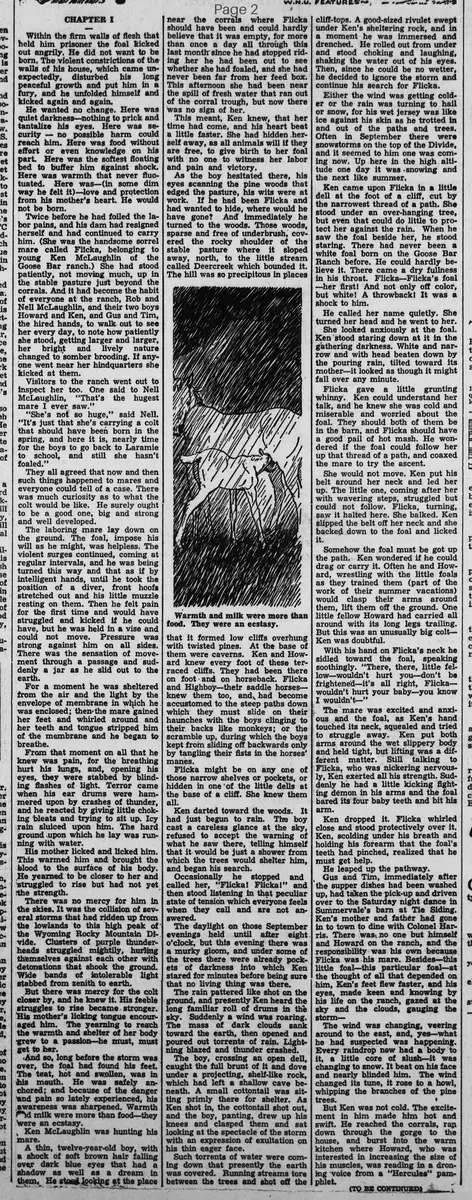
Warmth and milk were more than food. They were an ecstasy.
Within the firm walls of flesh that held him prisoner the foal kicked out angrily. He did not want to be born. The violent constrictions of the walls of his house, which came unexpectedly, disturbed his long peaceful growth and put him in a fury, and he unfolded himself and kicked again and again.
He wanted no change. Here was quiet darkness - nothing to prick and tantalize his eyes. Here was security - no possible harm could reach him. Here was food without effort or even knowledge on his part. Here was the softest floating bed to buffer him against shock. Here was warmth that never fluctuated. Here was - (in some dim way he felt it) - love and protection from his mother's heart. He would not be born.
Twice before he had foiled the labor pains, and his dam had resigned herself and had continued to carry him. (She was the handsome sorrel mare called Flicka, belonging to young Ken McLaughlin of the Goose Bar ranch.) She had stood patiently, not moving much, up in the stable pasture just beyond the corrals. And it had become the habit of everyone at the ranch, Rob and Nell McLaughlin, and their two boys Howard and Ken, and Gus and Tim, the hired hands, to walk out to see her every day, to note how patiently she stood, getting larger and larger, her bright and lively nature changed to somber brooding. If anyone went near her hindquarters she kicked at them.
Visitors to the ranch went out to inspect her too. One said to Nell McLaughlin, "That's the hugest mare I ever saw."
"She's not so huge," said Nell. "It's just that she's carrying a colt that should have been born in the spring, and here it is, nearly time for the boys to go back to Laramie to school, and still she hasn't foaled."
They all agreed that now and then such things happened to mares and everyone could tell of a case. There was much curiosity as to what the colt would be like. He surely ought to be a good one, big and strong and well developed.
The laboring mare lay down on the ground. The foal, impose his will as he might, was helpless. The violent surges continued, coming at regular intervals, and he was being turned this way and that as if by intelligent hands, until he took the position of a diver, front hoofs stretched out and his little muzzle resting on them. Then he felt pain for the first time and would have struggled and kicked if he could have, but he was held in a vise and could not move. Pressure was strong against him on all sides. There was the sensation of movement through a passage and suddenly a jar as he slid out to the earth.
For a moment he was sheltered from the air and the light by the envelope of membrane in which he was enclosed; then - the mare gained her feet and whirled around and her teeth and tongue stripped him of the membrane and he began to breathe.
From that moment on all that he knew was pain, for the breathing hurt his lungs, and, opening his eyes, they were stabbed by blinding flashes of light. Terror came when his ear drums were hammered upon by crashes of thunder, and he reacted by giving little choking bleats and trying to sit up. Icy rain sluiced upon him. The hard ground upon which he lay was running with water.
His mother licked and licked him. This warmed him and brought the blood to the surface of his body. He yearned to be closer to her and struggled to rise but had not yet the strength.
There was no mercy for him in the skies. It was the collision of several storms that had ridden up from the lowlands to this high peak of the Wyoming Rocky Mountain Divide. Clusters of purple thunderheads struggled mightily, hurling themselves against each other with detonations that shook the ground. Wide bands of intolerable light stabbed from zenith to earth.
But there was mercy for the colt closer by, and he knew it. His feeble struggles to rise became stronger. His mother's licking tongue encouraged him. The yearning to reach the warmth and shelter of her body grew to a passion - he must, must get to her.
And so, long before the storm was over, the foal had found his feet. The teat, hot and swollen, was in his mouth. He was safely anchored; and because of the danger and pain so lately experienced, his awareness was sharpened. Warm milk were more than food - they were an ecstasy.
Ken McLaughlin was hunting his mare.
A thin, twelve-year-old boy, with a shock of soft brown hair falling over dark blue eyes that had a shadow as well as a dream in them. He stood looking at the place near the corrals where Flicka should have been and could hardly believe that it was empty, for more than once a day all through this last month since he had stopped riding her he had been out to see whether she had foaled, and she had never been far from her feed box.
This afternoon she had been near the spill of fresh water that ran out of the corral trough, but now there was no sign of her.
This meant, Ken knew, that her time had come, and his heart beat a little faster. She had hidden herself away, as all animals will if they are free, to give birth to her foal with no one to witness her labor and pain and victory.
As the boy hesitated there, his eyes scanning the pine woods that edged the pasture, his wits were at work. If he had been Flicka and had wanted to hide, where would he have gone? And immediately he turned to the woods. Those woods, sparse and free of underbrush, covered the rocky shoulder of the stable pasture where it sloped away, north, to the little stream called Deercreek which bounded it.
The hill was so precipitous in places that it formed low cliffs overhung with twisted pines. At the base of them were caverns. Ken and Howard knew every foot of these terraced cliffs. They had been there on foot and on horseback. Flicka and Highboy - their saddle horses - knew them too, and had become accustomed to the steep paths down which they must slide on their haunches with the boys clinging to their backs like monkeys; or the scramble up, during which the boys kept from sliding off backwards only by tangling their fists in the horses' manes.
Flicka might be on any one of those narrow shelves or pockets, or hidden in one of the little dells at the base of a cliff. She knew them all.
Ken darted toward the woods. It had just begun to rain. The boy cast a careless glance at the sky, refused to accept the warning of what he saw there, telling himself that it would be just a shower from which the trees would shelter him, and began his search.
Occasionally he stopped and called her, "Flicka! Flicka!" and then stood listening in that peculiar state of tension which everyone feels when they call and are not answered.
The daylight on those September evenings held until after eight o'clock, but this evening there was a murky gloom, and under some of the trees there were already pockets of darkness into which Ken stared for minutes before being sure that no living thing was there.
The rain pattered like shot on the ground, and presently Ken heard the long familiar roll of drums in the sky. Suddenly a wind was roaring. The mass of dark clouds sank toward the earth, then opened and poured out torrents of rain. Lightning blazed and thunder crashed.
The boy, crossing an open dell, caught the full brunt of it and dove under a projecting, shelf-like rock, which had left a shallow cave beneath. A small cottontail was sitting primly there for shelter. As Ken shot in, the cottontail shot out, and the boy, panting, drew up his knees and clasped them and sat looking at the spectacle of the storm with an expression of exultation on his thin eager face.
Such torrents of water were coming down that presently the earth was covered. Running streams tore between the trees and shot off the cliff-tops. A good-sized rivulet swept under Ken's sheltering rock, and in a moment he was immersed and drenched. He rolled out from under and stood choking and laughing, shaking the water out of his eyes.
Then, since he could be no wetter, he decided to ignore the storm and continue his search for Flicka.
Either the wind was getting colder or the rain was turning to hail or snow, for his wet jersey was like ice against his skin as he trotted in and out of the paths and trees.
Often in September there were snowstorms on the top of the Divide, and it seemed to him one was coming now. Up here in the high altitude one day it was snowing and the next like summer.
Ken came upon Flicka in a little dell at the foot of a cliff, cut by the narrowest thread of a path. She stood under an over-hanging tree, but even that could do little to protect her against the rain. When he saw the foal beside her, he stood staring. There had never been a white foal born on the Goose Bar Ranch before. He could hardly believe it. There came a dry fullness in his throat. Flicka - Flicka's foal - her first! And not only off color, but white! A throwback! It was a shock to him.
He called her name quietly. She turned her head and he went to her. She looked anxiously at the foal. Ken stood staring down at it in the gathering darkness. White and narrow and with head beaten down by the pouring rain, tilted toward its mother - it looked as though it might fall over any minute.
Flicka gave a little grunting whinny. Ken could understand her talk, and he knew she was cold and miserable and worried about the foal. They should both of them be in the barn, and Flicka should have a good pail of hot mash. He wondered if the foal could follow her up that thread of a path, and coaxed the mare to try the ascent.
She would not move. Ken put his belt around her neck and led her up. The little one, coming after her with wavering steps, struggled but could not follow. Flicka, turning, saw it halted here. She balked. Ken slipped the belt off her neck and she backed down to the foal and licked it.
Somehow the foal must be got up the path. Ken wondered if he could drag or carry it. Often he and Howard, wrestling with the little foals as they trained them (part of the work of their summer vacations) would clasp their arms around them, lift them off the ground. One little fellow Howard had carried all around with its long legs trailing.
But this was an unusually big colt - Ken was doubtful.
With his hand on Flicka's neck he sidled toward the foal, speaking soothingly. "There, there, little fellow - wouldn't hurt you - don't be frightened - it's all right, Flicka - wouldn't hurt your baby - you know I wouldn't -"
The mare was excited and anxious and the foal, as Ken's hand touched its neck, squealed and tried to struggle away. Ken put both arms around the wet slippery body and held tight, but lifting was a different matter. Still talking to Flicka, who was nickering nervously, Ken exerted all his strength. Suddenly he had a little kicking fighting demon in his arms and the foal bared its four baby teeth and bit his arm.
Ken dropped it. Flicka whirled close and stood protectively over it. Ken, scolding under his breath and holding his forearm that the foal's teeth had pinched, realized that he must get help.
He leaped up the pathway.
Gus and Tim, immediately after the supper dishes had been washed up, had taken the pick-up and driven over to the Saturday night dance in Summervale's barn at Tie Siding. Ken's mother and father had gone in to town to dine with Colonel Harris. There was no one but himself and Howard on the ranch, and the responsibility was his own because Flicka was - his mare. Besides - this little foal - this particular foal - at the thought of all that depended on him, Ken's feet flew faster, and his eyes, made keen and knowing by his life on the ranch, gazed at the sky and the clouds, gauging the storm -
The wind was changing, veering around to the east, and, yes - what he had suspected was happening. Every raindrop now had a body to it, a little core of slush - it was changing to snow. It beat on his face and nearly blinded him. The wind changed its tune, it rose to a howl, whipping the branches of the pine trees.
But Ken was not cold. The excitement in him made him hot and swift. He reached the corrals, ran down through the gorge to the house, and burst into the warm kitchen where Howard, who was interested in increasing the size of his muscles, was reading in a droning voice from a "Hercules" pamphlet.
Warmth and milk were more than food. They were an ecstasy.
What sub-type of article is it?
Prose Fiction
What themes does it cover?
Agriculture Rural
Nature
Friendship
What keywords are associated?
Foal Birth
Ranch Life
Wyoming Storm
Horse Bonding
Mare Flicka
Literary Details
Title
Chapter I
Subject
Birth Of Flicka's Foal
Key Lines
Within The Firm Walls Of Flesh That Held Him Prisoner The Foal Kicked Out Angrily. He Did Not Want To Be Born.
Here Was Quiet Darkness Nothing To Prick And Tantalize His Eyes. Here Was Security No Possible Harm Could Reach Him.
There Had Never Been A White Foal Born On The Goose Bar Ranch Before. He Could Hardly Believe It. There Came A Dry Fullness In His Throat. Flicka Flicka's Foal Her First! And Not Only Off Color, But White! A Throwback! It Was A Shock To Him.
Warmth And Milk Were More Than Food. They Were An Ecstasy.