Thank you for visiting SNEWPapers!
Sign up free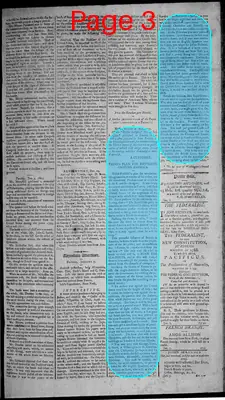
Editorial
January 7, 1803
Alexandria Advertiser And Commercial Intelligencer
Alexandria, Virginia
What is this article about?
An 1794 editorial republishes and denounces Thomas Paine's proposal to the French government for revolutionizing America by burning U.S. seaports to counter British influence, criticizing it as destructive and aligned with French radicalism.
Merged-components note: Continuation of the editorial criticizing Thomas Paine's plan, split across components but coherent in topic and flow.
Clipping
OCR Quality
95%
Excellent
Full Text
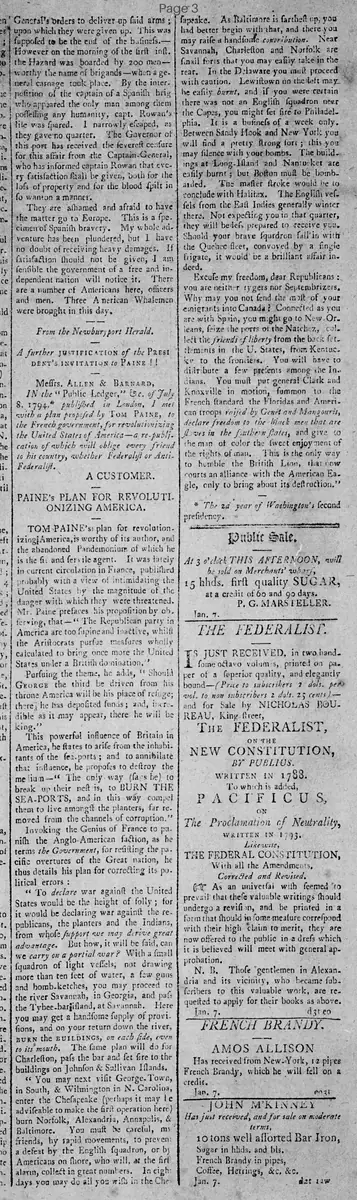
Messrs. Allen & Barnard,
IN the "Public Ledger," &c. of July 8, 1794, published in London, I met with a plan proposed by Tom Paine, to the French government, for revolutionizing the United States of America—a republication of which will oblige every friend to his country, whether Federalist or Anti-Federalist.
A CUSTOMER.
PAINE's PLAN FOR REVOLUTIONIZING AMERICA.
TOM PAINE's plan for revolutionizing America, is worthy of its author, and the abandoned Pandemonium of which he is the fit and servile agent. It was lately in current circulation in France, published probably with a view of intimidating the United States by the magnitude of the danger with which they were threatened.
Mr. Paine prefaces his proposition by observing, that—“The Republican party in America are too supine and inactive, whilst the Aristocrats pursue measures wholly calculated to bring once more the United States under a British domination.”
Pursuing the theme, he adds, “Should George the third be driven from his throne America will be his place of refuge: there he has deposited funds; and, incredible as it may appear, there he will be king.”
This powerful influence of Britain in America, he states to arise from the inhabitants of the sea-ports; and to annihilate that influence, he proposes to destroy the million—“The only way (says he) to break up their nest is, to BURN THE SEA-PORTS, and in this way compel them to live amongst the planters, far removed from the channels of corruption.”
Invoking the Genius of France to punish the Anglo-American faction, as he terms the Government, or resisting the pacific overtures of the Great nation, he thus details his plan for correcting its political errors:
“To declare war against the United States would be the height of folly; for it would be declaring war against the republicans, the planters and the Indians, from whose support we may derive great advantage. But how, it will be said, can we carry on a partial war? With a small squadron of light vessels; not drawing more than ten feet of water, a few guns and bomb-ketches, you may proceed to the river Savannah, in Georgia, and pass the Tybee-bar, at Savannah. Here you may get a handsome supply of provisions, and on your return down the river, BURN the BUILDINGS, on each side, even to its mouth. The same plan will do for Charleston, pass the bar and set fire to the buildings on Johnson & Sullivan Islands.
“You may next visit George-Town, in South, & Wilmington in N. Carolina, enter the Chesapeake (perhaps it may be advisable to make the first operation here) burn Norfolk, Alexandria, Annapolis, & Baltimore. You must be careful, my friends, by rapid movements, to prevent a defeat by the English squadron, or by Americans on shore, who will, at the first alarm, collect in great numbers. In eight days you may do all you wish in the Chesapeake. As Baltimore is farthest up, you had better begin with that, and there you may raise a handsome contribution. Near Savannah, Charleston and Norfolk are small forts that you may easily take in the rear. In the Delaware you must proceed with caution. Lewistown on the left may be easily burnt, and if you were certain there was not an English squadron near the Capes, you might set fire to Philadelphia. It is a business of a week only.
“Between Sandy Hook and New-York you will find a pretty strong fort; this you may silence with your bombs. The buildings at Long-Island and Nantucket are easily burnt; but Boston must be bombarded. The master stroke would be to conclude with Halifax. The English vessels from the East Indies generally winter there. Not expecting you in that quarter, they will be less prepared to receive you.
“Should your brave squadron fall in with the Quebec fleet, convoyed by a single frigate, it would be a brilliant affair indeed.
“Excuse my freedom, dear Republicans: you are neither tygers nor Septembrizers. Why may you not send the most of your emigrants into Canada? Connected as you are with Spain, you might go to New-Orleans, seize the ports of the Natchez, collect the friends of liberty from the back settlements in the U. States, from Kentucky to the frontiers. You will have to distribute a few presents among the Indians. You must put general Clark and Knoxville in motion, summon to the French standard the Floridas and American troops raised by Genet and Mangouris, declare freedom to the black men that are slaves in the southern states, and give to the man of color the sweet enjoyment of the rights of man. This is the only way to humble the British Lion, that now courts an alliance with the American Eagle, only to bring about its destruction.”
IN the "Public Ledger," &c. of July 8, 1794, published in London, I met with a plan proposed by Tom Paine, to the French government, for revolutionizing the United States of America—a republication of which will oblige every friend to his country, whether Federalist or Anti-Federalist.
A CUSTOMER.
PAINE's PLAN FOR REVOLUTIONIZING AMERICA.
TOM PAINE's plan for revolutionizing America, is worthy of its author, and the abandoned Pandemonium of which he is the fit and servile agent. It was lately in current circulation in France, published probably with a view of intimidating the United States by the magnitude of the danger with which they were threatened.
Mr. Paine prefaces his proposition by observing, that—“The Republican party in America are too supine and inactive, whilst the Aristocrats pursue measures wholly calculated to bring once more the United States under a British domination.”
Pursuing the theme, he adds, “Should George the third be driven from his throne America will be his place of refuge: there he has deposited funds; and, incredible as it may appear, there he will be king.”
This powerful influence of Britain in America, he states to arise from the inhabitants of the sea-ports; and to annihilate that influence, he proposes to destroy the million—“The only way (says he) to break up their nest is, to BURN THE SEA-PORTS, and in this way compel them to live amongst the planters, far removed from the channels of corruption.”
Invoking the Genius of France to punish the Anglo-American faction, as he terms the Government, or resisting the pacific overtures of the Great nation, he thus details his plan for correcting its political errors:
“To declare war against the United States would be the height of folly; for it would be declaring war against the republicans, the planters and the Indians, from whose support we may derive great advantage. But how, it will be said, can we carry on a partial war? With a small squadron of light vessels; not drawing more than ten feet of water, a few guns and bomb-ketches, you may proceed to the river Savannah, in Georgia, and pass the Tybee-bar, at Savannah. Here you may get a handsome supply of provisions, and on your return down the river, BURN the BUILDINGS, on each side, even to its mouth. The same plan will do for Charleston, pass the bar and set fire to the buildings on Johnson & Sullivan Islands.
“You may next visit George-Town, in South, & Wilmington in N. Carolina, enter the Chesapeake (perhaps it may be advisable to make the first operation here) burn Norfolk, Alexandria, Annapolis, & Baltimore. You must be careful, my friends, by rapid movements, to prevent a defeat by the English squadron, or by Americans on shore, who will, at the first alarm, collect in great numbers. In eight days you may do all you wish in the Chesapeake. As Baltimore is farthest up, you had better begin with that, and there you may raise a handsome contribution. Near Savannah, Charleston and Norfolk are small forts that you may easily take in the rear. In the Delaware you must proceed with caution. Lewistown on the left may be easily burnt, and if you were certain there was not an English squadron near the Capes, you might set fire to Philadelphia. It is a business of a week only.
“Between Sandy Hook and New-York you will find a pretty strong fort; this you may silence with your bombs. The buildings at Long-Island and Nantucket are easily burnt; but Boston must be bombarded. The master stroke would be to conclude with Halifax. The English vessels from the East Indies generally winter there. Not expecting you in that quarter, they will be less prepared to receive you.
“Should your brave squadron fall in with the Quebec fleet, convoyed by a single frigate, it would be a brilliant affair indeed.
“Excuse my freedom, dear Republicans: you are neither tygers nor Septembrizers. Why may you not send the most of your emigrants into Canada? Connected as you are with Spain, you might go to New-Orleans, seize the ports of the Natchez, collect the friends of liberty from the back settlements in the U. States, from Kentucky to the frontiers. You will have to distribute a few presents among the Indians. You must put general Clark and Knoxville in motion, summon to the French standard the Floridas and American troops raised by Genet and Mangouris, declare freedom to the black men that are slaves in the southern states, and give to the man of color the sweet enjoyment of the rights of man. This is the only way to humble the British Lion, that now courts an alliance with the American Eagle, only to bring about its destruction.”
What sub-type of article is it?
Foreign Affairs
War Or Peace
Partisan Politics
What keywords are associated?
Tom Paine
French Intervention
Burn Seaports
Revolutionizing America
British Influence
Coastal Attacks
Political Factionalism
What entities or persons were involved?
Tom Paine
French Government
George Iii
Federalists
Anti Federalists
Republicans
Aristocrats
Editorial Details
Primary Topic
Critique Of Tom Paine's Plan For French Intervention And Revolution In America
Stance / Tone
Strongly Critical And Derisive Of Paine's Destructive Proposal
Key Figures
Tom Paine
French Government
George Iii
Federalists
Anti Federalists
Republicans
Aristocrats
Key Arguments
Paine's Plan Proposes Burning U.S. Seaports To Eliminate British Influence Among Urban Inhabitants.
The Plan Involves A Small French Squadron Attacking Coastal Cities From Savannah To Boston.
Paine Suggests Allying With Republicans, Planters, Indians, And Slaves Against The Government.
The Editorial Portrays The Plan As A Threat From French Radicals And British Exiles.
Republication Urged To Alert All Patriots Regardless Of Political Affiliation.