Thank you for visiting SNEWPapers!
Sign up free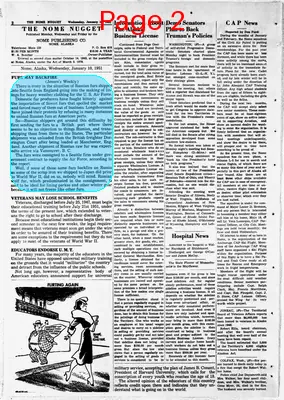
Story
January 10, 1951
The Nome Nugget
Nome, Nome County, Alaska
What is this article about?
Irony arises as Russian furs, shipped via England to evade US protests, are used to line US Air Force winter clothing in Seattle. Domestic producers and longshoremen opposed Soviet imports, but shippers reroute through British ports like Manchester, with another via Vancouver, B.C.
Clipping
OCR Quality
98%
Excellent
Full Text
FURS MAY BACKFIRE
(Jessen's Weekly)
There is irony in the situation of Russian furs shipped into Seattle from England going into the making of linings for heavy weather clothing for the U. S. Air Force.
Domestic fur producers have fought bitterly against the importation of Soviet furs that spoiled the market and forced many of them out of business. Longshoremen have joined their protests by refusing in many instances to unload Russian furs at American ports.
So Russian shippers got around this difficulty by first sending the furs to a British port where there seems to be no objection to things Russian, and transshipping them from there to the States. The particular shipment was unloaded from the British freighter Dorrington Court after being loaded at Manchester, England. Another shipment of Russian raw fur was expected to arrive via Vancouver, B. C.
The furs were consigned to a Seattle firm under government contract to supply the Air Force, according to the report.
Well, if some of those same furs backfire on Russia as some of the scrap iron we shipped to Japan did prior to World War II, did on us, nobody will mind. Russian wolf fur, which predominated in the consignment, is said to be ideal for lining parkas and other winter gear because it will not freeze like other furs.
(Jessen's Weekly)
There is irony in the situation of Russian furs shipped into Seattle from England going into the making of linings for heavy weather clothing for the U. S. Air Force.
Domestic fur producers have fought bitterly against the importation of Soviet furs that spoiled the market and forced many of them out of business. Longshoremen have joined their protests by refusing in many instances to unload Russian furs at American ports.
So Russian shippers got around this difficulty by first sending the furs to a British port where there seems to be no objection to things Russian, and transshipping them from there to the States. The particular shipment was unloaded from the British freighter Dorrington Court after being loaded at Manchester, England. Another shipment of Russian raw fur was expected to arrive via Vancouver, B. C.
The furs were consigned to a Seattle firm under government contract to supply the Air Force, according to the report.
Well, if some of those same furs backfire on Russia as some of the scrap iron we shipped to Japan did prior to World War II, did on us, nobody will mind. Russian wolf fur, which predominated in the consignment, is said to be ideal for lining parkas and other winter gear because it will not freeze like other furs.
What sub-type of article is it?
Curiosity
What themes does it cover?
Deception
Misfortune
What keywords are associated?
Russian Furs
Seattle Importation
Us Air Force
Trade Protests
British Transshipment
Wolf Fur Linings
What entities or persons were involved?
Domestic Fur Producers
Longshoremen
Russian Shippers
Where did it happen?
Seattle, Manchester, England, Vancouver, B. C.
Story Details
Key Persons
Domestic Fur Producers
Longshoremen
Russian Shippers
Location
Seattle, Manchester, England, Vancouver, B. C.
Story Details
Russian furs are routed through England to Seattle to bypass US protests, destined for US Air Force winter clothing linings despite domestic opposition that ruined local markets.