Thank you for visiting SNEWPapers!
Sign up free
Rhode Island American, Statesman And Providence Gazette
Providence, Providence County, Rhode Island
What is this article about?
In 1828-1830, Rev. William Fuller, a Presbyterian missionary, was expelled from Coventry, RI, by the Baptist-dominated Town Council based on secret accusations of slander and immorality, despite testimonials affirming his good character. The article defends Fuller and condemns the action as a violation of religious toleration.
Merged-components note: The editorial directly continues the presentation and development of the Rev. William Fuller controversy detailed in the preceding story component.
Clipping
OCR Quality
Full Text
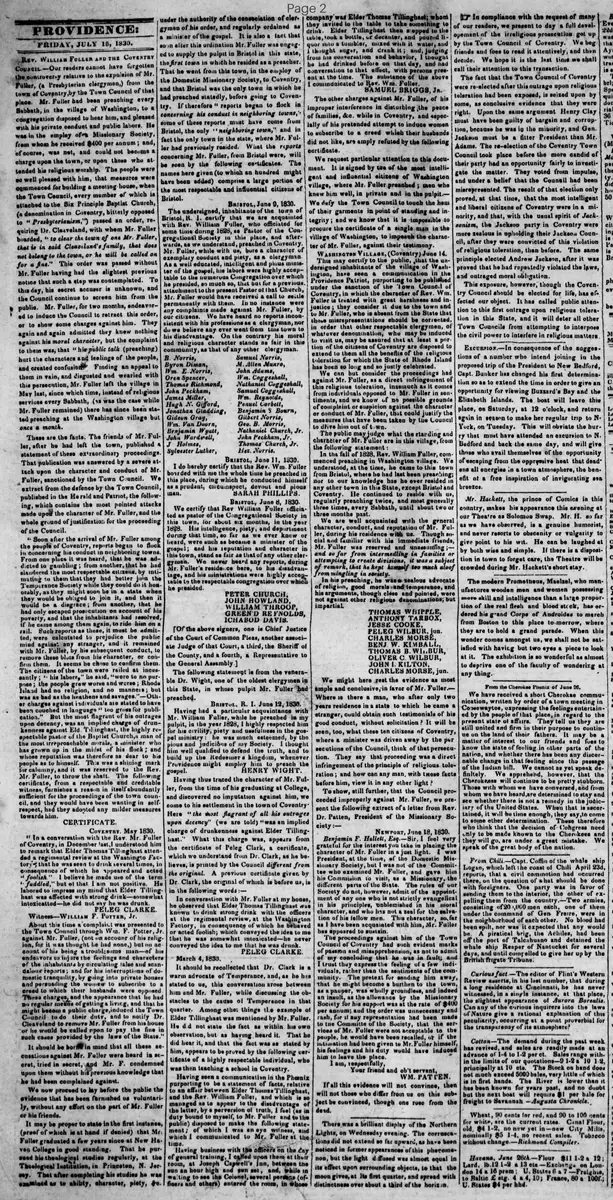
Our readers cannot have forgotten the controversy relative to the expulsion of Mr. Fuller, a Presbyterian clergyman, from the town of Coventry, by the Town Council of that place. Mr. Fuller had been preaching every Sabbath, in the village of Washington, to a congregation disposed to hear him, and pleased with his private conduct and public labors. He was in the employ of the Missionary Society, from whom he received $400 per annum; and, of course, was not, and could not become a charge upon the town, or upon those who attended his religious worship. The people were so well pleased with him, that measures were commenced for building a meeting-house, when the Town Council, every member of which is attached to the Six Principle Baptist Church, (a denomination in Coventry, bitterly opposed to Presbyterianism,) passed an order, requiring Dr. Cleaveland, with whom Mr. Fuller boarded, "to clear the town of one Mr. Fuller, that is in said Cleaveland's family, that does not belong to the town, or he will be called on for a fine." This order was passed without Mr. Fuller having had the slightest previous notice that such a step was contemplated. To this day, his secret accuser is unknown, and the Council continue to screen him from the public. Mr. Fuller, for two months, endeavored to induce the Council to retract this order, or to show some charges against him. They again and again admitted they knew nothing against his moral character, but the complaint to them was, that "his public talk (preaching) hurt the characters and feelings of the people, and created confusion." Finding an appeal to them in vain, and disgusted and wearied with this persecution, Mr. Fuller left the village in May last, since which time, instead of religious services every Sabbath, (as was the case while Mr. Fuller remained) there has since been stated preaching at the Washington village but once a month.
These are the acts. The friends of Mr. Fuller, after he had left the town, published a statement of these extraordinary proceedings. That publication was answered by a severe attack upon the character and conduct of Mr. Fuller, sanctioned by the Town Council. We extract from the defence by the Town Council, published in the Herald and Patriot, the following, which contains the most pointed attacks made upon the character of Mr. Fuller, and the whole ground of justification for the proceedings of the Council.
"Soon after the arrival of Mr. Fuller among the people of Coventry, reports began to flock in concerning his conduct in neighboring towns. From one place it was heard, that he was addicted to gambling; from another, that he had slandered the most respectable citizens, by intimating to them that they had better join the Temperance Society while they could do it honorably, as they might soon be in a state when they would be obliged to join it, and then it would be a disgrace; from another, that he had only escaped prosecution on account of his poverty, and that the inhabitants had resolved, if he came among them again, to ride him on a rail. Such reports as these, it must be admitted, were calculated to prejudice the public mind against any stranger, and it remained with Mr. Fuller, by his subsequent conduct, to remove these blots from his character, or confirm them. It seems he chose to confirm them. The citizens of the town were railed at incessantly; 'his labors,' he said, 'were to no purpose; the people grew worse and worse; Rhode Island had no religion, and no manners; but was as bad as the heathens and savages.'—Other charges against individuals are stated to have been couched in language 'too gross for publication.' But the most flagrant of his outrages upon decency, was an implied charge of drunkenness against Eld. Tillinghast, the highly respectable pastor of the Baptist Church, a man of the most irreproachable morals, a minister who has grown up in the midst of his flock; and whose reputation was therefore as dear to his people as to himself. This was a shining mark for calumny, and it was reserved to the Rev. Mr. Fuller, to throw the shaft. The following certificate, from a respectable and creditable witness, furnishes a reason in itself abundantly sufficient for the proceedings of the town council, and they would have been wanting in self-respect, had they adopted any milder measures towards him.
CERTIFICATE.
COVENTRY, May 1830.
I, in a conversation with the Rev. Mr. Fuller of Coventry, in December last, understood him to remark that Elder Thomas Tillinghast attended a regimental review at the Washington Factory that he was seen to drink several times, in consequence of which he appeared and acted 'foolish.' I believe he made use of the term 'fuddled,' but of that I am not positive. He labored to impress my mind that Elder Tillinghast was affected with strong drink—somewhat intoxicated—he did not say he was drunk.
PELEG CLARKE.
Witness—William F. Potter, Jr.
About this time a complaint was presented to the Town Council through Wm. F. Potter, Jr. against Mr. Fuller, (not on account of his religion, for it was thought he had none,) but on account of his being a troublesome man—of his endeavors to injure the feelings and characters of the inhabitants by circulating false and scandalous reports; and of his interruptions of domestic tranquility, by going into private houses and persuading the women to subscribe to a creed to which their husbands were opposed. These charges, and the appearance that he had no regular means of getting a living, and that he might become a public charge, induced the Town Council to do their duty, and to notify Dr. Cleaveland to remove Mr. Fuller from his house or he would be called upon to pay the fine in such cases provided by the laws of the State."
It should be borne in mind that all these accusations against Mr. Fuller were heard in secret, tried in secret, and Mr. F. condemned upon them without his previous knowledge that he had been complained against.
We now proceed to lay before the public the evidence that has been furnished us voluntarily, without any effort on the part of Mr. Fuller or his friends.
It may be proper to state in the first instance, (proof which is at hand if denied) that Mr. Fuller graduated a few years since at New Haven College in good standing. That he pursued his theological studies regularly, at the Theological Institution, in Princeton, N. Jersey. That after completing his studies he was examined as to ability, character, piety, &c. under the authority of the consociation of clergymen of his order, and regularly ordained as a minister of the gospel. It is also a fact that soon after this ordination Mr. Fuller was engaged to supply the pulpit in Bristol in this state, the first town in which he resided as a preacher. That he went from this town, in the employ of the Domestic Missionary Society, to Coventry, and that Bristol was the only town in which he had preached statedly, before going to Coventry. Therefore 'reports began to flock in concerning his conduct in neighboring towns,' some of these reports must have come from Bristol, the only 'neighboring town,' and in fact the only town in the state, where Mr. Fuller had previously resided. What the reports concerning Mr. Fuller, from Bristol were, will be seen by the following certificates. The names here given (to which an hundred might have been added) comprise a large portion of the most respectable and influential citizens of Bristol.
BRISTOL, June 9, 1830.
The undersigned, inhabitants of the town of Bristol, R. I. certify that we are acquainted with Rev. William Fuller, who officiated for some time during 1828, as Pastor of the Congregational Society in this place, and afterwards, as we understand, preached in Coventry. Mr. Fuller, while with us, bore a character of exemplary conduct and piety, as a clergyman. As a well educated, intelligent and pious minister of the gospel, his labors were highly acceptable to the numerous Congregation over which he presided, so much so, that but for a previous attachment to the present Pastor of that Church, Mr. Fuller would have received a call to settle permanently with them. In no instance were any complaints made against Mr. Fuller, by our citizens. We have heard no reports inconsistent with his professions as a clergyman, nor do we believe any ever went from this town to his disadvantage. On the contrary his moral and religious character stands as fair in this community, as that of any other clergyman.
B. Norris,
Byron Diman,
M. Allen Munro,
Wm. E. Norris,
John Adams,
Oren Spencer,
Wm. Coggeshall,
Thomas Richmond,
Nathaniel Coggeshall,
John Peckham,
Samuel Coggeshall,
James Miller,
Wm. Reynolds,
Hugh N. Gifford,
Penuel Corbet,
Jonathan Gladding,
Benjamin S. Bourn,
Gideon Gray,
Gilbert Norris,
Wm. Van Doorn,
Geo. B. Morris,
Benjamin Wyatt,
Nathaniel Church, Jr.,
John Wardwell,
John Peckham, Jr.,
J. Holmes,
Thomas Church, Jr.,
Sylvester Luther,
Hez. Norris.
I do hereby certify that the Rev. Wm. Fuller boarded with me the whole time he preached in this place, during which he conducted himself as a prudent, circumspect, devout and pious man.
SARAH PHILLIPS.
Bristol, June 8, 1830.
We certify that Rev. William Fuller officiated as pastor of the Congregational Society in this town, for about six months, in the year 1828. His intelligence, piety, and deportment during that time, so far as we ever knew or heard, were such as became a minister of the gospel; and his reputation and character in this town, stand as fair as that of any other clergyman. We never heard any reports, during Mr. Fuller's residence here, to his disadvantage, and his ministrations were highly acceptable to the respectable congregation over which he presided.
PETER CHURCH,
JOHN HOWLAND,
WILLIAM THROOP,
GREEN'D REYNOLDS,
ICHABOD DAVIS.
[Of the above signers, one is Chief Justice of the Court of Common Pleas, another associate Judge of that Court, a third, the Sheriff of the County, and a fourth, a Representative to the General Assembly.]
The following statement is from the venerable Dr. Wight, one of the oldest clergymen in this State, in whose pulpit Mr. Fuller had preached.
BRISTOL, R. I. June 12, 1830.
Having had a particular acquaintance with Mr. William Fuller, while he preached in my pulpit, in the year 1823, I highly respected him for his civility, piety and usefulness in the gospel ministry: he was much esteemed, by the pious and judicious of my Society. I thought him well qualified to defend the truth, and to build up the Redeemer's kingdom, whenever Providence might employ him to preach the gospel.
HENRY WIGHT.
Having thus traced the character of Mr. Fuller, from the time of his graduating at College, and discovered no imputation against him, we come to his settlement in the town of Coventry. Here 'the most flagrant of all his outrages upon decency' (we are told) 'was an implied charge of drunkenness against Elder Tillinghast.' What this charge was, appears from the certificate of Peleg Clarke, a certificate, which we understand from Dr. Clarke, as he believes, is printed by the Council different from the original. A previous certificate given by Dr. Clarke, the original of which is before us, is in the following words:-
In conversation with Mr. Fuller at my house, he observed that Elder Thomas Tillinghast was known to drink strong drink with the officers at the regimental review, at the Washington Factory, in consequence of which he behaved or acted foolish; which conveyed the idea to me that he was somewhat intoxicated—he never conveyed the idea to me that he was drunk.
PELEG CLARKE.
March 4, 1830.
It should be recollected that Dr. Clarke is a warm advocate of Temperance, and, as he has stated to us, this conversation arose between him and Mr. Fuller, while discussing the obstacles to the cause of Temperance in that quarter. Among other things the example of Elder Tillinghast was mentioned by Mr. Fuller. He did not state the fact as within his own observation, but as having heard it. That he did hear it, and that the fact was as stated by him, appears to be proved by the following certificate of a highly respectable individual, who was then teaching a school in Coventry.
Having seen a communication in the Phænix purporting to be a statement of facts, relative to an affair between Elder Thomas Tillinghast, and the Rev. William Fuller, and which is so managed as to appear to the disadvantage of the latter, by a perversion of truth, I feel (as in duty bound to myself, to Mr. Fuller and to the public) disposed to make the following statement; of which I was an eye witness, and which I communicated to Mr. Fuller at the time.
Having business with the officers on the day of general training, I called upon them at their room, at Joseph Capwell's Inn, between the sun an hour high and sun set, and, while in waiting to see the Colonel, several persons (officers and others) entered the character room, in whose company was Elder Thomas Tillinghast; whom they invited to the table to take something to drink. Elder Tillinghast then stepped to the table, took a bottle, or decanter, and poured liquor into a tumbler, mixed with it water, and I thought sugar, and drank it; and, judging from his conversation and behavior, I thought he had drank before on that day, and had conversation to that effect, with persons present at the time. The substance of the above I communicated to Rev. Wm. Fuller.
SAMUEL BRIGGS, JR.
The other charges against Mr. Fuller, of his improper interference in disturbing the peace of families, &c. while in Coventry, and especially of his pretended attempt to induce women to subscribe to a creed which their husbands did not like, are amply refuted by the following certificate. We request particular attention to this document. It is signed by ten of the most intelligent and influential citizens of Washington village, where Mr. Fuller preached; men who knew him well, in private and in the pulpit.—We defy the Town Council to touch the hem of their garments in point of standing and integrity; and we know that it is impossible to procure the certificate of a single man in the village of Washington, to impeach the character of Mr. Fuller, against their testimony.
WASHINGTON VILLAGE, (Coventry) June 14.
This may certify to the public, that the undersigned inhabitants of the village of Washington, have seen a communication in the Providence Patriot, purporting to be published under the sanction of the Town Council of Coventry, in which the character of Rev. Wm. Fuller is treated with great harshness and injustice; they consider it due to the town and to Mr. Fuller, who is absent from the State that those misrepresentations should be corrected. In order that other respectable clergymen, of whatever denomination, who may be induced to visit us, may be assured that at least a portion of the citizens of Coventry are disposed to extend to them all the benefits of the religious toleration for which the State of Rhode Island has been so long and so justly celebrated.
We can but consider the proceedings had against Mr. Fuller, as a direct infringement of this religious toleration, inasmuch as it comes from individuals opposed to Mr. Fuller in sentiments, and we know of no possible grounds of complaint or suspicion against the character or conduct of Mr. Fuller, that could justify the measures that have been taken by the Council to drive him out of town.
The public may judge what the standing and character of Mr. Fuller are in this village, from the following statement:
In the fall of 1828, Rev. William Fuller commenced preaching in Washington village. We understood, at the time, he came to this town from Bristol, where he had last been preaching; nor to our knowledge has he ever resided in any other town in this State, except Bristol and Coventry. He continued to reside with us, regularly preaching twice, and most generally three times, every Sabbath, until about two or three months past.
We are well acquainted with the general character, conduct, and reputation of Mr. Fuller, during his residence with us. Though social and familiar with his immediate friends, Mr. Fuller was reserved and unassuming;—and so far from intermeddling in families or attempting to create divisions, it was a subject of remark, that he kept himself too much aloof from mingling in society.
In his preaching, he was a zealous advocate of religion, good morals and temperance, and his arguments, though close and pointed, were not against other religious denominations; but impartial.
THOMAS WHIPPLE,
ANTHONY TARBOX,
JESSE COOKE,
PELEG WILBUR, jun.,
CHARLES MORSE,
BENJ. W. KIMBALL,
THOMAS B. WILBUR,
OLIVER C. WILBUR,
JOHN I. KILTON,
CHARLES MORSE, jun.
We might here rest the evidence as most ample and conclusive, in favor of Mr. Fuller.—Where is there a man, who after only two years residence in a state to which he came a stranger, could obtain such testimonials of his good conduct, without solicitation? It will be seen, too, what these ten citizens of Coventry, where a minister was driven away by the persecution of the Council, think of that persecution. They say that proceeding was a direct infringement of the principle of religious toleration; and how can any man, with these facts before him, view it in any other light?
To show, still further, that the Council proceeded improperly against Mr. Fuller, we present the following extract of a letter from Rev. Dr. Patten, President of the Missionary Society:
Newport, June 18, 1830.
Benjamin F. Hallett, Esq.—Sir, I feel very grateful for the interest you take in placing the character of Mr. Fuller in a just light. I was President, at the time, of the Domestic Missionary Society, but I was not of the Committee who examined Mr. Fuller, and gave him his Commission to visit, as a Missionary, the different parts of the State. The rules of our Society do not, however, admit of the appointment of any one who is not strictly evangelical in his principles, unblemished in his moral character, and who has not a zeal for the salvation of his fellow men. This character, so far as I have been acquainted with him, Mr. Fuller has appeared to sustain.
The proceedings against him of the Town Council of Coventry had such evident marks of passion and misapprehension, as not to admit of my concluding that he was in fault; and I trust they express the feeling of a few individuals, rather than the sentiments of the community. The pretext for sending him away, that he might become a burthen to the town as a pauper, was wholly groundless, and indeed an insult, as the allowance by the Missionary Society for his support was at the rate of $400 per annum; and the order was unnecessary and rash, or if any representation had been made to the Committee of the Society, that the services of Mr. Fuller were not acceptable to the people, he would have been recalled, or if the intimation had been given to Mr. Fuller himself, his feelings and his duty would have induced him to leave the place.
I am, respectfully,
Your friend and ob't servant,
WM. PAT TEN.
If all this evidence will not convince, then will not those who differ from us on this subject be convinced, though one rose from the dead.
In compliance with the request of many of our readers, we present to day a full development of the irreligious prosecution got up by the Town Council of Coventry. We beg friends and foes to read it attentively, and thus decide. We hope it is the last time we shall call their attention to this transaction.
The act that the Town Council of Coventry were re-elected after this outrage upon religious toleration had been exposed, is seized upon by some, as conclusive evidence that they were right. Upon the same argument Henry Clay must have been guilty of bargain and corruption, because he was in the minority, and Gen. Jackson must be a fitter President than Mr. Adams. The re-election of the Coventry Town Council took place before the more candid of their party had an opportunity fairly to investigate the matter. They voted from impulse, and under a belief that the Council had been misrepresented. The result of that election only proved, at that time, that the most intelligent and liberal citizens of Coventry were in a minority, and that, with the usual spirit of Jacksonism, the Jackson party in Coventry were more zealous in upholding their Jackson Council, after they were convicted of this violation of religious toleration, than before. The same principle elected Andrew Jackson, after it was proved that he had repeatedly violated the laws, and outraged moral obligation.
This exposure, however, though the Coventry Council should be elected for life, has effected our object. It has called public attention to this first outrage upon religious toleration in this State, and it will deter all other Town Councils from attempting to interpose the civil power to interfere in religious matters.
What sub-type of article is it?
What themes does it cover?
What keywords are associated?
What entities or persons were involved?
Where did it happen?
Story Details
Key Persons
Location
Coventry, Rhode Island; Washington Village; Bristol, Rhode Island
Event Date
1828 1830
Story Details
Rev. William Fuller, a Presbyterian missionary, preached in Coventry but was secretly accused of slander and immorality by the Baptist Town Council, leading to his expulsion in May 1830 without notice or trial. Testimonials from Bristol and Coventry residents affirm his exemplary character, refuting charges and highlighting religious intolerance.