Thank you for visiting SNEWPapers!
Sign up free
Carbon County News
Red Lodge, Carbon County, Montana
What is this article about?
U.S. Post Office issues Army-Navy stamp series honoring military heroes from Revolutionary War to Civil War, including proposed Lee-Jackson stamp. Covers history of Native American representations on stamps, biography of Chief Hollow Horn Bear, and anticipation for Indian honors series.
Clipping
OCR Quality
Full Text
For the United States Post Office department has begun issuing some new stamps, known as the Army-Navy series, which bear the portraits of heroes in both arms of the service, some of whom have never before been thus honored.
All of these are oblong in shape and, in addition to the portraits of our military and naval heroes shown in ovals at the left and right of the stamp, they show in the center a view of some patriotic shrine or some historic American scene.
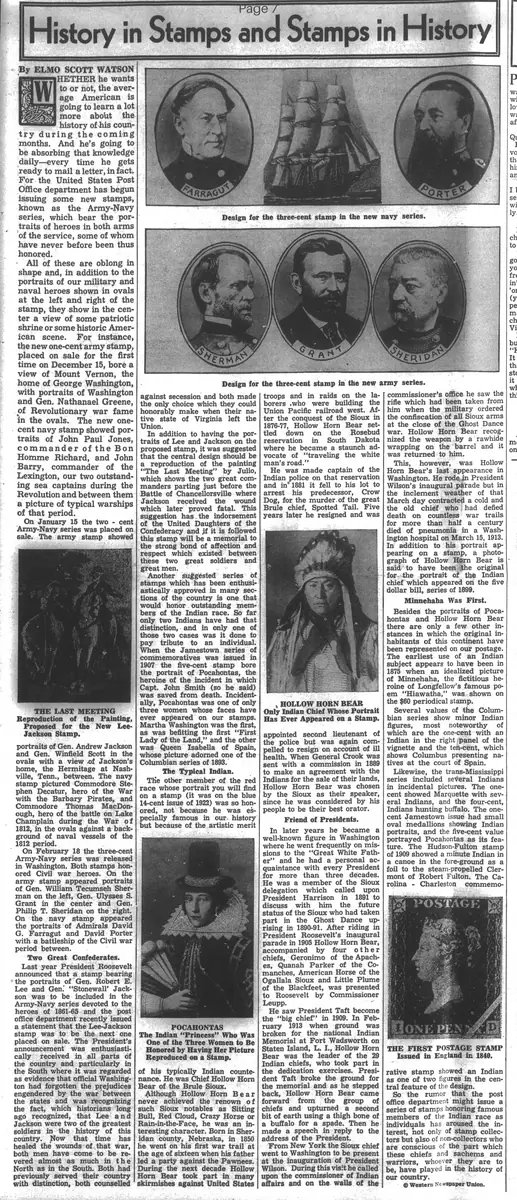
For instance, the new one-cent army stamp, placed on sale for the first time on December 15, bore a view of Mount Vernon, the home of George Washington, with portraits of Washington and Gen. Nathanael Greene, of Revolutionary war fame in the ovals. The new one-cent navy stamp showed portraits of John Paul Jones, commander of the Bon Homme Richard, and John Barry, commander of the Lexington, our two outstanding sea captains during the Revolution and between them a picture of typical warships of that period.
On January 15 the two-cent Army-Navy series was placed on sale. The army stamp showed portraits of Gen. Andrew Jackson and Gen. Winfield Scott in the ovals with a view of Jackson's home, the Hermitage at Nashville, Tenn., between. The navy stamp pictured Commodore Stephen Decatur, hero of the War with the Barbary Pirates, and Commodore Thomas MacDonough, hero of the battle on Lake Champlain during the War of 1812, in the ovals against a background of naval vessels of the 1812 period.
On February 18 the three-cent Army-Navy series was released in Washington. Both stamps honored Civil war heroes. On the army stamp appeared portraits of Gen. William Tecumseh Sherman on the left, Gen. Ulysses S. Grant in the center and Gen. Philip T. Sheridan on the right. On the navy stamp appeared the portraits of Admirals David G. Farragut and David Porter with a battleship of the Civil war period between.
Two Great Confederates.
Last year President Roosevelt announced that a stamp bearing the portraits of Gen. Robert E. Lee and Gen. 'Stonewall' Jackson was to be included in the Army-Navy series devoted to the heroes of 1861-65 and the post office department recently issued a statement that the Lee-Jackson stamp was to be the next one placed on sale. The President's announcement was enthusiastically received in all parts of the country and particularly in the South where it was regarded as evidence that official Washington had forgotten the prejudices engendered by the war between the states and was recognizing the fact, which historians long ago recognized, that Lee and Jackson were two of the greatest soldiers in the history of this country. Now that time has healed the wounds of that war, both men have come to be revered almost as much in the North as in the South. Both had previously served their country with distinction, both counseled against secession and both made the only choice which they could honorably make when their native state of Virginia left the Union.
In addition to having the portraits of Lee and Jackson on the proposed stamp, it was suggested that the central design should be a reproduction of the painting 'The Last Meeting' by Julio, which shows the two great commanders parting just before the Battle of Chancellorsville where Jackson received the wound which later proved fatal. This suggestion has the indorsement of the United Daughters of the Confederacy and if it is followed this stamp will be a memorial to the strong bond of affection and respect which existed between these two great soldiers and great men.
THE LAST MEETING
Reproduction of the Painting, Proposed for the New Lee-Jackson Stamp.
Another suggested series of stamps which has been enthusiastically approved in many sections of the country is one that would honor outstanding members of the Indian race. So far only two Indians have had that distinction, and in only one of those two cases was it done to pay tribute to an individual.
When the Jamestown series of commemoratives was issued in 1907 the five-cent stamp bore the portrait of Pocahontas, the heroine of the incident in which Capt. John Smith (so he said) was saved from death. Incidentally, Pocahontas was one of only three women whose faces have ever appeared on our stamps. Martha Washington was the first, as was befitting the first 'First Lady of the Land,' and the other was Queen Isabella of Spain, whose picture adorned one of the Columbian series of 1893.
POCAHONTAS
The Indian 'Princess' Who Was One of the Three Women to Be Honored by Having Her Picture Reproduced on a Stamp.
The Typical Indian.
The other member of the red race whose portrait you will find on a stamp (it was on the blue 14-cent issue of 1922) was so honored, not because he was especially famous in our history but because of the artistic merit of his typically Indian countenance. He was Chief Hollow Horn Bear of the Brule Sioux.
Although Hollow Horn Bear never achieved the renown of such Sioux notables as Sitting Bull, Red Cloud, Crazy Horse or Rain-in-the-Face, he was an interesting character. Born in Sheridan county, Nebraska, in 1850 he went on his first war trail at the age of sixteen when his father led a party against the Pawnees. During the next decade Hollow Horn Bear took part in many skirmishes against United States troops and in raids on the laborers who were building the Union Pacific railroad west. After the conquest of the Sioux in 1876-77, Hollow Horn Bear settled down on the Rosebud reservation in South Dakota where he became a staunch advocate of 'traveling the white man's road.'
He was made captain of the Indian police on that reservation and in 1881 it fell to his lot to arrest his predecessor, Crow Dog, for the murder of the great Brule chief, Spotted Tail. Five years later he resigned and was appointed second lieutenant of the police but was again compelled to resign on account of ill health. When General Crook was sent with a commission in 1889 to make an agreement with the Indians for the sale of their lands, Hollow Horn Bear was chosen by the Sioux as their speaker, since he was considered by his people to be their best orator.
HOLLOW HORN BEAR
Only Indian Chief Whose Portrait Has Ever Appeared on a Stamp.
Friend of Presidents.
In later years he became a well-known figure in Washington where he went frequently on missions to the 'Great White Father' and he had a personal acquaintance with every President for more than three decades.
He was a member of the Sioux delegation which called upon President Harrison in 1891 to discuss with him the future status of the Sioux who had taken part in the Ghost Dance uprising in 1890-91. After riding in President Roosevelt's inaugural parade in 1905 Hollow Horn Bear, accompanied by four other chiefs, Geronimo of the Apaches, Quanah Parker of the Comanches, American Horse of the Ogallala Sioux and Little Plume of the Blackfeet, was presented to Roosevelt by Commissioner Leupp.
He saw President Taft become the 'big chief' in 1909. In February 1913 when ground was broken for the national Indian Memorial at Fort Wadsworth on Staten Island, L. I., Hollow Horn Bear was the leader of the 29 Indian chiefs who took part in the dedication exercises. President Taft broke the ground for the memorial and as he stepped back, Hollow Horn Bear came forward from the group of chiefs and upturned a second bit of earth using a thigh bone of a buffalo for a spade. Then he made a speech in reply to the address of the President.
From New York the Sioux chief went to Washington to be present at the inauguration of President Wilson. During this visit he called upon the commissioner of Indian affairs and on the walls of the commissioner's office he saw the rifle which had been taken from him when the military ordered the confiscation of all Sioux arms at the close of the Ghost Dance war. Hollow Horn Bear recognized the weapon by a rawhide wrapping on the barrel and it was returned to him.
This, however, was Hollow Horn Bear's last appearance in Washington. He rode in President Wilson's inaugural parade but in the inclement weather of that March day contracted a cold and the old chief who had defied death on countless war trails for more than half a century died of pneumonia in a Washington hospital on March 15, 1913.
In addition to his portrait appearing on a stamp, a photograph of Hollow Horn Bear is said to have been the original for the portrait of the Indian chief which appeared on the five dollar bill, series of 1899.
Design for the three-cent stamp in the new navy series.
Design for the three-cent stamp in the new army series.
Minnehaha Was First.
Besides the portraits of Pocahontas and Hollow Horn Bear there are only a few other instances in which the original inhabitants of this continent have been represented on our postage. The earliest use of an Indian subject appears to have been in 1875 when an idealized picture of Minnehaha, the fictitious heroine of Longfellow's famous poem 'Hiawatha,' was shown on the $60 periodical stamp.
Several values of the Columbian series show minor Indian figures, most noteworthy of which are the one-cent with an Indian in the right panel of the vignette and the ten-cent, which shows Columbus presenting natives at the court of Spain.
Likewise, the trans-Mississippi series included several Indians in incidental pictures. The one-cent showed Marquette with several Indians, and the four-cent Indians hunting buffalo. The one-cent Jamestown issue had small oval medallions showing Indian portraits, and the five-cent value portrayed Pocahontas as its feature. The Hudson-Fulton stamp of 1909 showed a minute Indian in a canoe in the fore-ground as a foil to the steam-propelled Clermont of Robert Fulton. The Carolina-Charleston commemorative stamp showed an Indian as one of two figures in the central feature of the design.
THE FIRST POSTAGE STAMP
Issued in England in 1840.
So the rumor that the post office department might issue a series of stamps honoring famous members of the Indian race as individuals has aroused the interest, not only of stamp collectors but also of non-collectors who are conscious of the part which these chiefs and sachems, and warriors, whoever they are to be, have played in the history of our country.
History in Stamps and Stamps in History
What sub-type of article is it?
What themes does it cover?
What keywords are associated?
What entities or persons were involved?
Where did it happen?
Story Details
Key Persons
Location
United States
Event Date
December 15, January 15, February 18
Story Details
Article describes new U.S. Army-Navy commemorative stamps honoring Revolutionary War, War of 1812, and Civil War heroes, including proposed Lee-Jackson stamp. Discusses history of Indian figures on stamps, focusing on Pocahontas and detailed biography of Chief Hollow Horn Bear, whose portrait appeared on a 1922 stamp. Notes rumor of future Indian honors series.