Thank you for visiting SNEWPapers!
Sign up free
Editorial
December 9, 1840
Republican Herald
Providence, Providence County, Rhode Island
What is this article about?
The editorial critiques Rhode Island's restricted suffrage, arguing that three-fifths of citizens are in 'political slavery' without voting or judicial rights, similar to southern slaves, and urges philanthropists to address this white bondage first.
Clipping
OCR Quality
95%
Excellent
Full Text
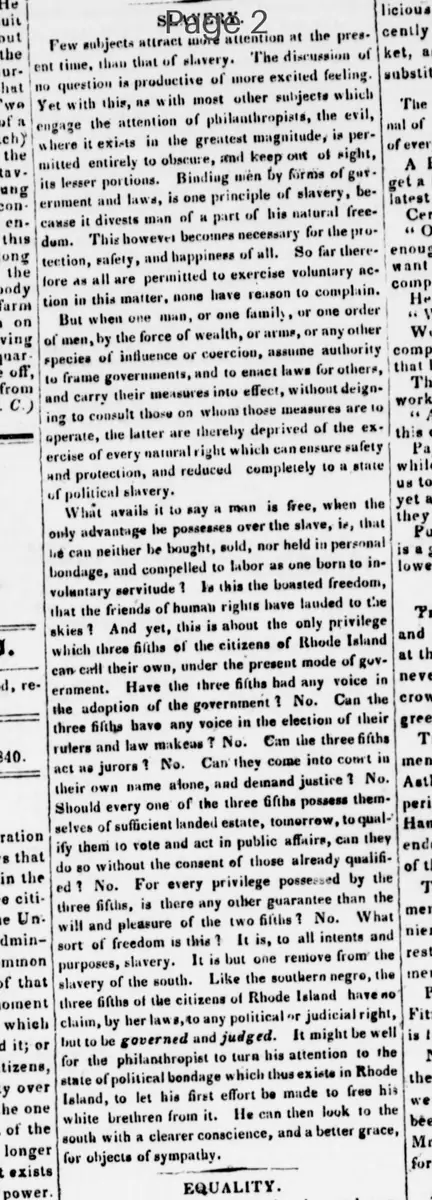
Few subjects attract more attention at the present time, than that of slavery. The discussion of no question is productive of more excited feeling. Yet with this, as with most other subjects which engage the attention of philanthropists, the evil, where it exists in the greatest magnitude, is permitted entirely to obscure, and keep out of sight, its lesser portions. Binding men by forms of government and laws, is one principle of slavery, because it divests man of a part of his natural freedom. This however becomes necessary for the protection, safety, and happiness of all. So far therefore as all are permitted to exercise voluntary action in this matter, none have reason to complain. But when one man, or one family, or one order of men, by the force of wealth, or arms, or any other species of influence or coercion, assume authority to frame governments, and to enact laws for others, and carry their measures into effect, without deigning to consult those on whom those measures are to operate, the latter are thereby deprived of the exercise of every natural right which can ensure safety and protection, and reduced completely to a state of political slavery.
What avails it to say a man is free, when the only advantage he possesses over the slave, is, that he can neither be bought, sold, nor held in personal bondage, and compelled to labor as one born to involuntary servitude? Is this the boasted freedom, that the friends of human rights have lauded to the skies? And yet, this is about the only privilege which three fifths of the citizens of Rhode Island can call their own, under the present mode of government. Have the three fifths had any voice in the adoption of the government? No. Can the three fifths have any voice in the election of their rulers and law makers? No. Can the three fifths act as jurors? No. Can they come into court in their own name alone, and demand justice? No. Should every one of the three fifths possess themselves of sufficient landed estate, tomorrow, to qualify them to vote and act in public affairs, can they do so without the consent of those already qualified? No. For every privilege possessed by the three fifths, is there any other guarantee than the will and pleasure of the two fifths? No. What sort of freedom is this? It is, to all intents and purposes, slavery. It is but one remove from the slavery of the south. Like the southern negro, the three fifths of the citizens of Rhode Island have no claim, by her laws, to any political or judicial right, but to be governed and judged. It might be well for the philanthropist to turn his attention to the state of political bondage which thus exists in Rhode Island, to let his first effort be made to free his white brethren from it. He can then look to the south with a clearer conscience, and a better grace, for objects of sympathy.
What avails it to say a man is free, when the only advantage he possesses over the slave, is, that he can neither be bought, sold, nor held in personal bondage, and compelled to labor as one born to involuntary servitude? Is this the boasted freedom, that the friends of human rights have lauded to the skies? And yet, this is about the only privilege which three fifths of the citizens of Rhode Island can call their own, under the present mode of government. Have the three fifths had any voice in the adoption of the government? No. Can the three fifths have any voice in the election of their rulers and law makers? No. Can the three fifths act as jurors? No. Can they come into court in their own name alone, and demand justice? No. Should every one of the three fifths possess themselves of sufficient landed estate, tomorrow, to qualify them to vote and act in public affairs, can they do so without the consent of those already qualified? No. For every privilege possessed by the three fifths, is there any other guarantee than the will and pleasure of the two fifths? No. What sort of freedom is this? It is, to all intents and purposes, slavery. It is but one remove from the slavery of the south. Like the southern negro, the three fifths of the citizens of Rhode Island have no claim, by her laws, to any political or judicial right, but to be governed and judged. It might be well for the philanthropist to turn his attention to the state of political bondage which thus exists in Rhode Island, to let his first effort be made to free his white brethren from it. He can then look to the south with a clearer conscience, and a better grace, for objects of sympathy.
What sub-type of article is it?
Suffrage
Constitutional
What keywords are associated?
Political Slavery
Rhode Island Suffrage
Voting Rights
Electoral Reform
Constitutional Rights
Philanthropy
Southern Slavery
What entities or persons were involved?
Three Fifths Of Rhode Island Citizens
Two Fifths Of Qualified Voters
Philanthropists
Southern Slaves
Editorial Details
Primary Topic
Political Slavery In Rhode Island Due To Restricted Suffrage
Stance / Tone
Strongly Critical Of Restricted Voting Rights As Slavery
Key Figures
Three Fifths Of Rhode Island Citizens
Two Fifths Of Qualified Voters
Philanthropists
Southern Slaves
Key Arguments
Binding By Government Without Consent Is Political Slavery
Rhode Island's Three Fifths Lack Voice In Government Adoption
Three Fifths Cannot Elect Rulers Or Lawmakers
Three Fifths Cannot Serve As Jurors
Three Fifths Cannot Sue In Their Own Name
Even With Land, Three Fifths Need Consent To Vote
Privileges Of Three Fifths Depend On Will Of Two Fifths
This Is Slavery Akin To Southern Bondage
Philanthropists Should Free White Political Slaves In Rhode Island First