Thank you for visiting SNEWPapers!
Sign up free
Letter to Editor
July 29, 1842
Carroll Free Press
Carrollton, Carroll County, Ohio
What is this article about?
Thomas L. Hamer criticizes Samuel M. Medary and Ohio Democrats for misguided banking policies, including forced specie resumption on March 4, 1842, and an ineffective banking law that fails to provide relief or stability, accusing them of political manipulation and harming the economy.
Clipping
OCR Quality
95%
Excellent
Full Text
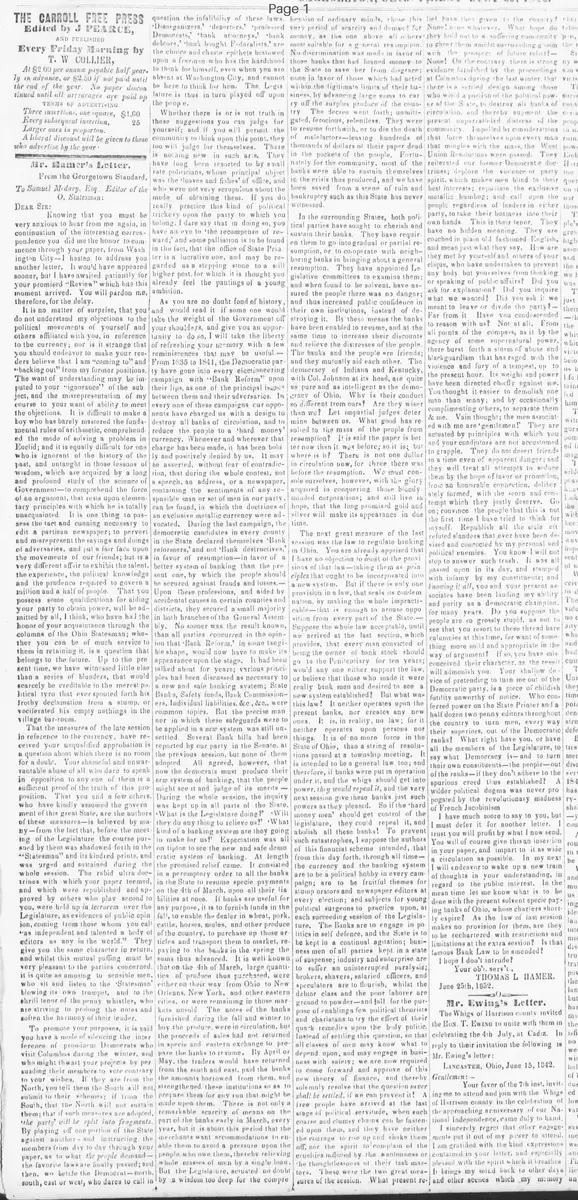
Mr. Manner's Letter.
From the Georgetown Standard.
To Samuel M. Medary, Esq. Editor of the Ohio Statesman:
DEAR SIR:
Knowing that you must be very anxious to hear from me again, in continuation of the interesting correspondence you did me the honor to commence through your paper, from Washington City—I hasten to address you another letter. It would have appeared sooner, but I have awaited patiently for your promised "Review" which has this moment arrived. You will pardon me, therefore, for the delay.
It is no matter of surprise, that you do not understand my objections to the political movements of yourself and others affiliated with you, in reference to the currency; nor is it strange that you should endeavor to make your readers believe that I am "coming to" and "backing out" from my former positions. The want of understanding may be imputed to your ignorance of the subject, and the misrepresentation of my course to your want of ability to meet the objections. It is difficult to make a boy who has barely mastered the fundamental rules of arithmetic, comprehend the mode of solving a problem in Euclid: and it is equally difficult for one who is ignorant of the history of the past, and untaught in those lessons of wisdom, which are acquired by a long and profound study of the science of Government—to comprehend the force of an argument, that rests upon elementary principles with which he is totally unacquainted. It is one thing to possess the tact and cunning necessary to edit a partisan newspaper; to pervert and misrepresent the sayings and doings of adversaries, and put a fair face upon the movements of our friends; but is a very different affair to exhibit the talent, the experience, the political knowledge and the prudence required to govern a million and a half of people. That you possess some qualifications for aiding your party to obtain power, will be admitted by all, I think, who have had the honor of your acquaintance through the columns of the Ohio Statesman; whether you can be of much service to them in retaining it, is a question that belongs to the future. Up to the present time, we have witnessed little else than a series of blunders, that would scarcely be creditable to the merest political tyro that ever spouted forth his frothy declamation from a stump, or vociferated his empty nothings in the village bar-room.
That the measures of the late session in reference to the currency, have received your unqualified approbation is a question about which there is no room for a doubt. Your shameful and unwarrantable abuse of all who dare to speak in opposition to any one of them is a sufficient proof of the truth of this proposition. That you and a few others, who have kindly assumed the government of this great State, are the authors of these measures—is believed by many—from the fact that, before the meeting of the Legislature the course pursued by them was shadowed forth in the "Statesman" and its kindred prints, and was urged and sustained during the whole session. The rabid ultra doctrines with which your paper teemed, and which were republished and approved by others who play second to you, were held up in terrorem over the Legislature, as evidences of public opinion, coming from those whom you call "as independent and talented a body of editors as any in the world." They give you the same character in return, and whilst this mutual puffing must be very pleasant to the parties concerned, it is quite as amusing to sensible men, who sit and listen to the Statesman's blowing its own trumpet, and to the shrill tenor of the penny whistles, who are striving to prolong the notes and soften the harmony of their leader.
To promote your purposes, it is said you have a mode of silencing the interference of prominent Democrats who visit Columbus during the winter, and who might thwart your projects by persuading their members to vote contrary to your wishes. If they are from the North, you tell them the South will not submit to their schemes; if from the South, that the North will not sustain them; that if such measures are adopted, the party will be split into fragments. By playing off one portion of the State against another—and instructing the members from day to day through your paper, as to what the people demand—the favorite laws are finally passed; and then, woe betide the Democrat—north, south, east or west, who dares to call in question the infallibility of these laws. Disorganizers, deserters, "professed Democrats," "bank attorneys," "bank debtors," "bank bought Federalists," are the choice and chaste epithets bestowed upon a freeman who has the hardihood to think for himself, even when you are absent at Washington City, and cannot be here to think for him. The Legislature is thus in turn played off upon the people.
Whether there is or is not truth in these suggestions you can judge for yourself; and if you will permit the community to think upon this point, they too will judge for themselves. There is nothing new in such arts. They have long been resorted to by small rate politicians, whose principal object was the "loaves and fishes" of office, and who were not very scrupulous about the mode of obtaining them. If you do really practice this kind of political trickery upon the party to which you belong, I dare say that in doing so, you have an eye to the recompense of "reward;" and some palliation is to be found in the fact, that the office of State Printer is a lucrative one, and may be regarded as a stepping stone to a still higher post, for which it is thought you already feel the pantings of a young ambition.
As you are no doubt fond of history, and would read it if some one would take the weight of the Government off your shoulders, and give you an opportunity to do so, I will take the liberty of refreshing your memory with a few reminiscences that may be useful.
From 1835 to 1841, the Democratic party have gone into every electioneering campaign with "Bank Reform" upon their lips, as one of the principal issues between them and their adversaries. In every one of these campaigns our opponents have charged us with a design to destroy all banks of circulation, and to reduce the people to a "hard money currency." Whenever and wherever that charge has been made, it has been boldly and positively denied by us. It may be asserted, without fear of contradiction, that during the whole contest, not a speech, an address, or a newspaper, containing the sentiments of any responsible man or set of men in our party, can be found, in which the doctrines of an exclusive metallic currency were advocated. During the last campaign, the democratic candidates in every county in the State declared themselves "Bank reformers," and not "Bank destructives," in favor of resumption—in favor of a better system of banking than the present one, by which the people should be secured against frauds and losses. Upon these professions, and aided by accidental causes in certain counties and districts, they secured a small majority in both branches of the General Assembly. No sooner was the result known, than all parties concurred in the opinion that "Bank Reform," in some tangible shape, would now have to make its appearance upon the stage. It had been talked about for years; various principles had been discussed as necessary to a new and safe banking system: State Banks, Safety funds, Bank Commissioners, Individual liabilities, &c. &c., were common topics. But the precise manner in which these safeguards were to be applied in a new system was still unsettled. Several Bank bills had been reported by our party in the Senate, at the previous session, but none of them adopted. All agreed, however, that now the democrats must produce their new system of banking, that the people might see it and judge of its merits.
During the whole session, the inquiry was kept up in all parts of the State. "What is the Legislature doing?" "Will they do anything to relieve us?" "What kind of a banking system are they going to make for us?" Expectation was all on tiptoe to see the new and safe democratic system of banking. At length the promised relief came. It consisted in a peremptory order to all the banks in the State to resume specie payments on the 4th of March, upon all their liabilities at once. If banks are useful for any purpose, it is to furnish funds in the fall, to enable the dealer in wheat, pork, cattle, horses, mules, and other produce of the country, to purchase up those articles and transport them to market, repaying to the banks in the spring the sums thus advanced. It is well known that on the 4th of March, large quantities of produce thus purchased, were either on their way from Ohio to New Orleans, New York, and other eastern cities, or were remaining in those markets unsold. The notes of the banks furnished during the fall and winter to buy the produce, were in circulation, but the proceeds of sales had not returned in specie and eastern exchange to prepare the banks to resume. By April or May, the traders would have returned from the south and east, paid the banks the amounts borrowed from them, and strengthened these institutions so as to prepare them for any run that might be made upon them. There is not only a remarkable scarcity of means on the part of the banks early in March, every year, but it is about this period that the merchants want accommodations to enable them to avoid a pressure upon the people who owe them, thereby relieving whole masses of men by a single loan. But the Legislature, actuated no doubt by a wisdom too deep for the comprehension of ordinary minds, chose this very period of scarcity and demand for money, as the one above all others most suitable for a general resumption. No discrimination was made in favor of those banks that had loaned money to the State to save her from disgrace; none in favor of those which had acted within the legitimate limits of their business, by advancing large sums to carry off the surplus produce of the country.
The decree went forth; unmitigated, ferocious, relentless. They were to resume forthwith, or to die the death of malefactors—leaving hundreds of thousands of dollars of their paper dead in the pockets of the people. Fortunately for the community, most of the banks were able to sustain themselves in the crisis thus produced, and we have been saved from a scene of ruin and bankruptcy such as this State has never witnessed.
In the surrounding States, both political parties have sought to cherish and sustain their banks. They have required them to go into gradual or partial resumption, or to co-operate with neighboring banks in bringing about a general resumption. They have appointed Legislative committees to examine them; and when found to be solvent, have assured the people there was no danger; and thus increased public confidence in their own institutions, instead of destroying it. By these means the banks have been enabled to resume, and at the same time to increase their discounts and relieve the distresses of the people. The banks and the people are friends; and they mutually aid each other. The democracy of Indiana and Kentucky, with Col. Johnson at its head, are quite as pure and as intelligent as the democracy of Ohio. Why is their conduct so different from ours? Are they wiser than we? Let impartial judges determine between us. What good has resulted to the mass of the people from resumption? It is said the paper is better now than it was before; so it is; but where is it? There is not one dollar in circulation now, for three there was before the resumption. We must console ourselves, however, with the glory acquired in conquering those bloody minded corporations; and still live in hope, that the long promised gold and silver will make its appearance in due time.
The next great measure of the last session was the law to regulate banking in Ohio. You are already apprised that I have no objection to most of the provisions of that law—taking them as principles that ought to be incorporated into a new system. But if there is only one provision in a law, that seals its condemnation, by making the whole impracticable—that is enough to arouse opposition from every part of the State. Suppose the whole law acceptable, until we arrived at the last section, which provides, that every man convicted of being the owner of bank stock should go to the Penitentiary for ten years; would any one either support the law, or believe that those who made it were really bank men and desired to see a new system established? But what was this law? It neither operates upon the present banks, nor creates any new ones. It is, in reality, no law; for it neither operates upon persons nor things. It is of no more force in the State of Ohio, than a string of resolutions passed at a township meeting. It is intended to be a general law too; and therefore, if banks were put in operation under it, and the whigs should get into power, they would repeal it, and the very next session give these banks just such powers as they pleased. So if the "hard money men" should get control of the legislature, they could repeal it, and abolish all these banks! To prevent such catastrophes, I suppose the authors of this financial scheme intended, that from this day forth, through all time—the currency and the banking system are to be a political hobby in every campaign; are to be fruitful themes for stump orators and newspaper editors at every election; and subjects for young political surgeons to practice upon, at each succeeding session of the Legislature. The Banks are to engage in politics in self defence, and the State is to be kept in a continual agitation; business men of all parties kept in a state of suspense; industry and enterprise are to suffer an uninterrupted paralysis; brokers, shavers, salaried officers, and speculators are to flourish, whilst the debtor class and the poor laborer are ground to powder—and jail for the purpose of enabling a few political theorists and charlatans to try the effect of their quack remedies upon the body politic.
Instead of settling this question, so that all classes of men may know what to depend upon, and may engage in business with safety: we are now required to come forward and approve of this new theory of finance, and thereby solemnly resolve that the question never shall be settled, if we can prevent it! A free people have arrived at the last stage of political servitude, when such coarse and clumsy chains can be fastened upon them, and they have neither the courage to rise up and shake them off, nor the spirit to complain of the cruelties inflicted by the wantonness or the thoughtlessness of their task masters. These were the two great measures of the session. What present relief have they given to the country? None! none whatever. What hope do they hold out to a suffering community to cheer them amidst surrounding gloom with the prospect of future relief?—None! On the contrary there is strong evidence furnished by the proceedings at Columbus during the last winter that there is a settled design among those who wield a portion of the political power of the State, to destroy all banks of circulation, and thereby augment the present unparalleled distress of the community. Impelled by considerations that force themselves upon every man that mingles with the mass, the West Union Resolutions were passed. They reiterated our former Democratic doctrines; deplore the violence of party spirit, which makes men blind to their best interests; repudiate the exclusive metallic humbug; and call upon the people regardless of leaders in either party, to take their business into their own hands. This is their tenor. They have no hidden meaning. They are couched in plain old fashioned English, and mean just what they say. How are they met by yourself and others of your clique, who have undertaken to prevent anybody but yourselves from thinking or speaking of public affairs? Did you ask for explanation?—Did you inquire what we wanted? Did you ask if we meant to leave or divide the party?—Far from it. Have you condescended to reason with us? Not at all. From all points of the compass, as if by the agency of some supernatural power, there burst forth a storm of abuse and blackguardism that has raged with the violence and fury of a tempest, up to the present hour. Its weight and power have been directed chiefly against me. You thought it easier to demolish one man than many; and by occasionally complimenting others, to separate them & me. Vain thought; the men associated with me are gentlemen! They are actuated by principles with which you and your coadjutors are not accustomed to grapple. They do not desert friends in a time even of apparent danger: and they will treat all attempts to seduce them by the hope of favor or promotion, from an honorable connection, deliberately formed, with the scorn and contempt which they justly deserve. Go on; convince the people that this is not the first time I have tried to think for myself. Republish all the stale oft refuted slanders that ever have been devised and concocted by my personal and political enemies. You know I will not stop to answer such trash. It was all passed upon in its day, and stamped with infamy by my constituents; and knowing it all, you and your present associates have been lauding my ability and purity as a democratic champion, for many years. Do you suppose the people are so grossly stupid, as not to see that you resort to these thread bare calumnies at this time, for want of something more solid and appropriate in the way of argument? If so, you have mis-conceived their character, as the result will admonish you. Your shallow device of pretending to turn me out of the Democratic party, is a piece of childish futility unworthy of notice. Who conferred power on the State Printer and a half dozen two penny editors throughout the country to turn men, every way their superiors, out of the Democratic ranks? What right have you, or have all the members of the Legislature, to say what Democracy is—and to turn their own constituents—the people—out of the ranks—if they don't adhere to the spurious creed thus established? A wilder political dogma was never promulgated by the revolutionary madness of French Jacobinism.
I have much more to say to you, but I must defer it for another letter. I trust you will profit by what I now send. You will of course give this an insertion in your paper, and impart to it as wide a circulation as possible. In my next I will endeavor to wake up a new train of thoughts in your understanding, in regard to the public interest. In the mean time let me know what is to be done with the present solvent specie paying banks of Ohio, whose charters shortly expire? As the law of last session makes no provision for them, are they to be rechartered with restrictions and limitations at the extra session? Is that famous Bank Law to be amended?
I hope I don't intrude?
Your ob't serv't.
THOMAS L. HAMER.
June 25th, 1842.
From the Georgetown Standard.
To Samuel M. Medary, Esq. Editor of the Ohio Statesman:
DEAR SIR:
Knowing that you must be very anxious to hear from me again, in continuation of the interesting correspondence you did me the honor to commence through your paper, from Washington City—I hasten to address you another letter. It would have appeared sooner, but I have awaited patiently for your promised "Review" which has this moment arrived. You will pardon me, therefore, for the delay.
It is no matter of surprise, that you do not understand my objections to the political movements of yourself and others affiliated with you, in reference to the currency; nor is it strange that you should endeavor to make your readers believe that I am "coming to" and "backing out" from my former positions. The want of understanding may be imputed to your ignorance of the subject, and the misrepresentation of my course to your want of ability to meet the objections. It is difficult to make a boy who has barely mastered the fundamental rules of arithmetic, comprehend the mode of solving a problem in Euclid: and it is equally difficult for one who is ignorant of the history of the past, and untaught in those lessons of wisdom, which are acquired by a long and profound study of the science of Government—to comprehend the force of an argument, that rests upon elementary principles with which he is totally unacquainted. It is one thing to possess the tact and cunning necessary to edit a partisan newspaper; to pervert and misrepresent the sayings and doings of adversaries, and put a fair face upon the movements of our friends; but is a very different affair to exhibit the talent, the experience, the political knowledge and the prudence required to govern a million and a half of people. That you possess some qualifications for aiding your party to obtain power, will be admitted by all, I think, who have had the honor of your acquaintance through the columns of the Ohio Statesman; whether you can be of much service to them in retaining it, is a question that belongs to the future. Up to the present time, we have witnessed little else than a series of blunders, that would scarcely be creditable to the merest political tyro that ever spouted forth his frothy declamation from a stump, or vociferated his empty nothings in the village bar-room.
That the measures of the late session in reference to the currency, have received your unqualified approbation is a question about which there is no room for a doubt. Your shameful and unwarrantable abuse of all who dare to speak in opposition to any one of them is a sufficient proof of the truth of this proposition. That you and a few others, who have kindly assumed the government of this great State, are the authors of these measures—is believed by many—from the fact that, before the meeting of the Legislature the course pursued by them was shadowed forth in the "Statesman" and its kindred prints, and was urged and sustained during the whole session. The rabid ultra doctrines with which your paper teemed, and which were republished and approved by others who play second to you, were held up in terrorem over the Legislature, as evidences of public opinion, coming from those whom you call "as independent and talented a body of editors as any in the world." They give you the same character in return, and whilst this mutual puffing must be very pleasant to the parties concerned, it is quite as amusing to sensible men, who sit and listen to the Statesman's blowing its own trumpet, and to the shrill tenor of the penny whistles, who are striving to prolong the notes and soften the harmony of their leader.
To promote your purposes, it is said you have a mode of silencing the interference of prominent Democrats who visit Columbus during the winter, and who might thwart your projects by persuading their members to vote contrary to your wishes. If they are from the North, you tell them the South will not submit to their schemes; if from the South, that the North will not sustain them; that if such measures are adopted, the party will be split into fragments. By playing off one portion of the State against another—and instructing the members from day to day through your paper, as to what the people demand—the favorite laws are finally passed; and then, woe betide the Democrat—north, south, east or west, who dares to call in question the infallibility of these laws. Disorganizers, deserters, "professed Democrats," "bank attorneys," "bank debtors," "bank bought Federalists," are the choice and chaste epithets bestowed upon a freeman who has the hardihood to think for himself, even when you are absent at Washington City, and cannot be here to think for him. The Legislature is thus in turn played off upon the people.
Whether there is or is not truth in these suggestions you can judge for yourself; and if you will permit the community to think upon this point, they too will judge for themselves. There is nothing new in such arts. They have long been resorted to by small rate politicians, whose principal object was the "loaves and fishes" of office, and who were not very scrupulous about the mode of obtaining them. If you do really practice this kind of political trickery upon the party to which you belong, I dare say that in doing so, you have an eye to the recompense of "reward;" and some palliation is to be found in the fact, that the office of State Printer is a lucrative one, and may be regarded as a stepping stone to a still higher post, for which it is thought you already feel the pantings of a young ambition.
As you are no doubt fond of history, and would read it if some one would take the weight of the Government off your shoulders, and give you an opportunity to do so, I will take the liberty of refreshing your memory with a few reminiscences that may be useful.
From 1835 to 1841, the Democratic party have gone into every electioneering campaign with "Bank Reform" upon their lips, as one of the principal issues between them and their adversaries. In every one of these campaigns our opponents have charged us with a design to destroy all banks of circulation, and to reduce the people to a "hard money currency." Whenever and wherever that charge has been made, it has been boldly and positively denied by us. It may be asserted, without fear of contradiction, that during the whole contest, not a speech, an address, or a newspaper, containing the sentiments of any responsible man or set of men in our party, can be found, in which the doctrines of an exclusive metallic currency were advocated. During the last campaign, the democratic candidates in every county in the State declared themselves "Bank reformers," and not "Bank destructives," in favor of resumption—in favor of a better system of banking than the present one, by which the people should be secured against frauds and losses. Upon these professions, and aided by accidental causes in certain counties and districts, they secured a small majority in both branches of the General Assembly. No sooner was the result known, than all parties concurred in the opinion that "Bank Reform," in some tangible shape, would now have to make its appearance upon the stage. It had been talked about for years; various principles had been discussed as necessary to a new and safe banking system: State Banks, Safety funds, Bank Commissioners, Individual liabilities, &c. &c., were common topics. But the precise manner in which these safeguards were to be applied in a new system was still unsettled. Several Bank bills had been reported by our party in the Senate, at the previous session, but none of them adopted. All agreed, however, that now the democrats must produce their new system of banking, that the people might see it and judge of its merits.
During the whole session, the inquiry was kept up in all parts of the State. "What is the Legislature doing?" "Will they do anything to relieve us?" "What kind of a banking system are they going to make for us?" Expectation was all on tiptoe to see the new and safe democratic system of banking. At length the promised relief came. It consisted in a peremptory order to all the banks in the State to resume specie payments on the 4th of March, upon all their liabilities at once. If banks are useful for any purpose, it is to furnish funds in the fall, to enable the dealer in wheat, pork, cattle, horses, mules, and other produce of the country, to purchase up those articles and transport them to market, repaying to the banks in the spring the sums thus advanced. It is well known that on the 4th of March, large quantities of produce thus purchased, were either on their way from Ohio to New Orleans, New York, and other eastern cities, or were remaining in those markets unsold. The notes of the banks furnished during the fall and winter to buy the produce, were in circulation, but the proceeds of sales had not returned in specie and eastern exchange to prepare the banks to resume. By April or May, the traders would have returned from the south and east, paid the banks the amounts borrowed from them, and strengthened these institutions so as to prepare them for any run that might be made upon them. There is not only a remarkable scarcity of means on the part of the banks early in March, every year, but it is about this period that the merchants want accommodations to enable them to avoid a pressure upon the people who owe them, thereby relieving whole masses of men by a single loan. But the Legislature, actuated no doubt by a wisdom too deep for the comprehension of ordinary minds, chose this very period of scarcity and demand for money, as the one above all others most suitable for a general resumption. No discrimination was made in favor of those banks that had loaned money to the State to save her from disgrace; none in favor of those which had acted within the legitimate limits of their business, by advancing large sums to carry off the surplus produce of the country.
The decree went forth; unmitigated, ferocious, relentless. They were to resume forthwith, or to die the death of malefactors—leaving hundreds of thousands of dollars of their paper dead in the pockets of the people. Fortunately for the community, most of the banks were able to sustain themselves in the crisis thus produced, and we have been saved from a scene of ruin and bankruptcy such as this State has never witnessed.
In the surrounding States, both political parties have sought to cherish and sustain their banks. They have required them to go into gradual or partial resumption, or to co-operate with neighboring banks in bringing about a general resumption. They have appointed Legislative committees to examine them; and when found to be solvent, have assured the people there was no danger; and thus increased public confidence in their own institutions, instead of destroying it. By these means the banks have been enabled to resume, and at the same time to increase their discounts and relieve the distresses of the people. The banks and the people are friends; and they mutually aid each other. The democracy of Indiana and Kentucky, with Col. Johnson at its head, are quite as pure and as intelligent as the democracy of Ohio. Why is their conduct so different from ours? Are they wiser than we? Let impartial judges determine between us. What good has resulted to the mass of the people from resumption? It is said the paper is better now than it was before; so it is; but where is it? There is not one dollar in circulation now, for three there was before the resumption. We must console ourselves, however, with the glory acquired in conquering those bloody minded corporations; and still live in hope, that the long promised gold and silver will make its appearance in due time.
The next great measure of the last session was the law to regulate banking in Ohio. You are already apprised that I have no objection to most of the provisions of that law—taking them as principles that ought to be incorporated into a new system. But if there is only one provision in a law, that seals its condemnation, by making the whole impracticable—that is enough to arouse opposition from every part of the State. Suppose the whole law acceptable, until we arrived at the last section, which provides, that every man convicted of being the owner of bank stock should go to the Penitentiary for ten years; would any one either support the law, or believe that those who made it were really bank men and desired to see a new system established? But what was this law? It neither operates upon the present banks, nor creates any new ones. It is, in reality, no law; for it neither operates upon persons nor things. It is of no more force in the State of Ohio, than a string of resolutions passed at a township meeting. It is intended to be a general law too; and therefore, if banks were put in operation under it, and the whigs should get into power, they would repeal it, and the very next session give these banks just such powers as they pleased. So if the "hard money men" should get control of the legislature, they could repeal it, and abolish all these banks! To prevent such catastrophes, I suppose the authors of this financial scheme intended, that from this day forth, through all time—the currency and the banking system are to be a political hobby in every campaign; are to be fruitful themes for stump orators and newspaper editors at every election; and subjects for young political surgeons to practice upon, at each succeeding session of the Legislature. The Banks are to engage in politics in self defence, and the State is to be kept in a continual agitation; business men of all parties kept in a state of suspense; industry and enterprise are to suffer an uninterrupted paralysis; brokers, shavers, salaried officers, and speculators are to flourish, whilst the debtor class and the poor laborer are ground to powder—and jail for the purpose of enabling a few political theorists and charlatans to try the effect of their quack remedies upon the body politic.
Instead of settling this question, so that all classes of men may know what to depend upon, and may engage in business with safety: we are now required to come forward and approve of this new theory of finance, and thereby solemnly resolve that the question never shall be settled, if we can prevent it! A free people have arrived at the last stage of political servitude, when such coarse and clumsy chains can be fastened upon them, and they have neither the courage to rise up and shake them off, nor the spirit to complain of the cruelties inflicted by the wantonness or the thoughtlessness of their task masters. These were the two great measures of the session. What present relief have they given to the country? None! none whatever. What hope do they hold out to a suffering community to cheer them amidst surrounding gloom with the prospect of future relief?—None! On the contrary there is strong evidence furnished by the proceedings at Columbus during the last winter that there is a settled design among those who wield a portion of the political power of the State, to destroy all banks of circulation, and thereby augment the present unparalleled distress of the community. Impelled by considerations that force themselves upon every man that mingles with the mass, the West Union Resolutions were passed. They reiterated our former Democratic doctrines; deplore the violence of party spirit, which makes men blind to their best interests; repudiate the exclusive metallic humbug; and call upon the people regardless of leaders in either party, to take their business into their own hands. This is their tenor. They have no hidden meaning. They are couched in plain old fashioned English, and mean just what they say. How are they met by yourself and others of your clique, who have undertaken to prevent anybody but yourselves from thinking or speaking of public affairs? Did you ask for explanation?—Did you inquire what we wanted? Did you ask if we meant to leave or divide the party?—Far from it. Have you condescended to reason with us? Not at all. From all points of the compass, as if by the agency of some supernatural power, there burst forth a storm of abuse and blackguardism that has raged with the violence and fury of a tempest, up to the present hour. Its weight and power have been directed chiefly against me. You thought it easier to demolish one man than many; and by occasionally complimenting others, to separate them & me. Vain thought; the men associated with me are gentlemen! They are actuated by principles with which you and your coadjutors are not accustomed to grapple. They do not desert friends in a time even of apparent danger: and they will treat all attempts to seduce them by the hope of favor or promotion, from an honorable connection, deliberately formed, with the scorn and contempt which they justly deserve. Go on; convince the people that this is not the first time I have tried to think for myself. Republish all the stale oft refuted slanders that ever have been devised and concocted by my personal and political enemies. You know I will not stop to answer such trash. It was all passed upon in its day, and stamped with infamy by my constituents; and knowing it all, you and your present associates have been lauding my ability and purity as a democratic champion, for many years. Do you suppose the people are so grossly stupid, as not to see that you resort to these thread bare calumnies at this time, for want of something more solid and appropriate in the way of argument? If so, you have mis-conceived their character, as the result will admonish you. Your shallow device of pretending to turn me out of the Democratic party, is a piece of childish futility unworthy of notice. Who conferred power on the State Printer and a half dozen two penny editors throughout the country to turn men, every way their superiors, out of the Democratic ranks? What right have you, or have all the members of the Legislature, to say what Democracy is—and to turn their own constituents—the people—out of the ranks—if they don't adhere to the spurious creed thus established? A wilder political dogma was never promulgated by the revolutionary madness of French Jacobinism.
I have much more to say to you, but I must defer it for another letter. I trust you will profit by what I now send. You will of course give this an insertion in your paper, and impart to it as wide a circulation as possible. In my next I will endeavor to wake up a new train of thoughts in your understanding, in regard to the public interest. In the mean time let me know what is to be done with the present solvent specie paying banks of Ohio, whose charters shortly expire? As the law of last session makes no provision for them, are they to be rechartered with restrictions and limitations at the extra session? Is that famous Bank Law to be amended?
I hope I don't intrude?
Your ob't serv't.
THOMAS L. HAMER.
June 25th, 1842.
What sub-type of article is it?
Political
Persuasive
Provocative
What themes does it cover?
Economic Policy
Politics
Commerce Trade
What keywords are associated?
Bank Reform
Specie Resumption
Ohio Banking Law
Democratic Party
Currency Policy
Economic Distress
Political Manipulation
What entities or persons were involved?
Thomas L. Hamer.
Samuel M. Medary, Esq. Editor Of The Ohio Statesman
Letter to Editor Details
Author
Thomas L. Hamer.
Recipient
Samuel M. Medary, Esq. Editor Of The Ohio Statesman
Main Argument
the ohio democratic party's recent banking measures, including forced specie resumption and an ineffective regulatory law, fail to provide economic relief, manipulate politics for personal gain, and harm the public, contrary to past party promises of bank reform.
Notable Details
- criticizes timing of resumption on march 4, 1842, during seasonal scarcity
- references democratic campaigns from 1835-1841 denying hard money currency
- compares ohio policies unfavorably to indiana and kentucky
- mentions west union resolutions opposing exclusive metallic currency
- accuses editor of political trickery and abuse of dissenters