Thank you for visiting SNEWPapers!
Sign up free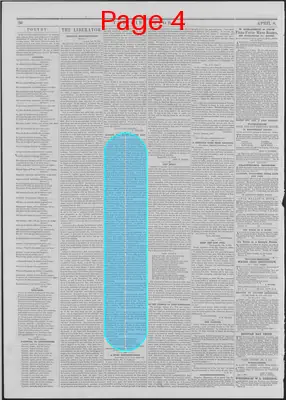
Letter to Editor
April 8, 1853
The Liberator
Boston, Suffolk County, Massachusetts
What is this article about?
Micajah T. Johnson, from Ohio, writes against the Maine Liquor Law, calling it wicked and tyrannical for forcing abstinence and mixing temperance with politics. He argues it will harm the cause by provoking rebellion and compares it to past impositions on personal freedoms. Dated January 1, 1853.
Clipping
OCR Quality
98%
Excellent
Full Text
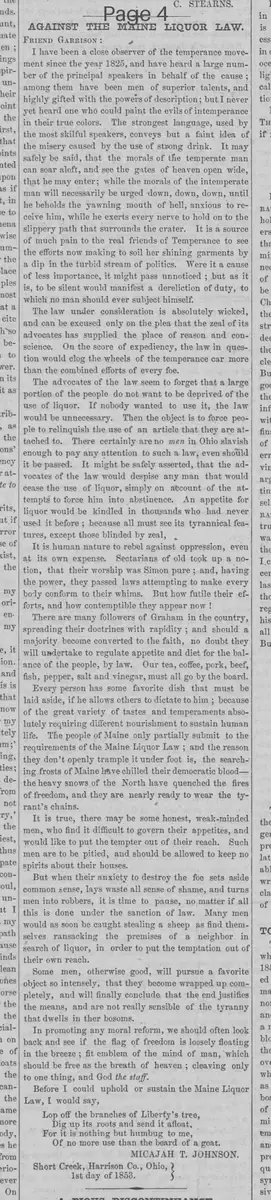
AGAINST THE MAINE LIQUOR LAW
FRIEND GARRISON:
I have been a close observer of the temperance movement since the year 1825, and have heard a large number of the principal speakers in behalf of the cause; among them have been men of superior talents, and highly gifted with the powers of description; but I never yet heard one who could paint the evils of intemperance in their true colors. The strongest language, used by the most skilful speakers, conveys but a faint idea of the misery caused by the use of strong drink. It may safely be said, that the morals of the temperate man can soar aloft, and see the gates of heaven open wide, that he may enter; while the morals of the intemperate man will necessarily be urged down, down, down, until he beholds the yawning mouth of hell, anxious to receive him. while he exerts every nerve to hold on to the slippery path that surrounds the crater. It is a source of much pain to the real friends of Temperance to see the efforts now making to soil her shining garments by a dip in the turbid stream of politics. Were it a cause of less importance. it might pass unnoticed : but as it is, to be silent would manifest a dereliction of duty, to which no man should ever subject himself.
The law under consideration is absolutely wicked and can be excused only on the plea that the zeal of its advocates has supplied the place of reason and conscience. On the score of expediency, the law in question would clog the wheels of the temperance car more than the combined efforts of every foe.
The advocates of the law seem to forget that a large portion of the people do not want to be deprived of the use of liquor. If nobody wanted to use it, the law would be unnecessary. Then the object is to force people to relinquish the use of an article that they are attached to. There certainly are no men in Ohio slavish enough to pay any attention to such a law, even should it be passed. It might be safely asserted, that the advocates of the law would despise any man that would cease the use of liquor, simply on account of the attempts to force him into abstinence. An appetite for liquor would be kindled in thousands who had never used it before; because all must see its tyrannical features, except those blinded by zeal.
It is human nature to rebel against oppression, even at its own expense. Sectarians of old took up a notion, that their worship was Simon pure; and, having the power, they passed laws attempting to make everybody conform to their whims. But how futile their efforts, and how contemptible they appear now!
There are many followers of Graham in the country, spreading their doctrines with rapidity; and should a majority become converted to the faith, no doubt they will undertake to regulate appetite and diet for the balance of the people, by law. Our tea, coffee, pork. beef. fish, pepper, salt and vinegar, must all go by the board. Every person has some favorite dish that must be laid aside, if he allows others to dictate to him ; because of the great variety of tastes and temperaments absolutely requiring different nourishment to sustain human life. The people of Maine only partially submit to the requirements of the Maine Liquor Law ; and the reason they don't openly trample it under foot is, the searching frosts of Maine have chilled their democratic blood— the heavy snows of the North have quenched the fires of freedom, and they are nearly ready to wear the tyrant's chains.
It is true, there may be some honest, weak-minded men, who find it difficult to govern their appetites, and would like to put the tempter out of their reach. Such men are to be pitied, and should be allowed to keep no spirits about their houses.
But when their anxiety to destroy the foe sets aside common sense, lays waste all sense of shame, and turns men into robbers, it is time to pause, no matter if all this is done under the sanction of law. Many men would as soon be caught stealing a sheep as find themselves ransacking the premises of a neighbor in search of liquor, in order to put the temptation out of their own reach.
Some men, otherwise good, will pursue a favorite object so intensely, that they become wrapped up completely, and will finally conclude that the end justifies the means, and are not really sensible of the tyranny that dwells in their bosoms.
In promoting any moral reform, we should often look back and see if the flag of freedom is loosely floating in the breeze; fit emblem of the mind of man, which should be free as the breath of heaven ; cleaving only to one thing, and God the staff
Before I could uphold or sustain the Maine Liquor Law, I would say,
Lop off the branches of Liberty's tree,
Dig up its roots and send it afloat,
For it is nothing but humbug to me,
Of no more use than the beard of a goat.
MICAJAH T. JOHNSON
Short Creek, Harrison Co., Ohio,
1st day of 1853.
FRIEND GARRISON:
I have been a close observer of the temperance movement since the year 1825, and have heard a large number of the principal speakers in behalf of the cause; among them have been men of superior talents, and highly gifted with the powers of description; but I never yet heard one who could paint the evils of intemperance in their true colors. The strongest language, used by the most skilful speakers, conveys but a faint idea of the misery caused by the use of strong drink. It may safely be said, that the morals of the temperate man can soar aloft, and see the gates of heaven open wide, that he may enter; while the morals of the intemperate man will necessarily be urged down, down, down, until he beholds the yawning mouth of hell, anxious to receive him. while he exerts every nerve to hold on to the slippery path that surrounds the crater. It is a source of much pain to the real friends of Temperance to see the efforts now making to soil her shining garments by a dip in the turbid stream of politics. Were it a cause of less importance. it might pass unnoticed : but as it is, to be silent would manifest a dereliction of duty, to which no man should ever subject himself.
The law under consideration is absolutely wicked and can be excused only on the plea that the zeal of its advocates has supplied the place of reason and conscience. On the score of expediency, the law in question would clog the wheels of the temperance car more than the combined efforts of every foe.
The advocates of the law seem to forget that a large portion of the people do not want to be deprived of the use of liquor. If nobody wanted to use it, the law would be unnecessary. Then the object is to force people to relinquish the use of an article that they are attached to. There certainly are no men in Ohio slavish enough to pay any attention to such a law, even should it be passed. It might be safely asserted, that the advocates of the law would despise any man that would cease the use of liquor, simply on account of the attempts to force him into abstinence. An appetite for liquor would be kindled in thousands who had never used it before; because all must see its tyrannical features, except those blinded by zeal.
It is human nature to rebel against oppression, even at its own expense. Sectarians of old took up a notion, that their worship was Simon pure; and, having the power, they passed laws attempting to make everybody conform to their whims. But how futile their efforts, and how contemptible they appear now!
There are many followers of Graham in the country, spreading their doctrines with rapidity; and should a majority become converted to the faith, no doubt they will undertake to regulate appetite and diet for the balance of the people, by law. Our tea, coffee, pork. beef. fish, pepper, salt and vinegar, must all go by the board. Every person has some favorite dish that must be laid aside, if he allows others to dictate to him ; because of the great variety of tastes and temperaments absolutely requiring different nourishment to sustain human life. The people of Maine only partially submit to the requirements of the Maine Liquor Law ; and the reason they don't openly trample it under foot is, the searching frosts of Maine have chilled their democratic blood— the heavy snows of the North have quenched the fires of freedom, and they are nearly ready to wear the tyrant's chains.
It is true, there may be some honest, weak-minded men, who find it difficult to govern their appetites, and would like to put the tempter out of their reach. Such men are to be pitied, and should be allowed to keep no spirits about their houses.
But when their anxiety to destroy the foe sets aside common sense, lays waste all sense of shame, and turns men into robbers, it is time to pause, no matter if all this is done under the sanction of law. Many men would as soon be caught stealing a sheep as find themselves ransacking the premises of a neighbor in search of liquor, in order to put the temptation out of their own reach.
Some men, otherwise good, will pursue a favorite object so intensely, that they become wrapped up completely, and will finally conclude that the end justifies the means, and are not really sensible of the tyranny that dwells in their bosoms.
In promoting any moral reform, we should often look back and see if the flag of freedom is loosely floating in the breeze; fit emblem of the mind of man, which should be free as the breath of heaven ; cleaving only to one thing, and God the staff
Before I could uphold or sustain the Maine Liquor Law, I would say,
Lop off the branches of Liberty's tree,
Dig up its roots and send it afloat,
For it is nothing but humbug to me,
Of no more use than the beard of a goat.
MICAJAH T. JOHNSON
Short Creek, Harrison Co., Ohio,
1st day of 1853.
What sub-type of article is it?
Persuasive
Political
Ethical Moral
What themes does it cover?
Temperance
Politics
Morality
What keywords are associated?
Maine Liquor Law
Temperance Reform
Prohibition Opposition
Personal Liberty
Political Tyranny
Moral Reform
Intemperance Evils
What entities or persons were involved?
Micajah T. Johnson
Friend Garrison
Letter to Editor Details
Author
Micajah T. Johnson
Recipient
Friend Garrison
Main Argument
the maine liquor law is wicked and tyrannical, forcing abstinence on those attached to liquor, mixing temperance with politics, and provoking rebellion rather than promoting reform effectively.
Notable Details
References To Sylvester Graham's Dietary Doctrines
Comparison To Historical Sectarian Impositions
Poem Rejecting The Law In Favor Of Liberty