Thank you for visiting SNEWPapers!
Sign up free
Editorial
December 8, 1810
The Enquirer
Richmond, Henrico County, Virginia
What is this article about?
Editorial praises President Madison's message on improved U.S. foreign relations with France's revocation of decrees, critiques Federalist opposition, and supports U.S. occupation of West Florida under existing laws, anticipating potential measures against Britain if needed.
Clipping
OCR Quality
95%
Excellent
Full Text
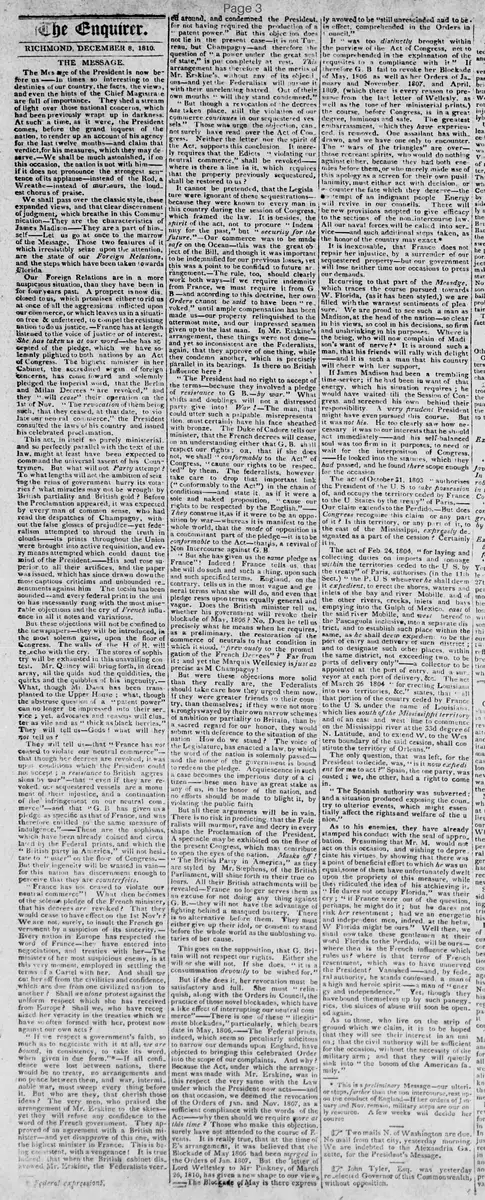
RICHMOND, DECEMBER 8, 1810.
THE MESSAGE
The Message of the President is now before us—in times so interesting to the destinies of our country, the facts, the views, and even the hints of the Chief Magistrate are full of importance. They shed a stream of light over those national concerns, which had been previously wrapt up in darkness.
At such a time, as it were, the President comes before the grand inquest of the nation, to render up an account of his agency for the last twelve months—and claim that verdict, for his measures, which they may deserve.—We shall be much astonished, if on this occasion, the nation is not with him—. if it does not pronounce the strongest sentence of its applause—instead of the Rod, a Wreathe—instead of murmurs, the loudest chorus of praise.
We shall pass over the classic style, those expanded views, and that clear discernment of judgment, which breathe in this Communication—They are the characteristics of James Madison—They are a part of himself.. Let us go at once to the marrow of the Message. Those two features of it which irresistibly seize upon the attention, are the state of our Foreign Relations, and the steps which have been taken towards Florida
Our Foreign Relations are in a more auspicious situation, than they have been in for four years past. A prospect is now disclosed to us, which promises either to rid us at once of all the aggressions inflicted upon our commerce, or which leaves us in a situation free & unfettered, to Compel the resisting nation to do us justice. —France has at length listened to the voice of justice or of interest. She has taken us at our word—she has accepted of the pledge, which we have so- solemnly plighted to both nations by an Act of Congress. The highest minister in her Cabinet, the accredited organ of foreign concerns, has come forward and solemnly pledged the imperial word, that the Berlin and Milan Decrees "are revoked," and they "will cease" their operation on the 1st of Nov. "The revocation of them being such, that they ceased, at that date, to violate our neutral commerce." the President consulted the laws of his country and issued his celebrated proclamation.
This act, in itself so purely ministerial. and so perfectly parallel with the text of the law, might at least have been expected to command the universal assent of his Countrymen. But what will not Party attempt? To what lengths will not the ambition of seizing the reins of government hurry its votaries? what miracles may not be wrought by British partiality and British gold? Before the Proclamation appeared, it was expected by every man of common sense, who had read the despatches of Champagny, without the false glosses of prejudice—yet federalism attempted to shroud the truth in clouds—misprints throughout the Union were brought into active requisition, and every means attempted which could daunt the mind of the President.—His soul rose superior to all their artifices, and the paper was issued, which has since drawn down the most captious criticisms and unbounded resentments against him The tocsin has been sounded—and every federal print in the union has incessantly rung with the most miserable objections and the cry of French influence in all its notes and variations.
But these objections will not be confined to the newspapers—they will be introduced, in the most solemn guise, upon the floor of Congress. The walls of the H of R. will te echo with the cry. The stores of sophistry will be exhausted in this unavailing contest. Mr. Quincy will bring forth, in dread array, all the quids and the quiddities, the quirks and the quibbles of his ingenuity.- What, though Mr. Dana has been transplanted to the Upper House; what, though the abstruse question of a "patent power" can no longer be impressed into their service; yet, advocates and reasons will cluster as vile and as "thick as black berries."
They will tell us—Gods! what will they not tell us?
They will tell us—that "France has not ceased to violate our neutral commerce"_ that though her decrees are revoked, it was upon conditions which the President could not accept; a resistance to British aggressions by war"—that "even if they are revoked, our sequestered vessels are a monument of their injustice, and a continuation of the infringement on our neutral commerce"—and that "G. B. has given us a pledge as specific as that of France, and was therefore entitled to the same measure of indulgence."
These are the sophisms, which have been already coined and circulated by the Federal prints. and which the "British party in America," will not hesitate to "utter" on the floor of Congress.- But their ingenuity will be wasted in vain— for this nation has discernment enough to perceive that they are counterfeits.
"France has not ceased to violate our neutral commerce"! What then becomes of the solemn pledge of the French minister, that his decrees are revoked? That they would cease to have effect on the 1st Nov'r? We are not, surely, to insult the French government by a suspicion of its sincerity.- Every nation in Europe has respected the word of France—they have entered into negociations, and treaties with her—The ministry of her most suspicious enemy, is at this very moment, employed in settling the terms of a Cartel with her. And shall we cut her off from the civilities and confidence, which are due from one civilized nation to another? Shall we alone protest against the uniform respect which she has received from Europe? Shall we, who have recognized her veracity in the treaties which we have so often formed with her, protest now against our own acts?
"If we respect a government's faith, so much as to negociate with it at all, we are bound, in consistency, to take its word, when given in due form."*—If all confidence were lost between nations, there would be no treaty, no arrangements and no peace between them, and war, interminable war, must sweep every thing before it. But who are they, that cherish those ideas? The very men, who praised the arrangement of Mr. Erskine to the skies- yet they will refuse any confidence to the word of the French government. They approved of an agreement with a British minister—and yet disapprove of this one, with the highest minister in France: This is being consistent, with a vengeance! It is true indeed! that when the British cabinet disavowed Mr. Erskine, the Federalists veered around, and condemned the President. for not having required the production of a patent power."
But this objection does not lie in the present case—it is not Turreau, but Champagny—and therefore the question of "a power under the great seal of state," is put completely at rest. This arrangement has therefore all the merits of Mr. Erskine's. without any of its objections—and yet the Federalists will pursue it with their unrelenting hatred. Out of their own mouths "will they stand condemned."
"But though a revocation of the decrees has taken place. still the violation of our commerce continues in our sequestered vessels." Those who urge the objection, can not surely have read over the Act of Congress. Neither the letter nor the spirit of the Act, supports this conclusion It merely requires that the Edicts "violating our neutral commerce." shall be revoked-.. where is there a line in it, which requires that the property previously sequestered, shall be restored to us?
It cannot be pretended, that the Legislature were ignorant of these sequestrations- because they were known to every man in this country during the session of Congress. which framed the law. It is besides. the spirit of the act, not to procure "Indemnity for the past," but "security for the future."—Our commerce was to be made safe on the Ocean—this was the great object of the Bill, and though it was important to be indemnified for our previous losses, yet this was a point to be confided to future arrangement.—The rule. too, should clearly work both ways—if we require indemnity from France, we must require it from G B—and according to this doctrine. her own Orders cannot be said to have been "revoked" until ample compensation has been made us—our property relinquished to the uttermost mite, and our impressed seamen given up to the last man. In Mr. Erskine's arrangement, these things were not done— and yet so inconsistent are the Federalists, again, that they approve of one thing, while they condemn another, which is precisely parallel in its bearings. Is there no British Influence here?
"The President had no right to accept of the terms—because they involved a pledge of resistance to G B.—by war." What shifts and doublings will not a distressed party give into! War!—The man, that could utter such a palpable misrepresentation, must certainly have his face sheathed with bronze. The Duke of Cadore tells our minister, that the French decrees will cease, on an understanding either that G.B. shall respect our rights; or, that if she does not, we shall "conformably to the Act" of Congress, "cause our rights to be respected" by them. The federalists, however take care to drop that important link ("Conformably to the Act") in the chain of conditions—and state it. as if it were a sole and naked proposition, "cause our rights to be respected by the English."
They construe it, as if it were to be an opposition by war—whereas it is manifest to the whole world, that the mode of opposition is a concomitant part of the pledge—it is to be conformable to the Act—that is, a revival of Non Intercourse against G.B.
But she has given us the same pledge as France"! Indeed! France tells us. that she will do such and such a thing, upon such and such specified terms. England, on the contrary. tells us in the most vague and general terms what she will do, and even that pledge rests upon terms equally general and vague. Does the British minister tell us. whether his government will revoke their blockade of May, 1806? No. Does he tell us precisely what he means when he requires, as a preliminary, the restoration of the commerce of neutrals to that condition in which it stood, "previously to the promulgation of the French Decrees"? Far from it: and yet the Marquis Wellesley is just as precise as M Champagny!
But were these objections more solid than they really are, the Federalists should take care how they urged them now If they were greater friends to their country. than themselves; if they were not more strongly swayed by their own narrow schemes of ambition or partiality to Britain, than by a sacred regard for our honor, they would submit with deference to the situation of the nation How do we stand? The voice of the Legislature, has enacted a law, by which the word of the nation is solemnly passed- and the honor of the government is bound to redeem the pledge. Acquiescence in such a case becomes the imperious duty of a citizen—these men have as great stake as any of us, in the honor of the nation, and no efforts should be made to blight it, by violating the public faith
But all these arguments will be in vain. There is no risk in predicting. that the Federalists will murmur, rave and decry in every shape the Proclamation of the President. A spectacle may be exhibited on the floor of the present Congress, which may contribute to open the eyes of the nation. Masks off! "The British Party in America," as they are styled by Mr. Stephens, of the British Parliament, will shine forth in their true colours. All their British attachments will be revealed—France no longer serves them as an excuse for not doing any thing against G. B.—they will not have the advantage of fighting behind a masked battery. There is no alternative before them. They must either give up their idol, or consent to stand before the whole world as the unblushing votaries of her cause.
This goes on the supposition, that G. Britain will not respect our rights. Either she will or she will not. If she does. "it is a consummation devoutly to be wished for." But if she does not, her revocation must be satisfactory and full. She must "relinquish, along with the Orders in Council, the practice of those novel blockades, which have a like effect of interrupting our neutral commerce" There is one of these "illegitimate blockades," particularly, which bears date in May, 1806.—The Federal prints, indeed, which seem so peculiarly solicitous to narrow our demands upon England. have objected to bringing this celebrated Order into the scope of our complaints. And why? Because the Act, under which the arrangement was made with Mr. Erskine, was in this respect the very same with the Law under which the President now acts—and on that occasion, we deemed the revocation of the Orders of Jan. and Nov. 1807, as a sufficient compliance with the words of the Act—why then should we require more at this time? Those who make this objection. surely have not attended to the course of events. It is really true, that at the time of E's arrangement." it was believed that the Blockade of May 1806 had been merged in the Orders of Jan. 1807. But the letter of Lord Wellesley to Mr- Pinkney, of March 26, 1810, has given a new shape to our view The Blockade of May is there expressly avowed to be "still unrescinded and to be. in effect. comprehended in the Orders in Council."
It "was too distinctly brought within the purview of the Act of Congress, not to be comprehended in the explanation of the requisites to a compliance with it" If therefore G. B fail to revoke her Blockade of May. 1806 as well as her Orders of January and November. 1807. and April. 1809. (which there is every reason to presume from the last letter of Wellesley. as well as the tone of her ministerial prints.) the course, before Congress. is in a great degree, luminous and safe. The greatest embarrassment. which they have experienced. is removed. One assailant has withdrawn, and we have one only to encounter. The "wars of the triangles" are over— those recreant spirits, who would do nothing against either, because they had both enemies before them, or who merely made use of this apology as a screen for their own pusillanimity, must either act with decision, or counter the fate which they deserve—the Contempt of an indignant people Energy will revive in our councils. There will be new provisions adopted to give efficacy to the sections of the non.intercourse law. All our naval forces will be called into service—and such additional steps taken, as the honor of the country may exact.*
It is inexcusable, that France does not repair her injustice, by a surrender of our sequestered property—but our government will lose neither time nor occasions to press our demands.
Recurring to that part of the Message. which traces the course pursued towards W. Florida, (as it has been styled,) we are filled with the warmest sentiments of pleasure. We are proud to see such a man as Madison, at the head of the nation—so clear in his views, so cool in his decisions, so firm and unshrinking in his purposes. Where is the being, who will now complain of Madison's want of nerve? It is around such a man, that his friends will rally with delight -and it is such a man that his country will cheer with her support.
If James Madison had been a trembling time-server; if he had been in want of that energy. which his situation requires; he would have waited till the Session of Congress, and screened his own behind their responsibility. A very prudent President might have even pursued this course. But it was not his. He too clearly saw how necessary it was to our interests that he should act immediately—and his self-balanced soul was too firm in its purposes, to need or wait for the interposition of Congress. -He looked into the statutes, which they had passed, and he found there scope enough for the occupation
The act of October 31. 1803 "authorises the President of the U. S to take possession of, and occupy the territory ceded by France to the U States by the treaty" of Paris.-. Our claim extends to the Perdido.—But does Congress recognize this claim or any part of it? Is this territory, or any part of it, to the east of the Mississippi, expressly designated as a part of the cession? Certainly it is.
The act of Feb. 24, 1804, "for laying and collecting duties on imports and tonnage within the territories ceded to the U S. by the treaty" of Paris, authorises (in the 11th Sect.) "the P. U.S whenever he shall deem it expedient, to erect the shores, waters and inlets of the bay and river Mobile. and of the other rivers, creeks, inlets and bays emptying into the Gulph of Mexico. east of the said river Mobile, and west hereof to the Pascagoula inclusive, into a separate district, and to establish such place within the same, as he shall deem expedient to be the port of entry and delivery of such district; and to designate such other places, within the same district, not exceeding two. to be ports of delivery only" -a collector to be appointed at the port of entry, and a surveyor at each port of delivery, &c. The act of March 3 1804 "for erecting Louisiana into two territories, &c." states, that all that portion of the country ceded by France to the U S. under the name of Louisiana. which lies south of the Mississippi territory and of an east and west line to commence on the Mississippi river at the 33d degree of N. Latitude, and to extend W. to the Western boundary of the said cession, shall constitute the territory of Orleans."
The only question, that was left, for the President to decide, was, "is it now expedient for me to act?" Spain, the one party, was ousted; we, the other, had a right to come in.
The Spanish authority was subverted: and a situation produced exposing the country to ulterior events, which might essentially affect the rights and welfare of the union."
As to his enemies, they have already stamped his conduct with the seal of approbation. Presuming that Mr. M. would not act on this occasion, and wishing to depreciate his virtues, by showing that there was a point of beneficial effort to which he was unequal, some of them have unfortunately dwelt upon the propriety of this measure, while they ridiculed the idea of his achieving it. "He dares not occupy Florida." was their cry; "if France were out of the question, perhaps, he might do it; but he dares not risk her resentment; had we an energetic and independent man, indeed. at the helm, W Florida might be ours" Well then, we shall now take these gentlemen at their word Florida to the Perdido, will be ours- where then is the French influence which rules us? where is that terror of French resentment, which was to have unnerved the President? Vanished—and, by federal authority, he stands confessed. a man of a high and heroic spirit a man of "energy and independence." Yet, though they have bound themselves up by such panegyrics, the sluices of abuse will soon be opened again.
As to those, who live on the strip of ground which we claim, it is to be hoped that they will see their interest in a union; that the civil authority will be sufficient for the occasion, without the necessity of the military arm; and that they will quietly sink into "the bosom of the American family."
This is a preliminary Message—our ulterior steps, further than the non intercourse, rest upon the conduct of England—If her orders of January and Nov. remain, military steps are our only resource. A few weeks will decide her course
Two mails N. of Washington are due.
No mail from that city, yesterday morning
We are indebted to the Alexandria Gazette, for the President's Message.
John Tyler, Esq. was yesterday re-elected Governor of this Commonwealth, without opposition.
THE MESSAGE
The Message of the President is now before us—in times so interesting to the destinies of our country, the facts, the views, and even the hints of the Chief Magistrate are full of importance. They shed a stream of light over those national concerns, which had been previously wrapt up in darkness.
At such a time, as it were, the President comes before the grand inquest of the nation, to render up an account of his agency for the last twelve months—and claim that verdict, for his measures, which they may deserve.—We shall be much astonished, if on this occasion, the nation is not with him—. if it does not pronounce the strongest sentence of its applause—instead of the Rod, a Wreathe—instead of murmurs, the loudest chorus of praise.
We shall pass over the classic style, those expanded views, and that clear discernment of judgment, which breathe in this Communication—They are the characteristics of James Madison—They are a part of himself.. Let us go at once to the marrow of the Message. Those two features of it which irresistibly seize upon the attention, are the state of our Foreign Relations, and the steps which have been taken towards Florida
Our Foreign Relations are in a more auspicious situation, than they have been in for four years past. A prospect is now disclosed to us, which promises either to rid us at once of all the aggressions inflicted upon our commerce, or which leaves us in a situation free & unfettered, to Compel the resisting nation to do us justice. —France has at length listened to the voice of justice or of interest. She has taken us at our word—she has accepted of the pledge, which we have so- solemnly plighted to both nations by an Act of Congress. The highest minister in her Cabinet, the accredited organ of foreign concerns, has come forward and solemnly pledged the imperial word, that the Berlin and Milan Decrees "are revoked," and they "will cease" their operation on the 1st of Nov. "The revocation of them being such, that they ceased, at that date, to violate our neutral commerce." the President consulted the laws of his country and issued his celebrated proclamation.
This act, in itself so purely ministerial. and so perfectly parallel with the text of the law, might at least have been expected to command the universal assent of his Countrymen. But what will not Party attempt? To what lengths will not the ambition of seizing the reins of government hurry its votaries? what miracles may not be wrought by British partiality and British gold? Before the Proclamation appeared, it was expected by every man of common sense, who had read the despatches of Champagny, without the false glosses of prejudice—yet federalism attempted to shroud the truth in clouds—misprints throughout the Union were brought into active requisition, and every means attempted which could daunt the mind of the President.—His soul rose superior to all their artifices, and the paper was issued, which has since drawn down the most captious criticisms and unbounded resentments against him The tocsin has been sounded—and every federal print in the union has incessantly rung with the most miserable objections and the cry of French influence in all its notes and variations.
But these objections will not be confined to the newspapers—they will be introduced, in the most solemn guise, upon the floor of Congress. The walls of the H of R. will te echo with the cry. The stores of sophistry will be exhausted in this unavailing contest. Mr. Quincy will bring forth, in dread array, all the quids and the quiddities, the quirks and the quibbles of his ingenuity.- What, though Mr. Dana has been transplanted to the Upper House; what, though the abstruse question of a "patent power" can no longer be impressed into their service; yet, advocates and reasons will cluster as vile and as "thick as black berries."
They will tell us—Gods! what will they not tell us?
They will tell us—that "France has not ceased to violate our neutral commerce"_ that though her decrees are revoked, it was upon conditions which the President could not accept; a resistance to British aggressions by war"—that "even if they are revoked, our sequestered vessels are a monument of their injustice, and a continuation of the infringement on our neutral commerce"—and that "G. B. has given us a pledge as specific as that of France, and was therefore entitled to the same measure of indulgence."
These are the sophisms, which have been already coined and circulated by the Federal prints. and which the "British party in America," will not hesitate to "utter" on the floor of Congress.- But their ingenuity will be wasted in vain— for this nation has discernment enough to perceive that they are counterfeits.
"France has not ceased to violate our neutral commerce"! What then becomes of the solemn pledge of the French minister, that his decrees are revoked? That they would cease to have effect on the 1st Nov'r? We are not, surely, to insult the French government by a suspicion of its sincerity.- Every nation in Europe has respected the word of France—they have entered into negociations, and treaties with her—The ministry of her most suspicious enemy, is at this very moment, employed in settling the terms of a Cartel with her. And shall we cut her off from the civilities and confidence, which are due from one civilized nation to another? Shall we alone protest against the uniform respect which she has received from Europe? Shall we, who have recognized her veracity in the treaties which we have so often formed with her, protest now against our own acts?
"If we respect a government's faith, so much as to negociate with it at all, we are bound, in consistency, to take its word, when given in due form."*—If all confidence were lost between nations, there would be no treaty, no arrangements and no peace between them, and war, interminable war, must sweep every thing before it. But who are they, that cherish those ideas? The very men, who praised the arrangement of Mr. Erskine to the skies- yet they will refuse any confidence to the word of the French government. They approved of an agreement with a British minister—and yet disapprove of this one, with the highest minister in France: This is being consistent, with a vengeance! It is true indeed! that when the British cabinet disavowed Mr. Erskine, the Federalists veered around, and condemned the President. for not having required the production of a patent power."
But this objection does not lie in the present case—it is not Turreau, but Champagny—and therefore the question of "a power under the great seal of state," is put completely at rest. This arrangement has therefore all the merits of Mr. Erskine's. without any of its objections—and yet the Federalists will pursue it with their unrelenting hatred. Out of their own mouths "will they stand condemned."
"But though a revocation of the decrees has taken place. still the violation of our commerce continues in our sequestered vessels." Those who urge the objection, can not surely have read over the Act of Congress. Neither the letter nor the spirit of the Act, supports this conclusion It merely requires that the Edicts "violating our neutral commerce." shall be revoked-.. where is there a line in it, which requires that the property previously sequestered, shall be restored to us?
It cannot be pretended, that the Legislature were ignorant of these sequestrations- because they were known to every man in this country during the session of Congress. which framed the law. It is besides. the spirit of the act, not to procure "Indemnity for the past," but "security for the future."—Our commerce was to be made safe on the Ocean—this was the great object of the Bill, and though it was important to be indemnified for our previous losses, yet this was a point to be confided to future arrangement.—The rule. too, should clearly work both ways—if we require indemnity from France, we must require it from G B—and according to this doctrine. her own Orders cannot be said to have been "revoked" until ample compensation has been made us—our property relinquished to the uttermost mite, and our impressed seamen given up to the last man. In Mr. Erskine's arrangement, these things were not done— and yet so inconsistent are the Federalists, again, that they approve of one thing, while they condemn another, which is precisely parallel in its bearings. Is there no British Influence here?
"The President had no right to accept of the terms—because they involved a pledge of resistance to G B.—by war." What shifts and doublings will not a distressed party give into! War!—The man, that could utter such a palpable misrepresentation, must certainly have his face sheathed with bronze. The Duke of Cadore tells our minister, that the French decrees will cease, on an understanding either that G.B. shall respect our rights; or, that if she does not, we shall "conformably to the Act" of Congress, "cause our rights to be respected" by them. The federalists, however take care to drop that important link ("Conformably to the Act") in the chain of conditions—and state it. as if it were a sole and naked proposition, "cause our rights to be respected by the English."
They construe it, as if it were to be an opposition by war—whereas it is manifest to the whole world, that the mode of opposition is a concomitant part of the pledge—it is to be conformable to the Act—that is, a revival of Non Intercourse against G.B.
But she has given us the same pledge as France"! Indeed! France tells us. that she will do such and such a thing, upon such and such specified terms. England, on the contrary. tells us in the most vague and general terms what she will do, and even that pledge rests upon terms equally general and vague. Does the British minister tell us. whether his government will revoke their blockade of May, 1806? No. Does he tell us precisely what he means when he requires, as a preliminary, the restoration of the commerce of neutrals to that condition in which it stood, "previously to the promulgation of the French Decrees"? Far from it: and yet the Marquis Wellesley is just as precise as M Champagny!
But were these objections more solid than they really are, the Federalists should take care how they urged them now If they were greater friends to their country. than themselves; if they were not more strongly swayed by their own narrow schemes of ambition or partiality to Britain, than by a sacred regard for our honor, they would submit with deference to the situation of the nation How do we stand? The voice of the Legislature, has enacted a law, by which the word of the nation is solemnly passed- and the honor of the government is bound to redeem the pledge. Acquiescence in such a case becomes the imperious duty of a citizen—these men have as great stake as any of us, in the honor of the nation, and no efforts should be made to blight it, by violating the public faith
But all these arguments will be in vain. There is no risk in predicting. that the Federalists will murmur, rave and decry in every shape the Proclamation of the President. A spectacle may be exhibited on the floor of the present Congress, which may contribute to open the eyes of the nation. Masks off! "The British Party in America," as they are styled by Mr. Stephens, of the British Parliament, will shine forth in their true colours. All their British attachments will be revealed—France no longer serves them as an excuse for not doing any thing against G. B.—they will not have the advantage of fighting behind a masked battery. There is no alternative before them. They must either give up their idol, or consent to stand before the whole world as the unblushing votaries of her cause.
This goes on the supposition, that G. Britain will not respect our rights. Either she will or she will not. If she does. "it is a consummation devoutly to be wished for." But if she does not, her revocation must be satisfactory and full. She must "relinquish, along with the Orders in Council, the practice of those novel blockades, which have a like effect of interrupting our neutral commerce" There is one of these "illegitimate blockades," particularly, which bears date in May, 1806.—The Federal prints, indeed, which seem so peculiarly solicitous to narrow our demands upon England. have objected to bringing this celebrated Order into the scope of our complaints. And why? Because the Act, under which the arrangement was made with Mr. Erskine, was in this respect the very same with the Law under which the President now acts—and on that occasion, we deemed the revocation of the Orders of Jan. and Nov. 1807, as a sufficient compliance with the words of the Act—why then should we require more at this time? Those who make this objection. surely have not attended to the course of events. It is really true, that at the time of E's arrangement." it was believed that the Blockade of May 1806 had been merged in the Orders of Jan. 1807. But the letter of Lord Wellesley to Mr- Pinkney, of March 26, 1810, has given a new shape to our view The Blockade of May is there expressly avowed to be "still unrescinded and to be. in effect. comprehended in the Orders in Council."
It "was too distinctly brought within the purview of the Act of Congress, not to be comprehended in the explanation of the requisites to a compliance with it" If therefore G. B fail to revoke her Blockade of May. 1806 as well as her Orders of January and November. 1807. and April. 1809. (which there is every reason to presume from the last letter of Wellesley. as well as the tone of her ministerial prints.) the course, before Congress. is in a great degree, luminous and safe. The greatest embarrassment. which they have experienced. is removed. One assailant has withdrawn, and we have one only to encounter. The "wars of the triangles" are over— those recreant spirits, who would do nothing against either, because they had both enemies before them, or who merely made use of this apology as a screen for their own pusillanimity, must either act with decision, or counter the fate which they deserve—the Contempt of an indignant people Energy will revive in our councils. There will be new provisions adopted to give efficacy to the sections of the non.intercourse law. All our naval forces will be called into service—and such additional steps taken, as the honor of the country may exact.*
It is inexcusable, that France does not repair her injustice, by a surrender of our sequestered property—but our government will lose neither time nor occasions to press our demands.
Recurring to that part of the Message. which traces the course pursued towards W. Florida, (as it has been styled,) we are filled with the warmest sentiments of pleasure. We are proud to see such a man as Madison, at the head of the nation—so clear in his views, so cool in his decisions, so firm and unshrinking in his purposes. Where is the being, who will now complain of Madison's want of nerve? It is around such a man, that his friends will rally with delight -and it is such a man that his country will cheer with her support.
If James Madison had been a trembling time-server; if he had been in want of that energy. which his situation requires; he would have waited till the Session of Congress, and screened his own behind their responsibility. A very prudent President might have even pursued this course. But it was not his. He too clearly saw how necessary it was to our interests that he should act immediately—and his self-balanced soul was too firm in its purposes, to need or wait for the interposition of Congress. -He looked into the statutes, which they had passed, and he found there scope enough for the occupation
The act of October 31. 1803 "authorises the President of the U. S to take possession of, and occupy the territory ceded by France to the U States by the treaty" of Paris.-. Our claim extends to the Perdido.—But does Congress recognize this claim or any part of it? Is this territory, or any part of it, to the east of the Mississippi, expressly designated as a part of the cession? Certainly it is.
The act of Feb. 24, 1804, "for laying and collecting duties on imports and tonnage within the territories ceded to the U S. by the treaty" of Paris, authorises (in the 11th Sect.) "the P. U.S whenever he shall deem it expedient, to erect the shores, waters and inlets of the bay and river Mobile. and of the other rivers, creeks, inlets and bays emptying into the Gulph of Mexico. east of the said river Mobile, and west hereof to the Pascagoula inclusive, into a separate district, and to establish such place within the same, as he shall deem expedient to be the port of entry and delivery of such district; and to designate such other places, within the same district, not exceeding two. to be ports of delivery only" -a collector to be appointed at the port of entry, and a surveyor at each port of delivery, &c. The act of March 3 1804 "for erecting Louisiana into two territories, &c." states, that all that portion of the country ceded by France to the U S. under the name of Louisiana. which lies south of the Mississippi territory and of an east and west line to commence on the Mississippi river at the 33d degree of N. Latitude, and to extend W. to the Western boundary of the said cession, shall constitute the territory of Orleans."
The only question, that was left, for the President to decide, was, "is it now expedient for me to act?" Spain, the one party, was ousted; we, the other, had a right to come in.
The Spanish authority was subverted: and a situation produced exposing the country to ulterior events, which might essentially affect the rights and welfare of the union."
As to his enemies, they have already stamped his conduct with the seal of approbation. Presuming that Mr. M. would not act on this occasion, and wishing to depreciate his virtues, by showing that there was a point of beneficial effort to which he was unequal, some of them have unfortunately dwelt upon the propriety of this measure, while they ridiculed the idea of his achieving it. "He dares not occupy Florida." was their cry; "if France were out of the question, perhaps, he might do it; but he dares not risk her resentment; had we an energetic and independent man, indeed. at the helm, W Florida might be ours" Well then, we shall now take these gentlemen at their word Florida to the Perdido, will be ours- where then is the French influence which rules us? where is that terror of French resentment, which was to have unnerved the President? Vanished—and, by federal authority, he stands confessed. a man of a high and heroic spirit a man of "energy and independence." Yet, though they have bound themselves up by such panegyrics, the sluices of abuse will soon be opened again.
As to those, who live on the strip of ground which we claim, it is to be hoped that they will see their interest in a union; that the civil authority will be sufficient for the occasion, without the necessity of the military arm; and that they will quietly sink into "the bosom of the American family."
This is a preliminary Message—our ulterior steps, further than the non intercourse, rest upon the conduct of England—If her orders of January and Nov. remain, military steps are our only resource. A few weeks will decide her course
Two mails N. of Washington are due.
No mail from that city, yesterday morning
We are indebted to the Alexandria Gazette, for the President's Message.
John Tyler, Esq. was yesterday re-elected Governor of this Commonwealth, without opposition.
What sub-type of article is it?
Foreign Affairs
Partisan Politics
War Or Peace
What keywords are associated?
Madison Message
French Decrees
Neutral Commerce
West Florida
Federalist Opposition
British Orders
Non Intercourse
What entities or persons were involved?
James Madison
Federalists
France
Great Britain
Champagny
Mr. Erskine
Mr. Quincy
Spain
Editorial Details
Primary Topic
Support For Madison's Handling Of French Decrees Revocation And West Florida Occupation
Stance / Tone
Strongly Pro Madison, Anti Federalist, Patriotic Exhortation
Key Figures
James Madison
Federalists
France
Great Britain
Champagny
Mr. Erskine
Mr. Quincy
Spain
Key Arguments
France's Revocation Of Berlin And Milan Decrees Ends Violations Of U.S. Neutral Commerce
President's Proclamation Aligns With Congressional Act And Merits National Support
Federalist Criticisms Are Sophistry Influenced By British Partiality
U.S. Occupation Of West Florida Justified By Existing Laws And Spanish Ouster
Anticipates Measures Against Britain If Orders In Council Persist
Madison Demonstrates Energy And Firmness In Leadership