Thank you for visiting SNEWPapers!
Sign up free
Domestic News
June 6, 1809
The Enquirer
Richmond, Henrico County, Virginia
What is this article about?
An opinion piece refutes Mr. Randolph's claim that Britain's Orders in Council were unknown in Washington when the 1807 Embargo was enacted, citing December 1807 letters from Congress members, newspaper reports, and historical parallels to 1794 treaty events.
Clipping
OCR Quality
96%
Excellent
Full Text
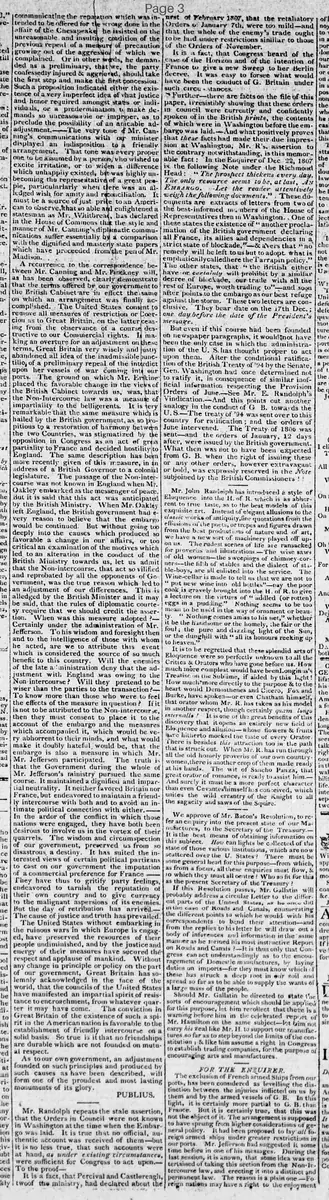
Mr. Randolph repeats the stale assertion, that the Orders in Council were not known in Washington at the time when the Embargo was laid. It is true that no official, authentic account was received of them—but it is no less true, that such accounts were at hand, as under existing circumstances, were sufficient for Congress to act upon.
To the proof—
It is a fact, that Percival and Castlereagh, two of the ministry, had declared about the first of February 1809, that the retaliatory Orders of January 7th, were too mild—and that the whole of the enemy's trade ought to be laid under restrictions similar to those of the Orders of November.
It is a fact, that Congress heard of the case of the Horizon and of the intention of France to give a new Sweep to her Berlin decree. It was easy to forsee what would have been the conduct of G. Britain under such circumstances.
Further—there are facts on the file of this paper, irresistibly showing that these orders in council were currently and confidently spoken of in the British prints, the contents of which were in Washington before the embargo was laid.—And what positively proves that these facts had made their due impression at Washington; Mr. R's. assertion to the contrary notwithstanding, is this memorable fact: In the Enquirer of Dec 22, 1807 is the following Note under the Richmond Head: "The prospect thickens every day. The only resource seems to be, at last, an EMBargo.—Let the reader attentively weigh the following documents." These documents are extracts of letters from two of the best-informed members of the House of Representatives then in Washington. One of these states the existence of "another proclamation of the British government declaring all France, its allies and dependencies in a strict state of blockade." & avers that "no remedy will be left to us but to adopt what is emphatically called here the Tarrapin policy." The other states, that "the British either have or certainly will prohibit by a similar decree of blockade, our trade with all the rest of Europe, worth trading to"—and soon after points to the embargo as our best refuge against the storm. These two letters are conclusive. They bear date on the 17th Dec.; one day before the date of the President's message.
But even if this course had been founded on newspaper paragraphs, it would not have been the only case in which the administration of the U. S. has thought proper to act upon them. After the conditional ratification of the British Treaty of '94 by the Senate, Gen. Washington had once determined not to ratify it, in consequence of similar unofficial information respecting the Provision Orders of June.—See Mr. E. Randolph's Vindication.—And this points out another analogy in the conduct of G B. towards the U. S.—The treaty of '94 was sent over to this country for ratification; and the orders of June intervened. The Treaty of 1806 was sent—and the orders of January, 12 days after, were issued by the British government.
What then was not to have been expected from G. B. when the right of issuing these or any other orders, however extravagant or bold, was expressly reserved in the Note subjoined by the British Commissioners!
To the proof—
It is a fact, that Percival and Castlereagh, two of the ministry, had declared about the first of February 1809, that the retaliatory Orders of January 7th, were too mild—and that the whole of the enemy's trade ought to be laid under restrictions similar to those of the Orders of November.
It is a fact, that Congress heard of the case of the Horizon and of the intention of France to give a new Sweep to her Berlin decree. It was easy to forsee what would have been the conduct of G. Britain under such circumstances.
Further—there are facts on the file of this paper, irresistibly showing that these orders in council were currently and confidently spoken of in the British prints, the contents of which were in Washington before the embargo was laid.—And what positively proves that these facts had made their due impression at Washington; Mr. R's. assertion to the contrary notwithstanding, is this memorable fact: In the Enquirer of Dec 22, 1807 is the following Note under the Richmond Head: "The prospect thickens every day. The only resource seems to be, at last, an EMBargo.—Let the reader attentively weigh the following documents." These documents are extracts of letters from two of the best-informed members of the House of Representatives then in Washington. One of these states the existence of "another proclamation of the British government declaring all France, its allies and dependencies in a strict state of blockade." & avers that "no remedy will be left to us but to adopt what is emphatically called here the Tarrapin policy." The other states, that "the British either have or certainly will prohibit by a similar decree of blockade, our trade with all the rest of Europe, worth trading to"—and soon after points to the embargo as our best refuge against the storm. These two letters are conclusive. They bear date on the 17th Dec.; one day before the date of the President's message.
But even if this course had been founded on newspaper paragraphs, it would not have been the only case in which the administration of the U. S. has thought proper to act upon them. After the conditional ratification of the British Treaty of '94 by the Senate, Gen. Washington had once determined not to ratify it, in consequence of similar unofficial information respecting the Provision Orders of June.—See Mr. E. Randolph's Vindication.—And this points out another analogy in the conduct of G B. towards the U. S.—The treaty of '94 was sent over to this country for ratification; and the orders of June intervened. The Treaty of 1806 was sent—and the orders of January, 12 days after, were issued by the British government.
What then was not to have been expected from G. B. when the right of issuing these or any other orders, however extravagant or bold, was expressly reserved in the Note subjoined by the British Commissioners!
What sub-type of article is it?
Politics
Economic
What keywords are associated?
Embargo 1807
Orders In Council
British Blockade
Congress Letters
Washington Politics
What entities or persons were involved?
Mr. Randolph
Percival
Castlereagh
Gen. Washington
Mr. E. Randolph
Where did it happen?
Washington
Domestic News Details
Primary Location
Washington
Event Date
December 1807
Key Persons
Mr. Randolph
Percival
Castlereagh
Gen. Washington
Mr. E. Randolph
Event Details
Opinion refuting claim that Britain's Orders in Council were unknown in Washington during 1807 Embargo decision, citing unofficial reports, December 17 letters from House members on British blockades, Enquirer note of December 22, and parallels to 1794 treaty.