Thank you for visiting SNEWPapers!
Sign up free
The National Intelligencer And Washington Advertiser
Washington, District Of Columbia
What is this article about?
This editorial from the National Intelligencer advocates for ratifying a congressional amendment to the U.S. Constitution separating the election of President and Vice President. It argues the current system risks minority presidencies, factionalism, disunity, and anarchy, emphasizing adaptability of the Constitution and strong public support.
Merged-components note: Merged sequential reading order components that form a single continuous editorial piece on the proposed amendment to the Constitution, ending with 'To be concluded in our next'.
Clipping
OCR Quality
Full Text
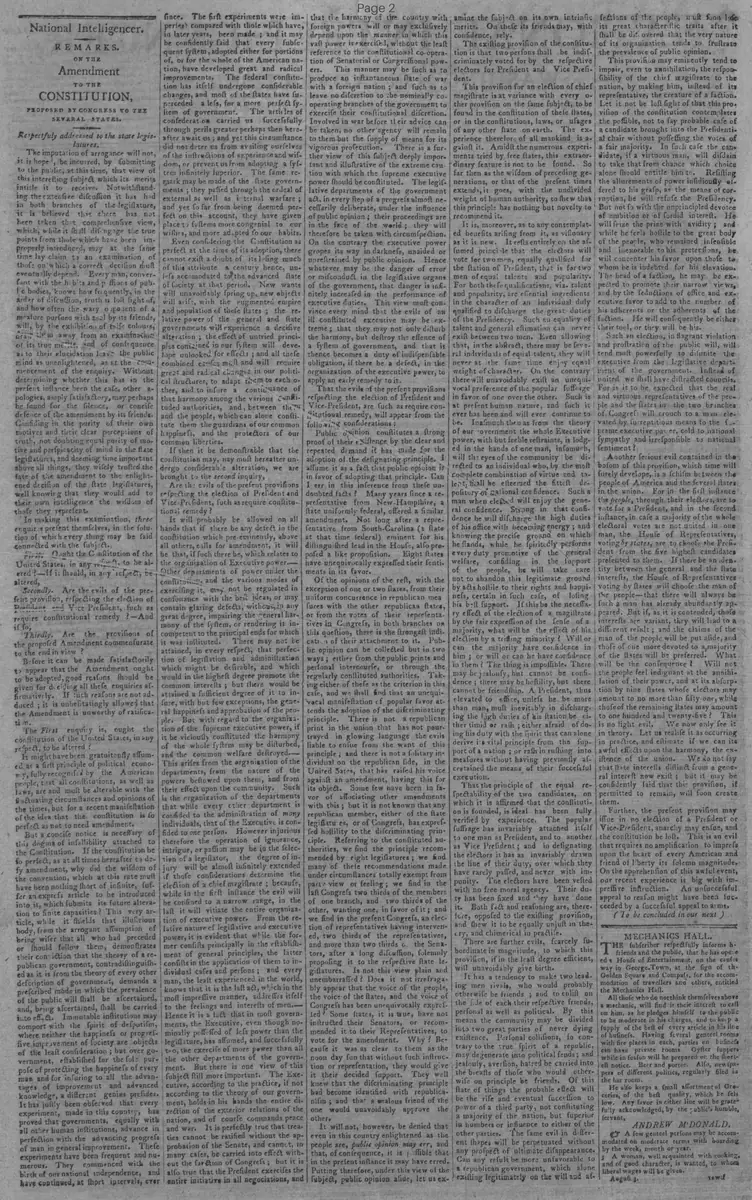
REMARKS.
ON THE
Amendment
TO THE
CONSTITUTION,
PROPOSED BY CONGRESS TO THE
SEVERAL STATES.
Respectfully addressed to the state legislatures.
The imputation of arrogance will not, it is hoped, be incurred by submitting to the public, at this time, that view of this interesting subject which its merits entitle it to receive. Notwithstanding the extensive discussion it has had in both branches of the legislature, it is believed that there has not been taken that comprehensive view, which, while it all disengage the true points from those which have been improperly introduced, may at the same time lay claim to an examination of those on which a correct decision must eventually depend. Every man, conversant with the habits and opinions of public bodies, knows how frequently, in the order of discussion, truth is lost sight of, and how often the wary opponent of a measure pursued with zeal by its friends, will, by the exhibition of false colours, draw them away from an examination of its merits, and of consequence as to their elucidation leave the public mind as unenlightened, as at the commencement of the enquiry. Without determining whether this has in the present instance been the case, other apologies, amply satisfactory, may perhaps be found for the silence, or concise defence of the amendment by its friends. Confiding in the purity of their own motives and their clear perceptions of truth, not doubting equal purity of motive and perspicacity of mind in the state legislatures, and deeming time important above all things, they wisely trusted the fate of the amendment to the enlightened decision of the state legislatures, well knowing that they would add to their own intelligence the wisdom of those they represent.
In making this examination, three enquiries present themselves, in the solution of which every thing may be said connected with the subject.
First. Ought the Constitution of the United States, in any respect, to be altered?
If it should, in any respect, be altered,
Secondly. Are the evils of the present provision, respecting the election of President and Vice President, such as require constitutional remedy?
And if so,
Thirdly. Are the provisions of the proposed Amendment commensurate to the end in view?
Before it can be made satisfactorily to appear that the Amendment ought to be adopted, good reasons should be given for deciding all these enquiries affirmatively. If such reasons are not adduced; it is unhesitatingly allowed that the Amendment is unworthy of ratification.
The First enquiry is, ought the constitution of the United States, in any respect, to be altered?
It might have been gratuitously assumed as a first principle of political economy, fully recognized by the American people, that all constitutions, as well as laws, are and must be alterable with the fluctuating circumstances and opinions of the times, but for a recent manifestation of the idea that the constitution is so perfect as not to need amendment.
But a concise notice is necessary of this dogma of infallibility attached to the Constitution. If the constitution be so perfect, as at all times hereafter to defy amendment, why did the wisdom of the convention, which at this rate must have been nothing short of infinite, suffer an express article to be introduced into it, which submits its future alteration to finite capacities? This very article, while it shields that illustrious body, from the arrogant assumption of being wiser than all who had preceded or should follow them, demonstrates their conviction that the theory of a republican government, distinguished as it is from the theory of every other description of government, demands a prescribed mode in which the prevalence of the public will shall be ascertained, and, being ascertained, shall be carried into effect. Immutable institutions may comport with the spirit of despotism, where neither the happiness or progressive improvement of society are objects of the least consideration; but over government, established for the sole purpose of protecting the happiness of every man and for insuring to all the advantages of improvement and advanced knowledge, a different genius presides.
It has justly been observed that every experiment, made in this country, has proved that governments, equally with all other human institutions, advance in perfection with the advancing progress of man in general improvement. These experiments have been frequent and numerous. They commenced with the birth of our national independence, and have continued, at short intervals, ever since.
Since. The first experiments were imperfect compared with those which have, in later years, been made; and it may be confidently said that every subsequent system, adopted either for portions of, or for the whole of the American nation, have developed great and radical improvements. The federal constitution has itself undergone considerable changes, and most of the states have succeeded a less, for a more perfect system of government. The articles of confederation carried us successfully through perils greater perhaps than here after await us; and yet this circumstance did not deter us from availing ourselves of the instructions of experience and wisdom, or prevent us from adopting a system infinitely superior. The same remark may be made of the state governments; they passed through the ordeal of external as well as internal warfare; and yet so far from being deemed perfect on this account, they have given place to systems more congenial to our wishes, and more adapted to our habits.
Even considering the Constitution as perfect at the time of its adoption, there cannot exist a doubt of its losing much of this attribute a century hence, unless accommodated to the advanced state of society at that period. New wants will unavoidably spring up, new objects will arise, with the augmented empire and population of these states; the relative power of the general and state governments will experience a decisive alteration; the effect of untried principles contained in our system will develop unlooked for results; and all these combined causes must and will require great and radical changes in our political structures, to adapt them to each other, and to insure a continuance of that harmony among the various constituted authorities, and, between them and the people, which can alone constitute them the guardians of our common happiness, and the protectors of our common liberties.
If then it be demonstrable that the constitution may, nay must hereafter undergo considerable alteration, we are brought to the second inquiry,
Are the evils of the present provisions respecting the election of President and Vice President, such as require constitutional remedy?
It will probably be allowed on all hands that if there be any defect in the constitution which pre-eminently, above all others, calls for amendment, it will be that, if such there be, which relates to the organization of Executive power.
Other departments of power under the constitution and the various modes of exercising it, may not be regulated in consonance with the best ideas, or may contain glaring defects, without, in any great degree, impairing the general harmony of the system, or rendering it incompetent to the principal ends for which it was instituted. There may not be attained, in every respect, that perfection of legislation and administration which might be desirable, and which would in the highest degree promote the common interests; but there would be attained a sufficient degree of it to insure, with but few exceptions, the general happiness and approbation of the people. But with regard to the organization of the supreme executive power, if it be viciously constituted the harmony of the whole system may be disturbed, and the common welfare destroyed.
This arises from the organisation of the departments, from the nature of the powers bestowed upon them, and from their effect upon the community. Such is the organization of the departments that while every other department is confided to the administration of many individuals, that of the Executive is confided to one person. However injurious therefore the operation of ignorance, intrigue, or passion may be in the election of a legislator, the degree of injury will be almost infinitely extended if those considerations determine the election of a chief magistrate; because, while in the first instance the evil will be confined to a narrow range, in the last it will vitiate the entire organisation of executive power. From the relative nature of legislative and executive power, it is evident that while the former consists principally in the establishment of general principles, the latter consists in the application of them to individual cases and persons; and every man, the least experienced in the world, knows that it is the last act, which in the most impressive manner, addresses itself to the feelings and interests of men.
Hence it is a fact that in most governments, the Executive, even though nominally possessed of less power than the legislature, has assumed, and successfully too, the exercise of more power than all the other departments of the government. But there is one view of this subject still more important. The Executive, according to the practice, if not according to the theory of our government, holds in his hands the entire direction of the exterior relations of the nation, and of course commands peace and war. It is perfectly true that treaties cannot be ratified without the approbation of the Senate, and cannot, in many cases, be carried into effect without the appropriation of Congress; but it is also true that the President exercises the entire initiative in all negociations, and that the harmony of the country with foreign powers will or may exclusively depend upon the manner in which this vast power is exercised, without the least reference to the constitutional co-operation of Senatorial or Congressional powers.
This manner may be such as to produce an instantaneous state of war with a foreign nation; and such as to leave no discretion to the nominally co-operating branches of the government to exercise their constitutional discretion. Involved in war before their advice can be taken, no other agency will remain to them but the supply of means for its vigorous prosecution. There is a further view of this subject deeply important and illustrative of the extreme caution with which the supreme executive power should be constituted. The legislative departments of the government act, in every step of a progress almost necessarily deliberate, under the influence of public opinion; their proceedings are in the face of the world; they will therefore be taken with circumpection. On the contrary the executive power gropes its way in darkness, unaided or unrestrained by public opinion. Hence whatever may be the danger of error or misconduct in the legislative organs of the government, that danger is infinitely increased in the performance of executive duties. This view must convince every mind that the evils of an ill constituted executive may be extreme; that they may not only disturb the harmony, but destroy the essence of a system of government, and that it thence becomes a duty of indispensable obligation, if there be a defect, in the organization of the executive power, to apply an early remedy to it.
That the evil of the present provisions respecting the election of President and Vice President, are such as require constitutional remedy, will appear from the following considerations:
Public opinion constitutes a strong proof of their existence by the clear and repeated demand it has made for the adoption of the discriminating principle. I assume it as a fact that public opinion is in favor of adopting that principle. Can I err in this inference from these undoubted facts? Many years since a representative from New-Hampshire, a state uniformly federal, offered a similar amendment. Not long after a representative from South-Carolina (a state at that time federal) eminent for his distinguished lead in the House, also proposed a like proposition. Eight states have unequivocally expressed their sentiments in its favor.
Of the opinions of the rest, with the exception of one or two states, from their uniform concurrence in republican measures with the other republican states, or from the votes of their representatives in Congress, in both branches on this question, there is the strongest indication of their attachment to it. Public opinion can be collected but in two ways; either from the public prints and personal intercourse, or through the regularly constituted authorities. Taking either of these as the criterion in this case, and we shall find that an unequivocal manifestation of popular favor attends the adoption of the discriminating principle. There is not a republican print in the union that has not portrayed in glowing language the evils liable to ensue from the want of this principle; and there is not a solitary individual on the republican side, in the United States, that has raised his voice against an amendment, having this for its object. Some few have been in favor of associating other amendments with this; but it is not known that any republican member, either of the state legislatures, or of Congress, has expressed hostility to the discriminating principle. Referring to the constituted authorities, we find the principle recommended by eight legislatures; we find many of these recommendations made under circumstances totally exempt from party view or feeling; we find in the last Congress two thirds of the members of one branch, and two thirds of the other, wanting one, in favor of it; and we find in the present Congress, an election of representatives having intervened, two thirds of the representatives, and more than two thirds of the Senators, after a long discussion, solemnly proposing it to the respective state legislatures. Is not this view plain and unembarrassed? Does it not irresistibly appear that the voice of the people, the voice of the states, and the voice of Congress has been unequivocally expressed? Some states, it is true, have not instructed their Senators, or recommended it to their Representatives, to vote for the amendment. Why? Because it was as clear to them as the noon day sun that without such instruction or representation, they would give it their decided support. They well knew that the discriminating principle had become identified with republicanism; and that a zealous friend of the one would unavoidably approve the other.
It will not, however, be denied that even in this country enlightened as the people are, public opinion may err, and that, of consequence, it is possible that in the present instance it may have erred. Putting therefore, under this view of the subject, public opinion aside, let us examine the subject on its own intrinsic merits.
On these its friends may, with confidence, rely.
The existing provision of the constitution is that two persons shall be indiscriminately voted for by the respective electors for President and Vice President.
This provision for an election of chief magistrate is at variance with every other provision on the same subject, to be found in the constitution of these states, or in the constitutions, laws, or usages of any other state on earth. The experience therefore of all mankind is against it. Amidst the numerous experiments tried by free states, this extraordinary feature is not to be found. So far then as the wisdom of preceding generations, or that of the present times extends, it goes, with the undivided weight of human authority, to shew that this principle has nothing but novelty to recommend it.
It is, moreover, as to any contemplated benefits arising from it, as visionary as it is new. It rests entirely on the assumed principle that the electors will vote for two men, equally qualified for the station of President, that is for two men of equal talents and popularity. For both these qualifications, viz. talent and popularity, are essential ingredients in the character of an individual duly qualified to discharge the great duties of the Presidency. Such an equality of talent and general estimation can never exist between two men. Even allowing that, in the abstract, there may be several individuals of equal talent, they will never at the same time enjoy equal weight of character. On the contrary there will unavoidably exist an unequivocal preference of the popular suffrage in favor of one over the other. Such is at present human nature, and such it ever has been and will ever continue to be. Inasmuch then as from the theory of our government the whole Executive power, with but feeble restraints, is lodged in the hands of one man, inasmuch, will the eyes of the community be directed to an individual who, by the most complete combination of virtue and talent, shall be esteemed the fittest depository of national confidence. Such a man when elected will enjoy the general confidence. Strong in that confidence he will discharge the high duties of his office with becoming energy; and knowing the precise ground on which he stands, while he strenuously performs every duty promotive of the general welfare, confiding in the support of the people, he will take care not to abandon this legitimate ground by acts hostile to their rights and happiness, certain in such case, of losing his best support. If this be the necessary effect of the election of a magistrate by the fair expression of the sense of a majority, what will be the effect of his election by a trifling minority? Will or can the majority have confidence in him; or will or can he have confidence in them? The thing is impossible. There may be jealousy, but cannot be confidence; there may be hostility, but there cannot be friendship. A President, thus elevated to office, unless he be more than man, must inevitably in discharging the high duties of his station be either timid or rash: either afraid of doing his duty with the spirit that can alone derive its vital principle from the support of a nation; or rash in rushing into measures without having previously ascertained the means of their successful execution.
That the principle of the equal respectability of the two candidates, on which it is affirmed that the constitution is founded, is ideal has been fully verified by experience. The popular suffrage has invariably attached itself to one man as President, and to another as Vice President; and in designating the electors it has as invariably drawn the line of their duty, over which they have rarely passed, and never with impunity. The electors have been vested with no free moral agency. Their duty has been fixed and they have done it. Both fact and reasoning are, therefore, opposed to the existing provision, and shew it to be equally unjust in theory, and chimerical in practice.
There are further evils, scarcely subordinate in magnitude, to which this provision, if in the least degree efficient, will unavoidably give birth.
It has a tendency to make two leading men rivals, who would probably otherwise be friends; and to enlist on the side of each their respective friends, personal as well as political. By this means the community may be divided into two great parties of never dying existence. Personal collisions, so contrary to the true spirit of a republic, may degenerate into political feuds; and jealousy, aversion, hatred be carried into the breasts of those who would otherwise on principle be friends. Of this state of things the probable effect will be the rise and eventual succession to power of a third party, not constituting a majority of the nation, but superior in numbers or influence to either of the other parties. The same evil in different shapes will be perpetuated without any prospect of ultimate disappearance. Can any result be more unfavorable to a republican government, which alone existing legitimately on the will and affections of the people, must soon lose its great characteristic traits after it shall be discovered that the very nature of its organization tends to frustrate the prevalence of public opinion.
This provision may eminently tend to impair, even to annihilation, the responsibility of the chief magistrate to the nation, by making him, instead of its representative, the creature of a faction.
Let it not be lost sight of that this provision of the constitution contemplates the possible, not to say probable case of a candidate brought into the Presidential chair without possessing the votes of a fair majority. In such case the candidate, if a virtuous man, will disdain to take that from chance which choice alone should entitle him to. Resisting the allurements of power insidiously offered to his grasp, as the means of corruption, he will refuse the Presidency. But not so with the unprincipled devotee of ambition or of sordid interest. He will seize the prize with avidity; and while he feels hostile to the great body of the people, who remained insensible and inexorable to his pretensions, he will concenter his favor upon those to whom he is indebted for his elevation. The head of a faction, he may be expected to promote their narrow views, and by the seductions of office and executive favor to add to the number of his adherents or the adherents of the faction. He will consequently be either their tool, or they will be his.
Such an election, in flagrant violation and prostration of the public will, will tend most powerfully to disunite the executive from the legislative department of the government. Instead of united we shall have distracted councils. For is it to be expected that the real and virtuous representatives of the people and the states in the two branches of Congress will crouch to a man elevated by surreptitious means to the supreme executive power, cold to national sympathy and irresponsible to national sentiment?
Another serious evil contained in the womb of this provision, which time will surely develope, is a chasm between the people of America and the several states in the union. For in the first instance the people, through their electors, are to vote for a President, and in the second instance, in case a majority of the whole electoral votes are not united in one man, the House of Representatives, voting by states, are to choose the President from the five highest candidates presented to them. If there be an identity between the general and the state interests, the House of Representatives voting by states will choose the man of the people-that there will always be such a man has already abundantly appeared. But if, as it is contended, those interests are variant, they will lead to a different result; and the claims of the man of the people will be put aside, and those of one more devoted to a majority of the states will be preferred. What will be the consequence? Will not the people feel indignant at the annihilation of their power, and at its absorption by nine states whose electors may amount to no more than fifty-one, while those of the remaining states may amount to one hundred and twenty-five? This is no light evil. We now only see it in theory. Let us realize it as occurring in practice, and estimate if we can its awful effects upon the harmony, the existence of the union. We do not say that state interests distinct from a general interest now exist; but it may be consistently said that this provision, if permitted to remain, will soon create them.
Further, the present provision may issue in no election of a President or Vice President, anarchy may ensue, and the constitution be lost. This is an evil that requires no amplification to impress upon the heart of every American and friend of liberty its solemn magnitude.
On the apprehension of this awful event, our recent experience is big with impressive instruction. An unsuccessful appeal to reason might have been succeeded by a successful appeal to arms.
(To be concluded in our next )
What sub-type of article is it?
What keywords are associated?
What entities or persons were involved?
Editorial Details
Primary Topic
Support For Amendment To Presidential And Vice Presidential Election Process
Stance / Tone
Advocacy For Ratification Of The Proposed Amendment
Key Figures
Key Arguments