Thank you for visiting SNEWPapers!
Sign up free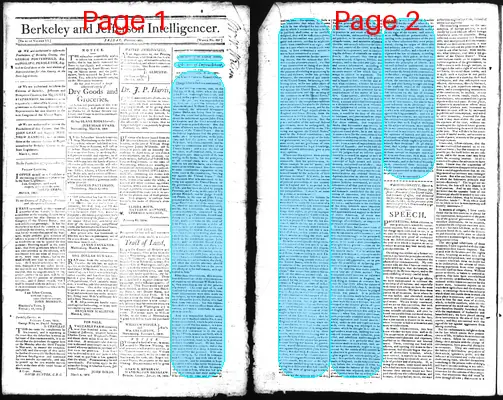
Berkeley And Jefferson Intelligencer
Martinsburg, Berkeley County, Virginia
What is this article about?
In his 1805 impeachment defense before the US Senate, Justice Samuel Chase justifies his conduct in the 1800 treason trial of John Fries, asserting that his opinions on treason law were correct, based on precedents, and properly delivered to counsel without infringing rights.
Merged-components note: Continuation of Judge Chase's defence across pages 1 and 2, as indicated by the text flow.
Clippings

1 of 2
OCR Quality
Full Text
SITTING AS A
High Court of Impeachment,
4th day of February, A. D. 1805.
The United States vs. Samuel Chase.
[Judge Chase's Defence continued.]
It was for these reasons, that, on the 22d day of April, 1800, when the said John Fries, was brought into court, and placed in the prisoner's box for trial, but before the petit jury was impannelled to try him, this Respondent informed the abovementioned William Lewis, one of his counsel, the aforesaid Alexander James Dallas not being then in court, "that the court had deliberately considered the indictment against John Fries for treason, and the three several overt acts of treason stated therein: that the crime of treason was defined by the constitution of the United States : that as the federal legislature had the power to make, alter, or repeal laws, so the judiciary only had the power, and it was their duty, to declare, expound, and interpret the constitution and laws of the United States : and it was the duty of the court, in all criminal cases, to state to the petit jury their opinion of the law arising on the facts; but the petit jury, in all criminal cases, were to decide both the law and the facts, on a consideration of the whole case : that there must be some constructive exposition of the terms used in the constitution, levying war against the United States :' . that the question what acts amounted to levying war against the United States, or the government thereof, was a question of law, and had been decided by judges Patterson and Peters, in the cases of Vigol and Mitchell, and by judge Iredell and Peters. in the case of John Fries, prisoner at the bar, in April 1799: That judge Peters remained of the same opinion, which he had twice before delivered, and he, this respondent, on long and great consideration, concurred in the opinion of judges Patterson, Iredell and Peters :-- That to prevent unnecessary delay, and to save time on the trial of John Fries, and to prevent a delay of justice, in the great number of civil cases depending for trial at that term, the court had drawn up in writing their opinion of the law. arising on the overt acts, stated in the indictment against John Fries: and had directed David Caldwell their clerk. to make out three copies of their opinion, one to be delivered to the attorney of the district, one to the counsel for the petit jury, after they should have been impannelled and heard the indictment read to them by the clerk, and after the district attorney should have stated to them the law on the overt acts alledged in the indictment, as it appeared to him."
After these observations, this respondent delivered one of the abovementioned copies to the aforesaid William Lewis, then attending as one of the prisoner's counsel : who read part of it, and then laid it down on the table before him. Some observations were then made on the subject, by him and the abovementioned Alexander James Dallas, who had then come into court ; but this respondent doth not now recollect those observations, and cannot undertake to state them accurately.
And this respondent further saith, that the paper marked exhibit No. 2, and herewith exhibited, which he prays leave to make part of this his answer, is a true copy of the original opinion, drawn up by him and concurred in by the said Richard Peters, as above set forth, which original opinion is now in the possession of this respondent, ready to be produced to this honourable court. He may have erred in forming this opinion, and in the time and manner of making it known to the counsel for the prisoner. If he erred in forming it, he erred in common with his colleague and with two of his predecessors ; and he presumes to hope that any error which has never been deemed criminal in them, will not be imputed as a crime to him, who was led into it by their example and their authority.
If he erred in the time and manner of
making known this opinion. he feels a just confidence that when the reasons which he has alleged for his conduct, and by which it seemed to him to be fully justified, shall come to be carefully weighed, they will be sufficient to prove, if not that his conduct was perfectly regular and correct, yet that he might sincerely have considered it as right ; and that in a case where so much doubt may exist, to have committed a mistake is not to have committed a crime.
And this respondent further answering insists, that the opinion thus delivered to the prisoner's council : viz. that " any insurrection or rising of any body of people within the United States,' for the purpose of resisting or preventing by force and violence, under any pretence whatever, the execution of any statute of the United States, for levying or collecting taxes, or for any other object of a general or national concern, is levying war against the United States, within the contemplation and the meaning of the constitution of the United States," is a legal and correct opinion, supported not only by the two previous opinions abovementioned, but also by the plainest principles of law and reason, and by the uniform tenor of legal adjudications in England and Great Britain, from the revolution in 1688 to this time. It ever was, and now is his opinion, that the peace and safety of the national federal government, must be endangered, by any other construction of the terms " levying war against, the United States." used by the federal constitution ; and he is confident that no judge of the federal government, no judge of a superior state court, nor any gentleman of established reputation for legal knowledge, would or could deliberately give a contrary opinion.
If however this opinion were erroneous, this respondent would be far less censurable than his predecessors, by whose example he was led astray, and by whose authority he considered himself bound. Was it an error to consider himself bound by the authority of their previous decision? If it were, he was led into the error by the uniform course of judicial-proceedings in this country and in England and is supported in it, by one of the fundamental principles of our jurisprudence. Can such an error be a crime or misdemeanor?
If on the other hand, the opinion be in itself correct, as he believes and insists that it is, could the expression of a correct opinion on the law, wherever and however made, mislead the jury, infringe their rights, or give an improper bias to their judgments? Could truth excite improper prejudice? Could the jury be less prepared to hear the law discussed, and to decide on it correctly, because it was correctly stated to them by the court? And is not that a new kind of offence, in this country at least, which consists in telling the truth, and giving a correct exposition of the law.
As to the second specific charge adduced in support of the first article of impeachment, which accuses this respondent, " of restricting the counsel for the said Fries, from recurring to such English authorities as they believed appropriate, or from citing certain statutes of the United States, which they deemed illustrative of the positions upon which they intended to rest the defence of their client." this respondent admits that he did, on the abovementioned trial, express it as his opinion to the aforesaid counsel for the prisoner. " that the decisions in England, in cases of indictments for treason at common law, against the person of the king, ought not to be read to the jury, on trials for treason under the constitution and statutes of the United States : because such decisions could not inform, but might mislead and receive the jury: that any decisions on cases of treason, in the courts of England, before the revolution of 1688 ought to have very little influence in the courts of the United States : that he would permit decisions in the courts of England or of Great Britain, since the said revolution, to be read to the court or jury, for the purpose of showing what acts have been considered by those courts, as a constructive levying war against the king of that country, in his regal capacity, but not against his person; because levying war against his government, was of the same nature of levying war against the government of the United States; but that such decisions, nevertheless, were not to be considered as authorities binding on the courts and juries of this country, but merely in the light of opinions entitled to great respect, as having been delivered after full consideration," by men of great legal learning and ability.
These are the opinions which he did, on that occasion, deliver to the counsel for the prisoner, and which he then thought, and still thinks, it was his duty to deliver. The counsellors, admitted to practice in any court of justice, are, in his opinion, and according to universal practice, to be considered as officers of such courts, - and ministers of justice therein,-and as such subject to the direction and control of the court, as to their conduct in its presence, and in conducting the defence of criminals on trial before it. As counsel, they owe to the person accused, diligence, fidelity, and secrecy, and to the court and jury, due and correct information, according to the best of their knowledge and ability, on every matter of law which they attempt to adduce in argument. The court, on the other hand, hath power and is bound in duty, to decide and direct what evidence, whether by record or by precedents of decisions in courts of justice, is proper to be admitted for the establishment of any matter of law or fact. Consequently, should counsel attempt to read to a jury, as a law still in force, a statute which had been repealed, or a decision which had been reversed, or the judgments of courts in countries whose laws have no connection with ours, it would be the duty of the court to interpose, and prevent such an imposition from being practised on the jury. For these reasons, this respondent thinks that his conduct was correct, in expressing to the counsel for Fries, the opinions stated above, he is not bound to answer here for the correctness of his motives in delivering them. A contrary opinion would convert this honourable court, from a court of impeachment into a court of Appeals ; and would lead directly to the strange absurdity, that whenever the judgment of an inferior court should be reversed on appeal or writ of error, the judges of that court must be convicted of high crimes and misdemeanors; and turned out of office ; that an error in judgment is a punishable offence. and that high crimes may be committed without any criminal intention.
Against a doctrine so absurd and mischievous, so contrary to every notion of justice hitherto entertained, so utterly subversive of all that part of our system of jurisprudence which has been wisely and humanely established for the protection of innocence, this respondent deems it his duty now, and on every future occasion, to enter his protest and lift up his voice; and he trusts in the discharge of his duty, infinitely more important to his country than to himself, he shall find approbation and support in the heart of every American, of every man throughout the world who knows the blessings of civil liberty, or respects the principles of universal justice.
It is only then. for the correctness of his motives. in delivering these opinions, that he can now be called to answer; and this correctness ought to be presumed, unless the contrary appear by some direct proof, or by some violent presumption, arising from his general conduct on the trial, or from the glaring impropriety of the opinion itself. For he admits that cases may be supposed, of an opinion delivered by a judge, so palpably erroneous, unjust and oppressive, as to preclude the possibility of its having proceeded from ignorance or mistake.
Do the opinions, now under consideration bear any of these marks? This honourable court need not be informed that there has existed in England, no such thing as treason at common law, since the year 1350, when the statute of the 25th Edward III, chap. 2, declaring what alone should. in future be judged treason, was passed. It is perfectly clear that decisions made before that statute, 430 years ago, when England, together with the rest of Europe, was still wrapped in the deepest gloom of ignorance and barbarism ; when the system of English jurisprudence was still in its infancy ; when law, justice and reason, were perpetually trampled under foot by feudal oppression and feudal anarchy? when, under an able and vigorous monarch, every thing was adjudged to be treason which he thought fit to call so ; and under a weak one, nothing was considered treason which turbulent, powerful, and rebellious nobles thought fit to perpetrate : is it perfectly clear that decisions made, at such a time, and, under such circumstances, ought to be received by the courts of this country as authorities to govern their decisions, or lights to guide the understanding of juries ? Is it perfectly clear that decisions made in England, on the subject of treason, before the revolution of 1688. by which alone the balance of the English constitution was adjusted,and the English liberties were fixt on a firm basis ; decisions made either during the furious civil wars. in which two rival families contended for the crown : when the vicissitudes of war, death and confiscation in the forms of law, continually walked in the train of the victors, and actions were treasonable or praiseworthy, according to the preponderance of the party by whose adherents they were perpetrated; during the reigns of three able and arbitrary monarchs, who succeeded this dreadful conflict, and relaxed or invigorated the law of treason, according to their anger, their policy, or their caprice; or during those terrible struggles between the principles of liberty, not yet well defined or understood, on one hand, and arbitrary power, insinuating itself under the forms of the constitution, on the other ; struggles which presented at some times the wildest anarchy, at others, the extremes of servile submission, and after having brought one king to the scaffold, ended in the expulsion of another from the throne : is it clear that decisions on the law of treason, made in times like these, ought not only to be received as authorities in the courts of this country, but also to have great influence on the decisions? Is it clear that decisions made in England, as to what acts will amount to levying war against the king personally, and not against his government, are applicable to the constitution and laws of this country? Is it clear that such English decisions on the subject of treason, as are applicable to our constitution and laws, are to be received in our courts, not merely as the opinions of learned and able men, which may enlighten their judgment,but as authorities which ought to govern absolutely their decisions? Is all this so clear, that a judge cannot honestly and sincerely have thought the contrary. without corrupt or improper motives?
If it be not thus clear, then must it be admitted that this respondent, sincerely and honestly and in the best of his judgment, considered these decisions as wholly inadmissible, or admissible only for the purposes and to the extent which he pointed out.
[To be continued.]
What sub-type of article is it?
What themes does it cover?
What keywords are associated?
What entities or persons were involved?
Where did it happen?
Story Details
Key Persons
Location
Senate Of The United States
Event Date
4th Day Of February, A. D. 1805
Story Details
Samuel Chase defends his judicial opinions and conduct in the 1800 treason trial of John Fries, arguing they were legally sound, based on precedents, and motivated by duty rather than misconduct, during his impeachment proceedings.