Thank you for visiting SNEWPapers!
Sign up free
The National Intelligencer And Washington Advertiser
Washington, District Of Columbia
What is this article about?
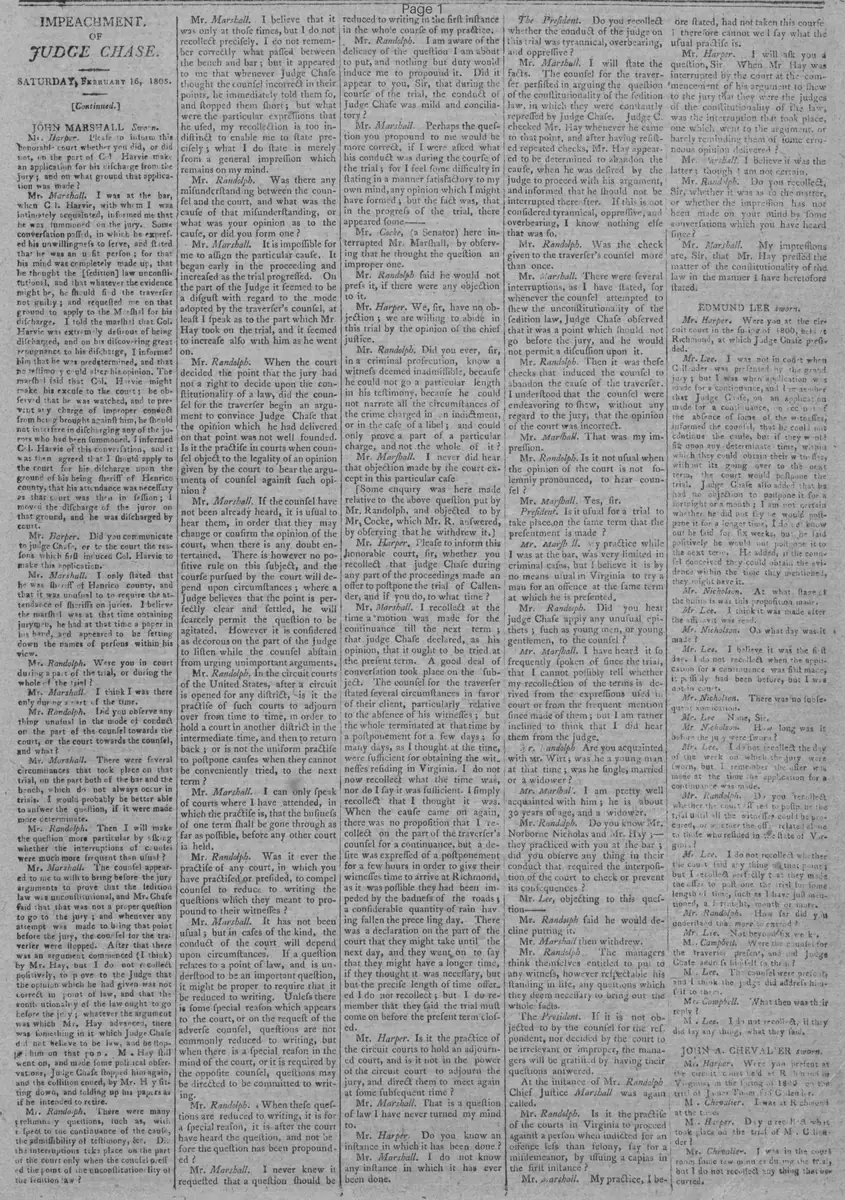
Transcript from the 1805 impeachment trial of Judge Samuel Chase, featuring testimonies by John Marshall, Edmund Lee, John A. Chevalier, Robert Gamble, Philip Gooch, and David Robertson about the 1800 sedition trial of James Callender in Richmond, Virginia. Witnesses describe jury selection, continuances, interruptions of counsel, and Judge Chase's conduct.
Merged-components note: These two components are a continuation of the same impeachment trial transcript across pages 1 and 2, with sequential reading orders and direct text flow ending in '(To be continued.)'.
Clippings
1 of 2
OCR Quality
Full Text
OF
JUDGE CHASE.
SATURDAY FEBRUARY 16, 1805.
[Continued.]
JOHN MARSHALL SWORN.
Mr. Harper. Please to inform this honorable court whether you did, or did not, on the part of Col. Harvie make an application for his discharge from the jury; and on what ground that application was made?
Mr. Marshall. I was at the bar, when Col. Harvie, with whom I was intimately acquainted, informed me that he was summoned on the jury. Some conversation passed, in which he expressed his unwillingness to serve, and stated that he was an unfit person; for that his mind was completely made up, that he thought the sedition law unconstitutional, and that whatever the evidence might be, he should find the traverser not guilty; and requested me on that ground to apply to the Marshal for his discharge. I told the marshal that Col. Harvie was extremely desirous of being discharged, and on his discovering great repugnance to his discharge, I informed him that he was predetermined, and that no testimony could alter his opinion. The marshal said that Col. Harvie might make his excuse to the court; he observed that he was watched, and to prevent any charge of improper conduct from being brought against him, he should not interfere in discharging any of the jurors who had been summoned. Informed Col. Harvie of this conversation, and it was then agreed that I should apply to the court for his discharge upon the ground of his being sheriff of Henrico county, that his attendance was necessary as that court was then in session; I moved the discharge of the juror on that ground, and he was discharged by court.
Mr. Harper. Did you communicate to Judge Chase, or to the court the reasons which first induced Col. Harvie to make this application.
Mr. Marshall. I only stated that he was sheriff of Henrico county, and that it was unusual to require the attendance of sheriffs on juries. I believe the marshal was at that time obtaining jurymen, he had at that time a paper in his hand, and appeared to be setting down the names of persons within his view.
Mr. Randolph. Were you in court during a part of the trial, or during the whole of the trial?
Mr. Marshall. I think I was there only during a part of the time.
Mr. Randolph. Did you observe anything unusual in the mode of conduct on the part of the counsel towards the court, or the court towards the counsel, and what?
Mr. Marshall. There were several circumstances that took place on that trial, on the part both of the bar and the bench, which do not always occur in trials. I would probably be better able to answer the question, if it were made more determinate.
Mr. Randolph. Then I will make the question more particular by asking whether the interruptions of Counsel were much more frequent than usual?
Mr. Marshall. The counsel appeared to me to wish to bring before the jury arguments to prove that the sedition law was unconstitutional, and Mr. Chase said that that was not a proper question to go to the jury; and whenever any attempt was made to bring that point before the jury, the counsel for the traverser were stopped. After that there was an argument commenced (I think) by Mr. Hay, but I do not recollect positively, to prove to the Judge that the opinion which he had given was not correct in point of law, and that the unconstitutionality of the law ought to go before the jury; whatever the argument was which Mr. Hay advanced, there was something in it which Judge Chase did not believe to be law, and he stopped him on that ground. Mr. Hay still went on, and made some political observations, Judge Chase stopped him again, and the collision ended, by Mr. Hay sitting down, and folding up his papers as if he intended to retire.
Mr. Randolph. There were many preliminary questions, such as, with respect to the continuance of the cause, the admissibility of testimony, &c. Did the interruptions take place on the part of the court only when the counsel offered the point of the unconstitutionality of the sedition law?
Mr. Marshall. I believe that it was only at those times, but I do not recollect precisely. I do not remember correctly what passed between the bench and bar; but it appeared to me that whenever Judge Chase thought the counsel incorrect in their points, he immediately told them so, and stopped them short; but what were the particular expressions that he used, my recollection is too indistinct to enable me to state precisely; what I do state is merely from a general impression which remains on my mind.
Mr. Randolph. Was there any misunderstanding between the counsel and the court, and what was the cause of that misunderstanding, or what was your opinion as to the cause, or did you form one?
Mr. Marshall. It is impossible for me to assign the particular cause. It began early in the proceeding and increased as the trial progressed. On the part of the Judge it seemed to be a disgust with regard to the mode adopted by the traverser's counsel, at least I speak as to the part which Mr. Hay took on the trial, and it seemed to increase also with him as he went on.
Mr. Randolph. When the court decided the point that the jury had not a right to decide upon the constitutionality of a law, did the counsel for the traverser begin an argument to convince Judge Chase that the opinion which he had delivered on that point was not well founded.
Is it the practice in courts when counsel object to the legality of an opinion given by the court to hear the arguments of counsel against such opinion?
Mr. Marshall. If the counsel have not been already heard, it is usual to hear them, in order that they may change or confirm the opinion of the court, when there is any doubt entertained. There is however no positive rule on this subject, and the course pursued by the court will depend upon circumstances; where a Judge believes that the point is perfectly clear and settled, he will scarcely permit the question to be agitated. However it is considered as decorous on the part of the judge to listen while the counsel abstain from urging unimportant arguments.
Mr. Randolph. In the circuit courts of the United States, after a circuit is opened for any district, is it the practice of such courts to adjourn over from time to time, in order to hold a court in another district in the intermediate time, and then to return back; or is not the uniform practice to postpone causes when they cannot be conveniently tried, to the next term?
Mr. Marshall. I can only speak of courts where I have attended, in which the practice is, that the business of one term shall be gone through as far as possible, before any other court is held.
Mr. Randolph. Was it ever the practice of any court, in which you have practiced or presided, to compel counsel to reduce to writing the questions which they meant to propound to their witnesses?
Mr. Marshall. It has not been usual; but in cases of the kind, the conduct of the court will depend upon circumstances. If a question relates to a point of law, and is understood to be an important question, it might be proper to require that it be reduced to writing. Unless there is some special reason which appears to the court, or on the request of the adverse counsel, questions are not commonly reduced to writing, but when there is a special reason in the mind of the court, or it is required by the opposite counsel, questions may be directed to be committed to writing.
Mr. Randolph. When these questions are reduced to writing, it is for a special reason, it is after the court have heard the question, and not before the question has been propounded?
Mr. Marshall. I never knew it requested that a question should be reduced to writing in the first instance in the whole course of my practice.
Mr. Randolph. I am aware of the delicacy of the question I am about to put, and nothing but duty would induce me to propound it. Did it appear to you, Sir, that during the course of the trial, the conduct of Judge Chase was mild and conciliatory?
Mr. Marshall. Perhaps the question you propound to me would be more correct, if I were asked what his conduct was during the course of the trial; for I feel some difficulty in stating in a manner satisfactory to my own mind, any opinion which I might have formed; but the fact was, that in the progress of the trial, there appeared some—
Mr. Cocke, (a Senator) here interrupted Mr. Marshall, by observing that he thought the question an improper one.
Mr. Randolph said he would not press it, if there were any objection to it.
Mr. Harper. We, Sir, have no objection; we are willing to abide in this trial by the opinion of the chief justice.
Mr. Randolph. Did you ever, Sir, in a criminal prosecution, know a witness deemed inadmissible, because he could not go a particular length in his testimony, because he could not narrate all the circumstances of the crime charged in an indictment, or in the case of a libel; and could only prove a part of a particular charge, and not the whole of it?
Mr. Marshall. I never did hear that objection made by the court except in this particular case.
[Some enquiry was here made relative to the above question put by Mr. Randolph, and objected to by Mr. Cocke, which Mr. R. answered, by observing that he withdrew it.]
Mr. Harper. Please to inform this honorable court, Sir, whether you recollect that Judge Chase during any part of the proceedings made an offer to postpone the trial of Callender, and if you do, to what time?
Mr. Marshall. I recollect at the time a motion was made for the continuance till the next term; that Judge Chase declared, as his opinion, that it ought to be tried at the present term. A good deal of conversation took place on the subject. The counsel for the traverser stated several circumstances in favor of their client, particularly relative to the absence of his witnesses; but the whole terminated at that time by a postponement for a few days; so many days, as I thought at the time, were sufficient for obtaining the witnesses residing in Virginia. I do not now recollect what the time was, nor do I say it was sufficient. I simply recollect that I thought it was. When the cause came on again, there was no proposition that I recollect on the part of the traverser's counsel for a continuance, but a desire was expressed of a postponement for a few hours in order to give their witnesses time to arrive at Richmond, as it was possible they had been impeded by the badness of the roads; a considerable quantity of rain having fallen the preceding day. There was a declaration on the part of the court that they might take until the next day, and they went on to say that they might have a longer time, if they thought it was necessary, but the precise length of time offered I do not recollect; but I do remember that they said the trial must come on before the present term closed.
Mr. Harper. Is it the practice of the circuit courts to hold an adjourned court, and is it not in the power of the circuit court to adjourn the jury, and direct them to meet again at some subsequent time?
Mr. Marshall. That is a question of law I have never turned my mind to.
Mr. Harper. Do you know an instance in which it has been done?
Mr. Marshall. I do not know any instance in which it has ever been done.
The President. Do you recollect whether the conduct of the judge on this trial was tyrannical, overbearing, and oppressive?
Mr. Marshall. I will state the facts. The counsel for the traverser persisted in arguing the question of the constitutionality of the sedition law, in which they were constantly repressed by Judge Chase. Judge C. checked Mr. Hay whenever he came to that point, and after having resisted repeated checks, Mr. Hay appeared to be determined to abandon the cause, when he was desired by the judge to proceed with his argument, and informed that he should not be interrupted thereafter. If this is not considered tyrannical, oppressive, and overbearing, I know nothing else that was so.
Mr. Randolph. Was the check given to the traverser's counsel more than once.
Mr. Marshall. There were several interruptions, as I have stated, for whenever the counsel attempted to show the unconstitutionality of the sedition law, Judge Chase observed that it was a point which should not go before the jury, and he would not permit a discussion upon it.
Mr. Randolph. Then it was these checks that induced the counsel to abandon the cause of the traverser. I understood that the counsel were endeavoring to show, without any regard to the jury, that the opinion of the court was incorrect.
Mr. Marshall. That was my impression.
Mr. Randolph. Is it not usual when the opinion of the court is not solemnly pronounced, to hear counsel?
Mr. Marshall. Yes, Sir.
President. Is it usual for a trial to take place on the same term that the presentment is made?
Mr. Marshall. My practice while I was at the bar, was very limited in criminal cases, but I believe it is by no means usual in Virginia to try a man for an offence at the same term at which he is presented.
Mr. Randolph. Did you hear Judge Chase apply any unusual epithets; such as young men, or young gentlemen, to the counsel?
Mr. Marshall. I have heard it so frequently spoken of since the trial, that I cannot possibly tell whether my recollection of the terms is derived from the expressions used in court or from the frequent mention since made of them; but I am rather inclined to think that I did hear them from the judge.
Mr. Randolph. Are you acquainted with Mr. Wirt; was he a young man at that time; was he single, married or a widower?
Mr. Marshall. I am pretty well acquainted with him; he is about 30 years of age, and a widower.
Mr. Randolph. Do you know Mr. Norborne Nicholas and Mr. Hay; they practiced with you at the bar; did you observe anything in their conduct that required the interposition of the court to check or prevent its consequences?
Mr. Lee, objecting to this question—
Mr. Randolph said he would decline putting it.
Mr. Marshall then withdrew.
Mr. Randolph. The managers think themselves entitled to put to any witness, however respectable his standing in life, any questions which they deem necessary to bring out the whole facts.
The President. If it is not objected to by the counsel for the respondent, nor decided by the court to be irrelevant or improper, the managers will be gratified by having their questions answered.
At the instance of Mr. Randolph Chief Justice Marshall was again called.
Mr. Randolph. Is it the practice of the courts in Virginia to proceed against a person when indicted for an offence less than felony, say for a misdemeanor, by issuing a capias in the first instance?
Mr. Marshall. My practice, I believe, had not taken this course I therefore cannot well say what the usual practice is.
Mr. Harper. I will ask you a question, Sir. When Mr. Hay was interrupted by the court at the commencement of his argument to show to the jury that they were the judges of the constitutionality of the law; was the interruption that took place one which went to the argument, or barely reminding them of some erroneous opinion delivered?
Mr. Marshall. I believe it was the latter; though I am not certain.
Mr. Randolph. Do you recollect, Sir, whether it was as to the matter, or whether the impression has not been made on your mind by some conversations which you have heard since?
Mr. Marshall. My impressions are, Sir, that Mr. Hay pressed the matter of the constitutionality of the law in the manner I have heretofore stated.
EDMUND LEE SWORN.
Mr. Harper. Were you at the circuit court in the spring of 1800, held at Richmond, at which Judge Chase presided.
Mr. Lee. I was not in court when Callender was presented by the grand jury; but I was when application was made for a continuance, and I remember that Judge Chase, on an application made for a continuance, on account of the absence of some of the witnesses, informed the counsel, that he could not continue the cause, but if they would name any determinate time, within which they could obtain their witnesses, without its going over to the next term, the court would postpone the trial. Judge Chase also added that he had no objection to postpone it for a fortnight or a month: I am not certain whether he did not say he would not postpone it for a longer time, I do not know but he said for six weeks, but he said positively he would not postpone it to the next term. He added, if the counsel conceived that they could obtain the evidence within the time they mentioned, they might have it.
Mr. Nicholson. At what stage of the business was this proposition made.
Mr. Lee. I think it was made after the affidavit was read.
Mr. Nicholson. On what day was it made?
Mr. Lee. I believe it was the first day. I do not recollect when the application for a continuance was first made. It probably had been before, but I was not in court to—
Mr. Nicholson. There was no subsequent application.
Mr. Lee. No, Sir.
Mr. Nicholson. How long was it before the jury were sworn?
Mr. Lee. I do not recollect the day of the week on which the jury were sworn, but I remember the weather was miserable at the time the application for a continuance was made.
Mr. Randolph. Do you recollect whether the court offered to postpone the trial until all the witnesses could be procured, or whether the offer related alone to those who resided in the state of Virginia.?
Mr. Lee. I do not recollect whether the court said anything on that point; but I recollect perfectly that they made the offer to postpone the trial for some length of time, such as I have just mentioned, a fortnight, month or more.
Mr. Randolph. How far did you understand that more to extend?
Mr. Lee. Not beyond six weeks.
Mr. Campbell. Were the counsel for the traverser present, and did Judge Chase address himself to them?
Mr. Lee. The counsel were present and I think the judge did address himself to them.
Mr. Campbell. What then was their reply?
Mr. Lee. I do not recollect, if they did say anything, what they said.
JOHN A. CHEVALIER SWORN,
Mr. Harper. Were you present at the circuit court held at Richmond Virginia in the spring of 1800 at the trial of James Thomas Callender.
Mr. Chevalier. I was at Richmond at the time.
Mr. Harper. Did you recollect what took place on the trial of Mr. Callender?
Mr. Chevalier. I was in the court room one two minutes during the trial but I do not recollect anything that occurred.
Mr. Harper. With what, Sir?
Mr. Chevalier. Because I was too far off to hear any thing which was said, and my mind was otherwise occupied.
Mr. Randolph. Pray how long have you resided in the United States?
Mr. Chevalier. About 20 years.
Mr. Randolph. Have you been much in courts?
Mr. Chevalier. I have had very little to do with court business. I had a suit, and it was on that account that I happened to be in the court.
Mr. Randolph. Do you recollect any thing remarkable in the conduct of the court while you happened to be present?
Mr. Chevalier. Why, Sir, I recollect Mr. Hay's shutting up his books and putting away his papers, and that Judge Chase said to him, when he observed it, Sir, you may go on with your speech as long as you please, and I will not interrupt you any more.
ROBERT GAMBLE Sworn.
Mr. Harper. Were you at the circuit court of the United States for the Virginia district, in the month of May or June 1800, held at Richmond?
Mr. Gamble. I was one of the jurors, Sir, and I was in court when a motion was made for continuing the court of Callender to the next term.
Mr. Harper. Do you recollect whether an offer was made by the court to postpone that cause?
Mr. Gamble. Yes, Sir, Judge Chase said he would postpone it for a week, a fortnight, a month, or more, and I think he mentioned he would postpone it for six weeks, or as long as the term would admit, without its going over to the next term.
Mr. Harper. Do you recollect what Mr. Brent's scruples were against serving on the jury?
Mr. Gamble. I recollect that he stated to the court that he had seen extracts in the newspapers that were alleged to be taken from the book called the Prospect Before Us, and upon that circumstance he had made a declaration that if the extracts were faithfully copied from the work he was satisfied that it would come under the operation of the sedition law. The Judge asked him whether he had made up and delivered an opinion on the articles contained in the indictment, and he answered that he had neither seen the indictment, nor heard it read; he therefore could not declare that he had formed any opinion upon it. The Judge said in that case he was a good juror and must be sworn.
Mr. Harper. What was understood to have been the subject of the indictment?
Mr. Gamble. It was pretty well understood that the indictment was for libellous matter contained in the book called the Prospect Before Us. I did not know it myself, for I was taken that morning to serve as a juror, without any previous intimation. I had not either seen the book or the extracts alleged, but I had heard them spoken of as being within the sedition law; yet I said nothing to the court after having heard Judge Chase declare, that Mr. Brent's objection would not excuse him.
Mr. Harper. Did you understand that Mr. Brent urged it as an objection to serve on the jury?
Mr. Gamble. No, Sir, he merely suggested it to the court.
Mr. Harper. Then he did not ask to be excused on that account?
Mr. Gamble. No, Sir.
Mr. Randolph. You say that Mr. Brent and yourself informed the Court that you had not made up your mind on the charges in the indictment, because you had not read it, and did not know its contents?
Mr. Gamble. I had never read or seen the indictment, of course I had not made up my mind in respect to any thing it contained.
Mr. Randolph. Had you made up your mind on the publication of the book called the Prospect Before Us, from which you believed the charges were extracted?
Mr. Gamble. Sir, I never read the Examiner, but contained those extracts, nor had I then seen the book called the Prospect Before Us, although after the jury retired, in order to determine on our verdict, we were compelled in a degree to read it nearly through.
Mr. Randolph. What induced you to read the book after you retired?
Mr. Gamble. Mr. Ballet wished it to be read. The whole book consisted in defamation of the government.
Mr. Randolph. As that book is a lengthy production, suppose you had read it before instead of after the indictment was read, would it not of happened that you might have made up your mind as to the publication, and in as to the indictment?
An objection having been made to this question by Mr. Martin,
Mr. Randolph said he would withdraw it, but would ask the witness another question. Do you recollect any thing of an offer made to postpone the trial of Callender on the part of the court.
Mr. Gamble. I remember there was a short adjournment of the cause in the first instance, and that an offer was made by the court to postpone the trial for a month, or more.
Mr. Randolph. Do you recollect what that more was?
Mr. Gamble. I do not recollect.
Mr. Nicholson. Was the offer to postpone the cause made before the jury was sworn or after?
Mr. Gamble. I do not recollect at what time it was made.
Mr. Randolph. Did you understand that an objection was to be made against you, Sir, as a juror on this trial?
Mr. Gamble. I had understood that I might be objected to, because I had spoken words disrespectful of Callender.
Mr. Randolph. Was evidence offered to show that you had done so?
Mr. Gamble. I acknowledged it myself, and the Judge said, notwithstanding, I was a good juror.
Mr. Randolph. Did you speak disrespectfully of Callender, and so declare it to the court, and what had you said?
Mr. Gamble. I had said that I thought him to be a very unworthy character.
Mr. Randolph. How did you understand that you were to be objected to?
Mr. Gamble. I had heard that Mr. — had heard me use his expression, and that it was intended to bring him forward as a witness to prove the fact: this was on the morning of the day of the trial, and just before I was sworn.
PHILIP GOOCH sworn.
Mr. Harper. Please to inform this honorable court whether you were present at the trial of James Thomson Callender, at a circuit court holden at Richmond, in the year 1800?
Mr. Gooch. I was in court during a part of the time of that trial, I did not get in until the jury were called and just before they were sworn, I believe I was not present at the whole of the trial.
Mr. Harper. What was the nature of that trial?
Mr. Gooch. I understood it to be an indictment for a libel upon the President, under the sedition law, and I went on purpose from Amherst county, where I reside, to be present at it.
Mr. Harper. What did you observe relative to the conduct of the court and counsel on that day, state what happened.
Mr. Gooch. When Mr. Brent suggested to the Court his wish to be informed whether it was their opinion that he was a proper person to serve on the jury, because he had formed and expressed an opinion on the extracts which he had seen, and declared that if correctly copied from the work called the Prospect Before Us, the author was within the pale of the sedition law. On that suggestion I recollect, the court decided, and laid it down as law, that he must not only have formed an opinion but delivered it all, and the judge gave some reasons why he must not only have formed, but delivered an opinion. I think he said that if a notorious murder was committed in the body of a county, which every man believed ought to be punished with death and had so formed his opinion, it would in that case be impossible to get a jury to try such an offender, if it were an objection, that a man had formed an opinion. I understood that he had consulted judge Griffin on this point. The court was very crowded, but I had obtained a situation just behind the judges, and had an opportunity of hearing in some degree what passed between them, though not distinctly. Mr. Brent was eventually sworn upon the jury. The cause proceeded. Mr. Nelson (the district attorney) then opened the case. I am unable to detail all his observations, nor is it material that I should do so; however, he said that the intention of the traverser was to be understood from the matter which had been extracted from the Prospect Before Us, and laid in the indictment with innuendoes. He examined the witnesses on the part of the prosecution, but I do not recollect that any question was put on the part of the counsel for the traverser in objection to the testimony; but I remember that when col. Taylor was called to give testimony on the part of the traverser, that the court required his counsel to state what they intended to prove by him, and that Judge Chase required the questions to be reduced to writing; after that was done, I remember that he determined that as this testimony did not go to prove the whole of a charge, it should not be received. He turned to Judge Griffin, and asked him if that also was his opinion; Judge Griffin said it was. Judge Chase added afterwards, in a pleasant manner, to the counsel for the traverser, "you know yourselves to be clever young men, and I believe you know that testimony of this kind ought not to be adduced, but perhaps you do it to blind the people and to work up their minds to a state of opposition;" he then turned to the attorney for the district, and said he was pressed by the counsel to admit the testimony of col. Taylor, and that he wished him to give his consent that it should be received. The district attorney told him that he could not; Judge Chase asked him a second time to accede to the reception of the testimony of col. Taylor; the district attorney replied he would not, it being inconsistent with his duty.
Mr. Wirt then opened the cause on the part of the traverser: he made some allusion to the court's prohibiting the mode of defence, which the counsel for the traverser had adopted, but he was interrupted by the court, and was told that the decision of the court must be binding for the present, that if they objected, they might file their bill of error, and it should be allowed.
Mr. Wirt proceeded in the cause, and was endeavoring to show that the sedition law was unconstitutional; the court interrupted him, and told him that what he had to say must be addressed to the court, but if he was going on that point, he must again be informed that the court would not suffer it to be urged. Mr. Wirt appeared to be in some agitation, but continued his argument, and when he came up to that point a second time, he was again interrupted by the court.
Mr. Wirt resumed his argument, and said he was going on. Judge Chase again interrupted him and said "no, sir, you are not going on, I am going on; sit down." I recollect also after the judge had made some observations, Mr. Wirt again proceeded, and having observed that as the jury had a right to consider the law, and as the constitution was law, it followed syllogistically that the jury had a right to decide on the constitutionality of a law. Judge Chase replied to him, a non sequitur, sir, and at the same time made him a bow. Whether these circumstances took place exactly in the order in which I have mentioned them, I am not positive, but I believe they did. Mr. Wirt sat down, and the judge delivered a lengthy opinion. He stated that the counsel must argue the law before the court, and not before the jury, for it was not competent for the jury to decide that point, or that the jury were competent to decide, whether the sedition law embraced this case or not, but that they were not competent to decide whether the sedition law was constitutional or not, and that he would not suffer that point to be argued.
Mr. Harper. What was the effect produced by the reply of judge Chase to Mr. Wirt's syllogism—a non sequitur?
Mr. Gooch. It appeared to me as if it was intended to excite merriment, and if it was so intended, it certainly had that effect, and the same appeared to me to be the motive of the judge in adding the word punctuation after the words, verbatim et literatim. I thought these circumstances were calculated to display his wit. After this, Mr. Hay addressed the court on behalf of Callender, and I recollect, he met with some interruptions in the course of his argument, which ended in his folding up his papers and moving as if he was about to quit the bar. The judge perceiving it, said to him, sir, since you are so captious, you may go on and say what you please, you shall not be again interrupted.
Mr. Harper. When the judge told Mr. Wirt to sit down, did you conceive the conduct of the court to be rude and peremptory, or was there any thing like it in his application of the term "young gentlemen?"
Mr. Gooch. I did not perceive any thing rude or intemperate, in his conduct, unless it can be inferred from the words themselves; when he said, you show yourselves clever young gentlemen, but the law is nevertheless, not as you have stated it.
Mr. Harper. Was this allusion made to a particular point of law, which had been agitated, or was it general?
Mr. Gooch. I do not know, sir, to what point of law it applied.
Mr. Harper. Did judge Chase consult his brother judge Griffin, on the several decisions which were made, and did judge Griffin concur in them all?
Mr. Gooch. I think he privately conversed with judge Griffin on all the points which he decided; I do not mean that he consulted him at every time at which he stopped or interrupted the counsel.
Mr. Harper. Pray, did Judge Chase say to Mr. Wirt, sit down, or please to take your seat, sir?
Mr. Gooch. I think it was 'please to sit down, sir.' I think on that occasion the Judge was proceeding to deliver an opinion of the court, and that Mr. Wirt was standing at the time, and that the judge spoke with a view of letting him have an opportunity of being easy in his seat.
DAVID ROBERTSON Sworn.
Mr. Harper. Did you attend the trial of James Thomson Callender, at the circuit court of the United States, held in Richmond, Virginia, in May or June, 1800?
Mr. Robertson. I attended during a part of the trial, and I took down what occurred in short hand. I have my original notes with me, as well as a printed copy. I must however observe that the printed copy does not exactly correspond with my short hand notes. There are four instances of a variation, which I have discovered by comparing it recently with my notes. If I may be permitted to have recourse to those papers, I can give as faithful a narrative, perhaps a more correct one, than when depending altogether on my own recollection. The notes were taken at the time, for my own amusement, and without any idea of their being made public. However, at the request of some of my friends, they were published, I think in July following.
Mr. Randolph. We have no objection to take the printed statement as evidence on this occasion.
Mr. Robertson then went on to read the printed statement.
[As this statement was published soon after the trial in the newspapers, and was republished by the committee of enquiry of the House of Representatives, its insertion on this occasion has been deemed unnecessary. The variations in the printed statement from the original notes are entirely verbal.]
Mr. Randolph. An observation has been made in your deposition, that Judge Chase consulted with his brother judge (Griffin) in the opinions which he gave as the opinions of the court; did you see him in the act of consultation, or did you hear him?
Mr. Robertson. I was too busily engaged in writing to have leisure for observing the attitudes or motions of the Judges on the bench, but I understood at the time, and my impression is, that they held those mutual consultations.
Mr. Randolph. I believe in this printed deposition, that Judge Chase always speaks in the first person singular, was that his manner of expressing himself?
Mr. Robertson. He spoke in that manner on all those occasions on which I cited him.
Mr. Randolph. How long, Sir, have you been in the practice of the law in Virginia?
Mr. Robertson. I have been a practitioner of the law for 17 or 18 years in Virginia. I have been a practitioner on the part of the public for several years. I am now a practitioner in two districts, having criminal jurisdiction, as public prosecutor. I have been twelve years employed in the one, and ever since the year 1788 employed in the other.
Mr. Randolph. What is the mode of proceeding in criminal cases less than capital; I mean less than felonies, such as misdemeanors, assaults and batteries,
Mr. Robertson. I will explain, Sir. Misdemeanors, (short of felony) such as assaults and batteries, are the only offences in which it is the practice to issue a summons, and upon the return of the summons, if the party does not appear, a capias is directed to be issued by the court; but I never knew, in offences of that nature, that a capias was ever issued in the first instance. When I say, I do not recollect a capias to have issued in the first instance, I mean to be understood as saying, that I never knew it to be issued, although there are two cases within my knowledge in which offenders, for crime less than felony, were indicted and tried at the same term. The one was a conspiracy to poison, and the person was bound, under recognizance, to attend at the court which was then sitting. Bail was given in a considerable sum, the trial came on shortly after, and a sentence of fine and three years imprisonment was pronounced. The other was a conspiracy to set fire to the town of Petersburg. It was examined in the County court, and sent to the court above, the district court. There they obtained a new indictment against the prisoner, and upon that indictment, which was tried at the same term, the person was found guilty, and sentenced also to fine and imprisonment. It was from the heinousness of these offences, I think, that bail was required,
Mr. Randolph. Then in cases of misdemeanor, not so heinous as to poison a person, or to burn a town, I understand it is your practice, under the laws of Virginia, to issue a summons?
Mr. Robertson. Yes, Sir.
Mr. Randolph. Well, Sir, at what time is your summons made returnable?
Mr. Robertson. Always to the next term.
Mr. Randolph. Does the trial take place at the next term, Sir?
Mr. Robertson. If the party appears he pleads, and the trial goes off until the next term; if he does not appear, a capias may be awarded, and he is brought in to answer at the next term.
Mr. Randolph. Did you ever know a capias to issue in the first instance for a misdemeanor, and the party ruled to trial at the first court at which he was prosecuted?
Mr. Robertson. No, sir, not in cases of that sort which I have described.
Mr. Randolph. Did you ever ask a man to be ruled to trial for a misdemeanor at the first term?
Mr. Robertson. I never did, sir, if I understand your question.
Mr. Randolph. Did you ever hear of an offer made by the court to postpone the trial of Callender?
Mr. Robertson. I have heard of it out of doors, but I have stated that I was not present the first day, it was only the two last days that I was there.
In an interrogatory,
Mr. Robertson answered. In those cases of misdemeanor to which I have alluded, the punishment is in fine and not imprisonment.
The President. When the party comes in on a summons, and the trial does not proceed, is bail required for his further appearance?
Mr. Robertson. I never knew an instance unless it was in a flagitious case. In one of those which I have mentioned, the party was imprisoned, and it was considered as a favor to him, to bring on the trial in order to avoid the imprisonment which must have taken place till the next term. It was however considered within the power of the court either to postpone the cause or to bring it on, but I felt it a duty on my part, as public prosecutor, to urge it forward; but I have always thought it in the power of the court, in cases of high misdemeanor or flagitious offences, that the party might not escape the punishment of the law upon conviction, to issue a capias and require bail.
Mr. Randolph. The 83d chapter of the revised code of Virginia has this clause respecting the mode of proceeding upon presentment. (Mr. R. here read the passage.)
Mr. Robertson. That is a law on this point: but there is another respecting proceedings upon information, which I will turn to if indulged with the volume—The book being handed to him—After some time he discovered and read some passages from the 24th, 25th, 26th and 28th sections, page 305, directing the mode of proceeding on informations.
Mr. Campbell. In the two cases which you have mentioned in respect to arson and poisoning, was there an application made for the continuance of either of them?
Mr. Robertson. I do not recollect that there was; I believe there was not.
Mr. Nicholson. Were they proceeded against by indictment or information?
Mr. Robertson. One by information, the other upon indictment. In one case it was impossible to obtain an acquittal, because the facts and the law came up to a conviction, and that notorously; but in both cases, if they had been continued, the imprisonment would have been for six months longer, the period of the court being half yearly. As the accused could not procure bail, they would have been confined for six months longer than the period for which they were condemned.
Mr. Hopkinson. Then if I understand you right, sir, you would have kept those persons in prison, till next term, if they could not furnish bail?
Mr. Robertson. Yes, sir.
(To be continued.)
What sub-type of article is it?
What themes does it cover?
What keywords are associated?
What entities or persons were involved?
Where did it happen?
Story Details
Key Persons
Location
Richmond, Virginia
Event Date
1805 02 16
Story Details
Witnesses testify in Judge Chase's impeachment trial about his handling of the 1800 sedition trial of James Callender, including jury discharges, interruptions of defense counsel on constitutionality arguments, refusals of continuances beyond the term, requirements for written questions, and perceived overbearing conduct.