Thank you for visiting SNEWPapers!
Sign up free
Literary
December 28, 1933
Atlanta Daily World
Atlanta, Fulton County, Georgia
What is this article about?
In Chapter 71 of 'Knave's Girl,' Patricia Warren navigates her secret love for polo player Clark Tracy while partnering with bridge expert Julian Haverholt, who poses as her uncle. After winning a tournament, Haverholt attempts to kiss her, leading to tension. At Belmont Park races, Patricia meets Clark's fiancée Marthe March, who nearly recognizes her from a past bridge game.
Clipping
OCR Quality
75%
Good
Full Text
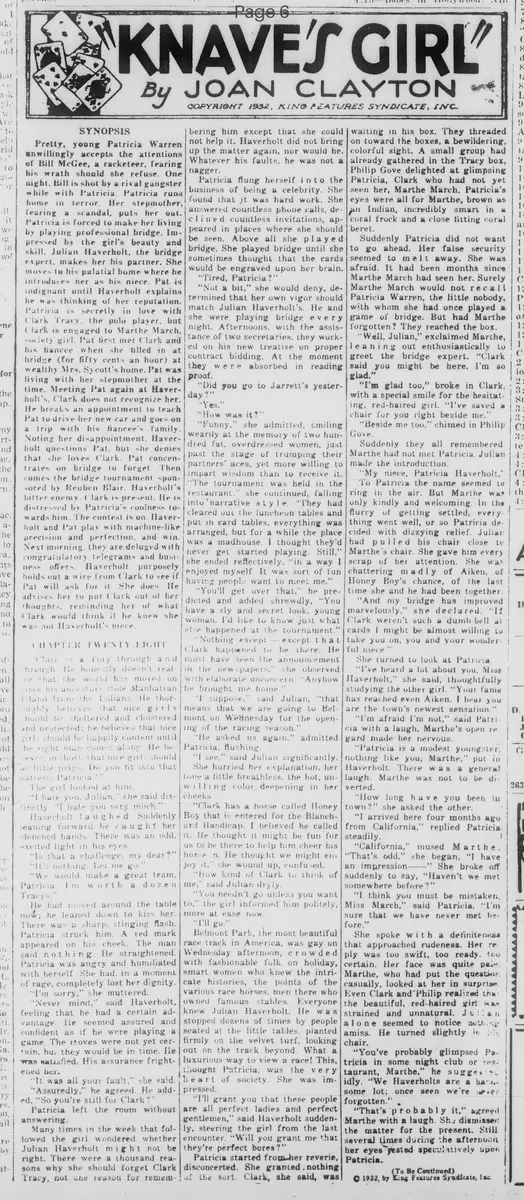
KNAVES GIRL"
By JOAN CLAYTON
COPYRIGHT 1932. KING FEATURES SYNDICATE, INC
Pretty, young Patricia Warren unwillingly accepts the attentions of Bill McGee, a racketeer, fearing his wrath should she refuse. One night, Bill is shot by a rival gangster while with Patricia. Patricia runs home in terror. Her stepmother, fearing a scandal, puts her out.
Patricia is forced to make her living by playing professional bridge. Impressed by the girl's beauty and skill, Julian Haverholt, the bridge expert, makes her his partner. She moves to his palatial home where he introduces her as his niece. Pat is indignant until Haverholt explains he was thinking of her reputation.
Patricia is secretly in love with Clark Tracy, the polo player, but Clark is engaged to Marthe March, society girl. Pat first met Clark and his fiancée when she filled in at bridge (for fifty cents an hour) at wealthy Mrs. Scott's home. Pat was living with her stepmother at the time. Meeting Pat again at Haverholt's, Clark does not recognize her. He breaks an appointment to teach Pat to drive her new car and goes on a trip with his fiancée's family.
Noting her disappointment, Haverholt questions Pat, but she denies that she loves Clark. Pat concentrates on bridge to forget. Then comes the bridge tournament sponsored by Reuben Blair, Haverholt's bitter enemy. Clark is present. He is distressed by Patricia's coolness towards him. The contest is on. Haverholt and Pat play with machine-like precision and perfection, and win.
Next morning, they are deluged with congratulatory telegrams and business offers. Haverholt purposely holds out a wire from Clark to see if Pat will ask for it. She does. He advises her to put Clark out of her thought, reminding her of what Clark would think if he knew she was not Haverholt's niece.
CHAPTER SEVENTY-ONE
Julian Haverholt was a holy terror through and through. He honestly doesn't realize that the world has moved on since his ancestor stole Manhattan Island from the Indians. He thoroughly believes that nice girls should be sheltered and cloistered and protected, he believes that nice girls should be happily content until the right man comes along. He believes, in short, that nice girls should stick to their knitting. Do you fit into that pattern, Patricia?
The girl looked at him.
"I hate you, Julian," she said distinctly. "I hate you very much."
Haverholt laughed. Suddenly leaning forward he caught her clenched hands. There was an odd, excited light in his eyes.
"Is that a challenge, my dear?"
"It's nothing. Let me go."
"We would make a great team, Patricia. I'm worth a dozen Tracys."
He had moved around the table now, he leaned down to kiss her.
There was a sharp, stinging flash. Patricia struck him. A red mark appeared on his cheek. The man said nothing. He straightened.
Patricia was angry and humiliated with herself. She had, in a moment of rage, completely lost her dignity.
"I'm sorry," she muttered.
"Never mind," said Haverholt, feeling that he had a certain advantage. He seemed assured and confident as if he were playing a game. The moves were not yet certain, but they would be in time. He was satisfied. His assurance frightened her.
"It was all your fault," she said.
"Assuredly," he agreed. He added, "So you're still for Clark?"
Patricia left the room without answering.
Many times in the week that followed the girl wondered whether Julian Haverholt might not be right. There were a thousand reasons why she should forget Clark Tracy, not one reason for remembering him except that she could not help it. Haverholt did not bring up the matter again, nor would he. Whatever his faults, he was not a nagger.
Patricia flung herself into the business of being a celebrity. She found that it was hard work. She answered countless phone calls, declined countless invitations, appeared in places where she should be seen. Above all she played bridge. She played bridge until she sometimes thought that the cards would be engraved upon her brain.
"Tired, Patricia?"
"Not a bit," she would deny, determined that her own vigor should match Julian Haverholt's. He and she were playing bridge every night. Afternoons, with the assistance of two secretaries, they worked on his new treatise on proper contract bidding. At the moment they were absorbed in reading proof.
"Did you go to Jarrett's yesterday?"
"Yes."
"How was it?"
"Funny," she admitted, smiling wearily at the memory of two hundred fat, overdressed women, just past the stage of trumping their partners' aces, yet more willing to impart wisdom than to receive it.
"The tournament was held in the restaurant," she continued, falling into narrative style. "They had cleared out the luncheon tables and put in card tables, everything was arranged, but for a while the place was a madhouse. I thought they'd never get started playing. Still," she ended reflectively, "in a way I enjoyed myself. It was sort of fun having people want to meet me."
"You'll get over that," he predicted and added shrewdly, "You have a sly and secret look, young woman. I'd like to know just what else happened at the tournament."
"Nothing except - except that Clark happened to be there. He must have seen the announcement in the newspapers," she observed with elaborate unconcern. "Anyhow he brought me home."
"I suppose," said Julian, "that means that we are going to Belmont on Wednesday for the opening of the racing season."
"He asked us again," admitted Patricia, flushing.
"I see," said Julian significantly.
She hurried her explanation, her tone a little breathless, the hot, unwilling color deepening in her cheeks.
"Clark has a horse called Honey Boy that is entered for the Blanchard Handicap. I believe he called it. He thought it might be fun for us to be there to help him cheer his horse on. He thought we might enjoy it," she wound up, confused.
"How kind of Clark to think of me," said Julian dryly.
"You needn't go unless you want to," the girl informed him politely, more at ease now.
"I'll go."
Belmont Park, the most beautiful race track in America, was gay on Wednesday afternoon, crowded with fashionable folk on holiday, smart women who knew the intricate histories, the points of the various race horses, men there who owned famous stables. Everyone knew Julian Haverholt. He was stopped dozens of times by people seated at the little tables, planted firmly on the velvet turf, looking out on the track beyond. What a luxurious way to view a race! This, thought Patricia, was the very heart of society. She was impressed.
"I'll grant you that these people are all perfect ladies and perfect gentlemen," said Haverholt suddenly, steering the girl from the last encounter. "Will you grant me that they're perfect bores?"
Patricia started from her reverie, disconcerted. She granted nothing of the sort. Clark, she said, was waiting in his box. They threaded on toward the boxes, a bewildering colorful sight. A small group had already gathered in the Tracy box. Philip Gove delighted at glimpsing Patricia. Clark who had not yet seen her. Marthe March. Patricia's eyes were all for Marthe, brown as an Indian, incredibly smart in a coral frock and a close fitting coral beret.
Suddenly Patricia did not want to go ahead. Her false security seemed to melt away. She was afraid. It had been months since Marthe March had seen her. Surely Marthe March would not recall Patricia Warren, the little nobody, with whom she had once played a game of bridge. But had Marthe forgotten? They reached the box.
"Well, Julian," exclaimed Marthe, leaning out enthusiastically to greet the bridge expert. "Clark said you might be here. I'm so glad."
"I'm glad too," broke in Clark, with a special smile for the hesitating, red-haired girl. "I've saved a chair for you right beside me."
"Beside me too," chimed in Philip Gove.
Suddenly they all remembered Marthe had not met Patricia. Julian made the introduction.
"My niece, Patricia Haverholt."
To Patricia the name seemed to ring in the air. But Marthe was only kindly and welcoming. In the flurry of getting settled, everything went well, or so Patricia decided with dizzying relief. Julian had pulled his chair close to Marthe's chair. She gave him every scrap of her attention. She was chattering madly of Aiken, of Honey Boy's chance, of the last time she and he had been together.
"And my bridge has improved marvelously," she declared. "If Clark weren't such a dumbbell at cards I might be almost willing to take you on, you and your wonderful niece."
She turned to look at Patricia.
"I've heard a lot about you, Miss Haverholt," she said, thoughtfully studying the other girl. "Your fame has reached even Aiken. I hear you are the town's newest sensation."
"I'm afraid I'm not," said Patricia with a laugh. Marthe's open regard made her nervous.
"Patricia is a modest youngster, nothing like you, Marthe," put in Haverholt. There was a general laugh. Marthe was not to be diverted.
"How long have you been in town?" she asked the other.
"I arrived here four months ago from California," replied Patricia steadily.
"California," mused Marthe.
"That's odd," she began. "I have an impression-" She broke off suddenly to say, "Haven't we met somewhere before?"
"I think you must be mistaken, Miss March," said Patricia. "I'm sure that we have never met before."
She spoke with a definiteness that approached rudeness. Her reply was too swift, too ready, too certain. Her face was quite pale.
Marthe, who had put the question casually, looked at her in surprise. Even Clark and Philip realized that the beautiful, red-haired girl was strained and unnatural. Julian alone seemed to notice nothing amiss. He turned slightly in his chair.
"You've probably glimpsed Patricia in some night club or restaurant, Marthe," he suggested idly. "We Haverholts are a handsome lot; once seen we're never forgotten."
"That's probably it," agreed Marthe with a laugh. She dismissed the matter for the present. Still several times during the afternoon her eyes rested speculatively upon Patricia.
(To Be Continued)
C 1932, by King Features Syndicate, Inc.
By JOAN CLAYTON
COPYRIGHT 1932. KING FEATURES SYNDICATE, INC
Pretty, young Patricia Warren unwillingly accepts the attentions of Bill McGee, a racketeer, fearing his wrath should she refuse. One night, Bill is shot by a rival gangster while with Patricia. Patricia runs home in terror. Her stepmother, fearing a scandal, puts her out.
Patricia is forced to make her living by playing professional bridge. Impressed by the girl's beauty and skill, Julian Haverholt, the bridge expert, makes her his partner. She moves to his palatial home where he introduces her as his niece. Pat is indignant until Haverholt explains he was thinking of her reputation.
Patricia is secretly in love with Clark Tracy, the polo player, but Clark is engaged to Marthe March, society girl. Pat first met Clark and his fiancée when she filled in at bridge (for fifty cents an hour) at wealthy Mrs. Scott's home. Pat was living with her stepmother at the time. Meeting Pat again at Haverholt's, Clark does not recognize her. He breaks an appointment to teach Pat to drive her new car and goes on a trip with his fiancée's family.
Noting her disappointment, Haverholt questions Pat, but she denies that she loves Clark. Pat concentrates on bridge to forget. Then comes the bridge tournament sponsored by Reuben Blair, Haverholt's bitter enemy. Clark is present. He is distressed by Patricia's coolness towards him. The contest is on. Haverholt and Pat play with machine-like precision and perfection, and win.
Next morning, they are deluged with congratulatory telegrams and business offers. Haverholt purposely holds out a wire from Clark to see if Pat will ask for it. She does. He advises her to put Clark out of her thought, reminding her of what Clark would think if he knew she was not Haverholt's niece.
CHAPTER SEVENTY-ONE
Julian Haverholt was a holy terror through and through. He honestly doesn't realize that the world has moved on since his ancestor stole Manhattan Island from the Indians. He thoroughly believes that nice girls should be sheltered and cloistered and protected, he believes that nice girls should be happily content until the right man comes along. He believes, in short, that nice girls should stick to their knitting. Do you fit into that pattern, Patricia?
The girl looked at him.
"I hate you, Julian," she said distinctly. "I hate you very much."
Haverholt laughed. Suddenly leaning forward he caught her clenched hands. There was an odd, excited light in his eyes.
"Is that a challenge, my dear?"
"It's nothing. Let me go."
"We would make a great team, Patricia. I'm worth a dozen Tracys."
He had moved around the table now, he leaned down to kiss her.
There was a sharp, stinging flash. Patricia struck him. A red mark appeared on his cheek. The man said nothing. He straightened.
Patricia was angry and humiliated with herself. She had, in a moment of rage, completely lost her dignity.
"I'm sorry," she muttered.
"Never mind," said Haverholt, feeling that he had a certain advantage. He seemed assured and confident as if he were playing a game. The moves were not yet certain, but they would be in time. He was satisfied. His assurance frightened her.
"It was all your fault," she said.
"Assuredly," he agreed. He added, "So you're still for Clark?"
Patricia left the room without answering.
Many times in the week that followed the girl wondered whether Julian Haverholt might not be right. There were a thousand reasons why she should forget Clark Tracy, not one reason for remembering him except that she could not help it. Haverholt did not bring up the matter again, nor would he. Whatever his faults, he was not a nagger.
Patricia flung herself into the business of being a celebrity. She found that it was hard work. She answered countless phone calls, declined countless invitations, appeared in places where she should be seen. Above all she played bridge. She played bridge until she sometimes thought that the cards would be engraved upon her brain.
"Tired, Patricia?"
"Not a bit," she would deny, determined that her own vigor should match Julian Haverholt's. He and she were playing bridge every night. Afternoons, with the assistance of two secretaries, they worked on his new treatise on proper contract bidding. At the moment they were absorbed in reading proof.
"Did you go to Jarrett's yesterday?"
"Yes."
"How was it?"
"Funny," she admitted, smiling wearily at the memory of two hundred fat, overdressed women, just past the stage of trumping their partners' aces, yet more willing to impart wisdom than to receive it.
"The tournament was held in the restaurant," she continued, falling into narrative style. "They had cleared out the luncheon tables and put in card tables, everything was arranged, but for a while the place was a madhouse. I thought they'd never get started playing. Still," she ended reflectively, "in a way I enjoyed myself. It was sort of fun having people want to meet me."
"You'll get over that," he predicted and added shrewdly, "You have a sly and secret look, young woman. I'd like to know just what else happened at the tournament."
"Nothing except - except that Clark happened to be there. He must have seen the announcement in the newspapers," she observed with elaborate unconcern. "Anyhow he brought me home."
"I suppose," said Julian, "that means that we are going to Belmont on Wednesday for the opening of the racing season."
"He asked us again," admitted Patricia, flushing.
"I see," said Julian significantly.
She hurried her explanation, her tone a little breathless, the hot, unwilling color deepening in her cheeks.
"Clark has a horse called Honey Boy that is entered for the Blanchard Handicap. I believe he called it. He thought it might be fun for us to be there to help him cheer his horse on. He thought we might enjoy it," she wound up, confused.
"How kind of Clark to think of me," said Julian dryly.
"You needn't go unless you want to," the girl informed him politely, more at ease now.
"I'll go."
Belmont Park, the most beautiful race track in America, was gay on Wednesday afternoon, crowded with fashionable folk on holiday, smart women who knew the intricate histories, the points of the various race horses, men there who owned famous stables. Everyone knew Julian Haverholt. He was stopped dozens of times by people seated at the little tables, planted firmly on the velvet turf, looking out on the track beyond. What a luxurious way to view a race! This, thought Patricia, was the very heart of society. She was impressed.
"I'll grant you that these people are all perfect ladies and perfect gentlemen," said Haverholt suddenly, steering the girl from the last encounter. "Will you grant me that they're perfect bores?"
Patricia started from her reverie, disconcerted. She granted nothing of the sort. Clark, she said, was waiting in his box. They threaded on toward the boxes, a bewildering colorful sight. A small group had already gathered in the Tracy box. Philip Gove delighted at glimpsing Patricia. Clark who had not yet seen her. Marthe March. Patricia's eyes were all for Marthe, brown as an Indian, incredibly smart in a coral frock and a close fitting coral beret.
Suddenly Patricia did not want to go ahead. Her false security seemed to melt away. She was afraid. It had been months since Marthe March had seen her. Surely Marthe March would not recall Patricia Warren, the little nobody, with whom she had once played a game of bridge. But had Marthe forgotten? They reached the box.
"Well, Julian," exclaimed Marthe, leaning out enthusiastically to greet the bridge expert. "Clark said you might be here. I'm so glad."
"I'm glad too," broke in Clark, with a special smile for the hesitating, red-haired girl. "I've saved a chair for you right beside me."
"Beside me too," chimed in Philip Gove.
Suddenly they all remembered Marthe had not met Patricia. Julian made the introduction.
"My niece, Patricia Haverholt."
To Patricia the name seemed to ring in the air. But Marthe was only kindly and welcoming. In the flurry of getting settled, everything went well, or so Patricia decided with dizzying relief. Julian had pulled his chair close to Marthe's chair. She gave him every scrap of her attention. She was chattering madly of Aiken, of Honey Boy's chance, of the last time she and he had been together.
"And my bridge has improved marvelously," she declared. "If Clark weren't such a dumbbell at cards I might be almost willing to take you on, you and your wonderful niece."
She turned to look at Patricia.
"I've heard a lot about you, Miss Haverholt," she said, thoughtfully studying the other girl. "Your fame has reached even Aiken. I hear you are the town's newest sensation."
"I'm afraid I'm not," said Patricia with a laugh. Marthe's open regard made her nervous.
"Patricia is a modest youngster, nothing like you, Marthe," put in Haverholt. There was a general laugh. Marthe was not to be diverted.
"How long have you been in town?" she asked the other.
"I arrived here four months ago from California," replied Patricia steadily.
"California," mused Marthe.
"That's odd," she began. "I have an impression-" She broke off suddenly to say, "Haven't we met somewhere before?"
"I think you must be mistaken, Miss March," said Patricia. "I'm sure that we have never met before."
She spoke with a definiteness that approached rudeness. Her reply was too swift, too ready, too certain. Her face was quite pale.
Marthe, who had put the question casually, looked at her in surprise. Even Clark and Philip realized that the beautiful, red-haired girl was strained and unnatural. Julian alone seemed to notice nothing amiss. He turned slightly in his chair.
"You've probably glimpsed Patricia in some night club or restaurant, Marthe," he suggested idly. "We Haverholts are a handsome lot; once seen we're never forgotten."
"That's probably it," agreed Marthe with a laugh. She dismissed the matter for the present. Still several times during the afternoon her eyes rested speculatively upon Patricia.
(To Be Continued)
C 1932, by King Features Syndicate, Inc.
What sub-type of article is it?
Prose Fiction
What themes does it cover?
Love Romance
Social Manners
What keywords are associated?
Romance
Bridge Tournament
High Society
Jealousy
Racing Season
Secret Identity
What entities or persons were involved?
By Joan Clayton
Literary Details
Title
Chapter Seventy One
Author
By Joan Clayton
Key Lines
"I Hate You, Julian," She Said Distinctly. "I Hate You Very Much."
"We Would Make A Great Team, Patricia. I'm Worth A Dozen Tracys."
"Haven't We Met Somewhere Before?"
"I Think You Must Be Mistaken, Miss March," Said Patricia. "I'm Sure That We Have Never Met Before."