Thank you for visiting SNEWPapers!
Sign up free
Letter to Editor
May 31, 1803
Kentucky Gazette And General Advertiser
Lexington, Fayette County, Kentucky
What is this article about?
A letter to Mr. Bradford mocks and refutes a Federalist writer's alarmist claims from New Orleans about French troops invading Louisiana and the Western states, dismissing it as absurd propaganda. It defends French policy toward the US, praises the Jefferson administration, and criticizes Eastern Federalist tactics.
Clipping
OCR Quality
98%
Excellent
Full Text
MR. BRADFORD,
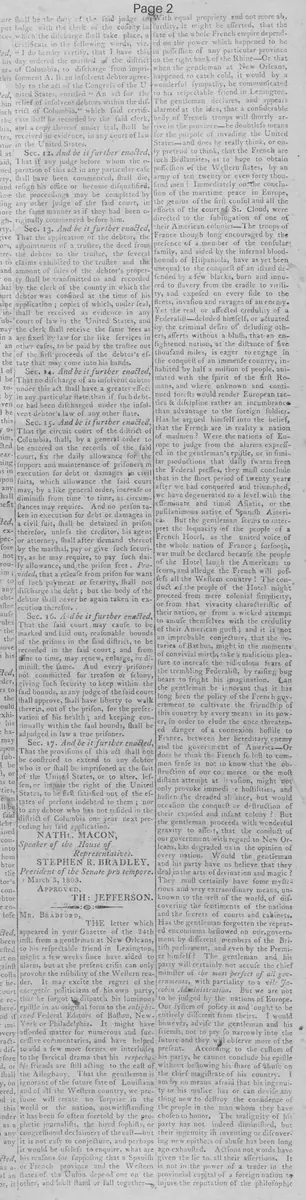
THE letter which appeared in your Gazette of the 24th inst. from a gentleman at New Orleans, to his respectable friend in Lexington, might a few weeks since have aided to alarm, but at the present crisis can only provoke the risibility of the Western reader. It may excite the regret of the energetic politicians of his own party, that he forgot to dispatch his luminous epistle in an original form to the enlightened Federal Editors of Boston, New-York or Philadelphia. It might have afforded matter for numerous and successive commentaries, and have helped to add a few more scenes or interludes to the farcical drama that his respectable friends are still acting to the east of the Alleghany. That the gentleman is ignorant of the future fate of Louisiana and of all the Western country, we presume will create no surprise in the world or the nation, notwithstanding it has been so often foretold by the prophetic journalists, the hired sophists, or congressional declaimers of the east—but it is not easy to conjecture, and perhaps it would be useless to enquire, what are his reasons for supposing that a Spanish or French province and the Western states of the Union depend one on the other, and must stand or fall together—
With equal propriety and not more absurdity, it might be asserted, that the fate of the whole French empire depended on the power which happened to be in possession of any particular province on the right bank of the Rhine—Or that when the gentleman at New Orleans, happened to catch cold, it would by a wonderful sympathy, be communicated to his respectable friend in Lexington.
The gentleman declares, and appears alarmed at the idea, that a considerable body of French troops will shortly arrive in the province—he doubtless means for the purpose of invading the United States—and does he really think, or only pretend to think, that the French are such Bedlamites, as to hope to obtain possession of the Western states, by an army of ten twenty or even forty thousand men? Immediately on the conclusion of the maritime peace in Europe, the genius of the first consul and all the efforts of the court of St. Cloud, were directed to the subjugation of one of their American colonies—The troops of France though long encouraged by the presence of a member of the consular family, and aided by the infernal blood-hounds of Hispaniola, have as yet been unequal to the conquest of an island defended by a few blacks, born and inured to slavery from the cradle to virility, and exposed on every side to the fleets, invasion and ravages of an enemy.
Yet the real or affected credulity of a Federalist—deluded himself, or actuated by the criminal desire of deluding others, asserts without a blush, that—an enlightened nation, at the distance of five thousand miles, is eager to engage in the conquest of an immense country, inhabited by half a million of people, animated with the spirit of the first Romans, and where unknown and continued forests would render European tactics & discipline rather an incumbrance than advantage to the foreign soldier.
Has he argued himself into the belief, that the French are in reality a nation of madmen? Were the nations of Europe to judge from the alarms expressed in the gentleman's epistle, or in similar productions that daily swarm from the Federal presses, they must conclude that in the short period of twenty years after we had conquered and triumphed, we have degenerated to a level with the effeminate and timid Asiatic, or the pusillanimous native of Spanish America. But the gentleman seems to interpret the loquacity of the people of a French Hotel, as the united voice of the whole nation of France; forsooth, war must be declared because the people of the Hotel laugh the Americans to scorn, and allege the French will possess all the Western country! The conduct of the people of the Hotel might proceed from mere colonial simplicity, or from that vivacity characteristic of their nation, or from a wicked attempt to amuse themselves with the credulity of their American guest; and it is not an improbable conjecture, that the votaries of Bacchus, might in the moments of convivial mirth, take a malicious pleasure to increase the ridiculous fears of the trembling Federalist, by raising bug bears to fright his imagination.
Can the gentleman be ignorant that it has long been the policy of the French government to cultivate the friendship of this country by every means in its power, in order to elude the once threatened danger of a connexion hostile to France, between her hereditary enemy and the government of America—Or does he think the French so lost to common sense as not to know that the obstruction of our commerce or the most distant attempt at invasion, might not only provoke immediate hostilities, and hasten the dreaded alliance, but would occasion the conquest or destruction of their exposed and infant colony? But the gentleman proceeds with wonderful gravity to assert, that the conduct of our government with regard to New Orleans, has degraded us in the opinion of every nation. Would the gentleman and his party have us believe that they deal in the arts of divination and magic? They must certainly have some mysterious and very extraordinary means, unknown to the rest of the world, of discovering the sentiments of the nations and the secrets of courts and cabinets.
Has the gentleman forgotten the repeated encomiums bestowed on our government by different members of the British parliament, and even by the Premier himself? The gentleman and his party will certainly not accuse the chief minister of the most perfect of all governments, with partiality to a vile Jacobin Administration. But we are not to be judged by the nations of Europe. Our system of policy is and ought to be entirely different from theirs. I would however, advise the gentleman and his friends, not to pry so narrowly into the future and they will observe more of the present. According to the custom of his party, he cannot conclude his epistle without bestowing his share of abuse on the chief magistrate of his country. I am by no means afraid that his ingenuity or his malice has or can devise any thing new to destroy the confidence of the people in the man whom they have chosen to honor. The malignity of his party has not indeed diminished, but their ingenuity in inventing or discovering new epithets of abuse has been long ago exhausted. Actions not words have given the lie to all their assertions. It is not in the power of a trader in the provincial capital of a foreign nation to injure the reputation of the philosophic statesman, who guides with so much wisdom and prudence, the helm of government.
THE letter which appeared in your Gazette of the 24th inst. from a gentleman at New Orleans, to his respectable friend in Lexington, might a few weeks since have aided to alarm, but at the present crisis can only provoke the risibility of the Western reader. It may excite the regret of the energetic politicians of his own party, that he forgot to dispatch his luminous epistle in an original form to the enlightened Federal Editors of Boston, New-York or Philadelphia. It might have afforded matter for numerous and successive commentaries, and have helped to add a few more scenes or interludes to the farcical drama that his respectable friends are still acting to the east of the Alleghany. That the gentleman is ignorant of the future fate of Louisiana and of all the Western country, we presume will create no surprise in the world or the nation, notwithstanding it has been so often foretold by the prophetic journalists, the hired sophists, or congressional declaimers of the east—but it is not easy to conjecture, and perhaps it would be useless to enquire, what are his reasons for supposing that a Spanish or French province and the Western states of the Union depend one on the other, and must stand or fall together—
With equal propriety and not more absurdity, it might be asserted, that the fate of the whole French empire depended on the power which happened to be in possession of any particular province on the right bank of the Rhine—Or that when the gentleman at New Orleans, happened to catch cold, it would by a wonderful sympathy, be communicated to his respectable friend in Lexington.
The gentleman declares, and appears alarmed at the idea, that a considerable body of French troops will shortly arrive in the province—he doubtless means for the purpose of invading the United States—and does he really think, or only pretend to think, that the French are such Bedlamites, as to hope to obtain possession of the Western states, by an army of ten twenty or even forty thousand men? Immediately on the conclusion of the maritime peace in Europe, the genius of the first consul and all the efforts of the court of St. Cloud, were directed to the subjugation of one of their American colonies—The troops of France though long encouraged by the presence of a member of the consular family, and aided by the infernal blood-hounds of Hispaniola, have as yet been unequal to the conquest of an island defended by a few blacks, born and inured to slavery from the cradle to virility, and exposed on every side to the fleets, invasion and ravages of an enemy.
Yet the real or affected credulity of a Federalist—deluded himself, or actuated by the criminal desire of deluding others, asserts without a blush, that—an enlightened nation, at the distance of five thousand miles, is eager to engage in the conquest of an immense country, inhabited by half a million of people, animated with the spirit of the first Romans, and where unknown and continued forests would render European tactics & discipline rather an incumbrance than advantage to the foreign soldier.
Has he argued himself into the belief, that the French are in reality a nation of madmen? Were the nations of Europe to judge from the alarms expressed in the gentleman's epistle, or in similar productions that daily swarm from the Federal presses, they must conclude that in the short period of twenty years after we had conquered and triumphed, we have degenerated to a level with the effeminate and timid Asiatic, or the pusillanimous native of Spanish America. But the gentleman seems to interpret the loquacity of the people of a French Hotel, as the united voice of the whole nation of France; forsooth, war must be declared because the people of the Hotel laugh the Americans to scorn, and allege the French will possess all the Western country! The conduct of the people of the Hotel might proceed from mere colonial simplicity, or from that vivacity characteristic of their nation, or from a wicked attempt to amuse themselves with the credulity of their American guest; and it is not an improbable conjecture, that the votaries of Bacchus, might in the moments of convivial mirth, take a malicious pleasure to increase the ridiculous fears of the trembling Federalist, by raising bug bears to fright his imagination.
Can the gentleman be ignorant that it has long been the policy of the French government to cultivate the friendship of this country by every means in its power, in order to elude the once threatened danger of a connexion hostile to France, between her hereditary enemy and the government of America—Or does he think the French so lost to common sense as not to know that the obstruction of our commerce or the most distant attempt at invasion, might not only provoke immediate hostilities, and hasten the dreaded alliance, but would occasion the conquest or destruction of their exposed and infant colony? But the gentleman proceeds with wonderful gravity to assert, that the conduct of our government with regard to New Orleans, has degraded us in the opinion of every nation. Would the gentleman and his party have us believe that they deal in the arts of divination and magic? They must certainly have some mysterious and very extraordinary means, unknown to the rest of the world, of discovering the sentiments of the nations and the secrets of courts and cabinets.
Has the gentleman forgotten the repeated encomiums bestowed on our government by different members of the British parliament, and even by the Premier himself? The gentleman and his party will certainly not accuse the chief minister of the most perfect of all governments, with partiality to a vile Jacobin Administration. But we are not to be judged by the nations of Europe. Our system of policy is and ought to be entirely different from theirs. I would however, advise the gentleman and his friends, not to pry so narrowly into the future and they will observe more of the present. According to the custom of his party, he cannot conclude his epistle without bestowing his share of abuse on the chief magistrate of his country. I am by no means afraid that his ingenuity or his malice has or can devise any thing new to destroy the confidence of the people in the man whom they have chosen to honor. The malignity of his party has not indeed diminished, but their ingenuity in inventing or discovering new epithets of abuse has been long ago exhausted. Actions not words have given the lie to all their assertions. It is not in the power of a trader in the provincial capital of a foreign nation to injure the reputation of the philosophic statesman, who guides with so much wisdom and prudence, the helm of government.
What sub-type of article is it?
Persuasive
Political
Provocative
What themes does it cover?
Politics
Military War
What keywords are associated?
Louisiana
French Troops
Federalist Propaganda
New Orleans
Jefferson Administration
Western States
Invasion Fears
What entities or persons were involved?
Mr. Bradford
Letter to Editor Details
Recipient
Mr. Bradford
Main Argument
the letter ridicules a federalist writer's fears of french invasion via louisiana as absurd and propagandistic, arguing that france seeks us friendship, not conquest, and defends the jefferson administration against partisan attacks.
Notable Details
Mocks Federalist 'Farcical Drama'
References French Failure In Haiti
Cites British Praise For Us Government
Defends Jefferson As 'Philosophic Statesman'