Thank you for visiting SNEWPapers!
Sign up free
Story
November 19, 1886
The Hope Pioneer
Hope, Steele County, Griggs County, North Dakota
What is this article about?
Major General Yakovitch recounts witnessing Napoleon at the Battle of Borodino, describing the intense fighting, the Imperial Guard's charge, and overhearing Napoleon's staff discuss the costly victory, foreseeing his downfall.
Clipping
OCR Quality
98%
Excellent
Full Text
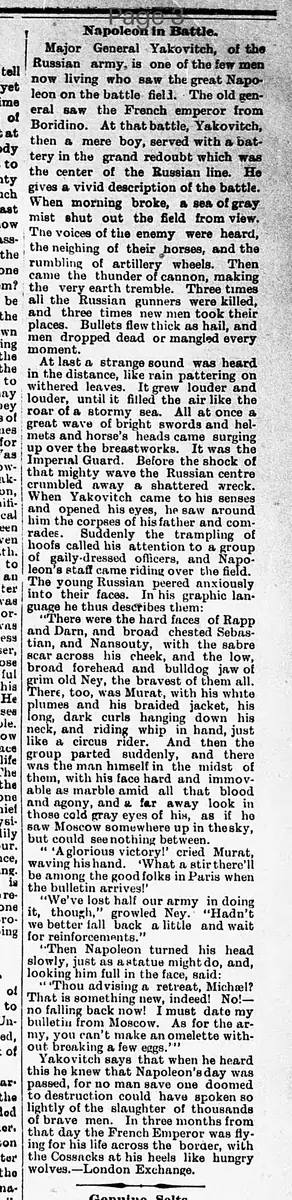
Napoleon in Battle
Major General Yakovitch, of the Russian army, is one of the few men now living who saw the great Napoleon on the battle field. The old general saw the French emperor from Borodino. At that battle, Yakovitch, then a mere boy, served with a battery in the grand redoubt which was the center of the Russian line. He gives a vivid description of the battle.
When morning broke, a sea of gray mist shut out the field from view. The voices of the enemy were heard, the neighing of their horses, and the rumbling of artillery wheels. Then came the thunder of cannon, making the very earth tremble. Three times all the Russian gunners were killed and three times new men took their places. Bullets flew thick as hail, and men dropped dead or mangled every moment.
At last a strange sound was heard in the distance, like rain pattering on withered leaves. It grew louder and louder, until it filled the air like the roar of a stormy sea. All at once a great wave of bright swords and helmets and horse's heads came surging up over the breastworks. It was the Imperial Guard. Before the shock of that mighty wave the Russian centre crumbled away a shattered wreck.
When Yakovitch came to his senses and opened his eyes, he saw around him the corpses of his father and comrades. Suddenly the trampling of hoofs called his attention to a group of gaily-dressed officers, and Napoleon's staff came riding over the field.
The young Russian peered anxiously into their faces. In his graphic language he thus describes them:
"There were the hard faces of Rapp and Daru, and broad chested Sebastian, and Nansouty, with the sabre scar across his cheek, and the low, broad forehead and bulldog jaw of grim old Ney, the bravest of them all. There, too, was Murat, with his white plumes and his braided jacket, his long, dark curls hanging down his neck, and riding whip in hand, just like a circus rider. And then the group parted suddenly, and there was the man himself in the midst of them, with his face hard and immovable as marble amid all that blood and agony, and a far away look in those cold gray eyes of his, as if he saw Moscow somewhere up in the sky, but could see nothing between.
" 'A glorious victory!' cried Murat, waving his hand. What a stir there'll be among the good folks in Paris when the bulletin arrives!"
"We've lost half our army in doing it, though," growled Ney. "Hadn't we better fall back a little and wait for reinforcements."
"Then Napoleon turned his head slowly, just as a statue might do, and, looking him full in the face, said:
" 'Thou advising a retreat, Michael? That is something new, indeed! No!—no falling back now! I must date my bulletin from Moscow. As for the army, you can't make an omelette without breaking a few eggs.'
Yakovitch says that when he heard this he knew that Napoleon's day was passed, for no man save one doomed to destruction could have spoken so lightly of the slaughter of thousands of brave men. In three months from that day the French Emperor was flying for his life across the border, with the Cossacks at his heels like hungry wolves.—London Exchange.
Major General Yakovitch, of the Russian army, is one of the few men now living who saw the great Napoleon on the battle field. The old general saw the French emperor from Borodino. At that battle, Yakovitch, then a mere boy, served with a battery in the grand redoubt which was the center of the Russian line. He gives a vivid description of the battle.
When morning broke, a sea of gray mist shut out the field from view. The voices of the enemy were heard, the neighing of their horses, and the rumbling of artillery wheels. Then came the thunder of cannon, making the very earth tremble. Three times all the Russian gunners were killed and three times new men took their places. Bullets flew thick as hail, and men dropped dead or mangled every moment.
At last a strange sound was heard in the distance, like rain pattering on withered leaves. It grew louder and louder, until it filled the air like the roar of a stormy sea. All at once a great wave of bright swords and helmets and horse's heads came surging up over the breastworks. It was the Imperial Guard. Before the shock of that mighty wave the Russian centre crumbled away a shattered wreck.
When Yakovitch came to his senses and opened his eyes, he saw around him the corpses of his father and comrades. Suddenly the trampling of hoofs called his attention to a group of gaily-dressed officers, and Napoleon's staff came riding over the field.
The young Russian peered anxiously into their faces. In his graphic language he thus describes them:
"There were the hard faces of Rapp and Daru, and broad chested Sebastian, and Nansouty, with the sabre scar across his cheek, and the low, broad forehead and bulldog jaw of grim old Ney, the bravest of them all. There, too, was Murat, with his white plumes and his braided jacket, his long, dark curls hanging down his neck, and riding whip in hand, just like a circus rider. And then the group parted suddenly, and there was the man himself in the midst of them, with his face hard and immovable as marble amid all that blood and agony, and a far away look in those cold gray eyes of his, as if he saw Moscow somewhere up in the sky, but could see nothing between.
" 'A glorious victory!' cried Murat, waving his hand. What a stir there'll be among the good folks in Paris when the bulletin arrives!"
"We've lost half our army in doing it, though," growled Ney. "Hadn't we better fall back a little and wait for reinforcements."
"Then Napoleon turned his head slowly, just as a statue might do, and, looking him full in the face, said:
" 'Thou advising a retreat, Michael? That is something new, indeed! No!—no falling back now! I must date my bulletin from Moscow. As for the army, you can't make an omelette without breaking a few eggs.'
Yakovitch says that when he heard this he knew that Napoleon's day was passed, for no man save one doomed to destruction could have spoken so lightly of the slaughter of thousands of brave men. In three months from that day the French Emperor was flying for his life across the border, with the Cossacks at his heels like hungry wolves.—London Exchange.
What sub-type of article is it?
Historical Event
Military Action
Biography
What themes does it cover?
Bravery Heroism
Fortune Reversal
Tragedy
What keywords are associated?
Battle Of Borodino
Napoleon
Imperial Guard
Russian Army
Military Victory
Napoleonic Wars
What entities or persons were involved?
Yakovitch
Napoleon
Murat
Ney
Rapp
Daru
Sebastian
Nansouty
Where did it happen?
Borodino
Story Details
Key Persons
Yakovitch
Napoleon
Murat
Ney
Rapp
Daru
Sebastian
Nansouty
Location
Borodino
Event Date
Borodino
Story Details
Young Yakovitch fights in the Russian center at Borodino, survives the Imperial Guard's charge, and overhears Napoleon dismissing heavy losses to push to Moscow, foreshadowing his defeat.