Thank you for visiting SNEWPapers!
Sign up free
Richmond Enquirer
Richmond, Richmond County, Virginia
What is this article about?
A Republican from Prince William County writes to defend Martin Van Buren as Andrew Jackson's preferred successor against Whig objections, emphasizing national unity over sectional divides, Southern principles in Van Buren, and criticizing the Whig party's inconsistencies on key issues like tariff, bank, and internal improvements.
Clipping
OCR Quality
Full Text
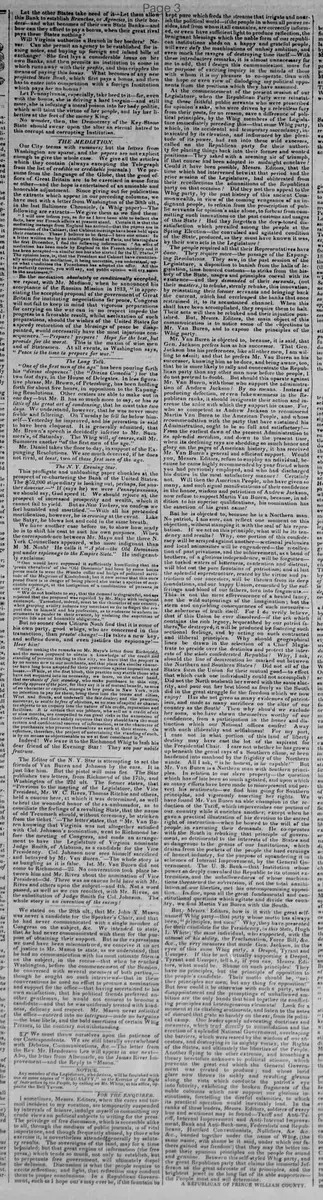
I sometimes, Messrs. Editors, when the cares and turmoil incident to my vocation, are temporarily suspended by intervals of leisure, indulge myself in committing my crude views on political subjects to writing for the press. The privilege of free discussion, which is accessible alike to all, through the medium of public journals, is of vital importance, and though frequently abused, by those who exercise it, is nevertheless attended generally by salutary results. The sovereigns of the land, may for a time be misled; but that great engine of information (the free press,) which tends so much, not only to establish, but to perpetuate free government, will ultimately dispel the delusion. Discussion is what the people require to excite reflection; and light, that reflection may conduct them to proper conclusions. In a Republican Government, such as I hope our's may ever be, if the fountain be kept pure which feeds the streams that irrigate and nourish the political world—if the people in whom all power resides, and from whom it all emanates, are correctly informed, or even have sufficient light to produce reflection, the benignant blessings which the noble form of our republican institutions sheds on a happy and grateful people, will ever defy the machinations of unholy ambition, and even mock the ravages of destroying time itself. With these introductory remarks, it is almost unnecessary for me to add, that I design this communication more for the purpose of exciting inquiry in the minds of those with whom it is my pleasure to co-operate, than with the hope or even view of dislodging my political opponents from the positions which they have assumed.
At the commencement of the present session of our Legislature, when the Republican Party were reinstating those faithful public servants who were proscribed for opinion's sake, who were driven from their posts, on no reason, save a difference of political principles, by the Whig members of the Legislature immediately preceding this—that same Whig party, which, in its accidental and temporary ascendancy, intoxicated by its elevation, and influenced by the plenitude of its power, had run into these wild excesses, called on the Republican party for their authority for placing things back into their former and wonted positions—They asked with a seeming air of triumph, if that course had been adopted in midnight conclave?
Could it have been possible, Messrs. Editors, that the time which had intervened betwixt that period and the prior session of the Legislature, had obliterated from their recollections the admonitions of the Republican party on that occasion? Did they not then appeal to the Whig party, by the past history of this ancient Commonwealth, in view of the coming vengeance of an indignant people, to refrain from the proscription of public servants for opinion's sake alone, to forbear from committing such innovations on the past customs and usages of this State? Had they forgotten the deep-toned dissatisfaction which prevailed among the people at the Spring Election—the convulsed and agitated condition of the State, produced, as they must have known it was, by their own acts in the Legislature?
The people required all that their Representatives have done. They require more—the passage of the Expunging Resolutions. They saw, in the past session of the Legislature, a disposition to banish from the halls of legislation, time-honored customs—to strike from the history of the State, usages and principles coeval with its existence—and they demanded of their servants, (not their masters,) to rebuke, sternly rebuke, this innovation, by reinstating their former servants and bringing back the current, which had overleaped the banks that once restrained it, to its accustomed channel. When this shall have been accomplished, they require them to halt. Their acts will then be rebuked and their injustice punished. But, Messrs. Editors, the main object of this communication is to notice some of the objections to Mr. Van Buren, and to expose the principles of the Whig party:
Mr. Van Buren is objected to, because, it is said, that Gen. Jackson prefers him as his successor. That Gen. Jackson has his preferences, like all other men, I am willing to admit; and that he prefers Mr. Van Buren as his successor, knowing him as he does, and being aware, too, that he is more likely to rally and concentrate the Republican party than any other man now before the people, I do not pretend to doubt. But should this operate against Mr. Van Buren, with those who support the administration of Andrew Jackson? By no means.—Instead of producing defection, or even lukewarmness in the Republican ranks, it should invigorate their action and increase the ardor with which they support his cause. For, who so competent as Andrew Jackson to recommend Martin Van Buren to the American People, and whose recommendation with the party that have sustained his Administration, ought to be so full and satisfactory?—From the earliest dawn of the present Administration to its splendid meridian, and down to the present time when its declining rays are shedding so much honor and glory on the pages of American history, it has received Mr. Van Buren's general and efficient support. Would you, Messrs. Editors, refuse to employ an individual, because he came highly recommended by your friend whom you had previously employed, and who had discharged his duties in the most satisfactory manner? Certainly not. Will then the American People, who have given so many, and such signal manifestations of their confidence in the honor, wisdom and patriotism of Andrew Jackson, now refuse to support Martin Van Buren, because, in addition to his superior qualifications, his nomination has the sanction of his great name?
But he is objected to, because he is a Northern man. No patriot, I am sure, can reflect one moment on this objection, without stamping it with the seal of his reprobation. If we act on this principle, what will be its tendency and results? Why, one portion of this confederacy will be arrayed against another—sectional jealousies and local animosities will be engendered—the recollection of past privations, and the achievement, as a band of brothers, of a glorious independence, will be forgotten—the turbid waters of bitterness, contention and distrust, will blot out the pure fountains of patriotism; and at last the splendid superstructure, reared by the virtue and patriotism of our ancestors, will be thrown from its deep foundations, and our happy Union, cemented by the sufferings and blood of our fathers, torn into fragments.—This is not the mere effervescence of a heated fancy, nor the wild outpourings of the imagination; but the stern and unyielding consequences of such measures—the soberness of truth itself. For I do verily believe that if this Union be ever dissolved—if the ark which contains the rich legacy, bequeathed by our patriot fathers, be destroyed, it will be produced by fostering such sectional feelings, and by acting on such contracted and illiberal principles. Why should geographical lines be drawn in the selection of a Chief Magistrate to preside over the destinies and protect the interests of the whole confederated Republic? Why, I ask, should the line of demarcation be marked out between the Northern and Southern States? Did not all of the States form the Union for their mutual good—to effect that which each one individually could not accomplish? Did not the North unsheath her sword with the same alacrity, and pour out her best blood as freely as the South did in the great struggle for the freedom which we now enjoy? Has she not given as many evidences of patriotism, and made as many sacrifices on the altar of our country as the South? Then why should we exclude her sons, who have shewn themselves worthy of our confidence, from a participation in the honor and distinction which our National offices confer? Away with such illiberality and selfishness! For my part, I care not in what portion of this land of liberty destiny may have cast the lot of the aspirant for the Presidential Chair. I care not whether he has grown up beneath the genial rays of a Southern clime, or been hardened into manhood by the frigidity of the Northern winds. All I ask, "is he honest, is he capable?" But Mr. Van Buren is a Northern man with Southern principles. In relation to our slave property—the question which has of late been so much agitated, and upon which so many efforts have been made to misrepresent and pervert his sentiments—we find him going on Southern principles, and vigorously asserting her rights. We have found Mr. Van Buren an able champion in the reduction of the Tariff, which impoverishes one portion of our country while it enriches another; except when he gave a practical illustration of his devotion to the sacred right of instruction—when he bowed to the will of the people in executing their demands. He co-operates with the South in rebuking that principle of government, so detrimental to the interests of the States and so dangerous to the genius of our Institutions, which drains from the pockets of the people the hard earnings of honest industry, for the purpose of squandering it in schemes of Internal Improvement, by the General Government. The U. S. Bank—that Institution whose power so deeply convulsed the Republic to its utmost extremities, and the unhallowedness of whose machinations threatened the subversion, if not the total annihilation of our liberties, met his uncompromising opposition. In fine, upon all the great fundamental and constitutional questions which agitate and divide the country, we find Martin Van Buren with the South.
But, Messrs. Editors, how is it with the great self-named Whig party—that party whose motto has always been, "principles, not men?" "Why, they have presented for their candidate for the Presidency, in this State, Hugh L. White: the same individual, who supported, with the utmost of his ability, the Proclamation, Force Bill, &c. &c., the very measures that made Gen. Jackson, in the eyes of this same Whig party, a Despot, Tyrant and Usurper. If this be not virtually supporting a Despot, Tyrant and Usurper, tell me, if you can, Messrs. Editors, what would be. Shame on such principles! They have no principles, but the principle of opposition to the people's candidate. Their motto should be, "neither principles nor men; but any thing for opposition!"
But how could it be otherwise with such a party, when disappointment and the promptings of unhallowed ambition are the only bands that bind together its conflicting principles and heterogeneous elements? Look for a moment at its clashing sentiments, and listen to the notes of discord that grate so harshly on the ear, from its political camp. One leader openly advocating doctrines and measures, which tend directly to consolidation and the erection of a splendid National Government, overleaping the barriers, which were reared by the wisdom of our ancestors, and destroying in its mighty vortex, the Rights of the States, and ultimately the liberties of the People. Another flying to the other extreme, and broaching a theory heretofore unknown to political science, which prevents the great end which the General Government was created to produce; and whose lurid glare now throws its sickly and revolting gleams along the vista which conducts the patriot's eye into futurity, exhibiting the broken fragments of the noble columns which now support our glorious institutions, foretelling the direful calamities, to which its practical operation would inevitably lead. In the ranks of these leaders, Messrs. Editors, soldiers of every hue and sentiment may be found—Tariff and Anti-Tariff, Internal Improvement and Anti-Internal Improvement, Bank and Anti-Bank-men, Federalists and Republicans, Hartford Conventionists, Nullifiers, &c. &c. &c., banded together under the name of Whig, (the same name, with shame be it said, under which our fathers gained our freedom!) that they may the better impose their spurious principles on the people for sound and genuine. Between this self-styled Whig party, and the great Republican party that claims the immortal Jefferson as the great advocate of its principles, and the brightest jewel in the long list of its able supporters—the People must and will determine.
A REPUBLICAN OF PRINCE WILLIAM COUNTY.
What sub-type of article is it?
What themes does it cover?
What keywords are associated?
What entities or persons were involved?
Letter to Editor Details
Author
A Republican Of Prince William County
Recipient
Messrs. Editors
Main Argument
the letter defends martin van buren against whig objections regarding his northern origin and jackson's endorsement, arguing that such sectionalism threatens the union and that van buren aligns with southern principles on key issues; it also criticizes the whig party for hypocrisy, lack of principles, and internal contradictions on policies like the tariff, bank, and internal improvements.
Notable Details