Thank you for visiting SNEWPapers!
Sign up free
Domestic News
May 23, 1915
The Sentinel=Record
Hot Springs, Garland County, Arkansas
What is this article about?
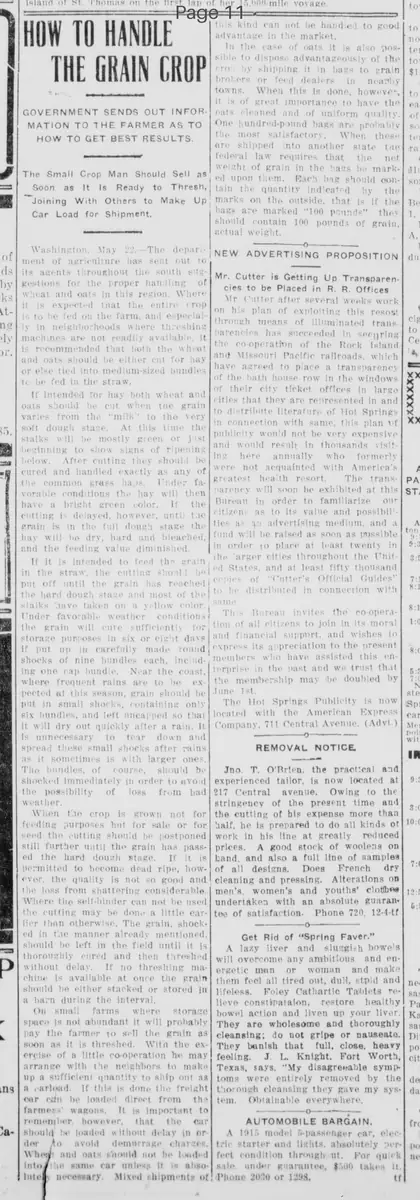
The U.S. Department of Agriculture sends guidelines to southern agents on handling wheat and oats crops: cutting stages for hay or straw feeding, curing methods, threshing, and cooperative sales/shipping for small farms.
Clipping
OCR Quality
75%
Good
Full Text
HOW TO HANDLE
THE GRAIN CROP
GOVERNMENT SENDS OUT INFORMATION
TO THE FARMER AS TO
HOW TO GET BEST RESULTS.
The Small Crop Man Should Sell as
Soon as It Is Ready to Thresh,
Joining With Others to Make Up
Car Load for Shipment.
Washington, May 2. The department
of agriculture has sent out to
its agents throughout the south sug-
gestions for the proper handling of
wheat and oats in this region. Where
it is expected that the entire crop
is to be fed on the farm, and espe-
cially in neighborhoods where threshing
machines are not readily available, it
is recommended that both the wheat
and oats should be either cut for hay
or else tied into medium-sized bundles
to be fed in the straw.
If intended for hay both wheat and
oats should be cut when the grain
is in the milk to the very
soft dough stage. At this time the
stalks will be mostly green or just
beginning to show signs of ripening
below. After cutting they should be
cured and handled exactly as any of
the common grass hay. Under fa-
vorable conditions the hay will then
have a bright green color. If the
cutting is delayed, however, until the
grain is in the full dough stage the
hay will be dry, hard and bleached,
and the feeding value diminished.
If it is intended to feed the grain
in the straw the cutting should be
put off until the grain has reached
the hard dough stage and most of the
stalks have taken on a yellow color.
Under favorable weather conditions
the grain will cure sufficiently for
storage purposes in six or eight days
if put up in carefully made round
shocks of nine bundles each, includ-
ing one cap bundle. Near the coast,
where frequent rains are to be ex-
pected at this season, grain should be
put in small shocks, containing only
six bundles, and left uncapped so that
it will dry out quickly after a rain. It
is unnecessary to tear down and
spread these small shocks after rains
as it sometimes is with larger ones.
The bundles, of course, should be
shocked immediately, in order to avoid
the possibility of loss from bad
weather.
When the crop is grown not for
feeding purposes but for sale or for
seed the cutting should be postponed
still further until the grain has passed
the hard dough stage. If it is
permitted to become dead ripe, how-
ever, the quality is not so good and
the loss from shattering considerable.
Where the self-binder can not be used
the cutting may be done a little ear-
lier than otherwise. The grain, shocked
in the manner already mentioned,
should be left in the field until it is
thoroughly cured and then threshed
without delay. If no threshing ma-
chine is available at once the grain
should be either stacked or stored in
a barn during the interval.
On small farms where storage
space is not abundant it will probably
pay the farmer to sell the grain as
soon as it is threshed. With the ex-
ercise of a little co-operation he may
arrange with the neighbors to make
up a sufficient quantity to ship out as
a carload. If this is done the freight
car can be loaded direct from the
farmers' wagons. It is important to
remember however, that the car
should be loaded without delay in order
to avoid demurrage charges.
Wheat and oats should not be loaded
into the same car unless it is abso-
lutely necessary. Mixed shipments of
this kind can not be handled to good
advantage in the market.
In the case of oats it is also ad-
visable to dispose advantageously of the
crop by shipping it in bags to grain
brokers or feed dealers in nearby
towns. When this is done, however,
it is of great importance to have the
oats cleaned and of uniform quality.
One hundred-pound bags are probably
the most satisfactory. When these
are shipped into another state the
federal law requires that the net
weight of grain in the bags be marked
upon them. Each bag should contain
the quantity indicated by the marks
on the outside, that is if the bags
are marked "100 pounds" they
should contain 100 pounds of grain,
actual weight.
THE GRAIN CROP
GOVERNMENT SENDS OUT INFORMATION
TO THE FARMER AS TO
HOW TO GET BEST RESULTS.
The Small Crop Man Should Sell as
Soon as It Is Ready to Thresh,
Joining With Others to Make Up
Car Load for Shipment.
Washington, May 2. The department
of agriculture has sent out to
its agents throughout the south sug-
gestions for the proper handling of
wheat and oats in this region. Where
it is expected that the entire crop
is to be fed on the farm, and espe-
cially in neighborhoods where threshing
machines are not readily available, it
is recommended that both the wheat
and oats should be either cut for hay
or else tied into medium-sized bundles
to be fed in the straw.
If intended for hay both wheat and
oats should be cut when the grain
is in the milk to the very
soft dough stage. At this time the
stalks will be mostly green or just
beginning to show signs of ripening
below. After cutting they should be
cured and handled exactly as any of
the common grass hay. Under fa-
vorable conditions the hay will then
have a bright green color. If the
cutting is delayed, however, until the
grain is in the full dough stage the
hay will be dry, hard and bleached,
and the feeding value diminished.
If it is intended to feed the grain
in the straw the cutting should be
put off until the grain has reached
the hard dough stage and most of the
stalks have taken on a yellow color.
Under favorable weather conditions
the grain will cure sufficiently for
storage purposes in six or eight days
if put up in carefully made round
shocks of nine bundles each, includ-
ing one cap bundle. Near the coast,
where frequent rains are to be ex-
pected at this season, grain should be
put in small shocks, containing only
six bundles, and left uncapped so that
it will dry out quickly after a rain. It
is unnecessary to tear down and
spread these small shocks after rains
as it sometimes is with larger ones.
The bundles, of course, should be
shocked immediately, in order to avoid
the possibility of loss from bad
weather.
When the crop is grown not for
feeding purposes but for sale or for
seed the cutting should be postponed
still further until the grain has passed
the hard dough stage. If it is
permitted to become dead ripe, how-
ever, the quality is not so good and
the loss from shattering considerable.
Where the self-binder can not be used
the cutting may be done a little ear-
lier than otherwise. The grain, shocked
in the manner already mentioned,
should be left in the field until it is
thoroughly cured and then threshed
without delay. If no threshing ma-
chine is available at once the grain
should be either stacked or stored in
a barn during the interval.
On small farms where storage
space is not abundant it will probably
pay the farmer to sell the grain as
soon as it is threshed. With the ex-
ercise of a little co-operation he may
arrange with the neighbors to make
up a sufficient quantity to ship out as
a carload. If this is done the freight
car can be loaded direct from the
farmers' wagons. It is important to
remember however, that the car
should be loaded without delay in order
to avoid demurrage charges.
Wheat and oats should not be loaded
into the same car unless it is abso-
lutely necessary. Mixed shipments of
this kind can not be handled to good
advantage in the market.
In the case of oats it is also ad-
visable to dispose advantageously of the
crop by shipping it in bags to grain
brokers or feed dealers in nearby
towns. When this is done, however,
it is of great importance to have the
oats cleaned and of uniform quality.
One hundred-pound bags are probably
the most satisfactory. When these
are shipped into another state the
federal law requires that the net
weight of grain in the bags be marked
upon them. Each bag should contain
the quantity indicated by the marks
on the outside, that is if the bags
are marked "100 pounds" they
should contain 100 pounds of grain,
actual weight.
What sub-type of article is it?
Agriculture
What keywords are associated?
Grain Crop
Wheat Handling
Oats Handling
Department Of Agriculture
Threshing
Shipping
Farming Advice
Where did it happen?
Washington
Domestic News Details
Primary Location
Washington
Event Date
May 2
Event Details
The Department of Agriculture sends suggestions to agents in the south for handling wheat and oats: cut for hay in milk to soft dough stage; for straw feeding in hard dough stage with specific shocking methods; for sale/seed after hard dough, threshed promptly; small farmers advised to sell immediately and cooperate for carload shipments, with details on bagging oats.