Thank you for visiting SNEWPapers!
Sign up free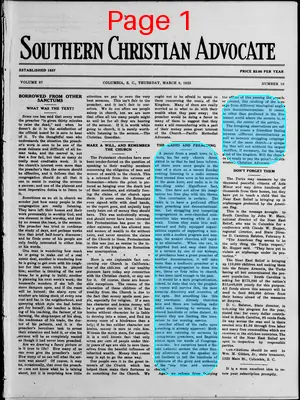
Editorial
March 8, 1923
Southern Christian Advocate
Charleston, Charleston County, South Carolina
What is this article about?
An editorial warns that radio broadcasts of sermons will profoundly impact preaching and denominationalism, urging over-churched communities to unite stronger congregations or risk elimination by mediocre ones. It highlights interdenominational listening fostering unity among Protestants.
Clipping
OCR Quality
98%
Excellent
Full Text
THE RADIO AND PREACHING
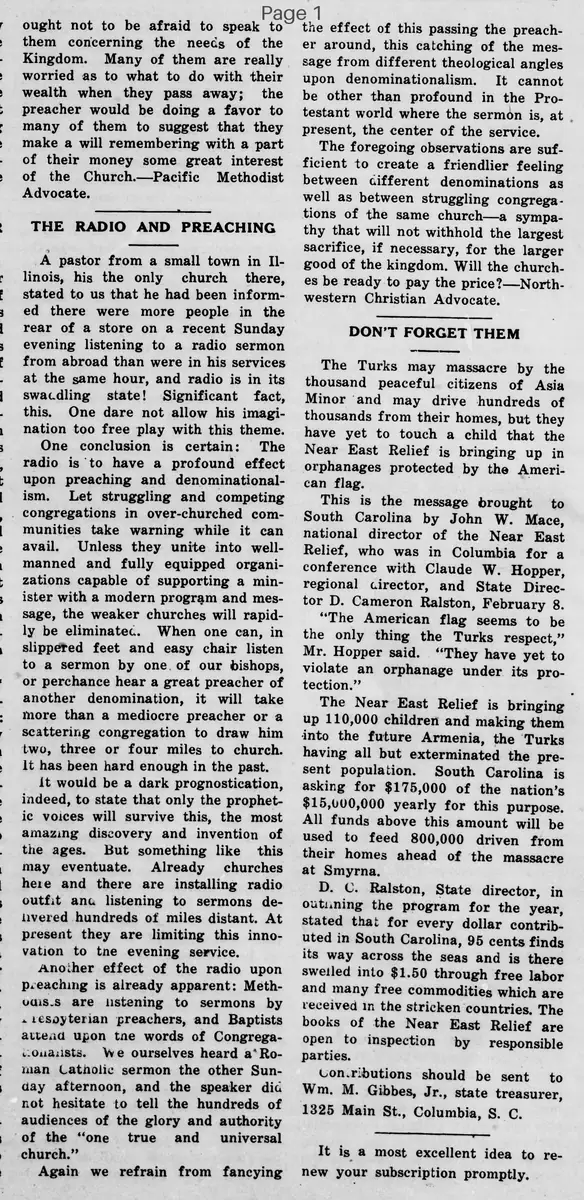
A pastor from a small town in Illinois, his the only church there, stated to us that he had been informed there were more people in the rear of a store on a recent Sunday evening listening to a radio sermon from abroad than were in his services at the same hour, and radio is in its swaddling state! Significant fact, this. One dare not allow his imagination too free play with this theme. One conclusion is certain: The radio is to have a profound effect upon preaching and denominationalism. Let struggling and competing congregations in over-churched communities take warning while it can avail. Unless they unite into well-manned and fully equipped organizations capable of supporting a minister with a modern program and message, the weaker churches will rapidly be eliminated. When one can, in slippered feet and easy chair listen to a sermon by one of our bishops, or perchance hear a great preacher of another denomination, it will take more than a mediocre preacher or a scattering congregation to draw him two, three or four miles to church. It has been hard enough in the past. It would be a dark prognostication, indeed, to state that only the prophetic voices will survive this, the most amazing discovery and invention of the ages. But something like this may eventuate. Already churches here and there are installing radio outfit and listening to sermons delivered hundreds of miles distant. At present they are limiting this innovation to the evening service.
Another effect of the radio upon preaching is already apparent: Methodists are listening to sermons by Presbyterian preachers, and Baptists attend upon the words of Congregationalists. We ourselves heard a Roman Catholic sermon the other Sunday afternoon, and the speaker did not hesitate to tell the hundreds of audiences of the glory and authority of the "one true and universal church."
Again we refrain from fancying the effect of this passing the preacher around, this catching of the message from different theological angles upon denominationalism. It cannot be other than profound in the Protestant world where the sermon is, at present, the center of the service. The foregoing observations are sufficient to create a friendlier feeling between different denominations as well as between struggling congregations of the same church--a sympathy that will not withhold the largest sacrifice, if necessary, for the larger good of the kingdom. Will the churches be ready to pay the price?--Northwestern Christian Advocate.
A pastor from a small town in Illinois, his the only church there, stated to us that he had been informed there were more people in the rear of a store on a recent Sunday evening listening to a radio sermon from abroad than were in his services at the same hour, and radio is in its swaddling state! Significant fact, this. One dare not allow his imagination too free play with this theme. One conclusion is certain: The radio is to have a profound effect upon preaching and denominationalism. Let struggling and competing congregations in over-churched communities take warning while it can avail. Unless they unite into well-manned and fully equipped organizations capable of supporting a minister with a modern program and message, the weaker churches will rapidly be eliminated. When one can, in slippered feet and easy chair listen to a sermon by one of our bishops, or perchance hear a great preacher of another denomination, it will take more than a mediocre preacher or a scattering congregation to draw him two, three or four miles to church. It has been hard enough in the past. It would be a dark prognostication, indeed, to state that only the prophetic voices will survive this, the most amazing discovery and invention of the ages. But something like this may eventuate. Already churches here and there are installing radio outfit and listening to sermons delivered hundreds of miles distant. At present they are limiting this innovation to the evening service.
Another effect of the radio upon preaching is already apparent: Methodists are listening to sermons by Presbyterian preachers, and Baptists attend upon the words of Congregationalists. We ourselves heard a Roman Catholic sermon the other Sunday afternoon, and the speaker did not hesitate to tell the hundreds of audiences of the glory and authority of the "one true and universal church."
Again we refrain from fancying the effect of this passing the preacher around, this catching of the message from different theological angles upon denominationalism. It cannot be other than profound in the Protestant world where the sermon is, at present, the center of the service. The foregoing observations are sufficient to create a friendlier feeling between different denominations as well as between struggling congregations of the same church--a sympathy that will not withhold the largest sacrifice, if necessary, for the larger good of the kingdom. Will the churches be ready to pay the price?--Northwestern Christian Advocate.
What sub-type of article is it?
Moral Or Religious
Social Reform
What keywords are associated?
Radio Preaching
Church Unity
Denominationalism
Sermon Broadcasts
Protestant World
What entities or persons were involved?
Methodists
Presbyterians
Baptists
Congregationalists
Roman Catholics
Northwestern Christian Advocate
Editorial Details
Primary Topic
Impact Of Radio On Preaching And Denominationalism
Stance / Tone
Warning And Exhortation For Church Unity
Key Figures
Methodists
Presbyterians
Baptists
Congregationalists
Roman Catholics
Northwestern Christian Advocate
Key Arguments
Radio Will Profoundly Affect Preaching And Denominationalism.
Struggling Churches Must Unite Or Be Eliminated By Radio Competition.
Listeners Can Easily Access Sermons From Great Preachers At Home, Reducing Attendance At Local Mediocre Services.
Interdenominational Listening Via Radio Fosters Unity And Sympathy Among Denominations.
Churches Should Make Sacrifices For The Larger Good Of The Kingdom.