Thank you for visiting SNEWPapers!
Sign up free
American Watchman And Delaware Advertiser
Wilmington, New Castle County, Delaware
What is this article about?
US President Monroe transmits to Congress a State Department report on foreign claims to the Northwest Pacific Coast territory north of 42°N, including British and Russian assertions conflicting with US plans for Columbia River occupation, and trade restrictions. Secretary Adams rejects Russian extension to 51°N in letter to envoy Poletica.
Clipping
OCR Quality
Full Text
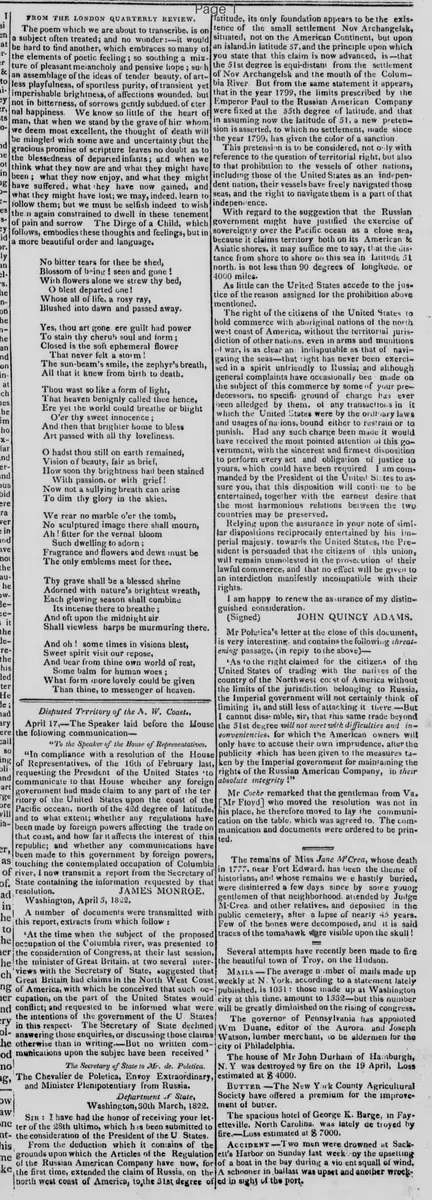
April 17,—The Speaker laid before the House the following communication—
"To the Speaker of the House of Representatives.
"In compliance with a resolution of the House of Representatives, of the 16th of February last, requesting the President of the United States 'to communicate to that House whether any foreign government had made claim to any part of the territory of the United States upon the coast of the Pacific ocean, north of the 42d degree of latitude, and to what extent; whether any regulations have been made by foreign powers affecting the trade on that coast, and how far it affects the interest of this republic; and whether any communications have been made to this government by foreign powers, touching the contemplated occupation of Columbia river, I now transmit a report from the Secretary of State containing the information requested by that resolution.
JAMES MONROE.
Washington, April 5, 1822."
A number of documents were transmitted with this report, extracts from which follow:
'At the time when the subject of the proposed occupation of the Columbia river, was presented to the consideration of Congress, at their last session, the minister of Great Britain, at two several interviews with the Secretary of State, suggested that Great Britain had claims in the North West Coast of America, with which he conceived that such occupation, on the part of the United States would conflict; and requested to be informed what were the intentions of the government of the U States in this respect. The Secretary of State declined answering those enquiries, or discussing those claims otherwise than in writing.—But no written communications upon the subject have been received'
The Secretary of State to Mr. de. Poletica.
The Chevalier de Poletica, Envoy Extraordinary, and Minister Plenipotentiary from Russia.
Department of State,
Washington, 30th March, 1822.
Sir: I have had the honor of receiving your letter of the 28th ultimo, which has been submitted to the consideration of the President of the U. States. From the deduction which it contains of the grounds upon which the Articles of the Regulation of the Russian American Company have now, for the first time, extended the claim of Russia, on the north west coast of America, to the 51st degree of latitude, its only foundation appears to be the existence of the small settlement Nov Archangelsk, situated, not on the American Continent, but upon an island, in latitude 57, and the principle upon which you state that this claim is now advanced, is—that the 51st degree is equi-distant from the settlement of Nov Archangelsk and the mouth of the Columbia River. But from the same statement it appears, that in the year 1799, the limits prescribed by the Emperor Paul to the Russian American Company were fixed at the 55th degree of latitude, and that in assuming now the latitude of 51, a new pretension is asserted, to which no settlement, made since the year 1799, has given the color of a sanction.
This pretension is to be considered, not only with reference to the question of territorial right, but also to that prohibition to the vessels of other nations, including those of the United States as an independent nation, their vessels have freely navigated those seas, and the right to navigate them is a part of that independence.
With regard to the suggestion that the Russian government might have justified the exercise of sovereignty over the Pacific ocean as a close sea, because it claims territory both on its American & Asiatic shores, it may suffice me to say, that the distance from shore to shore on this sea in latitude 51 north. is not less than 90 degrees of longitude, or 4000 miles.
As little can the United States accede to the justice of the reason assigned for the prohibition above mentioned.
The right of the citizens of the United States to hold commerce with aboriginal nations of the north west coast of America, without the territorial jurisdiction of other nations, even in arms and munitions of war, is as clear and indisputable as that of navigating the seas—that right has never been exercised in a spirit unfriendly to Russia; and although general complaints have occasionally been made on the subject of this commerce by some of your predecessors, no specific ground of charge has ever been alleged by them, of any transactions in it which the United States were by the ordinary laws and usages of nations, bound either to restrain or to punish. Had any such charge been made it would have received the most pointed attention of this government, with the sincerest and firmest disposition to perform every act and obligation of justice to yours, which could have been required I am commanded by the President of the United States to assure you, that this disposition will continue to be entertained, together with the earnest desire that the most harmonious relations between the two countries may be preserved.
Relying upon the assurance in your note of similar dispositions reciprocally entertained by his imperial majesty, towards the United States, the President is persuaded that the citizens of this union. will remain unmolested in the prosecution of their lawful commerce, and that no effect will be given to an interdiction manifestly incompatible with their rights.
I am happy to renew the assurance of my distinguished consideration.
(Signed)
JOHN QUINCY ADAMS.
Mr Poletica's letter at the close of this document, is very interesting, and contains the following threatening passage, (in reply to the above)—
'As to the right claimed for the citizens of the United States of trading with the natives of the country of the Northwest coast of America without the limits of the jurisdiction belonging to Russia, the Imperial government will not certainly think of limiting it, and still less of attacking it there.—But I cannot dissemble, sir, that this same trade beyond the 51st degree will not meet with difficulties and inconveniences, for which the American owners will only have to accuse their own imprudence, after the publicity which has been given to the measures taken by the Imperial government for maintaining the rights of the Russian American Company, in their absolute integrity!'
Mr Cocke remarked that the gentleman from Va. [Mr Floyd] who moved the resolution was not in his place, he therefore moved to lay the communication on the table, which was agreed to. The communication and documents were ordered to be printed.
What sub-type of article is it?
What keywords are associated?
What entities or persons were involved?
Where did it happen?
Foreign News Details
Primary Location
North West Coast Of America
Event Date
April 5, 1822
Key Persons
Outcome
communication laid on table in house; documents ordered printed. us rejects russian claims to 51st latitude and trade prohibitions, affirming navigation and commerce rights.
Event Details
President Monroe transmits State Department report to House per resolution, detailing British verbal claims conflicting with US Columbia River occupation plans and Russian extension of territorial claims to 51°N via American Company regulations. Adams' letter to Russian envoy Poletica refutes claims based on 1799 limits and Nov Archangelsk settlement, defends US navigation and trade rights including arms to natives, and expresses desire for harmonious relations. Poletica warns of difficulties for US trade beyond 51°N.