Thank you for visiting SNEWPapers!
Sign up free
Story
March 19, 1870
Ashtabula Weekly Telegraph
Ashtabula, Ashtabula County, Ohio
What is this article about?
Historical account of Ashtabula Township's library establishment in 1813 and reorganization in 1830, and the evolution of mail delivery from pedestrian carriers like John Metcalf in 1808 to stagecoaches and railroads by 1852, including postmasters and roads.
Clipping
OCR Quality
95%
Excellent
Full Text
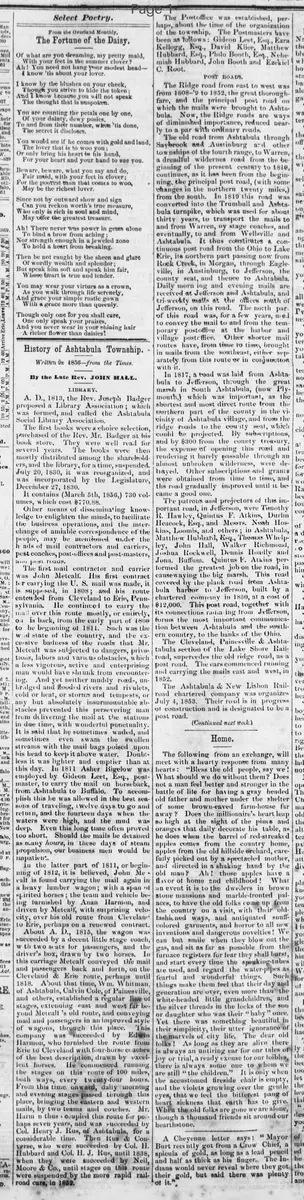
History of Ashtabula Township.
Written in 1856—from the Times
By the Late Rev. JOHN HALL.
LIBRARY,
A. D., 1813, the Rev. Joseph Badger proposed a Library Association; which was formed, and called the Ashtabula Social Library Association. The first books were a choice selection, purchased of the Rev. Mr. Badger at his book store. They were well read for several years. The books were then mostly distributed among the shareholders, and the library, for a time, suspended. July 20, 1830, it was reorganized, and was incorporated by the Legislature, December 27, 1830. It contains (March 5th, 1856,) 730 volumes, which cost $770.88.
Other means of disseminating knowledge to enlighten the minds, to facilitate the business operations, and the interchange of amiable correspondence of the people, may be mentioned under the heads of mail contractors and carriers, post coaches, post-offices and post-masters, and post roads.
The first mail contractor and carrier was John Metcalf. His first contract for carrying the U. S. mail was made, it is supposed, in 1808; and his route extended from Cleveland to Erie, Pennsylvania. He continued to carry the mail over this route mostly, or entirely, on his back, from the early part of 1808 to the beginning of 1811. Such was the wild state of the country, and the excessive badness of the roads that Mr. Metcalf was subjected to dangers, privations, labors and various obstacles, which a less vigorous, active and enterprising man would have shrunk from encountering. And yet neither muddy roads, unbridged and flooded rivers and rivulets, cold or heat, or storms and tempests, or any but absolutely insurmountable obstacles prevented this persevering man from delivering the mail at the stations in due time, with wonderful punctuality. It is said that he sometimes waded, and sometimes even swam the swollen streams with the mail bags poised upon his head to keep it above water. Doubtless it was lighter and emptier than at this day.
In 1811 Asher Bigelow was employed by Gideon Leet, Esq., post-master, to carry the mail on horseback, from Ashtabula to Buffalo. To accomplish this he was allowed in the best seasons of traveling, twelve days to go and return, and the fourteen days when the waters were high, and the mud was deep. Even this long time often proved too short. Should the mails be detained as many hours, in these days of steam propulsion, our business men would be impatient.
In the latter part of 1811, or beginning of 1812, it is believed, John Metcalf is found carrying the mail again in a heavy lumber wagon; with a span of spirited horses; the team and vehicle being furnished by Anan Harmon, and driven by Metcalf, with surprising velocity, over his old route from Cleveland to Erie, perhaps on a renewed contract.
About A. D., 1815, the wagon was succeeded by a decent little stage coach, with two seats for passengers, and the driver's box, drawn by two horses. In this carriage Metcalf conveyed the mail and passengers back and forth, on the Cleveland & Erie route, perhaps until 1818. About that time, Wm. Whitman, of Ashtabula, Calvin Cole, of Painesville, and others, established a regular line of stages, extending east and west far beyond Metcalf's old route, and conveying mail and passengers in an improved style of wagons, through this place. This company was succeeded by Edwin Harmon, who furnished the route from Erie to Cleveland with four-horse coaches of the best description, drawn by excellent horses. He commenced running the stages on this route of 100 miles, both ways, every twenty-four hours. From this time onward, daily morning and evening stages passed through this place, bringing the eastern and western mails, by two teams and coaches. Mr. Harmon thus occupied this route for perhaps seven years, and was succeeded by Col. Henry J. Russ, of Ashtabula, for a considerable time. Then Russ & Converse, who were succeeded by Col. H. Hubbard and Col. H. J. Russ, until 1838, when they were succeeded by Neil, Moore & Co., until stages on this route were suspended by the more rapid rail road cars, in 1852.
POST ROADS.
The Post-office was established, perhaps, about the time of the organization of the township. The Postmasters have been as follows: Gideon Leet, Esq., Ezra Kellogg, Esq., David Kice, Matthew Hubbard, Esq., Philo Booth, Esq., Nehemiah Hubbard, John Booth and Ezekiel C. Root.
The Ridge road from east to west was from 1808-'49 to 1852, the great thoroughfare, and the principal post road on which the mails were brought to Ashtabula. Now, the Ridge roads are ways of diminished importance, reduced nearly to a par with ordinary roads.
The old road from Ashtabula through Saybrook and Austinburg and other townships of the fourth range, to Warren, a dreadful wilderness road from the beginning of the present century to 1810, continues, as it has been from the beginning, the principal post road, (with some changes in the northern twenty miles,) from the south. In 1819 this road was converted into the Trumbull and Ashtabula turnpike, which was used for about thirty years, to transport the mails to and from Warren, by stage coaches, and eventually, to and from Wellsville and Ashtabula. It thus constitutes a continuous post road from the Ohio to Lake Erie, its northern part passing now from Rock Creek, in Morgan, through Eagleville, in Austinburg to Jefferson, the county seat, and thence to Ashtabula. Daily morning and evening mails are received at Jefferson and Ashtabula, and tri-weekly mails at the offices south of Jefferson, on this road. The north part of this road was, for a few years, used to convey the mail to and from the temporary post-office at the harbor and village post-office. Other shorter mail routes have, from time to time brought in mails from the southeast, either separately from this route or in conjunction with it.
In 1817, a road was laid from Ashtabula to Jefferson, through the great marsh in South Ashtabula, (now Plymouth) which was important, as the shortest and most direct route from the northern part of the county in the vicinity of Ashtabula village, and from the ridge roads to the county seat, which could be projected. By subscriptions, and by $300 from the county treasury, the expense of opening this road and rendering it barely passable through an almost unbroken wilderness, were defrayed. Other subscriptions and grants were obtained from time to time and this road gradually improved until it became a good one.
The patrons and projectors of this important road, in Jefferson, were Timothy R. Hawley, Quintus F. Atkins, Durbin Heacock, Esq., and Messrs. Noah Hoskins, Loomis, and others; in Ashtabula, Matthew Hubbard, Esq., Thomas Whelpley, John Hall, Walker Richmond, Joshua Rockwell, Dennis Hoadly and Jona. Buffum. Quintus F. Atkins performed the greatest job on the road, in causewaying the big marsh. This road covered by the plank road from Ashtabula harbor to Jefferson, built by a chartered company in 1850, at a cost of $12,000. This post road, together with its connections radiating from Jefferson forms the most important communication between Ashtabula and the southern country, to the banks of the Ohio.
The Cleveland, Painesville & Ashtabula section of the Lake Shore Railroad, supersedes the old ridge road, as a post road. The cars commenced running and carrying the mails east and west, in 1852.
The Ashtabula & New Lisbon Railroad chartered company was organized July 4, 1853. Their road is in progress of construction and is designated to be a post road.
(Continued next week.)
Written in 1856—from the Times
By the Late Rev. JOHN HALL.
LIBRARY,
A. D., 1813, the Rev. Joseph Badger proposed a Library Association; which was formed, and called the Ashtabula Social Library Association. The first books were a choice selection, purchased of the Rev. Mr. Badger at his book store. They were well read for several years. The books were then mostly distributed among the shareholders, and the library, for a time, suspended. July 20, 1830, it was reorganized, and was incorporated by the Legislature, December 27, 1830. It contains (March 5th, 1856,) 730 volumes, which cost $770.88.
Other means of disseminating knowledge to enlighten the minds, to facilitate the business operations, and the interchange of amiable correspondence of the people, may be mentioned under the heads of mail contractors and carriers, post coaches, post-offices and post-masters, and post roads.
The first mail contractor and carrier was John Metcalf. His first contract for carrying the U. S. mail was made, it is supposed, in 1808; and his route extended from Cleveland to Erie, Pennsylvania. He continued to carry the mail over this route mostly, or entirely, on his back, from the early part of 1808 to the beginning of 1811. Such was the wild state of the country, and the excessive badness of the roads that Mr. Metcalf was subjected to dangers, privations, labors and various obstacles, which a less vigorous, active and enterprising man would have shrunk from encountering. And yet neither muddy roads, unbridged and flooded rivers and rivulets, cold or heat, or storms and tempests, or any but absolutely insurmountable obstacles prevented this persevering man from delivering the mail at the stations in due time, with wonderful punctuality. It is said that he sometimes waded, and sometimes even swam the swollen streams with the mail bags poised upon his head to keep it above water. Doubtless it was lighter and emptier than at this day.
In 1811 Asher Bigelow was employed by Gideon Leet, Esq., post-master, to carry the mail on horseback, from Ashtabula to Buffalo. To accomplish this he was allowed in the best seasons of traveling, twelve days to go and return, and the fourteen days when the waters were high, and the mud was deep. Even this long time often proved too short. Should the mails be detained as many hours, in these days of steam propulsion, our business men would be impatient.
In the latter part of 1811, or beginning of 1812, it is believed, John Metcalf is found carrying the mail again in a heavy lumber wagon; with a span of spirited horses; the team and vehicle being furnished by Anan Harmon, and driven by Metcalf, with surprising velocity, over his old route from Cleveland to Erie, perhaps on a renewed contract.
About A. D., 1815, the wagon was succeeded by a decent little stage coach, with two seats for passengers, and the driver's box, drawn by two horses. In this carriage Metcalf conveyed the mail and passengers back and forth, on the Cleveland & Erie route, perhaps until 1818. About that time, Wm. Whitman, of Ashtabula, Calvin Cole, of Painesville, and others, established a regular line of stages, extending east and west far beyond Metcalf's old route, and conveying mail and passengers in an improved style of wagons, through this place. This company was succeeded by Edwin Harmon, who furnished the route from Erie to Cleveland with four-horse coaches of the best description, drawn by excellent horses. He commenced running the stages on this route of 100 miles, both ways, every twenty-four hours. From this time onward, daily morning and evening stages passed through this place, bringing the eastern and western mails, by two teams and coaches. Mr. Harmon thus occupied this route for perhaps seven years, and was succeeded by Col. Henry J. Russ, of Ashtabula, for a considerable time. Then Russ & Converse, who were succeeded by Col. H. Hubbard and Col. H. J. Russ, until 1838, when they were succeeded by Neil, Moore & Co., until stages on this route were suspended by the more rapid rail road cars, in 1852.
POST ROADS.
The Post-office was established, perhaps, about the time of the organization of the township. The Postmasters have been as follows: Gideon Leet, Esq., Ezra Kellogg, Esq., David Kice, Matthew Hubbard, Esq., Philo Booth, Esq., Nehemiah Hubbard, John Booth and Ezekiel C. Root.
The Ridge road from east to west was from 1808-'49 to 1852, the great thoroughfare, and the principal post road on which the mails were brought to Ashtabula. Now, the Ridge roads are ways of diminished importance, reduced nearly to a par with ordinary roads.
The old road from Ashtabula through Saybrook and Austinburg and other townships of the fourth range, to Warren, a dreadful wilderness road from the beginning of the present century to 1810, continues, as it has been from the beginning, the principal post road, (with some changes in the northern twenty miles,) from the south. In 1819 this road was converted into the Trumbull and Ashtabula turnpike, which was used for about thirty years, to transport the mails to and from Warren, by stage coaches, and eventually, to and from Wellsville and Ashtabula. It thus constitutes a continuous post road from the Ohio to Lake Erie, its northern part passing now from Rock Creek, in Morgan, through Eagleville, in Austinburg to Jefferson, the county seat, and thence to Ashtabula. Daily morning and evening mails are received at Jefferson and Ashtabula, and tri-weekly mails at the offices south of Jefferson, on this road. The north part of this road was, for a few years, used to convey the mail to and from the temporary post-office at the harbor and village post-office. Other shorter mail routes have, from time to time brought in mails from the southeast, either separately from this route or in conjunction with it.
In 1817, a road was laid from Ashtabula to Jefferson, through the great marsh in South Ashtabula, (now Plymouth) which was important, as the shortest and most direct route from the northern part of the county in the vicinity of Ashtabula village, and from the ridge roads to the county seat, which could be projected. By subscriptions, and by $300 from the county treasury, the expense of opening this road and rendering it barely passable through an almost unbroken wilderness, were defrayed. Other subscriptions and grants were obtained from time to time and this road gradually improved until it became a good one.
The patrons and projectors of this important road, in Jefferson, were Timothy R. Hawley, Quintus F. Atkins, Durbin Heacock, Esq., and Messrs. Noah Hoskins, Loomis, and others; in Ashtabula, Matthew Hubbard, Esq., Thomas Whelpley, John Hall, Walker Richmond, Joshua Rockwell, Dennis Hoadly and Jona. Buffum. Quintus F. Atkins performed the greatest job on the road, in causewaying the big marsh. This road covered by the plank road from Ashtabula harbor to Jefferson, built by a chartered company in 1850, at a cost of $12,000. This post road, together with its connections radiating from Jefferson forms the most important communication between Ashtabula and the southern country, to the banks of the Ohio.
The Cleveland, Painesville & Ashtabula section of the Lake Shore Railroad, supersedes the old ridge road, as a post road. The cars commenced running and carrying the mails east and west, in 1852.
The Ashtabula & New Lisbon Railroad chartered company was organized July 4, 1853. Their road is in progress of construction and is designated to be a post road.
(Continued next week.)
What sub-type of article is it?
Historical Event
What themes does it cover?
Bravery Heroism
Survival
Triumph
What keywords are associated?
Ashtabula History
Mail Carrier
Post Road
Library Association
Stagecoach Line
John Metcalf
Wilderness Travel
What entities or persons were involved?
John Metcalf
Rev. Joseph Badger
Gideon Leet
Asher Bigelow
Anan Harmon
Edwin Harmon
Col. Henry J. Russ
Matthew Hubbard
Where did it happen?
Ashtabula Township, Ohio
Story Details
Key Persons
John Metcalf
Rev. Joseph Badger
Gideon Leet
Asher Bigelow
Anan Harmon
Edwin Harmon
Col. Henry J. Russ
Matthew Hubbard
Location
Ashtabula Township, Ohio
Event Date
1808 1856
Story Details
Account of the formation and growth of the Ashtabula Social Library Association from 1813, and the development of mail services starting with pedestrian carrier John Metcalf in 1808, progressing to stagecoaches and railroads by 1852, overcoming wilderness obstacles with perseverance.