Thank you for visiting SNEWPapers!
Sign up free
Editorial
September 13, 1947
The Union Times
New Haven, New Haven County, Connecticut
What is this article about?
Editorial critiques deaths in boxing rings, highlighting cases like Jimmy Doyle vs. Sugar Ray Robinson and Ernie Schaaf vs. Max Baer. It condemns legal hypocrisy in charging manslaughter for boxing fatalities but not football, and criticizes ineffective boxing commissions for allowing unfit fighters to compete. Signed by Luther McCarthy.
Merged-components note: These components form a single continued editorial on page 3.
Clipping
OCR Quality
95%
Excellent
Full Text
Death In The Boxing Ring
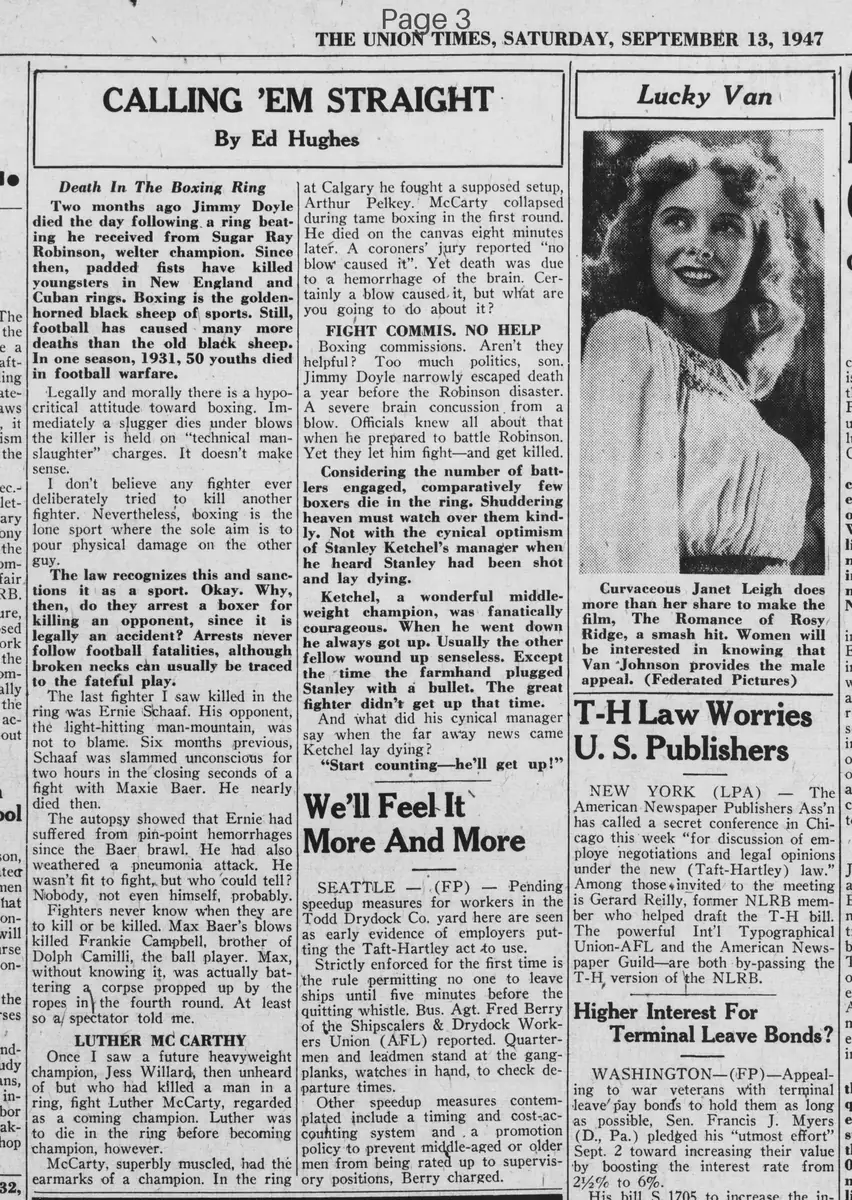
Two months ago Jimmy Doyle died the day following a ring beating he received from Sugar Ray Robinson, welter champion. Since then, padded fists have killed youngsters in New England and Cuban rings. Boxing is the golden horned black sheep of sports. Still, football has caused many more deaths than the old black sheep. In one season, 1931, 50 youths died in football warfare.
Legally and morally there is a hypocritical attitude toward boxing. Immediately a slugger dies under blows the killer is held on technical "manslaughter" charges. It doesn't make sense.
I don't believe any fighter ever deliberately tried to kill another fighter. Nevertheless, boxing is the lone sport where the sole aim is to pour physical damage on the other guy.
The law recognizes this and sanctions it as a sport. Okay. Why, then, do they arrest a boxer for killing an opponent, since it is legally an accident? Arrests never follow football fatalities, although broken necks can usually be traced to the fateful play.
The last fighter I saw killed in the ring was Ernie Schaaf. His opponent, the light-hitting man-mountain, was not to blame. Six months previous, Schaaf was slammed unconscious for two hours in the closing seconds of a fight with Maxie Baer. He nearly died then.
The autopsy showed that Ernie had suffered from pin-point hemorrhages since the Baer brawl. He had also weathered a pneumonia attack. He wasn't fit to fight, but who could tell? Nobody, not even himself, probably.
Fighters never know when they are to kill or be killed. Max Baer's blows killed Frankie Campbell, brother of Dolph Camilli, the ball player. Max, without knowing it, was actually battering a corpse propped up by the ropes in the fourth round. At least so a spectator told me.
LUTHER McCARTHY
Once I saw a future heavyweight champion, Jess Willard, then unheard of but who had killed a man in a ring, fight Luther McCarty, regarded as a coming champion. Luther was to die in the ring before becoming champion, however.
McCarty, superbly muscled, had the fight at Calgary he fought a supposed setup, Arthur Pelkey. McCarty collapsed during tame boxing in the first round. He died on the canvas eight minutes later. A coroners' jury reported "no blow caused it". Yet death was due to a hemorrhage of the brain. Certainly a blow caused it, but what are you going to do about it?
FIGHT COMMIS. NO HELP
Boxing commissions. Aren't they helpful? Too much politics, son.
Jimmy Doyle narrowly escaped death a year before the Robinson disaster. A severe brain concussion from a blow. Officials knew all about that when he prepared to battle Robinson. Yet they let him fight—and get killed.
Considering the number of battlers engaged, comparatively few boxers die in the ring. Shuddering heaven must watch over them kindly. Not with the cynical optimism of Stanley Ketchel's manager when he heard Stanley had been shot and lay dying.
Ketchel, a wonderful middleweight champion, was fanatically courageous. When he went down he always got up. Usually the other fellow wound up senseless. Except the time the farmhand plugged Stanley with a bullet. The great fighter didn't get up that time.
And what did his cynical manager say when the far away news came Ketchel lay dying?
"Start counting—he'll get up!"
Two months ago Jimmy Doyle died the day following a ring beating he received from Sugar Ray Robinson, welter champion. Since then, padded fists have killed youngsters in New England and Cuban rings. Boxing is the golden horned black sheep of sports. Still, football has caused many more deaths than the old black sheep. In one season, 1931, 50 youths died in football warfare.
Legally and morally there is a hypocritical attitude toward boxing. Immediately a slugger dies under blows the killer is held on technical "manslaughter" charges. It doesn't make sense.
I don't believe any fighter ever deliberately tried to kill another fighter. Nevertheless, boxing is the lone sport where the sole aim is to pour physical damage on the other guy.
The law recognizes this and sanctions it as a sport. Okay. Why, then, do they arrest a boxer for killing an opponent, since it is legally an accident? Arrests never follow football fatalities, although broken necks can usually be traced to the fateful play.
The last fighter I saw killed in the ring was Ernie Schaaf. His opponent, the light-hitting man-mountain, was not to blame. Six months previous, Schaaf was slammed unconscious for two hours in the closing seconds of a fight with Maxie Baer. He nearly died then.
The autopsy showed that Ernie had suffered from pin-point hemorrhages since the Baer brawl. He had also weathered a pneumonia attack. He wasn't fit to fight, but who could tell? Nobody, not even himself, probably.
Fighters never know when they are to kill or be killed. Max Baer's blows killed Frankie Campbell, brother of Dolph Camilli, the ball player. Max, without knowing it, was actually battering a corpse propped up by the ropes in the fourth round. At least so a spectator told me.
LUTHER McCARTHY
Once I saw a future heavyweight champion, Jess Willard, then unheard of but who had killed a man in a ring, fight Luther McCarty, regarded as a coming champion. Luther was to die in the ring before becoming champion, however.
McCarty, superbly muscled, had the fight at Calgary he fought a supposed setup, Arthur Pelkey. McCarty collapsed during tame boxing in the first round. He died on the canvas eight minutes later. A coroners' jury reported "no blow caused it". Yet death was due to a hemorrhage of the brain. Certainly a blow caused it, but what are you going to do about it?
FIGHT COMMIS. NO HELP
Boxing commissions. Aren't they helpful? Too much politics, son.
Jimmy Doyle narrowly escaped death a year before the Robinson disaster. A severe brain concussion from a blow. Officials knew all about that when he prepared to battle Robinson. Yet they let him fight—and get killed.
Considering the number of battlers engaged, comparatively few boxers die in the ring. Shuddering heaven must watch over them kindly. Not with the cynical optimism of Stanley Ketchel's manager when he heard Stanley had been shot and lay dying.
Ketchel, a wonderful middleweight champion, was fanatically courageous. When he went down he always got up. Usually the other fellow wound up senseless. Except the time the farmhand plugged Stanley with a bullet. The great fighter didn't get up that time.
And what did his cynical manager say when the far away news came Ketchel lay dying?
"Start counting—he'll get up!"
What sub-type of article is it?
Crime Or Punishment
Moral Or Religious
Legal Reform
What keywords are associated?
Boxing Deaths
Ring Fatalities
Manslaughter Charges
Sports Hypocrisy
Boxing Commissions
Fighter Injuries
What entities or persons were involved?
Jimmy Doyle
Sugar Ray Robinson
Ernie Schaaf
Maxie Baer
Frankie Campbell
Dolph Camilli
Jess Willard
Luther Mccarty
Arthur Pelkey
Stanley Ketchel
Boxing Commissions
Editorial Details
Primary Topic
Hypocrisy In Legal And Moral Treatment Of Boxing Deaths
Stance / Tone
Critical Of Boxing Dangers And Regulatory Failures
Key Figures
Jimmy Doyle
Sugar Ray Robinson
Ernie Schaaf
Maxie Baer
Frankie Campbell
Dolph Camilli
Jess Willard
Luther Mccarty
Arthur Pelkey
Stanley Ketchel
Boxing Commissions
Key Arguments
Boxing Causes Deaths But Is Legally Sanctioned As A Sport
Hypocritical To Charge Manslaughter In Boxing But Ignore Football Fatalities
Fighters Do Not Intend To Kill But Aim To Inflict Physical Damage
Boxing Commissions Fail To Prevent Unfit Fighters From Competing
Previous Injuries Often Contribute To Ring Deaths Unnoticed
Comparatively Few Boxing Deaths Relative To Participants, But Risks Remain High