Thank you for visiting SNEWPapers!
Sign up free
Norfolk Gazette And Publick Ledger
Norfolk, Virginia
What is this article about?
On May 11, the U.S. House debates a petition from Northampton County, PA, inhabitants seeking embargo repeal or modification. Proponents of postponement argue it's war preparation; opponents urge hearing complaints. Motion to postpone until July 4 passes 53-32. A Philadelphia County memorial for peace is tabled.
Clipping
OCR Quality
Full Text
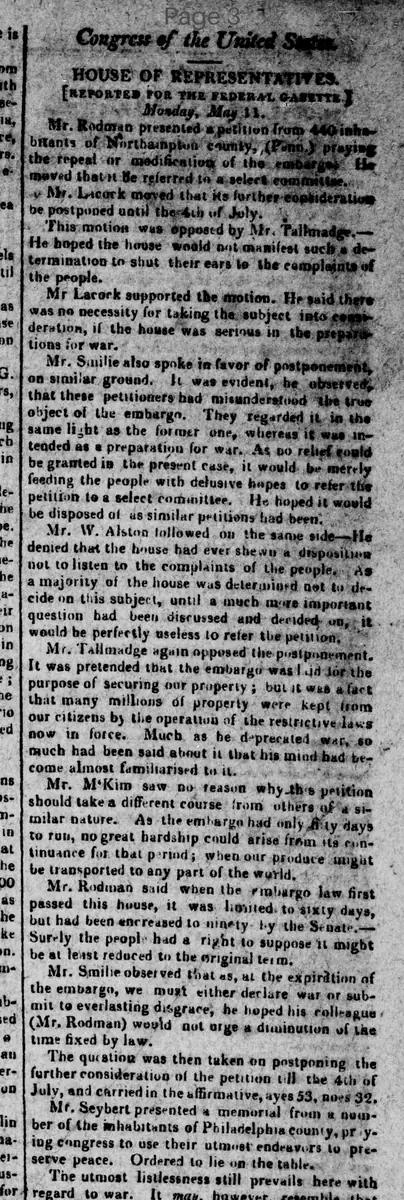
HOUSE OF REPRESENTATIVES.
REPORTED FOR THE FEDERAL GAZETTE
Monday May 11
Mr. Rodman presented a petition from sundry inhabitants of Northampton county, (Penn.) praying the repeal or modification of the embargo; moved that it be referred to a select committee.
Mr. Lowndes moved that its further consideration be postponed until the 4th of July.
This motion was opposed by Mr. Tallmadge.
He hoped the house would not manifest such a determination to shut their ears to the complaint of the people.
Mr. Lowndes supported the motion. He said there was no necessity for taking the subject into consideration, if the house was serious in the preparations for war.
Mr. Smilie also spoke in favor of postponement on similar ground. It was evident, he observed that these petitioners had misunderstood the true object of the embargo. They regarded it in the same light as the former one whereas it was intended as a preparation for war. As no relief could be granted in the present case, it would be merely feeding the people with delusive hopes to refer the petition to a select committee. He hoped it would be disposed of as similar petitions had been.
Mr. W. Alston followed on the same side He denied that the house had ever shown a disposition not to listen to the complaints of the people as a majority of the house was determined not to decide on this subject, until a much more important question had been discussed and decided on, it would be perfectly useless to refer the petition.
Mr. Tallmadge again opposed the postponement. It was pretended that the embargo was laid for the purpose of securing our property; but it was a fact that many millions of property were kept from our citizens by the operation of the restrictive laws now in force. Much as he deprecated war, so much had been said about it that his mind had become almost familiarised to it.
Mr. McKim saw no reason why this petition should take a different course from others of a similar nature. As the embargo had only fifty days to run, no great hardship could arise from its continuance for that period; when our produce might be transported to any part of the world.
Mr. Rodman said when the embargo law first passed this house, it was limited to sixty days, but had been increased to ninety by the Senate. Surely the people had a right to suppose it might be at least reduced to the original term.
Mr. Smilie observed that as, at the expiration of the embargo, we must either declare war or submit to everlasting disgrace, he hoped his colleague (Mr. Rodman) would not urge a diminution of the time fixed by law.
The question was then taken on postponing the further consideration of the petition till the 4th of July, and carried in the affirmative, ayes 53, noes 32.
Mr. Seybert presented a memorial from a number of the inhabitants of Philadelphia county, praying congress to use their utmost endeavors to preserve peace. Ordered to lie on the table.
What sub-type of article is it?
What themes does it cover?
What keywords are associated?
What entities or persons were involved?
Where did it happen?
Story Details
Key Persons
Location
House Of Representatives, United States Congress
Event Date
Monday May 11
Story Details
Debate on petition for embargo repeal: Rodman presents petition from Northampton County; Lowndes moves postponement to July 4, supported by Smilie, Alston, McKim citing war preparations; opposed by Tallmadge and Rodman emphasizing public complaints and property losses; motion passes 53-32. Seybert presents Philadelphia peace memorial, tabled.