Thank you for visiting SNEWPapers!
Sign up free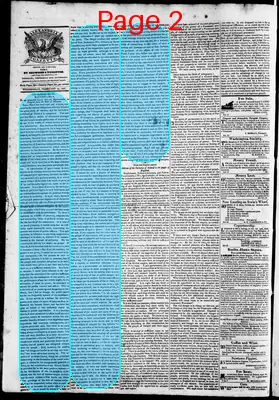
Editorial
February 14, 1827
Phenix Gazette
Alexandria, Virginia
What is this article about?
An editorial letter to Rep. Lewis McLane critiques Andrew Jackson's unconstitutional actions during the New Orleans events, emphasizing the Constitution as a citizen compact that limits government power and protects rights like habeas corpus and free press. It warns against supporting Jackson's presidential bid as a threat to liberties.
Clipping
OCR Quality
98%
Excellent
Full Text
[For the Phenix Gazette.]
BAYARD.-No. 9.
To the Honorable Lewis McLane, Representative in Congress from the State of Delaware.
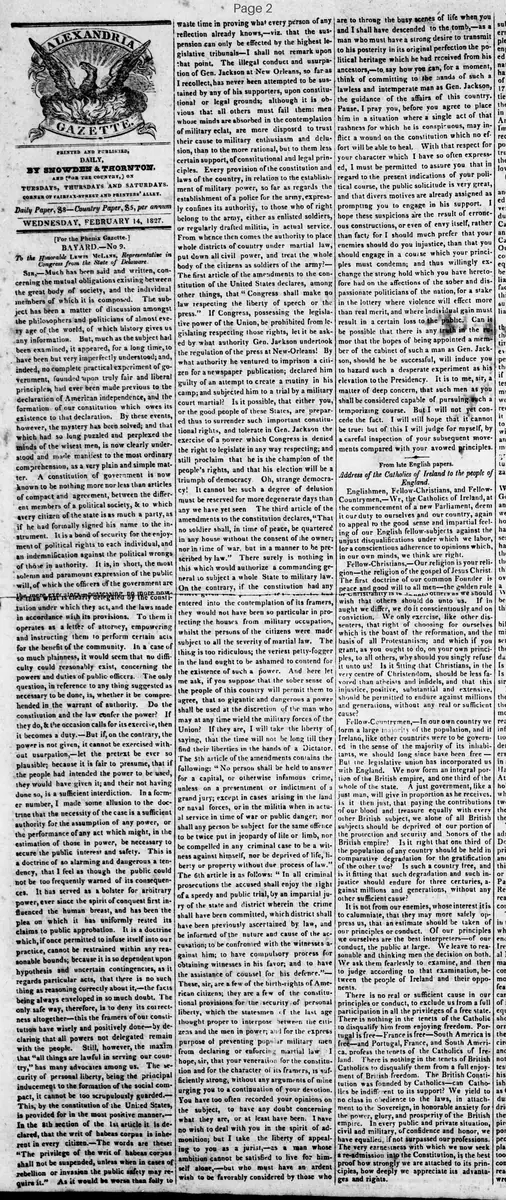
Sir,—Much has been said and written, concerning the mutual obligations existing between the great body of society, and the individual members of which it is composed. The subject has been a matter of discussion amongst the philosophers and politicians of almost every age of the world, of which history gives us any information. But, much as the subject had been examined, it appeared, for a long time, to have been but very imperfectly understood; and, indeed, no complete practical experiment of government, founded upon truly fair and liberal principles, had ever been made previous to the declaration of American independence, and the formation of our constitution which owes its existence to that declaration. By these events, however, the mystery has been solved; and that which had so long puzzled and perplexed the minds of the wisest men, is now clearly understood and made manifest to the most ordinary comprehension, as a very plain and simple matter. A constitution of government is now known to be nothing more nor less than articles of compact and agreement, between the different members of a political society, & to which every citizen of the state is as much a party, as if he had originally signed his name to the instrument. It is a bond of security for the enjoyment of political rights to each individual, and an indemnification against the political wrongs of those in authority. It is, in short, the most solemn and paramount expression of the public will, of which the officers of the government are the mere executors, to be regulated by the constitution under which they act, and the laws made in accordance with its provisions. To them it operates as a letter of attorney, empowering and instructing them to perform certain acts for the benefit of the community. In a case of so much plainness, it would seem that no difficulty could reasonably exist, concerning the powers and duties of public officers. The only question, in reference to any thing suggested as necessary to be done, is, whether it be comprehended in the warrant of authority. Do the constitution and the law confer the power? If they do, & the occasion calls for its exercise, then it becomes a duty.—But if, on the contrary, the power is not given, it cannot be exercised without usurpation,—let the pretext be ever so plausible; because it is fair to presume, that if the people had intended the power to be used, they would have given it; and their not having done so, is a sufficient interdiction. In a former number, I made some allusion to the doctrine that the necessity of the case is a sufficient authority for the assumption of any power, or the performance of any act which might, in the estimation of those in power, be necessary to secure the public interest and safety. This is a doctrine of so alarming and dangerous a tendency, that I feel as though the public could not be too frequently warned of its consequences. It has served as a bolster of arbitrary power, ever since the spirit of conquest first influenced the human breast, and has been the plea on which it has uniformly rested its claims to public approbation. It is a doctrine which, if once permitted to infuse itself into our practice, cannot be restrained within any reasonable bounds; because it is so dependent upon hypothesis and uncertain contingencies, as it regards particular acts, that there is no such thing as reasoning correctly about it,—the acts being always enveloped in so much doubt. The only safe way, therefore, is to deny its correctness altogether—this the framers of our constitution have wisely and positively done—by declaring that all powers not delegated remain with the people. Still, however, the maxim that "all things are lawful in serving our country," has many advocates among us. The security of personal liberty, being the principal inducement to the formation of the social compact, it cannot be too scrupulously guarded.—This, by the constitution of the United States, is provided for in the most positive manner.—In the 8th section of the 1st article it is declared, that the writ of habeas corpus is inherent in every citizen.—The words are these:
"The privilege of the writ of habeas corpus shall not be suspended, unless when in cases of rebellion or invasion the public safety may require it."
As it would be worse than folly to waste time in proving what every person of any reflection already knows,—viz. that the suspension can only be effected by the highest legislative tribunals—I shall not remark upon that point. The illegal conduct and usurpation of Gen. Jackson at New Orleans, so far as I recollect, has never been attempted to be sustained by any of his supporters, upon constitutional or legal grounds; although it is obvious that all others must fail them: men whose minds are absorbed in the contemplation of military eclat, are more disposed to trust their cause to military enthusiasm and delusion, than to the more rational, but to them less certain support, of constitutional and legal principles. Every provision of the constitution and laws of the country, in relation to the establishment of military power, so far as regards the establishment of a police for the army, expressly confines its authority, to those who of right belong to the army, either as enlisted soldiers or regularly drafted militia, in actual service. From whence then comes the authority to place whole districts of country under martial law, put down all civil power, and treat the whole body of the citizens as soldiers of the army?—The first article of the amendments to the constitution of the United States declares, among other things, that "Congress shall make no law respecting the liberty of speech or the press." If Congress, possessing the legislative power of the Union, be prohibited from legislating respecting those rights, let it be asked by what authority Gen. Jackson undertook the regulation of the press at New-Orleans! By what authority he ventured to imprison a citizen for a newspaper publication; declared him guilty of an attempt to create a mutiny in his camp; and subjected him to a trial by a military court martial? Is it possible, that either you, or the good people of these States, are prepared thus to surrender such important constitutional rights, and tolerate in Gen. Jackson the exercise of a power which Congress is denied the right to legislate in any way respecting; and still proclaim that he is the champion of the people's rights, and that his election will be a triumph of democracy. Oh, strange democracy! It cannot be: such a degree of delusion must be reserved for more degenerate days than any we have yet seen. The third article of the amendments to the constitution declares, "That no soldier shall, in time of peace, be quartered in any house without the consent of the owner; nor in time of war, but in a manner to be prescribed by law." There surely is nothing in this which would authorize a commanding general to subject a whole State to military law. On the contrary, if the constitution had any thing entered into the contemplation of its framers, they would not have been so particular in protecting the houses from military occupation, whilst the persons of the citizens were made subject to all the severity of martial law. The thing is too ridiculous; the veriest petty-fogger in the land ought to be ashamed to contend for the existence of such a power. And here let me ask, if you suppose that the sober sense of the people of this country will permit them to agree, that so gigantic and dangerous a power shall be used at the discretion of the man who may at any time wield the military forces of the Union? If they are, I will take the liberty of saying, that the time will not be long till they find their liberties in the hands of a Dictator. The 5th article of the amendments contains the following: "No person shall be held to answer for a capital, or otherwise infamous crime, unless on a presentment or indictment of a grand jury; except in cases arising in the land or naval forces, or in the militia when in actual service in time of war or public danger; nor shall any person be subject for the same offence to be twice put in jeopardy of life or limb, nor be compelled in any criminal case to be a witness against himself, nor be deprived of life, liberty or property without due process of law." The 6th article is as follows: "In all criminal prosecutions the accused shall enjoy the right of a speedy and public trial, by an impartial jury of the state and district wherein the crime shall have been committed, which district shall have been previously ascertained by law, and to be informed of the nature and cause of the accusation; to be confronted with the witnesses against him; to have compulsory process for obtaining witnesses in his favor; and to have the assistance of counsel for his defence." These, sir, are a few of the birth-rights of American citizens; they are a few of the constitutional provisions for the security of personal liberty, which the statesmen of the last age thought proper to interpose between the citizens and the men in power; and for the express purpose of preventing popular military men from declaring or enforcing martial law. I hope, sir, that your veneration for the constitution and for the character of its framers, is sufficiently strong, without any arguments of mine urging you to a continuation of your devotion. You have too often recorded your opinions on the subject, to have any doubt concerning what they are, or at least have been. I have no wish to deal with you in the spirit of admonition; but I take the liberty of appealing to you as a jurist,—as a man whose ambition cannot be satisfied to live for himself alone,—but who must have an ardent wish to be favorably considered by those who are to throng the busy scenes of life when you and I shall have descended to the tomb,—as a man who must have a strong desire to transmit to his posterity in its original perfection the political heritage which he had received from his ancestors,—to say how you can, for a moment, think of committing to the hands of such a lawless and intemperate man as Gen. Jackson, the guidance of the affairs of this country. Pause. I pray you, before you agree to place him in a situation where a single act of that rashness for which he is conspicuous, may inflict a wound on the constitution which no effort will be able to heal. With that respect for your character which I have so often expressed, I must be permitted to assure you that in regard to the present indications of your political course, the public solicitude is very great, and that divers motives are already assigned as prompting you to engage in his support. I hope these suspicions are the result of erroneous constructions, or even of envy itself, rather than fact; for I should much prefer that your enemies should do you injustice, than that you should engage in a course which your principles must condemn; and thus willingly exchange the strong hold which you have heretofore had on the affections of the sober and dispassionate politicians of the nation, for a stake in the lottery where violence will effect more than real merit, and where individual gain must result in a certain loss to the public. Can it be possible that there is any truth in the rumor that the hopes of being appointed a member of the cabinet of such a man as Gen. Jackson, should he be successful, will induce you to hazard such a desperate experiment as his elevation to the Presidency. It is to me, sir, a matter of deep concern, that such men as you shall be considered capable of pursuing such a temporizing course. But I will not yet concede the fact. I will still hope that it cannot be true: but of this I will judge for myself, by a careful inspection of your subsequent movements compared with your avowed principles.
BAYARD.-No. 9.
To the Honorable Lewis McLane, Representative in Congress from the State of Delaware.
Sir,—Much has been said and written, concerning the mutual obligations existing between the great body of society, and the individual members of which it is composed. The subject has been a matter of discussion amongst the philosophers and politicians of almost every age of the world, of which history gives us any information. But, much as the subject had been examined, it appeared, for a long time, to have been but very imperfectly understood; and, indeed, no complete practical experiment of government, founded upon truly fair and liberal principles, had ever been made previous to the declaration of American independence, and the formation of our constitution which owes its existence to that declaration. By these events, however, the mystery has been solved; and that which had so long puzzled and perplexed the minds of the wisest men, is now clearly understood and made manifest to the most ordinary comprehension, as a very plain and simple matter. A constitution of government is now known to be nothing more nor less than articles of compact and agreement, between the different members of a political society, & to which every citizen of the state is as much a party, as if he had originally signed his name to the instrument. It is a bond of security for the enjoyment of political rights to each individual, and an indemnification against the political wrongs of those in authority. It is, in short, the most solemn and paramount expression of the public will, of which the officers of the government are the mere executors, to be regulated by the constitution under which they act, and the laws made in accordance with its provisions. To them it operates as a letter of attorney, empowering and instructing them to perform certain acts for the benefit of the community. In a case of so much plainness, it would seem that no difficulty could reasonably exist, concerning the powers and duties of public officers. The only question, in reference to any thing suggested as necessary to be done, is, whether it be comprehended in the warrant of authority. Do the constitution and the law confer the power? If they do, & the occasion calls for its exercise, then it becomes a duty.—But if, on the contrary, the power is not given, it cannot be exercised without usurpation,—let the pretext be ever so plausible; because it is fair to presume, that if the people had intended the power to be used, they would have given it; and their not having done so, is a sufficient interdiction. In a former number, I made some allusion to the doctrine that the necessity of the case is a sufficient authority for the assumption of any power, or the performance of any act which might, in the estimation of those in power, be necessary to secure the public interest and safety. This is a doctrine of so alarming and dangerous a tendency, that I feel as though the public could not be too frequently warned of its consequences. It has served as a bolster of arbitrary power, ever since the spirit of conquest first influenced the human breast, and has been the plea on which it has uniformly rested its claims to public approbation. It is a doctrine which, if once permitted to infuse itself into our practice, cannot be restrained within any reasonable bounds; because it is so dependent upon hypothesis and uncertain contingencies, as it regards particular acts, that there is no such thing as reasoning correctly about it,—the acts being always enveloped in so much doubt. The only safe way, therefore, is to deny its correctness altogether—this the framers of our constitution have wisely and positively done—by declaring that all powers not delegated remain with the people. Still, however, the maxim that "all things are lawful in serving our country," has many advocates among us. The security of personal liberty, being the principal inducement to the formation of the social compact, it cannot be too scrupulously guarded.—This, by the constitution of the United States, is provided for in the most positive manner.—In the 8th section of the 1st article it is declared, that the writ of habeas corpus is inherent in every citizen.—The words are these:
"The privilege of the writ of habeas corpus shall not be suspended, unless when in cases of rebellion or invasion the public safety may require it."
As it would be worse than folly to waste time in proving what every person of any reflection already knows,—viz. that the suspension can only be effected by the highest legislative tribunals—I shall not remark upon that point. The illegal conduct and usurpation of Gen. Jackson at New Orleans, so far as I recollect, has never been attempted to be sustained by any of his supporters, upon constitutional or legal grounds; although it is obvious that all others must fail them: men whose minds are absorbed in the contemplation of military eclat, are more disposed to trust their cause to military enthusiasm and delusion, than to the more rational, but to them less certain support, of constitutional and legal principles. Every provision of the constitution and laws of the country, in relation to the establishment of military power, so far as regards the establishment of a police for the army, expressly confines its authority, to those who of right belong to the army, either as enlisted soldiers or regularly drafted militia, in actual service. From whence then comes the authority to place whole districts of country under martial law, put down all civil power, and treat the whole body of the citizens as soldiers of the army?—The first article of the amendments to the constitution of the United States declares, among other things, that "Congress shall make no law respecting the liberty of speech or the press." If Congress, possessing the legislative power of the Union, be prohibited from legislating respecting those rights, let it be asked by what authority Gen. Jackson undertook the regulation of the press at New-Orleans! By what authority he ventured to imprison a citizen for a newspaper publication; declared him guilty of an attempt to create a mutiny in his camp; and subjected him to a trial by a military court martial? Is it possible, that either you, or the good people of these States, are prepared thus to surrender such important constitutional rights, and tolerate in Gen. Jackson the exercise of a power which Congress is denied the right to legislate in any way respecting; and still proclaim that he is the champion of the people's rights, and that his election will be a triumph of democracy. Oh, strange democracy! It cannot be: such a degree of delusion must be reserved for more degenerate days than any we have yet seen. The third article of the amendments to the constitution declares, "That no soldier shall, in time of peace, be quartered in any house without the consent of the owner; nor in time of war, but in a manner to be prescribed by law." There surely is nothing in this which would authorize a commanding general to subject a whole State to military law. On the contrary, if the constitution had any thing entered into the contemplation of its framers, they would not have been so particular in protecting the houses from military occupation, whilst the persons of the citizens were made subject to all the severity of martial law. The thing is too ridiculous; the veriest petty-fogger in the land ought to be ashamed to contend for the existence of such a power. And here let me ask, if you suppose that the sober sense of the people of this country will permit them to agree, that so gigantic and dangerous a power shall be used at the discretion of the man who may at any time wield the military forces of the Union? If they are, I will take the liberty of saying, that the time will not be long till they find their liberties in the hands of a Dictator. The 5th article of the amendments contains the following: "No person shall be held to answer for a capital, or otherwise infamous crime, unless on a presentment or indictment of a grand jury; except in cases arising in the land or naval forces, or in the militia when in actual service in time of war or public danger; nor shall any person be subject for the same offence to be twice put in jeopardy of life or limb, nor be compelled in any criminal case to be a witness against himself, nor be deprived of life, liberty or property without due process of law." The 6th article is as follows: "In all criminal prosecutions the accused shall enjoy the right of a speedy and public trial, by an impartial jury of the state and district wherein the crime shall have been committed, which district shall have been previously ascertained by law, and to be informed of the nature and cause of the accusation; to be confronted with the witnesses against him; to have compulsory process for obtaining witnesses in his favor; and to have the assistance of counsel for his defence." These, sir, are a few of the birth-rights of American citizens; they are a few of the constitutional provisions for the security of personal liberty, which the statesmen of the last age thought proper to interpose between the citizens and the men in power; and for the express purpose of preventing popular military men from declaring or enforcing martial law. I hope, sir, that your veneration for the constitution and for the character of its framers, is sufficiently strong, without any arguments of mine urging you to a continuation of your devotion. You have too often recorded your opinions on the subject, to have any doubt concerning what they are, or at least have been. I have no wish to deal with you in the spirit of admonition; but I take the liberty of appealing to you as a jurist,—as a man whose ambition cannot be satisfied to live for himself alone,—but who must have an ardent wish to be favorably considered by those who are to throng the busy scenes of life when you and I shall have descended to the tomb,—as a man who must have a strong desire to transmit to his posterity in its original perfection the political heritage which he had received from his ancestors,—to say how you can, for a moment, think of committing to the hands of such a lawless and intemperate man as Gen. Jackson, the guidance of the affairs of this country. Pause. I pray you, before you agree to place him in a situation where a single act of that rashness for which he is conspicuous, may inflict a wound on the constitution which no effort will be able to heal. With that respect for your character which I have so often expressed, I must be permitted to assure you that in regard to the present indications of your political course, the public solicitude is very great, and that divers motives are already assigned as prompting you to engage in his support. I hope these suspicions are the result of erroneous constructions, or even of envy itself, rather than fact; for I should much prefer that your enemies should do you injustice, than that you should engage in a course which your principles must condemn; and thus willingly exchange the strong hold which you have heretofore had on the affections of the sober and dispassionate politicians of the nation, for a stake in the lottery where violence will effect more than real merit, and where individual gain must result in a certain loss to the public. Can it be possible that there is any truth in the rumor that the hopes of being appointed a member of the cabinet of such a man as Gen. Jackson, should he be successful, will induce you to hazard such a desperate experiment as his elevation to the Presidency. It is to me, sir, a matter of deep concern, that such men as you shall be considered capable of pursuing such a temporizing course. But I will not yet concede the fact. I will still hope that it cannot be true: but of this I will judge for myself, by a careful inspection of your subsequent movements compared with your avowed principles.
What sub-type of article is it?
Constitutional
Partisan Politics
Military Affairs
What keywords are associated?
Constitutional Compact
Martial Law
Habeas Corpus
Andrew Jackson
New Orleans
Presidential Election
Personal Liberty
Usurpation Of Power
What entities or persons were involved?
Lewis Mclane
Gen. Jackson
Framers Of The Constitution
Congress
Editorial Details
Primary Topic
Criticism Of Andrew Jackson's Unconstitutional Military Actions And Opposition To His Presidential Candidacy
Stance / Tone
Strongly Anti Jackson, Pro Constitutional Safeguards
Key Figures
Lewis Mclane
Gen. Jackson
Framers Of The Constitution
Congress
Key Arguments
Constitution Is A Compact Between Citizens And Government Limiting Powers To Those Delegated
Powers Not Granted By Constitution Cannot Be Exercised Without Usurpation
Doctrine Of Necessity Justifies Arbitrary Power And Must Be Rejected
Jackson's Suspension Of Habeas Corpus And Martial Law In New Orleans Violated Constitutional Rights
Jackson's Regulation Of The Press And Military Trials Infringe On Free Speech Protections
Election Of Jackson Risks Dictatorship And Endangers Personal Liberties
Appeal To Mclane To Uphold Principles And Avoid Supporting Jackson For Personal Gain