Thank you for visiting SNEWPapers!
Sign up free
The New Hampshire Gazette
Portsmouth, Rockingham County, New Hampshire
What is this article about?
Francis Baily writes from Alexandria on Sept. 14 to correct misinformation about US-Spain boundary settlements in the West. He reports ongoing tensions at Natchez, weak Spanish forces along the Mississippi, and two treaty violations: seizure of American flour at reduced price and denial of fair payment in a debt case.
Clipping
OCR Quality
Full Text
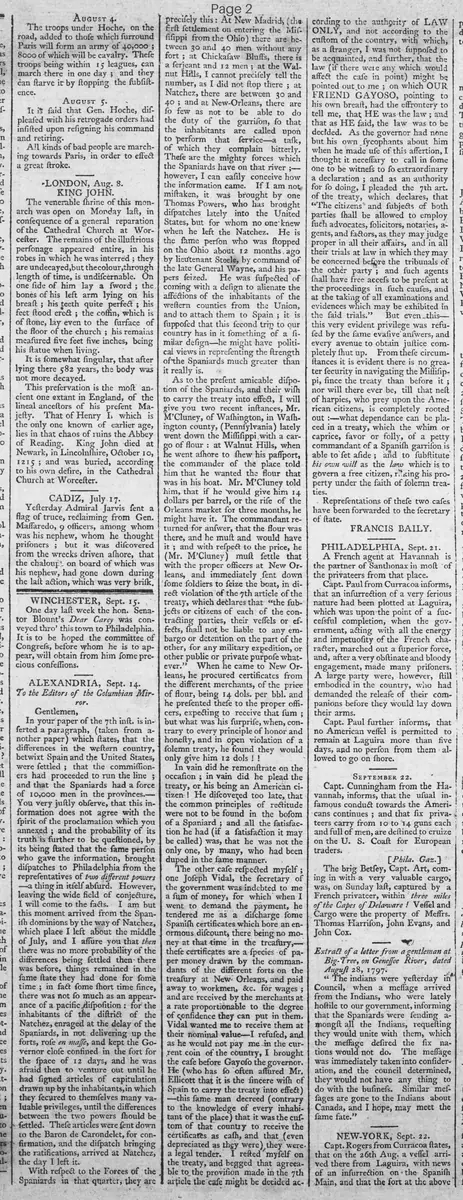
To the Editors of the Columbian Mirror.
Gentlemen,
In your paper of the 7th inst. is inserted a paragraph, (taken from another paper) which states, that the differences in the western country, betwixt Spain and the United States, were settled: that the commissioners had proceeded to run the line; and that the Spaniards had a force of 10,000 men in the provinces.--You very justly observe, that this information does not agree with the spirit of the proclamation which you annexed; and the probability of its truth is further to be questioned, by its being stated that the same person who gave the information, brought dispatches to Philadelphia from the representatives of two different powers --a thing in itself absurd. However, leaving the wide field of conjecture, I will come to the facts. I am but this moment arrived from the Spanish dominions by the way of Natchez, which place I left about the middle of July, and I assure you that then there was no more probability of the differences being settled than there was before, things remained in the same state they had done for some time; in fact some short time since, there was not so much as an appearance of a pacific disposition: for the inhabitants of the district of the Natchez, enraged at the delay of the Spaniards, in not delivering up the forts, rose en masse, and kept the Governor close confined in the fort for the space of 12 days, and he was afraid then to venture out until he had signed articles of capitulation drawn up by the inhabitants, in which they secured to themselves many valuable privileges, until the differences between the two powers should be settled. These articles were sent down to the Baron de Carondelet, for confirmation, and the dispatch bringing the ratifications, arrived at Natchez, the day I left it.
With respect to the Forces of the Spaniards in that quarter, they are precisely this: At New Madrid, (the first settlement on entering the Mississippi from the Ohio) there are between 30 and 40 men without any fort; at Chickasaw Bluffs, there is a sergeant and 12 men: at the Walnut Hills, I cannot precisely tell the number, as I did not stop there; at Natchez, there are between 30 and 40; and at New-Orleans, there are so few as not to be able to do the duty of the garrison, so that the inhabitants are called upon to perform that service--a task, of which they complain bitterly. These are the mighty forces which the Spaniards have on that river;--however, I can easily conceive how the information came. If I am not mistaken, it was brought by one Thomas Powers, who has brought dispatches lately into the United States, but for whom no one knew when he left the Natchez. He is the same person who was stopped on the Ohio about 12 months ago by lieutenant Steele, by command of the late General Wayne, and his papers seized. He was suspected of coming with a design to alienate the affections of the inhabitants of the western counties from the Union, and to attach them to Spain; it is supposed that this second trip to our country has in it something of a similar design--he might have political views in representing the strength of the Spaniards much greater than it really is.
As to the present amicable disposition of the Spaniards, and their wish to carry the treaty into effect, I will give you two recent instances, Mr. M'Cluney, of Washington, in Washington county, (Pennsylvania) lately went down the Mississippi with a cargo of flour: at Walnut Hills, when he went ashore to shew his passport, the commander of the place told him that he wanted the flour that was in his boat. Mr. M'Cluney told him, that if he would give him 14 dollars per barrel, or the rise of the Orleans market for three months, he might have it. The commandant returned for answer, that the flour was there, and he must and would have it; and with respect to the price, he (Mr. M'Cluney) must settle that with the proper officers at New Orleans, and immediately sent down some soldiers to seize the boat, in direct violation of the 7th article of the treaty, which declares that "the subjects or citizens of each of the contracting parties, their vessels or effects, shall not be liable to any embargo or detention on the part of the other, for any military expedition, or other public or private purpose whatever." When he came to New Orleans, he procured certificates from the different merchants, of the price of flour, being 14 dols. per bbl. and he presented these to the proper officers, expecting to receive that sum; but what was his surprise, when, contrary to every principle of honor and honesty, and in open violation of a solemn treaty, he found they would only give him 12 dols.!! In vain did he remonstrate on the occasion; in vain did he plead the treaty, or his being an American citizen! He discovered too late, that the common principles of rectitude were not to be found in the bosom of a Spaniard; and all the satisfaction he had (if a satisfaction it may be called) was, that he was not the only one, by many, who had been duped in the same manner.
The other case respected myself: one Joseph Vidal, the secretary of the government was indebted to me a sum of money, for which when I went to demand the payment, he tendered me as a discharge some Spanish certificates which bore an enormous discount, there being no money at that time in the treasury,--these certificates are a species of paper money drawn by the commandants of the different forts on the treasury at New Orleans, and paid away to workmen, &c. for wages; and are received by the merchants at a rate proportionable to the degree of confidence they can put in them. Vidal wanted me to receive them at their nominal value--I refused, and as he would not pay me in the current coin of the country, I brought the case before Gayoso the governor. He (who has so often assured Mr. Ellicott that it is the sincere wish of Spain to carry the treaty into effect) --this same man decreed (contrary to the knowledge of every inhabitant of the place) that it was the custom of that country to receive the certificates as cash, and that (even depreciated as they were) they were a legal tender. I rested myself on the treaty, and begged that agreeable to the provision made in the 7th article the case might be decided according to the authority of LAW ONLY, and not according to the custom of the country, with which, as a stranger, I was not supposed to be acquainted, and further, that the law (if there were any which would affect the case in point) might be pointed out to me; on which OUR FRIEND GAYOSO, pointing to his own breast, had the effrontery to tell me, that HE was the law; and that as HE said, the law was to be decided. As the governor had none but his own sycophants about him when he made use of this assertion, I thought it necessary to call in some one to be witness to so extraordinary a declaration; and as an authority for so doing, I pleaded the 7th art. of the treaty, which declares, that "The citizens and subjects of both parties shall be allowed to employ such advocates, solicitors, notaries, agents, and factors, as they may judge proper in all their affairs, and in all their trials at law in which they may be concerned before the tribunals of the other party'; and such agents shall have free access to be present at the proceedings in such causes, and at the taking of all examinations and evidences which may be exhibited in the said trials." But even this--this very evident privilege was refused by the same evasive answers, and every avenue to obtain justice completely shut up. From these circumstances it is evident there is no greater security in navigating the Mississippi, since the treaty than before it; nor will there ever be, till that nest of harpies, who prey upon the American citizens, is completely rooted out :--what dependance can be placed in a treaty, which the whim or caprice, favor or folly, of a petty commandant of a Spanish garrison is able to set aside: and to substitute his own will as the law which is to govern a free citizen, risking his property under the faith of solemn treaties.
Representations of these two cases have been forwarded to the secretary of state.
FRANCIS BAILY.
What sub-type of article is it?
What themes does it cover?
What keywords are associated?
What entities or persons were involved?
Letter to Editor Details
Author
Francis Baily
Recipient
To The Editors Of The Columbian Mirror
Main Argument
the reported settlement of us-spain differences in the west is false; tensions persist at natchez with weak spanish forces, and spaniards violate the treaty through seizures and unfair dealings, undermining navigation security on the mississippi.
Notable Details