Thank you for visiting SNEWPapers!
Sign up free
The Daily Worker
Chicago, Cook County, Illinois
What is this article about?
Detailed account of the preparation, organization, and execution of hunger marches by unemployed workers from New York to Albany and Trenton, demanding unemployment insurance. Emphasizes selection of disciplined marchers, logistical arrangements, warm receptions, clashes with authorities, and the marches' role in raising worker awareness and militancy.
Clipping
OCR Quality
Full Text
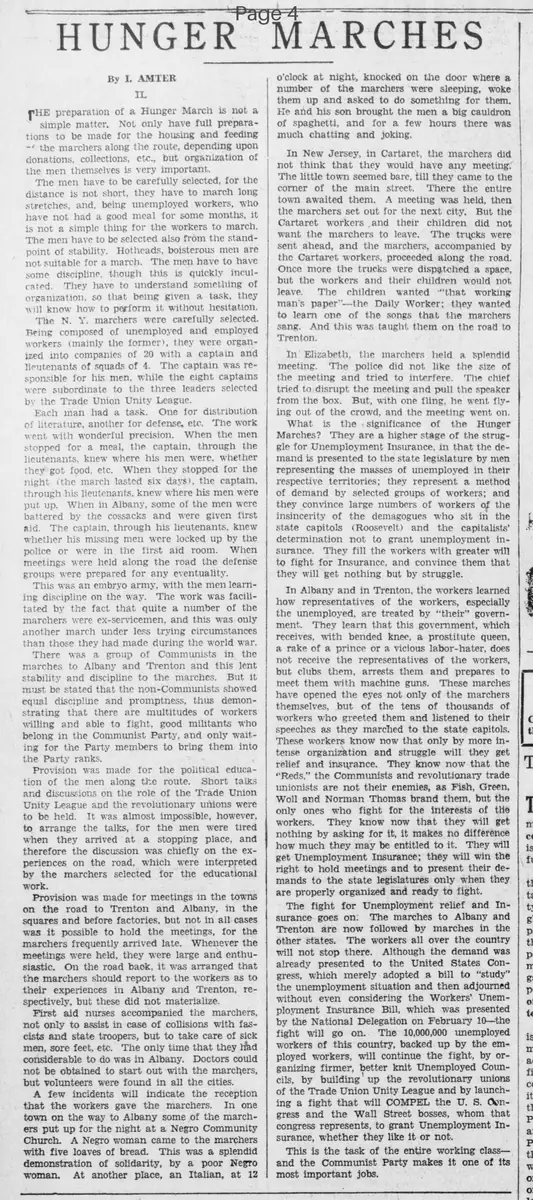
By I. AMTER
II.
The preparation of a Hunger March is not a simple matter. Not only have full preparations to be made for the housing and feeding of the marchers along the route, depending upon donations, collections, etc., but organization of the men themselves is very important.
The men have to be carefully selected, for the distance is not short, they have to march long stretches, and, being unemployed workers, who have not had a good meal for some months, it is not a simple thing for the workers to march.
The men have to be selected also from the standpoint of stability. Hotheads, boisterous men are not suitable for a march. The men have to have some discipline, though this is quickly inculcated. They have to understand something of organization, so that being given a task, they will know how to perform it without hesitation.
The N. Y. marchers were carefully selected. Being composed of unemployed and employed workers (mainly the former), they were organized into companies of 20 with a captain and lieutenants of squads of 4. The captain was responsible for his men, while the eight captains were subordinate to the three leaders selected by the Trade Union Unity League.
Each man had a task. One for distribution of literature, another for defense, etc. The work went with wonderful precision. When the men stopped for a meal, the captain, through the lieutenants, knew where his men were, whether they got food, etc. When they stopped for the night (the march lasted six days), the captain, through his lieutenants, knew where his men were put up. When in Albany, some of the men were battered by the cossacks and were given first aid. The captain, through his lieutenants, knew whether his missing men were locked up by the police or were in the first aid room. When meetings were held along the road the defense groups were prepared for any eventuality.
This was an embryo army, with the men learning discipline on the way. The work was facilitated by the fact that quite a number of the marchers were ex-servicemen, and this was only another march under less trying circumstances than those they had made during the world war.
There was a group of Communists in the marches to Albany and Trenton and this lent stability and discipline to the marches. But it must be stated that the non-Communists showed equal discipline and promptness, thus demonstrating that there are multitudes of workers willing and able to fight, good militants who belong in the Communist Party, and only waiting for the Party members to bring them into the Party ranks.
Provision was made for the political education of the men along the route. Short talks and discussions on the role of the Trade Union Unity League and the revolutionary unions were to be held. It was almost impossible, however, to arrange the talks, for the men were tired when they arrived at a stopping place, and therefore the discussion was chiefly on the experiences on the road, which were interpreted by the marchers selected for the educational work.
Provision was made for meetings in the towns on the road to Trenton and Albany, in the squares and before factories, but not in all cases was it possible to hold the meetings, for the marchers frequently arrived late. Whenever the meetings were held, they were large and enthusiastic. On the road back, it was arranged that the marchers should report to the workers as to their experiences in Albany and Trenton, respectively, but these did not materialize.
First aid nurses accompanied the marchers, not only to assist in case of collisions with fascists and state troopers, but to take care of sick men, sore feet, etc. The only time that they had considerable to do was in Albany. Doctors could not be obtained to start out with the marchers, but volunteers were found in all the cities.
A few incidents will indicate the reception that the workers gave the marchers. In one town on the way to Albany some of the marchers put up for the night at a Negro Community Church. A Negro woman came to the marchers with five loaves of bread. This was a splendid demonstration of solidarity, by a poor Negro woman. At another place, an Italian, at 12 o'clock at night, knocked on the door where a number of the marchers were sleeping, woke them up and asked to do something for them. He and his son brought the men a big cauldron of spaghetti, and for a few hours there was much chatting and joking.
In New Jersey, in Carteret, the marchers did not think that they would have any meeting. The little town seemed bare, till they came to the corner of the main street. There the entire town awaited them. A meeting was held, then the marchers set out for the next city. But the Carteret workers and their children did not want the marchers to leave. The trucks were sent ahead, and the marchers, accompanied by the Carteret workers, proceeded along the road. Once more the trucks were dispatched a space, but the workers and their children would not leave. The children wanted that working man's paper—the Daily Worker; they wanted to learn one of the songs that the marchers sang. And this was taught them on the road to Trenton.
In Elizabeth, the marchers held a splendid meeting. The police did not like the size of the meeting and tried to interfere. The chief tried to disrupt the meeting and pull the speaker from the box. But, with one fling, he went flying out of the crowd, and the meeting went on.
What is the significance of the Hunger Marches? They are a higher stage of the struggle for Unemployment Insurance, in that the demand is presented to the state legislature by men representing the masses of unemployed in their respective territories; they represent a method of demand by selected groups of workers; and they convince large numbers of workers of the insincerity of the demagogues who sit in the state capitols (Roosevelt) and the capitalists' determination not to grant unemployment insurance. They fill the workers with greater will to fight for Insurance, and convince them that they will get nothing but by struggle.
In Albany and in Trenton, the workers learned how representatives of the workers, especially the unemployed, are treated by "their" government. They learn that this government, which receives, with bended knee, a prostitute queen, a rake of a prince or a vicious labor-hater, does not receive the representatives of the workers, but clubs them, arrests them and prepares to meet them with machine guns. These marches have opened the eyes not only of the marchers themselves, but of the tens of thousands of workers who greeted them and listened to their speeches as they marched to the state capitols.
These workers know now that only by more intense organization and struggle will they get relief and insurance. They know now that the "Reds," the Communists and revolutionary trade unionists are not their enemies, as Fish, Green, Woll and Norman Thomas brand them, but the only ones who fight for the interests of the workers. They know now that they will get nothing by asking for it, it makes no difference how much they may be entitled to it. They will get Unemployment Insurance; they will win the right to hold meetings and to present their demands to the state legislatures only when they are properly organized and ready to fight.
The fight for Unemployment relief and Insurance goes on. The marches to Albany and Trenton are now followed by marches in the other states. The workers all over the country will not stop there. Although the demand was already presented to the United States Congress, which merely adopted a bill to "study" the unemployment situation and then adjourned without even considering the Workers' Unemployment Insurance Bill, which was presented by the National Delegation on February 10 the fight will go on. The 10,000,000 unemployed workers of this country, backed up by the employed workers, will continue the fight, by organizing firmer, better knit Unemployed Councils, by building up the revolutionary unions of the Trade Union Unity League and by launching a fight that will COMPEL the U. S. Congress and the Wall Street bosses, whom that congress represents, to grant Unemployment Insurance, whether they like it or not.
This is the task of the entire working class—and the Communist Party makes it one of its most important jobs.
What sub-type of article is it?
What themes does it cover?
What keywords are associated?
What entities or persons were involved?
Where did it happen?
Story Details
Key Persons
Location
From New York To Albany And Trenton, New Jersey, Carteret, Elizabeth
Story Details
Unemployed workers, organized by the Trade Union Unity League with Communist involvement, march from New York to Albany and Trenton over six days to demand unemployment insurance. Marchers are selected for discipline, structured into companies with captains and lieutenants for tasks like defense and literature distribution. They receive warm support from workers, face police violence in Albany and Elizabeth, and learn about government hostility toward labor. The marches educate participants and supporters on the need for militant struggle to achieve insurance and rights.