Thank you for visiting SNEWPapers!
Sign up free
The Virginia Gazette
Richmond, Williamsburg, Richmond County, Virginia
What is this article about?
At a Boston town meeting chaired by Samuel Adams, a committee reports defending against General Gage's letter to Peyton Randolph, accusing him of misrepresenting events like troop deployments and property seizures that alarmed colonists. The meeting thanks other colonies for support amid British oppression.
Merged-components note: Textual continuation: the second component picks up directly with the vote from the Boston town meeting report in the first.
Clippings
1 of 2
OCR Quality
Full Text
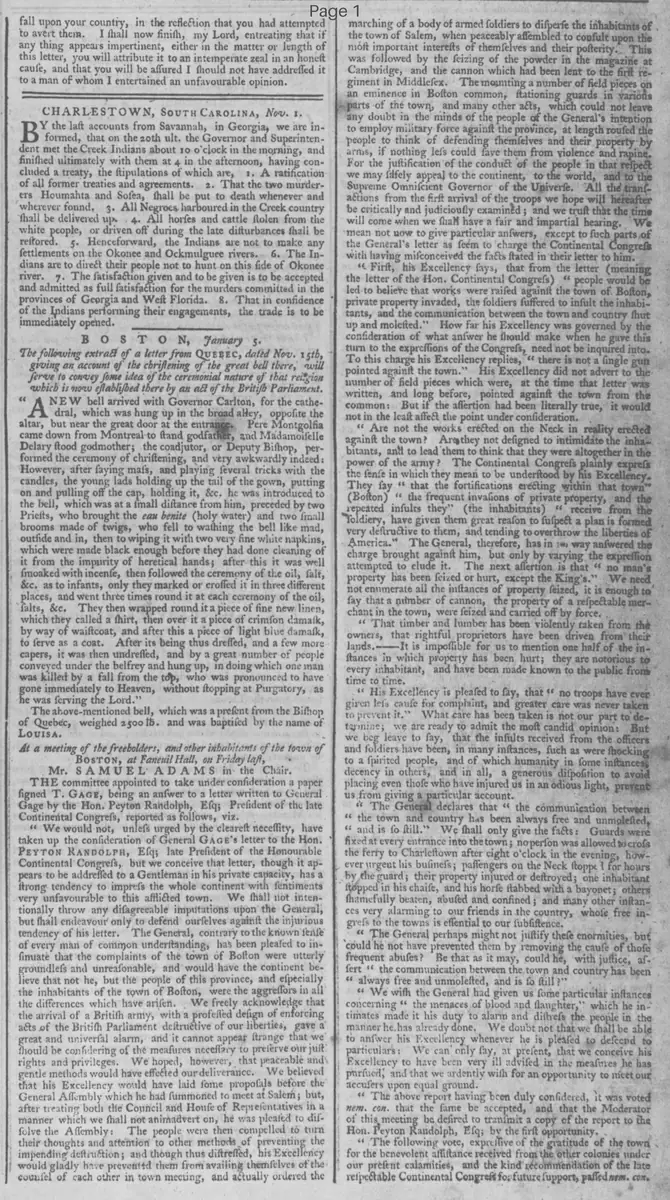
Mr. SAMUEL ADAMS in the Chair.
THE committee appointed to take under consideration a paper signed T. GAGE, being an answer to a letter written to General Gage by the Hon. Peyton Randolph, Esq; President of the late Continental Congress, reported as follows, viz.
"We would not, unless urged by the clearest necessity, have taken up the consideration of General GAGE's letter to the Hon. PEYTON RANDOLPH, Esq; late President of the Honourable Continental Congress, but we conceive that letter, though it appears to be addressed to a Gentleman in his private capacity, has a strong tendency to impress the whole continent with sentiments very unfavourable to this afflicted town. We shall not intentionally throw any disagreeable imputations upon the General, but shall endeavour only to defend ourselves against the injurious tendency of his letter. The General, contrary to the known sense of every man of common understanding, has been pleased to insinuate that the complaints of the town of Boston were utterly groundless and unreasonable, and would have the continent believe that not he, but the people of this province, and especially the inhabitants of the town of Boston, were the aggressors in all the differences which have arisen. We freely acknowledge that the arrival of a British army, with a professed design of enforcing acts of the British Parliament destructive of our liberties, gave a great and universal alarm, and it cannot appear strange that we should be considering of the measures necessary to preserve our just rights and privileges. We hoped, however, that peaceable and gentle methods would have effected our deliverance. We believed that his Excellency would have laid some proposals before the General Assembly which he had summoned to meet at Salem; but, after treating both the Council and House of Representatives in a manner which we shall not animadvert on, he was pleased to dissolve the Assembly: The people were then compelled to turn their thoughts and attention to other methods of preventing the impending destruction; and though thus distressed, his Excellency would gladly have prevented them from availing themselves of the counsel of each other in town meeting, and actually ordered the marching of a body of armed soldiers to disperse the inhabitants of the town of Salem, when peaceably assembled to consult upon the most important interests of themselves and their posterity. This was followed by the seizing of the powder in the magazine at Cambridge, and the cannon which had been lent to the first regiment in Middlesex. The mounting a number of field pieces on an eminence in Boston common, stationing guards in various parts of the town, and many other acts, which could not leave any doubt in the minds of the people of the General's intention to employ military force against the province, at length roused the people to think of defending themselves and their property by arms, if nothing less could save them from violence and rapine. For the justification of the conduct of the people in that respect we may safely appeal to the continent, to the world, and to the Supreme Omnicient Governor of the Universe. All the transactions from the first arrival of the troops we hope will hereafter be critically and judiciously examined; and we trust that the time will come when we shall have a fair and impartial hearing. We mean not now to give particular answers, except to such parts of the General's letter as seem to charge the Continental Congress with having misconceived the facts stated in their letter to him.
"First, his Excellency says, that from the letter (meaning the letter of the Hon. Continental Congress) people would be led to believe that works were raised against the town of Boston, private property invaded, the soldiers suffered to insult the inhabitants, and the communication between the town and country shut up and molested." How far his Excellency was governed by the consideration of what answer he should make when he gave this turn to the expressions of the Congress, need not be enquired into. To this charge his Excellency replies, "there is not a single gun pointed against the town." His Excellency did not advert to the number of field pieces which were, at the time that letter was written, and long before, pointed against the town from the common: But if the assertion had been literally true, it would not in the least affect the point under consideration.
"Are not the works erected on the Neck in reality erected against the town? Are they not designed to intimidate the inhabitants, and to lead them to think that they were altogether in the power of the army? The Continental Congress plainly express the sense in which they mean to be understood by his Excellency. They say "that the fortifications erecting within that town (Boston) the frequent invasions of private property, and the repeated insults they (the inhabitants) receive from the soldiery, have given them great reason to suspect a plan is formed very destructive to them, and tending to overthrow the liberties of America." The General, therefore, has in no way answered the charge brought against him, but only by varying the expression attempted to elude it. The next assertion is that "no man's property has been seized or hurt, except the King's." We need not enumerate all the instances of property seized, it is enough to say that a number of cannon, the property of a respectable merchant in the town, were seized and carried off by force.
"That timber and lumber has been violently taken from the owners, that rightful proprietors have been driven from their lands.---It is impossible for us to mention one half of the instances in which property has been hurt; they are notorious to every inhabitant, and have been made known to the public from time to time.
"His Excellency is pleased to say, that "no troops have ever given less cause for complaint, and greater care was never taken to prevent it." What care has been taken is not our part to determine; we are ready to admit the most candid opinion: But we beg leave to say, that the insults received from the officers and soldiers have been, in many instances, such as were shocking to a spirited people, and of which humanity in some instances, decency in others, and in all, a generous disposition to avoid placing even those who have injured us in an odious light, prevent us from giving a particular account.
The General declares that "the communication between the town and country has been always free and unmolested, and is so still." We shall only give the facts: Guards were fixed at every entrance into the town; no person was allowed to cross the ferry to Charlestown after eight o'clock in the evening, however urgent his business; passengers on the Neck stopped for hours by the guard; their property injured or destroyed; one inhabitant stopped in his chaise, and his horse stabbed with a bayonet; others shamefully beaten, abused and confined; and many other instances very alarming to our friends in the country, whose free ingress to the town is essential to our subsistence.
"The General perhaps might not justify these enormities, but could he not have prevented them by removing the cause of those frequent abuses? Be that as it may, could he, with justice, assert "the communication between the town and country has been always free and unmolested, and is so still?"
"We wish the General had given us some particular instances concerning "the menaces of blood and slaughter," which he intimates made it his duty to alarm and distress the people in the manner he has already done. We doubt not that we shall be able to answer his Excellency whenever he is pleased to descend to particulars: We can only say, at present, that we conceive his Excellency to have been very ill advised in the measures he has pursued, and that we ardently wish for an opportunity to meet our accusers upon equal ground.
"The above report having been duly considered, it was voted nem. con. that the same be accepted, and that the Moderator of this meeting be desired to transmit a copy of the report to the Hon. Peyton Randolph, Esq; by the first opportunity,
"The following vote, expressive of the gratitude of the town for the benevolent assistance received from the other colonies under our present calamities, and the kind recommendation of the late respectable Continental Congress for future support, passed nem. con.
Whereas the town of Boston is unfortunately become the most striking monument of ministerial tyranny and barbarity, as is particularly exhibited in the sudden shutting up of this port, thereby cruelly depriving the inhabitants of this metropolis of the means they have hitherto used to support themselves: And whereas our brethren in the other colonies, well knowing that we are suffering in the common cause of America, and of mankind, have, from a generous and brotherly disposition, contributed largely towards our support in this time of distress, without which many worthy and virtuous citizens must have been in imminent danger of perishing with cold and hunger: And whereas the Honourable Members of the Continental Congress have kindly recommended us to our sister colonies as worthy of further support from them, while the iron hand of unremitted oppression lies heavy upon us: Therefore, voted, that this town, truly sensible of the generous assistance they have received from their sympathising brethren, return them their warmest and most sincere thanks for the same, and pray that God, whose beneficence they so gloriously imitate, may bestow upon them the blessings he has promised to all those who feed the hungry and clothe the naked. And the thanks of this town are accordingly hereby given to our benefactors aforementioned, and to the Honourable Members of the Congress for their benevolence towards us expressed as aforesaid; which support, if continued, cannot fail of animating us to remain steadfast in the defence of the rights of America.
What sub-type of article is it?
What themes does it cover?
What keywords are associated?
What entities or persons were involved?
Where did it happen?
Story Details
Key Persons
Location
Boston, Faneuil Hall
Event Date
On Friday Last
Story Details
Boston town meeting responds to General Gage's letter denying aggressions, detailing British military actions like troop arrivals, assembly dissolutions, property seizures, and restrictions that justified colonial defenses; votes to send report to Peyton Randolph and thanks other colonies for support.