Thank you for visiting SNEWPapers!
Sign up free
Alexandria Gazette, Commercial And Political
Alexandria, Virginia
What is this article about?
In July 1813, during the War of 1812, U.S. militia at New London, Connecticut, were discharged by federal orders, leaving Commodore Decatur's frigates vulnerable to an imminent British attack. Reports confirmed a nearby enemy fleet, heightening alarms, while Governor Smith organized defenses.
Clipping
OCR Quality
Full Text
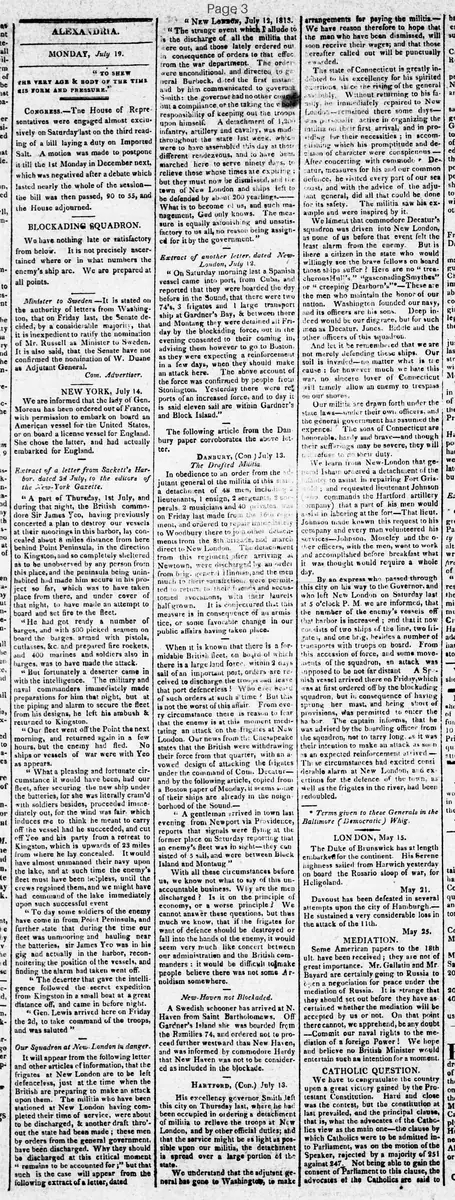
It will appear from the following letter and other articles of information, that the frigates at New London are to be left defenceless, just at the time when the British are preparing to make an attack upon them. The militia who have been stationed at New London having completed their time of service, were about to be discharged, & another draft thro' out the state had been made ; these men by orders from the general government. have been discharged. Why they should be discharged at this critical moment "remains to be accounted for;" but that such is the case will appear from the following extract of a letter, dated
"New London, July 12, 1813.
"The strange event which I allude to is the discharge of all the militia that were out, and those lately ordered out. in consequence of orders to that effect. from the war department. The orders were unconditional, and directed to general Burbeck, dated the first instant: and by him communicated to governor Smith: the governor had no other course but a compliance or the taking the whole responsibility of keeping out the troops upon himself. A detachment of 1300 infantry, artillery and cavalry, was made. throughout the state last week, which were to have assembled this day at their different rendezvous, and to have been. marched here to serve ninety days, to relieve those whose times are expiring ; but they must now be dismissed, and the town of New London and ships left to be defended by about 200 yearlings.— What is to become of us, and such management, God only knows. The measure is equally astonishing and unsatisfactory to us all, no reason being assigned for it by the government.
Extract of another letter, dated New-London, July 12.
"On Saturday morning last a Spanish vessel came into port, from Cuba, and reported that they were boarded the day before in the Sound, that there were two 74's, 3 frigates and 1 large transport ship at Gardner's Bay, & between there and Montauk they were detained all Friday by the blockading force, out in the evening consented to their coming in, advising them however to go to Boston, as they were expecting a reinforcement in a few days, when they should make an attack here. The above account of the force was confirmed by people from Stonington. Yesterday there were reports of an increased force, and to day it is said eleven sail are within Gardner's and Block Island."
The following article from the Danbury paper corroborates the above letter.
Danbury, (Con.) July 13.
The Drafted Militia.
In obedience to an order from the adjutant general of the militia of this state a detachment of 48 men, including 2 lieutenants, 1 ensign, 2 sergeants, 2 cor-porals, 2 musicians and 40 privates was on Friday last made from the 16th regiment, and ordered to repair immediately to Woodbury there to join other detachments from the 8th brigade. and march direct to New London. The detachment from this regiment after arriving at Newtown, were discharged by an order from brig. general Hinman, and the men much to their satisfaction. were permitted to return. to their friends and accustomed avocations, with their laurels half grown.
It is conjectured that this measure is in consequence of an armistice, or some favorable change in our public affairs having taken place. When it is known that there is a formidable British fleet, on board of which there is a large land force, within 3 days sail of an important port, orders are received to discharge the troops and leave that port defenceless! Who ever heard of such orders at such a time ? But this is not the worst of this affair. From every circumstance there is reason to fear that the enemy is at this moment meditating an attack on the frigates at New London. Our news from the Chesapeake states that the British were withdrawing their force from that quarter, with an avowed design of attacking the frigates under the command of Com. Decatur— and by the following article, copied from a Boston paper of Monday, it seems some of their ships are already in the neighborhood of the Sound.
: A gentleman arrived in town last evening from Newport via Providence, reports that signals were flying at the former place on Saturday reporting that an enemy's fleet was in sight—they consisted of 5 sail, and were between Block Island and Montauk
With all these circumstances before us, we know not what to say of this un-accountable business. Why are the men discharged? Is it on the principle of economy, or a worse principle? We cannot answer these questions, but thus much we know, that if the frigates for want of defence should be destroyed or fall into the hands of the enemy, it would seem very much like concert between our administration and the British commanders : it would be difficult to make people believe there was not some Arnoldism somewhere.
New-Haven not Blockaded.
A Swedish schooner has arrived at N. Haven from Saint Bartholomews. Off Gardner's Island she was boarded from the Ramillies 74, and ordered not to proceed further westward than New Haven, and was informed by commodore Hardy that New Haven was not to be considered as included in the blockade
Hartford, (Con.) July 13.
His excellency governor Smith left this city on Thursday last, where he had been occupied in ordering a detachment of militia to relieve the troops at New London, and by other official duties; and that the service might be as light as possible upon our militia, the detachment is spread over a large portion of the state.
We understand that the adjutant general has gone to Washington, to make arrangements for paying the militia.—
We have reason therefore to hope that the men who have been dismissed, will soon receive their wages; and that those hereafter called out will be punctually rewarded.
The state of Connecticut is greatly indebted to his excellency for his spirited exertions, since the rising of the general assembly. Without returning to his family, he immediately repaired to New London—remained there some days— was personally active in organizing the militia on their first arrival, and in providing for their necessities ; in accomplishing which his promptitude and decision of character were conspicuous -- After concerting with commodore - Decatur, measures for his and our common defence. he visited every part of our sea coast, and with the advice of the adjutant general, did all that could be done for its safety. The militia saw his example and were inspired by it.
We lament that commodore Decatur's squadron was driven into New London, as none of us before that event felt the least alarm from the enemy. But is there a citizen in the state who would willingly see the brave fellows on board those ships suffer? Here are no "treacherous Hull's" "gasconading Smythes" or "creeping Dearborn's"* These are the men who maintain the honor of our nation. Washington founded our navy, and its officers are his sons.
Deep indeed would be our disgrace, but for such men as Decatur, Jones, Biddle and the other officers of this squadron.
And let it be remembered that we are not merely defending these ships. Our soil is invaded—no matter what is the cause : for however much we hate this war, no sincere lover of Connecticut will tamely allow an enemy to trespass on our shores,
Our militia are drawn forth under the state laws—under their own, officers, and the general government has assumed the expense! The sons of Connecticut are honorable, hardy and brave—and though their sufferings may be severe, they will not refuse to do their duty.
We learn from New-London that general Isham ordered a detachment of the artillery to assist in repairing Fort Gris-wold; and requested lieutenant Johnson (who commands the Hartford artillery company) that a part of his men would assist in laboring at the fort—That lieut. Johnson made known this request to his company and every man volunteered his services—Johnson, Moseley and the other officers, with the men, went to work and accomplished before breakfast what it was thought would require a whole day.
By an express who passed through this city on his way to the Governor, and who left New London on Saturday last at 5 o'clock P. M. we are informed, that the number of the enemy's vessels off that harbor is increased; and that it now consists of two ships of the line, two frigates, and one brig, besides a number of transports with troops on board. From this accession of force, and some movements of the squadron, an attack was supposed to be not far distant A Spanish vessel arrived there on Friday, which was at first ordered off by the blockading squadron, but in consequence of having sprung her mast, and being short of provisions, was permitted to enter the harbor. The captain informs, that he was advised by the boarding officer from the squadron, not to tarry long, as it was their intention to make an attack as soon as an expected reinforcement arrived— These circumstances had excited considerable alarm at New London, and exertions for the defence of the town, as well as the frigates in the river, had been redoubled.
* Terms given to these Generals in the Baltimore (Democratic) Whig
What sub-type of article is it?
What keywords are associated?
What entities or persons were involved?
Where did it happen?
Domestic News Details
Primary Location
New London, Connecticut
Event Date
July 12, 1813
Key Persons
Outcome
militia detachments discharged, leaving approximately 200 defenders; increased british naval presence reported, heightening alarm and defensive efforts; no attack occurred in the reported period.
Event Details
Federal orders from the War Department led to the unconditional discharge of stationed and newly drafted militia at New London, despite reports of a nearby British fleet preparing an attack on Commodore Decatur's frigates. A detachment of 1300 was dismissed before assembly. Governor Smith complied but organized state defenses. Spanish and Swedish vessels reported British ships in the Sound, advising against staying. Local militia from Danbury was also discharged en route. Efforts to repair Fort Griswold proceeded with volunteers. Alarm grew with reports of enemy reinforcements.