Thank you for visiting SNEWPapers!
Sign up free
The Western Democrat
Charlotte, Mecklenburg County, North Carolina
What is this article about?
British Parliament debates recognition of Confederate States amid US Civil War; Roebuck relays French Emperor's urging for joint action, denied by government; concerns over cotton famine raised; debate postponed to July 13.
Merged-components note: Merged sequential components as they form a single article on the American question in the English Parliament.
Clipping
OCR Quality
Full Text
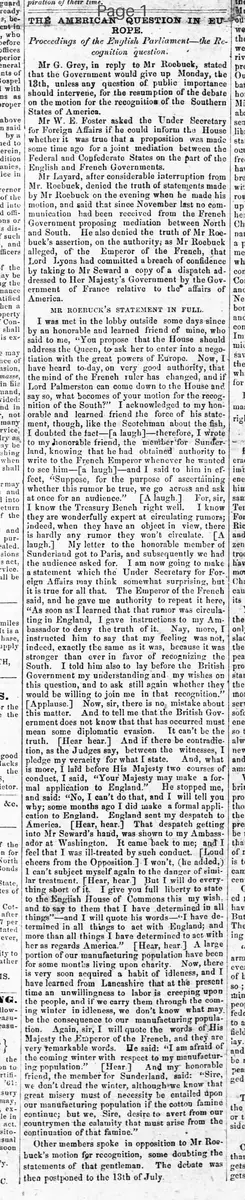
Proceedings of the English Parliament—the Recognition question.
Mr G. Grey, in reply to Mr Roebuck, stated that the Government would give up Monday, the 13th, unless any question of public importance should intervene, for the resumption of the debate on the motion for the recognition of the Southern States of America.
Mr W. E. Foster asked the Under Secretary for Foreign Affairs if he could inform the House whether it was true that a proposition was made some time ago for a joint mediation between the Federal and Confederate States on the part of the English and French Governments.
Mr Layard, after considerable interruption from Mr. Roebuck, denied the truth of statements made by Mr Roebuck on the evening when he made his motion, and said that since November last no communication had been received from the French Government proposing mediation between North and South. He also denied the truth of Mr Roebuck's assertion, on the authority, as Mr Roebuck alleged, of the Emperor of the French, that Lord Lyons had committed a breach of confidence by taking to Mr Seward a copy of a dispatch addressed to Her Majesty's Government by the Government of France relative to the affairs of America.
MR ROEBUCK'S STATEMENT IN FULL.
I was met in the lobby outside some days since by an honorable and learned friend of mine, who said to me, "You propose that the House should address the Queen, to ask her to enter into a negotiation with the great powers of Europe. Now, I have heard to-day, on very good authority, that the mind of the French ruler has changed, and if Lord Palmerston can come down to the House and say so, what becomes of your motion for the recognition of the South?" I acknowledged to my honorable and learned friend the force of his statement, though, like the Scotchman about the fish, I doubted the fact—a laugh—therefore, I wrote to my honorable friend, the member for Sunderland, knowing that he had obtained authority to write to the French Emperor whenever he wanted to see him—a laugh—and I said to him in effect, "Suppose, for the purpose of ascertaining whether this rumor be true, we go across and ask at once for an audience." [A laugh.] For, sir, I know the Treasury Bench right well. I know they are wonderfully expert at circulating rumors; indeed, when they have an object in view, there is hardly any rumor they won't circulate. [A laugh.] My letter to the honorable member of Sunderland got to Paris, and subsequently we had the audience asked for. I am now going to make a statement which the Under Secretary for Foreign Affairs may think somewhat surprising, but it is true for all that. The Emperor of the French said, and he gave me authority to repeat it here, "As soon as I learned that that rumor was circulating in England, I gave instructions to my Ambassador to deny the truth of it. Nay, more, I instructed him to say that my feeling was not, indeed, exactly the same as it was, because it was stronger than ever in favor of recognizing the South. I told him also to lay before the British Government my understanding and my wishes on this question, and to ask still again whether they would be willing to join me in that recognition."
[Applause.] Now, sir, there is no mistake about this matter. And to tell me that the British Government does not know that that has occurred must mean some diplomatic evasion. It can't be the truth. [Hear hear.] And if there be contradiction, as the Judges say, between the witnesses, I pledge my veracity for what I state. And, what is more, I laid before His Majesty two courses of conduct, I said, "Your Majesty may make a formal application to England." He stopped me, and said: "No, I can't do that, and I will tell you why; some months ago I did make a formal application to England. England sent my despatch to America. [Hear, hear.] That despatch getting into Mr Seward's hand, was shown to my Ambassador at Washington. It came back to me; and I feel that I was ill-treated by such conduct. [Loud cheers from the Opposition.]—I won't, (he added,) I can't subject myself again to the danger of similar treatment. [Hear, hear.] But I will do everything short of it. I give you full liberty to state to the English House of Commons this my wish, and to say to them that I have determined in all things"—and I will quote his words—"I have determined in all things to act with England; and more than all things I have determined to act with her as regards America." [Hear, hear.] A large portion of our manufacturing population have been for some months living upon charity. Now, there is very soon acquired a habit of idleness, and I have learned from Lancashire that at the present time an unwillingness to labor is creeping upon the people, and if we carry them through the coming winter in idleness, we don't know what may be the consequence to our manufacturing population. Again, sir, I will quote the words of His Majesty the Emperor of the French, and they are very remarkable words. He said: "I am afraid of the coming winter with respect to my manufacturing population." [Hear.] And my honorable friend, the member for Sunderland, said: "Sire, we don't dread the winter, although we know that great misery must of necessity be entailed upon our manufacturing population if the cotton famine continue; but we, Sire, desire to avert from our countrymen the calamity that must arise from the continuation of that famine."
Other members spoke in opposition to Mr Roebuck's motion for recognition, some doubting the statements of that gentleman. The debate was then postponed to the 13th of July.
What sub-type of article is it?
What keywords are associated?
What entities or persons were involved?
Where did it happen?
Foreign News Details
Primary Location
England
Event Date
13th Of July
Key Persons
Outcome
debate postponed to the 13th of july.
Event Details
In English Parliament, Mr G. Grey announced resumption of debate on recognizing Southern States on July 13. Mr W. E. Foster inquired about joint mediation by England and France. Mr Layard denied recent French mediation proposals and Roebuck's claims about Lord Lyons breaching confidence. Mr Roebuck detailed his conversation with the French Emperor, who authorized him to state stronger support for recognizing the South and desire for British cooperation, citing past ill-treatment when a dispatch was sent to America. Roebuck highlighted concerns over manufacturing populations and cotton famine. Other members opposed the motion, doubting Roebuck's statements.