Thank you for visiting SNEWPapers!
Sign up free
The New Hampshire Gazette And General Advertiser
Portsmouth, Rockingham County, New Hampshire
What is this article about?
Proceedings of the U.S. House of Representatives, September 18-23, 1789, covering bills on invalids, post-office, judicial salaries (Chief Justice $4000, others adjusted), Constitution amendments, government seat (passed 31-17), appropriations, frontier troops, petitions, and Senate concurrences. (248 characters)
Merged-components note: The table listing judicial salaries is embedded within the congressional proceedings text and directly relates to the bill discussed, so merge into the story component.
Clipping
OCR Quality
Full Text
(Continued.)
In the House of Representatives
of the United States.
FRIDAY, Sept. 18.
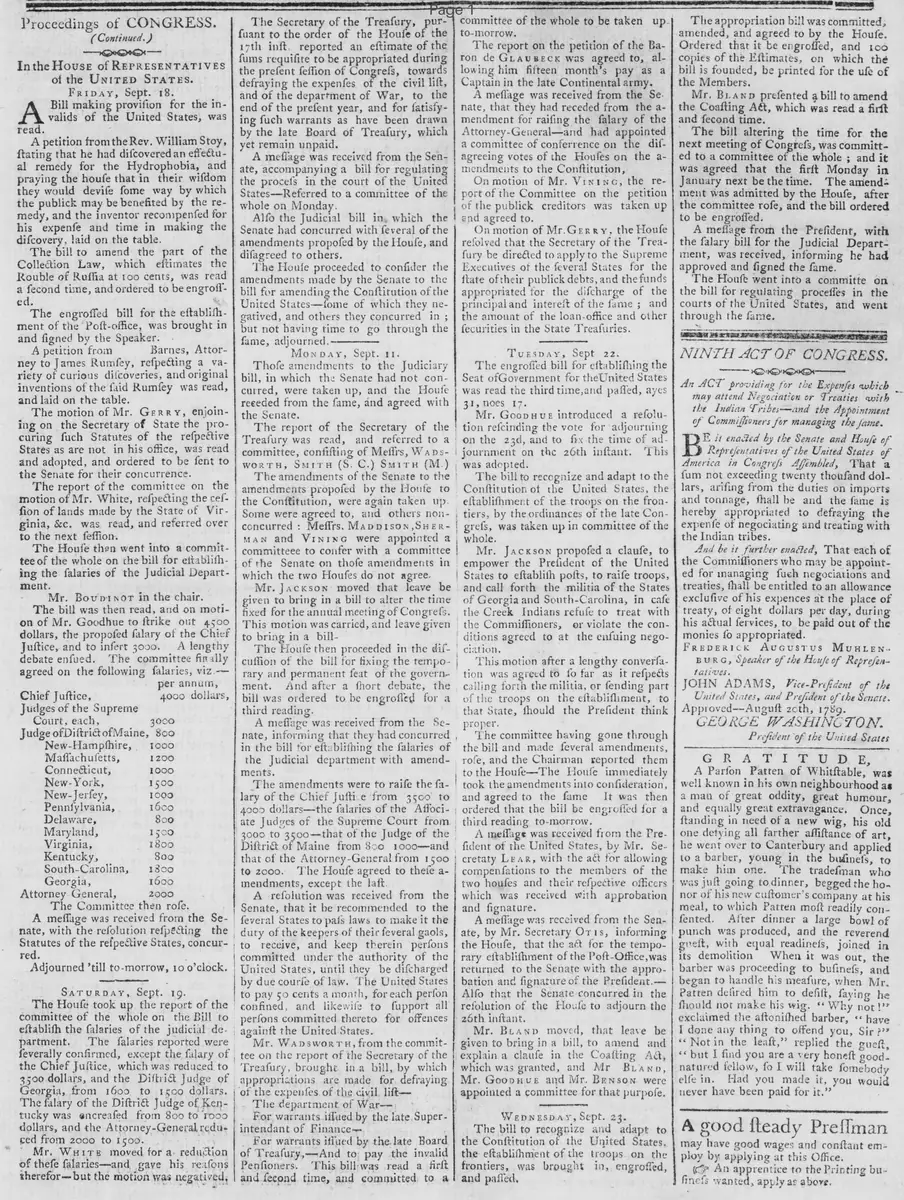
Bill making provision for the invalids of the United States, was read.
A petition from the Rev. William Story, stating that he had discovered an effectual remedy for the Hydrophobia, and praying the house that in their wisdom they would devise some way by which the public may be benefited by the remedy, and the inventor recompensed for his expense and time in making the discovery, laid on the table.
The bill to amend the part of the Collection Law, which estimates the Rouble of Russia at 100 cents, was read a second time, and ordered to be engrossed.
The engrossed bill for the establishment of the Post-office, was brought in and signed by the Speaker.
A petition from Barnes, Attorney to James Rumsey, respecting a variety of curious discoveries, and original inventions of the said Rumsey was read, and laid on the table.
The motion of Mr. Gerry, enjoining on the Secretary of State the procuring such Statutes of the respective States as are not in his office, was read and adopted, and ordered to be sent to the Senate for their concurrence.
The report of the committee on the motion of Mr. White, respecting the cession of lands made by the State of Virginia, &c. was read, and referred over to the next session.
The House then went into a committee of the whole on the bill for establishing the salaries of the Judicial Department.
Mr. Boudinot in the chair.
The bill was then read, and on motion of Mr. Goodhue to strike out 4500 dollars, the proposed salary of the Chief Justice, and to insert 3000. A lengthy debate ensued. The committee finally agreed on the following salaries, viz.-
per annum
Chief Justice, 4000 dollars,
Judges of the Supreme
Attorney General 2000
The Committee then rose.
A message was received from the Senate, with the resolution respecting the Statutes of the respective States, concurred.
Adjourned till to-morrow, 10 o'clock.
Saturday, Sept. 19.
The House took up the report of the committee of the whole on the Bill to establish the salaries of the judicial department.
The salaries reported were severally confirmed, except the salary of the Chief Justice, which was reduced to 3500 dollars, and the District Judge of Georgia, from 1600 to 1500 dollars.
The salary of the District Judge of Kentucky was increased from 800 to 1000 dollars, and the Attorney-General reduced from 2000 to 1500.
Mr. White moved for a reduction of these salaries--and gave his reasons therefor--but the motion was negatived.
The Secretary of the Treasury, pursuant to the order of the House of the 17th inst. reported an estimate of the sums requisite to be appropriated during the present session of Congress. towards defraying the expenses of the civil list, and of the department of War, to the end of the present year, and for satisfying such warrants as have been drawn by the late Board of Treasury, which yet remain unpaid.
A message was received from the Senate, accompanying a bill for regulating the process in the court of the United States--Referred to a committee of the whole on Monday.
Also the Judicial bill in which the Senate had concurred with several of the amendments proposed by the House, and disagreed to others.
The House proceeded to consider the amendments made by the Senate to the bill for amending the Constitution of the United States--some of which they negatived, and others they concurred in; but not having time to go through the same, adjourned.-
Monday, Sept. 21.
Those amendments to the Judiciary bill. in which the Senate had not concurred, were taken up, and the House receded from the same, and agreed with the Senate.
The report of the Secretary of the Treasury was read, and referred to a committee, consisting of Messrs. Wadsworth, Smith (S. C.) Smith (M.)
The amendments of the Senate to the amendments proposed by the House to the Constitution, were again taken up Some were agreed to, and others non-concurred : Messrs. Madison, Sherman and Vining were appointed a committee to confer with a committee of the Senate on those amendments in which the two Houses do not agree.
Mr. Jackson moved that leave be given to bring in a bill to alter the time fixed for the annual meeting of Congress. This motion was carried, and leave given to bring in a bill-
The House then proceeded in the discussion of the bill for fixing the temporary and permanent seat of the government. And after a short debate, the bill was ordered to be engrossed for a third reading.
A message was received from the Senate, informing that they had concurred in the bill for establishing the salaries of the Judicial department with amendments.
The amendments were to raise the salary of the Chief Justice from 3500 to 4000 dollars--the salaries of the Associate Judges of the Supreme Court from 3000 to 3500--that of the Judge of the District of Maine from 800 to 1000--and that of the Attorney-General from 1500 to 2000. The House agreed to these amendments, except the last
A resolution was received from the Senate, that it be recommended to the several States to pass laws to make it the duty of the keepers of their several gaols, to receive, and keep therein persons committed under the authority of the United States, until they be discharged by due course of law. The United States to pay 50 cents a month, for each person confined, and likewise to support all persons committed thereto for offences against the United States.
Mr. Wadsworth. from the committee on the report of the Secretary of the Treasury, brought in a bill, by which appropriations are made for defraying of the expenses of the civil list-- The department of War-- For warrants issued by the late Superintendent of Finance- For warrants issued by the late Board of Treasury,--And to pay the invalid Pensioners. This bill was read a first and second time, and committed to a
committee of the whole to be taken up- to-morrow.
The report on the petition of the Baron de Galbeck was agreed to, allowing him fifteen month's pay as a Captain in the late Continental army.
A message was received from the Senate, that they had receded from the amendment for raising the salary of the Attorney-General-and had appointed a committee of conference on the disagreeing votes of the Houses on the amendments to the Constitution.
On motion of Mr. Vining, the report of the Committee on the petition of the public creditors was taken up and agreed to.
On motion of Mr. Gerry. the House resolved that the Secretary of the Treasury be directed to apply to the Supreme Executives of the several States for the state of their public debts, and the funds appropriated for the discharge of the principal and interest of the same ; and the amount of the loan-office and other securities in the State Treasuries.
Tuesday, Sept 22.
The engrossed bill for establishing the Seat of Government for the United States was read the third time, and passed, ayes 31, noes 17.
Mr. Goodhue introduced a resolution rescinding the vote for adjourning on the 23d, and to fix the time of adjournment on the 26th instant. This was adopted.
The bill to recognize and adapt to the Constitution of the United States, the establishment of the troops on the frontiers, by the ordinances of the late Congress, was taken up in committee of the whole.
Mr. Jackson proposed a clause, to empower the President of the United States to establish posts, to raise troops, and call forth the militia of the States of Georgia and South-Carolina. in case the Creek Indians refuse to treat with the Commissioners, or violate the conditions agreed to at the ensuing negotiation.
This motion after a lengthy conversation was agreed to so far as it respects calling forth the militia, or sending part of the troops on the establishment, to that State, should the President think proper.
The committee having gone through the bill and made several amendments. rose, and the Chairman reported them to the House--The House immediately took the amendments into consideration, and agreed to the same It was then ordered that the bill be engrossed for a third reading to-morrow.
A message was received from the President of the United States, by Mr. Secretary Lear, with the act for allowing compensations to the members of the two houses and their respective officers which was received with approbation and signature.
A message was received from the Senate, by Mr. Secretary Otis, informing the House, that the act for the temporary establishment of the Post-Office, was returned to the Senate with the approbation and signature of the President.-- Also that the Senate concurred in the resolution of the House to adjourn the 26th instant.
Mr. Bland moved, that leave be given to bring in a bill, to amend and explain a clause in the Coasting Act, which was granted, and Mr. Bland, Mr. Goodhue and Mr. Benson were appointed a committee for that purpose.
Wednesday, Sept. 23.
The bill to recognize and adapt to the Constitution of the United States. the establishment of the troops on the frontiers, was brought in, engrossed, and passed.
The appropriation bill was committed, amended, and agreed to by the House.
Ordered that it be engrossed, and 100 copies of the Estimates, on which the bill is founded, be printed for the use of the Members.
Mr. Bland presented a bill to amend the Coasting Act, which was read a first and second time.
The bill altering the time for the next meeting of Congress, was committed to a committee of the whole ; and it was agreed that the first Monday in January next be the time. The amendment was admitted by the House, after the committee rose, and the bill ordered to be engrossed.
A message from the President, with the salary bill for the Judicial Department, was received, informing he had approved and signed the same.
The House went into a committee on the bill for regulating process in the courts of the United States, and went through the same.
| Court, each, | 3000 |
| Judge of District of Maine, | 800 |
| New-Hampshire, | 1000 |
| Massachusetts, | 1200 |
| Connecticut, | 1000 |
| New-York, | 1500 |
| New-Jersey, | 1000 |
| Pennsylvania, | 1600 |
| Delaware, | 800 |
| Maryland, | 1500 |
| Virginia, | 1800 |
| Kentucky, | 800 |
| South-Carolina, | 1800 |
| Georgia, | 1600 |
What sub-type of article is it?
What themes does it cover?
What keywords are associated?
What entities or persons were involved?
Where did it happen?
Story Details
Key Persons
Location
House Of Representatives Of The United States
Event Date
September 18 23, 1789
Story Details
Proceedings of the House of Representatives from September 18 to 23, 1789, including reading of bills for invalids and post-office establishment, petitions for hydrophobia remedy and inventions, adoption of motions for state statutes and land cessions, debates and agreements on judicial salaries, Treasury reports on appropriations, Senate messages on process regulation and Constitution amendments, establishment of government seat, frontier troops recognition, and various resolutions and bills.