Thank you for visiting SNEWPapers!
Sign up free
Mcallen Daily Press
Mcallen, Hidalgo County, Texas
What is this article about?
The U.S. House passed the Burke-Wadsworth conscription bill on Sept. 7, imposing the first peacetime draft, voting 263-149. The bill returns to the Senate due to changes, including draft ages 21-45 and a 60-day volunteer period. It aims to build a 1,200,000-man army for national defense.
Merged-components note: Merged continuation from page 6 of the conscription bill passage story.
Clippings
1 of 2
OCR Quality
Full Text
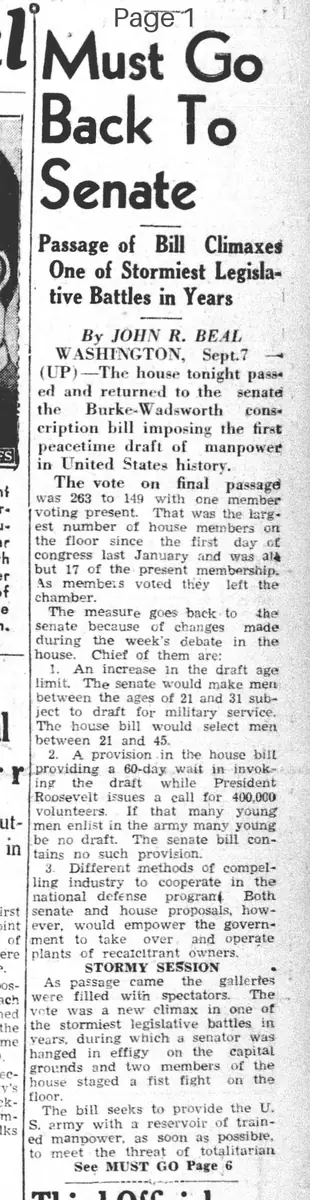
Passage of Bill Climaxes One of Stormiest Legislative Battles in Years
By JOHN R. BEAL
WASHINGTON, Sept.7 (UP)-The house tonight passed and returned to the senate the Burke-Wadsworth conscription bill imposing the first peacetime draft of manpower in United States history.
The vote on final passage was 263 to 149 with one member voting present. That was the largest number of house members on the floor since the first day of congress last January and was all but 17 of the present membership. As members voted they left the chamber.
The measure goes back to the senate because of changes made during the week's debate in the house. Chief of them are:
1. An increase in the draft age limit. The senate would make men between the ages of 21 and 31 subject to draft for military service. The house bill would select men between 21 and 45.
2. A provision in the house bill providing a 60-day wait in invoking the draft while President Roosevelt issues a call for 400,000 volunteers. If that many young men enlist in the army many young men will escape the draft. The senate bill contains no such provision.
3. Different methods of compelling industry to cooperate in the national defense program. Both senate and house proposals, however, would empower the government to take over and operate plants of recalcitrant owners.
STORMY SESSION
As passage came the galleries were filled with spectators. The vote was a new climax in one of the stormiest legislative battles in years, during which a senator was hanged in effigy on the capital grounds and two members of the house staged a fist fight on the floor.
The bill seeks to provide the U. S. army with a reservoir of trained manpower, as soon as possible, to meet the threat of totalitarian
See MUST GO Page 6
(Continued from page 1)
s
dictatorship of all Europe and Asia and possible infiltration into the Western Hemisphere.
Under its terms, within a year the army would swell to a force of 1,200,000 men.
Conscripts taken from civilian life would serve for 12 months and would be replaced by others. This process would continue for five years, until the nation had a reservoir of 5,000,000 trained reservists.
1,200,000 MEN
The force of 1,200,000 is that fixed by the war department as necessary to implement the Monroe Doctrine, which has stood as U. S. policy for more than a century, and which requires this country to resist the encroachments of foreign nations in this hemisphere.
The house ratified an amendment by Rep. Hamilton Fish, R., N.Y., previously included in the bill. It was designed to give the volunteer enlistment system a 60-day trial before invoking the draft.
It also voted to include provisions compelling industry to accept and give priority to government orders, under threat of penalties ranging up to imprisonment for three years, and a $50,000 fine. Refusal would also empower the government to take over and operate the plant of an owner who refused to cooperate in the defense program. However, he would be paid a "fair and just" rental.
The house, at the last minute turned aside an attempt by Rep. H. Jerry Voorhis, D., Calif., to cut the life of the conscription program from the designated five years to two, so that it would end Oct. 1, 1942.
21 TO 45 REGISTER
The measure provides that all male citizens between 21 and 45 years of age (that is including the years 21 and 44) must register on designated days for military service.
The army will classify the estimated 24,000,000 registrants as to those needed in key industries, those who have wives, children or other dependents, those who have physical defects, and those who qualify in all respects.
From this last group the army will select by an "impartial method" the troops it needs to build up the land forces to 1,200,000. The "impartial method" will be by lot and drawings will be from the famous goldfish bowl used in the World War draft lottery.
The troops thus conscripted would be given 12 consecutive months' training, but they could be kept in service for the duration of an emergency.
Their uses would be limited to the Western Hemisphere, U. S. territories and possessions, and the Philippine Islands.
After a year's service the trainees would go into reserve components of the armed forces, to remain on the rolls for 10 years or until they are 45 or until discharged, whichever occurs first. Men desiring to avoid this obligation may discharge it by serving two years in the national guard or regular army.
Conscripted men will get the same pay as those in the regular army. The bill raises the base army pay for enlisted men to the level of that for the navy—$30 a month for men who have served four months. At present it is $21 a month.
The burden of conscription will fall on the states in proportion to their male population of draft age. Quotas are not yet worked out.
Men now in the army, navy, marine corps, coast guard, in various reserve components, in the training academies, and diplomatic representatives will not be registered.
What sub-type of article is it?
What keywords are associated?
What entities or persons were involved?
Where did it happen?
Domestic News Details
Primary Location
Washington
Event Date
Sept.7
Key Persons
Outcome
house passed the bill 263 to 149 with one present; returned to senate due to changes including draft ages 21-45, 60-day volunteer period, and industry cooperation provisions; aims to build 1,200,000-man army over five years.
Event Details
The House of Representatives passed the Burke-Wadsworth conscription bill after stormy debates, marking the first peacetime draft in U.S. history. Changes made include expanding draft age to 21-45, a 60-day volunteer enlistment trial before drafting, and measures to compel industry cooperation with government takeover powers. The bill provides for registration of men 21-45, selection by lottery, 12-month training, and reserve service, limited to Western Hemisphere defense.