Thank you for visiting SNEWPapers!
Sign up free
The Cecil Whig
Elkton, Cecil County, Maryland
What is this article about?
In a House speech on the 18th inst., Mr. Cocke of Tennessee criticizes the Mexican War treaty, estimating costs at over $200 million and 15,000 lives lost, questioning the 'indemnity for the past and security for the future' promised by President Polk.
Clipping
OCR Quality
Full Text
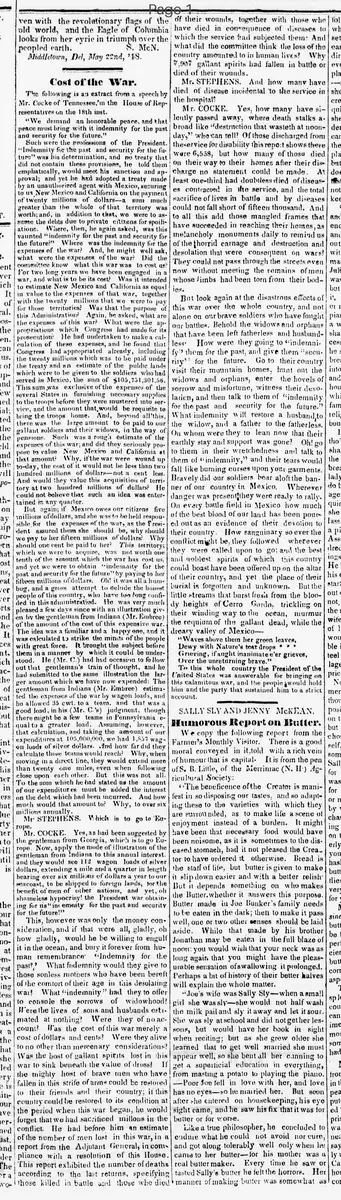
The following is an extract from a speech by Mr. Cocke of Tennessee, in the House of Representatives on the 18th inst.
"We demand an honorable peace and that peace must bring with it indemnity for the past and security for the future." Such were the professions of the President "Indemnity for the past and security for the future" was his determination, and no treaty that did not contain these provisions, he told them emphatically, would meet his sanction and approval; and yet he had adopted a treaty made by an unauthorized agent with Mexico, securing to us New Mexico and California on the payment of twenty millions of dollars—a sum much greater than the whole of that territory was worth; and, in addition to that, we were to assume the debts due to private citizens for spoliations. Where, then, he again asked, was this vaunted "indemnity for the past and security for the future?" Where was the indemnity for the expenses of the war? And, he might well ask, what were the expenses of the war? Did the committee know what this war was to cost us? For two long years we have been engaged in a war, and what is to be its cost? Was it intended to estimate New Mexico and California as equal in value to the expenses of that war, together with the twenty millions that we were to pay for those territories? Was that the purpose of this Administration? Again, he asked, what are the expenses of this war What were the appropriations which Congress had made for its prosecution? He had undertaken to make a calculation of these expenses, and he found that Congress had appropriated already, including the twenty millions which was to be paid under the treaty and an estimate of the public lands which were to be given to the soldiers who had served in Mexico, the sum of $105,751,301.56. This sum was exclusive of the expenses of the several States in furnishing necessary supplies to the troops before they were mustered into service, and the amount that would be requisite to bring the troops home. And, beyond all this, there was the large amount to be paid to our gallant soldiers and their widows, in the way of pensions. Such was a rough estimate of the expenses of this war; and did they seriously propose to value New Mexico and California at that amount? Why, if the war were wound up to-day, the cost of it would not be less than two hundred millions of dollars—not a cent less. And would they value this acquisition of territory at two hundred millions of dollars? He could not believe that such an idea was entertained in any quarter.
But again; if Mexico owes our citizens five millions of dollars, and she was to be held responsible for the expenses of the war, as the President assured them she should be, why should we pay to her fifteen millions of dollars? Why should one cent be paid to her? This territory, which we were to acquire, was not worth one tenth of the amount which the war has cost us. and yet we were to obtain "indemnity for the past and security for the future" by paying to her fifteen millions of dollars. Oh! it was all a humbug, and a gross attempt to delude the honest people of this country, who have too long confided in this administration. He was very much pleased a few days since with an illustration given by the gentleman from Indiana (Mr. Embree) of the amount of the cost of this expensive war. The idea was a familiar and a happy one, and it was calculated to strike the minds of the people with great force. It brought the subject before them in a manner by which it could be understood. He (Mr. C.) had had occasion to follow out that gentleman's train of thought, and he had submitted to the same illustration the larger amount which we have now expended: The gentleman from Indiana (Mr. Embree) estimated the expenses of the war by wagon loads, and he allowed 35 cwt. to a team. and that was a good load, in his (Mr. C.'s) judgment, though there might be a few teams in Pennsylvania equal to a greater load. Assuming, however, that calculation, and taking the amount of our expenditures at 105,000,000, we had 1,857 wagon loads of silver dollars. and how far did they calculate those teams would reach? Why, when moving in a direct line, they would extend more than twenty one miles, even when following close upon each other. But this was not all. To the sum which he had stated as the amount of our expenditures must be added the interest on the debt which had been incurred. And how much would that amount to? Why, to over six millions annually.
Mr STEPHENS.
Which is to go to Europe.
Mr. COCKE. Yes, as had been suggested by the gentleman from Georgia, which is to go Europe. Now, apply the mode of illustration of the gentleman from Indiana to this annual interest. and they would see 112 wagon loads of silver dollars, extending a mile and a quarter in length bearing over six millions of dollars a year to our seacoast, to be shipped to foreign lands, for the benefit of men of other nations, and yet, oh shameless hypocrisy! the President was obtaining for us "indemnity for the past and security for the future!"
This, however was only the money consideration, and if that were all, gladly, oh how gladly, would he be willing to engulf it in the ocean, and bury it forever from human remembrance' "Indemnity for the past?,' What indemnity would they give to those sonless mothers who have been bereft of the comfort of their age in this desolating war? What "indemnity" had they to offer to console the sorrows of widowhood? Here the lives of sons and husbands cost estimated at nothing? Were they of no account? Was the cost of this war merely a cost of dollars and cents? Were they alive to no other than mercenary considerations? Was the host of gallant spirits lost in this war to sink beneath the value of dross? If the mighty host of brave men who have fallen in this strife of arms could be restored to their friends and their country; if this country could be restored to its condition at the period when this war began, he would forget that we had sacrificed millions in the conflict. He had before him an estimate of the number of men lost in this war, in a report from the Adjutant General, in compliance with a resolution of this House. This report exhibited the number of deaths according to the last returns, specifying those killed in battle and those who died
of their wounds, together with those who have died in consequence of diseases to which the service had subjected them: And what did the committee think the loss of the country amounted to in human lives? Why 7,900 gallant spirits had fallen in battle or died of their wounds.
Mr. STEPHENS. And how many have died of disease incidental to the service in the hospital?
Mr. COCKE. Yes. how many have silently passed away, where death stalks abroad like "destruction that wasteth at noon-day," who can tell? Of those discharged from the service for disability this report shows there were 6,558, but how many of those died on their way to their homes after their discharge no statement could be made. At least one-third had doubtless died of diseases contracted in the service, and the total sacrifice of lives in battle and by diseases could not fall short of fifteen thousand. And to all this add those mangled frames that have succeeded in reaching their homes, as melancholy monuments daily to remind us of the horrid carnage and destruction and desolation that were consequent on wars? They could not pass through the streets even now without meeting the remains of men whose limbs had been torn from their bodies.
But look again at the disastrous effects of this war over the whole country, and not alone on our brave soldiers who have fought our battles. Behold the widows and orphans that have been left fatherless and husbandless: How were they going to "indemnify" them for the past, and give them "security'' for the future. Go to their country visit their mountain homes, hunt out the widows and orphans, enter the hovels of sorrow and misfortune, witness their desolation, and then talk to them of "indemnity for the past and security for the future." What indemnity will restore a husband to the widow, and a father to the fatherless. On whom were they to lean now that their earthly stay and support was gone? Oh! go to them in their wretchedness and talk to them of "indemnity," and their tears would fall like burning curses upon your garments.
Bravely did our soldiers bear aloft the banner of our country in Mexico. Wherever danger was present they were ready to rally. On every battle field in Mexico how much of the best blood of our land has been poured out as an evidence of their devotion to their country. How sanguinary so ever the conflict might be, they followed wherever they were called upon to go; and the best and noblest spirits of which this country could boast have been offered up on the altar of their country, and yet the place of their burial is forgotten and unknown, But the little streams that burst fresh from the bloody heights of Cerro Gordo, trickling on their winding way to the ocean, murmur the requiem of the gallant dead, while the dreary valley of Mexico—
"Waves above them her green leaves,
Dewy with Nature's tear drops
Grieving, if aught inanimate e'er grieves,
Over the unreturning brave."
To this whole country the President of the United States was answerable for bringing on this calamitous war, and the people would hold him and the party that sustained him to a strict account.
What sub-type of article is it?
What keywords are associated?
What entities or persons were involved?
Where did it happen?
Domestic News Details
Primary Location
Washington, D.C.
Event Date
18th Inst.
Key Persons
Outcome
war costs estimated at over $200 million; approximately 15,000 american lives lost, including 7,900 in battle or from wounds; criticism of treaty paying mexico $15-20 million for territories while forgoing indemnity.
Event Details
Mr. Cocke delivers a speech in the House criticizing President Polk's acceptance of the Treaty of Guadalupe Hidalgo, arguing it fails to provide indemnity for war expenses and security; details financial appropriations totaling $105,751,301.56 plus more, illustrates costs with wagon loads of silver dollars, laments human losses including soldiers, widows, and orphans.