Thank you for visiting SNEWPapers!
Sign up free
The Enquirer
Richmond, Henrico County, Virginia
What is this article about?
A 1810 letter from Dr. Benjamin Smith Barton to Thomas Jefferson discusses new drawings of a well-preserved Asiatic Mammoth found in Russia, its relation to American mammoths, shared continental species, and philosophical reflections on extinction by divine providence. (248 characters)
Clipping
OCR Quality
Full Text
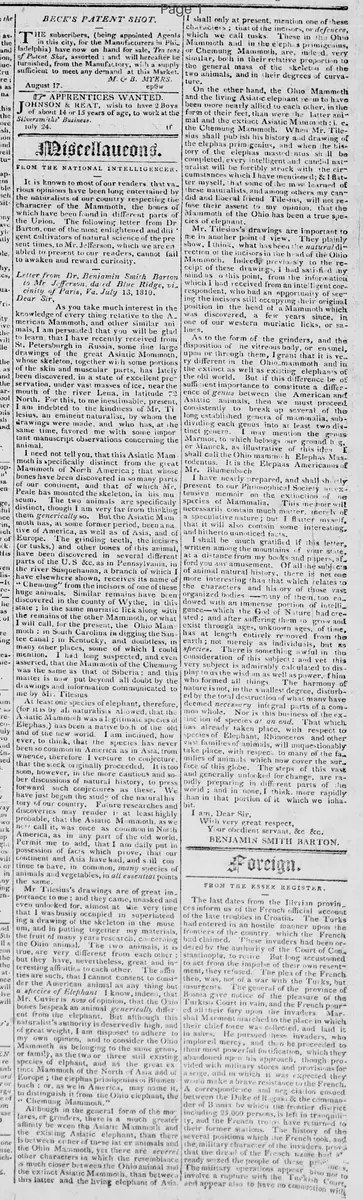
FROM THE NATIONAL INTELLIGENCER.
It is known to most of our readers, that various opinions have been long entertained by the naturalists of our country respecting the character of the Mammoth, the bones of which have been found in different parts of the Union. The following letter from Dr. Barton, one of the most enlightened and diligent cultivators of natural science of the present times, to Mr. Jefferson, which we are enabled to present to our readers, cannot fail to awaken and reward curiosity.
Letter from Dr. Benjamin Smith Barton to Mr. Jefferson, dated Blue Ridge, vicinity of Paris, Va. July 13, 1810.
Dear Sir,
As you take much interest in the knowledge of every thing relative to the American Mammoth, and other similar animals, I am persuaded that you will be glad to learn, that I have recently received from St. Petersburgh in Russia, some fine large drawings of the great Asiatic Mammoth, whose skeleton, together with some portions of the skin and muscular parts, has lately been discovered, in a state of excellent preservation, under vast masses of ice, near the mouth of the river Lena, in latitude 72 North. For this, to me inestimable, present, I am indebted to the kindness of Mr. Tilesius, an eminent naturalist, by whom the drawings were made, and who has, at the same time, favored me with some important manuscript observations concerning the animal.
I need not tell you, that this Asiatic Mammoth is specifically distinct from the great Mammoth of North America; that whose bones have been discovered in so many parts of our continent, and that of which Mr. Peale has mounted the skeleton, in his museum.
The two animals are specifically distinct, though I am very far from thinking them generically so. But the Asiatic Mammoth has, at some former period, been a native of America, as well as of Asia, and of Europe. The grinding teeth, the incisors (or tusks,) and other bones of this animal, have been discovered in several different parts of the U. S. &c. as in Pennsylvania, in the river Susquehanna, a branch of which I have elsewhere shown, receives its name of "Chenung" from the incisors of one of these huge animals. Similar remains have been discovered in the county of Wythe, in this state; in the same muriatic lick along with the remains of the other Mammoth, or what I will call, for the present, the Ohio Mammoth: in South Carolina in digging the Santee Canal; in Kentucky, and doubtless, in many other places, some of which I could mention. I had long suspected, and even asserted, that the Mammoth of the Chemung was the same as that of Siberia: and this matter is now put beyond all doubt by the drawings and information communicated to me by M. Tilesius.
At least one species of elephant, therefore, (for it is by all naturalists allowed, that the Asiatic Mammoth was a legitimate species of Elephas,) has been a native both of the old and of the new world. I am inclined, however, to think, that the species has never been so common in America as in Asia, from whence, therefore I venture to conjecture, that the stock originally proceeded. It is too soon, however, in the more cautious and sober discussions of natural history, to press forward such conjectures as these. We have just begun the study of the natural history of our country. Future researches and discoveries may render it at least highly probable, that the Asiatic Mammoth, as we now call it, was once as common in North America, as in any part of the old world.
Permit me to add, that I am daily put in possession of facts which prove, that our continent and Asia have had, and still continue to have, in common, many species of animals and vegetables, in all essential points the same.
Mr. Tilesius's drawings are of great importance to me: and they came, unasked and even unlooked for, almost at the very time that I was busily occupied in superintending a drawing of the skeleton in the museum, and in putting together my materials, the fruit of many years research, concerning the Ohio animal. The two animals, it is true, are very different from each other: but they have, nevertheless, great and interesting affinities to each other. The affinities are such, that I cannot consent to consider the American animal as any thing but a species of Elephant. I know, indeed, that Mr. Cuvier is now of opinion, that the Ohio bones bespeak an animal generically different from the elephant. But although this naturalist's authority is deservedly high, and of great weight, I am disposed to adhere to my own opinion, and to consider the Ohio Mammoth as belonging to the same genus, or family, as the two or three still existing species of elephant, and as the great extinct Mammoth of the North of Asia and of Europe; the elephas primigenius of Blumenbach: or, as we in America, may name it, to distinguish it from the Ohio elephant, the "Chemung Mammoth."
Although in the general form of the molars, or grinders, there is a much greater affinity between the Asiatic Mammoth and the existing Asiatic elephant, than there is between either of these latter animals and the Ohio Mammoth, yet there are several other characters in which the resemblance is much closer between the Ohio animal and the extinct Asiatic Mammoth, than between this latter and the living elephant of Asia.
I shall only at present, mention one of these characters: that of the incisors, or defences, which we call tusks. These in the Ohio Mammoth and in the elephas primigenius, or Chemung Mammoth, are, indeed, very similar, both in their relative proportion to the general mass of the skeleton of the two animals, and in their degrees of curvature.
On the other hand, the Ohio Mammoth and the living Asiatic elephant seem to have been more nearly allied to each other, in the form of their feet, than were the latter animal and the extinct Asiatic Mammoth: i. e. the Chemung Mammoth. When Mr. Tilesius shall publish his history and drawing of the elephas primigenius, and when his history of the elephas mastodontus shall be completed, every intelligent and candid naturalist will be forcibly struck with the circumstances which I have mentioned; & I flatter myself, that some of the most learned of these naturalists, and among others my candid and liberal friend Tilesius, will not refuse their assent to my opinion, that the Mammoth of the Ohio has been a true species of elephant.
Mr. Tilesius's drawings are important to me in another point of view. They plainly show, I think, what has been the natural direction of the incisors in the head of the Ohio Mammoth. Indeed, previously to the receipt of these drawings, I had satisfied my mind as to this point, from the information which I had received from an intelligent correspondent, who had an opportunity of seeing the incisors still occupying their original position in the head of a Mammoth which was discovered, a few years since, in one of our western muriatic licks, or salines.
As to the form of the grinders, and the disposition of the vitreous body, or enamel, upon or through them, I grant that it is very different in the Ohio mammoth and in the extinct as well as existing elephants of the old world. But if this difference be of sufficient importance to constitute a difference of genus between the American and Asiatic animals, then we must proceed consistently to break up several of the long established genera of mammalia, subdividing each genus into at least two distinct genera. I may mention the genus Marmot, to which belongs our ground hog, or Woodchuck, as illustrative of this idea. I shall call the Ohio mammoth Elephas Mastodontus. It is the Elephas Americanus of Mr. Blumenbach.
I have nearly prepared, and shall shortly present to our Philosophical Society an extensive memoir on the extinction of several species of Mammalia. This memoir will necessarily contain much matter, merely of a speculative nature; but I flatter myself, that it will also contain some interesting, and hitherto unnoticed facts.
I shall be much gratified if this letter, written among the mountains of your state, at a distance from my books and papers, afford you any amusement. Of all the subjects of animal natural history, there is not one more interesting than that which relates to the characters and history of those vast organized bodies - many of them too endowed with an immense portion of intelligence - which the God of Nature had created; and after suffering them to grow and exist through ages, unknown ages, of time, has at length entirely removed from the earth; not merely as individuals, but as species. There is something awful in the consideration of this subject: and yet this very subject is admirably calculated to display to us the wisdom as well as power, of him who formed all things. The harmony of nature is not, in the smallest degree, disturbed by the total destruction of what many have deemed necessary integral parts of a common whole. Nor is this business of the extinction of species at an end. That which has already taken place, with respect to species of Elephant, Rhinoceros and other vast families of animals, will unquestionably take place, with respect to many of the families of animals which now cover the surface of this globe. The steps of this vast and generally unlooked for change, are rapidly preparing in different parts of the world; and in none, I think, more rapidly than in that portion of it which we inhabit.
I am, Dear Sir,
With very great respect,
Your obedient servant, &c. &c.
BENJAMIN SMITH BARTON.
What sub-type of article is it?
What themes does it cover?
What keywords are associated?
What entities or persons were involved?
Where did it happen?
Story Details
Key Persons
Location
Blue Ridge, Vicinity Of Paris, Va.; St. Petersburgh, Russia; Mouth Of The River Lena, Latitude 72 North; Various Parts Of The U.S. Including Pennsylvania, Susquehanna, Wythe County, Ohio, South Carolina, Kentucky
Event Date
July 13, 1810
Story Details
Dr. Barton writes to Jefferson about receiving drawings and observations from Mr. Tilesius on the preserved Asiatic Mammoth discovered in Russia. He discusses distinctions and affinities between the Asiatic Mammoth, the Ohio Mammoth, and existing elephants, arguing they are the same genus. He notes shared species between continents and speculates on extinction.