Thank you for visiting SNEWPapers!
Sign up free
Story
November 8, 1855
American Lancaster Gazette
Lancaster, Fairfield County, Ohio
What is this article about?
A 1800 London newspaper obituary eulogizes George Washington's physical traits, character, leadership in the American Revolution, and presidency, portraying him as a virtuous, patriotic hero unmatched in history.
Clipping
OCR Quality
98%
Excellent
Full Text
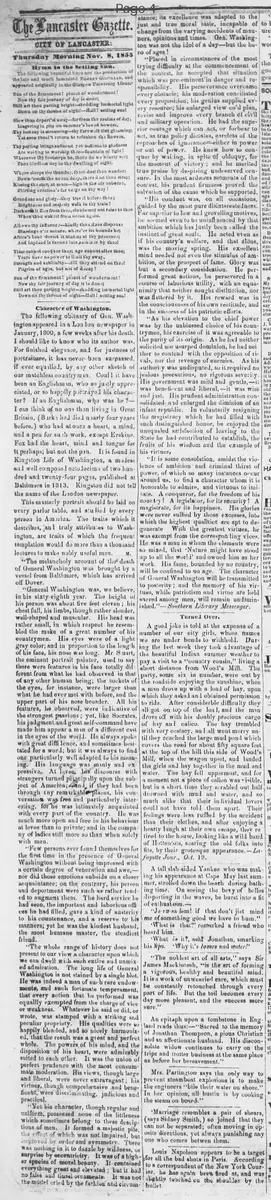
Character of Washington.
The following obituary of Gen. Washington appeared in a London newspaper in January, 1800, a few weeks after his death.
I should like to know who its author was. For finished elegance, and for justness of portraiture, it has never been surpassed if ever equaled, by any other sketch of our matchless countryman. Could it have been an Englishman, who so justly appreciated, or so happily portrayed his character? If an Englishman, who was he?—I can think of no one then living in Great Britain, (Burke had died nearly four years before,) who had at once a heart, a mind, and a pen for such work, except Erskine. Fox had the heart, mind and tongue for it perhaps; but not the pen. It is found in Kingston's Life of Washington, a modest and well composed octavo of two hundred and twenty-four pages, published at Baltimore in 1813. Kingston did not tell the name of the London newspaper.
This masterly portrait should be laid on every parlor table, and studied by every person in America. The traits which it describes, and truly attributes to Washington, are traits of which the frequent contemplation would do more than a thousand lectures to make nobly useful men.
M.
"The melancholy account of the death of General Washington was brought by a vessel from Baltimore, which has arrived off Dover.
"General Washington was, we believe, in his sixty-eighth year. The height of his person was about five feet eleven; his chest full, his limbs, though rather slender, well-shaped and muscular. His head was rather small, in which respect he resembled the make of a great number of his countrymen. His eyes were of a light gray color; and in proportion to the length of his face, his nose was long. Mr. Stuart, the eminent portrait painter, used to say there were features in his face totally different from what he had observed in that of any other human being; the sockets of the eyes, for instance, were larger than what he had ever met with before, and the upper part of his nose broader. All his features, he observed, were indicative of the strongest passions; yet, like Socrates, his judgment and great self-command have made him appear a man of a different cast in the eyes of the world. He always spoke with great diffidence, and sometimes hesitated for a word; but it was always to find one particularly well adapted to his meaning. His language was manly and expressive. At levee, his discourse with strangers turned principally upon the subject of America; and, if they had been through any remarkable places, his conversation was free and particularly interesting, for he was intimately acquainted with every part of the country. He was much more open and free in his behaviour at levee than in private; and in the company of ladies still more so than when solely with men.
"Few persons ever found themselves for the first time in the presence of General Washington without being impressed with a certain degree of veneration and awe,—nor did those emotions subside on a close acquaintance; on the contrary, his person and deportment were such as rather tended to augment them. The hard service he had seen, the important and laborious offices he had filled, gave a kind of austerity to his countenance, and a reserve to his manners; yet he was the kindest husband, the most humane master, the steadiest friend.
"The whole range of history does not present to our view a character upon which we can dwell with such entire and unmixed admiration. The long life of General Washington is not stained by a single blot. He was indeed a man of such rare endowments, and such fortunate temperament, that every action that he performed was equally exempted from the charge of vice or weakness. "Whatever he said or did, or wrote, was stamped with a striking and peculiar propriety. His qualities were so happily blended, and so nicely harmonized, that the result was a great and perfect whole. The powers of his mind, and the disposition of his heart, were admirably suited to each other. It was the union of perfect prudence with the most consummate moderation. His views, though large and liberal, were never extravagant; his virtues, though comprehensive and beneficent, were discriminating, judicious and practical.
"Yet his character, though regular and uniform, possessed none of the littleness which sometimes belong to these descriptions of men. It formed a majestic pile, the effect of which was not impaired, but improved by order and symmetry. There was nothing in it to dazzle by wildness, or surprise by eccentricity. It was of a higher species of moral beauty. It contained everything great and elevated; but it had no false and tinsel ornaments: It was not the model cried by the fashion and circumstance; its excellence was adapted to the just and true moral taste, incapable of change from the varying accidents of manners, opinions and times. Gen. Washington was not the idol of a day—but the hero of ages!
"Placed in circumstances of the most trying difficulty at the commencement of the contest, he accepted that situation which was pre-eminent in danger and responsibility. His perseverance overcame every obstacle; his moderation conciliated every proposition; his genius supplied every resource; his enlarged view could plan, revise and improve every branch of civil and military operation. He had the superior courage which can act, or forbear to act, as true policy dictates, careless of the reproaches of ignorance—either in power or out of power. He knew how to conquer by waiting, in spite of obloquy, for the moment of victory; and he merited true praise by despising undeserved censure. In the most arduous moments of the contest, his prudent firmness proved the salvation of the cause which he supported.
"His conduct was, on all occasions, guided by the most pure disinterestedness. Far superior to low and grovelling motives, he seemed even to be uninfluenced by that ambition which has justly been called the instinct of great souls. He acted even as if his country's welfare, and that alone, was the moving spring. His excellent mind needed not even the stimulus of ambition, or the prospect of fame. Glory was but a secondary consideration. He performed great actions, he persevered in a course of laborious utility, with an equanimity that neither sought distinction, nor was flattered by it. His reward was in the consciousness of his own rectitude, and in the success of his patriotic efforts.
"As his elevation to the chief power was by the unbiassed choice of his countrymen, his exercise of it was agreeable to the purity of its origin. As he had neither solicited nor usurped dominion, he had neither to contend with the opposition of rivals, nor the revenge of enemies. As his authority was undisputed, so it required no jealous precautions, no rigorous severity. His government was mild and gentle,—it was beneficent and liberal,—it was wise and just. His prudent administration consolidated and enlarged the dominion of an infant republic. In voluntarily resigning the magistracy which he had filled with such distinguished honor, he enjoyed the unequaled satisfaction of leaving to the State he had contributed to establish, the fruits of his wisdom and the example of his virtues,
"It is some consolation, amidst the violence of ambition and criminal thirst of power, of which so many instances occur around us, to find a character whom it is honorable to admire, and virtuous to imitate. A conqueror, for the freedom of his Country! A legislator, for its security! A magistrate, for its happiness. His glories were never sullied by those excesses, into which the highest qualities are apt to degenerate With the greatest virtues, he was exempt from the corresponding vices. He was a man in whom the elements were so mixed, that Nature might have stood up to all the world and owned him as her work. His fame, bounded by no country, will be confined to no age. The character of General Washington will be transmitted to posterity; and the memory of his virtues, while patriotism and virtue are held sacred among men, will remain undiminished."—Southern Literary Messenger.
The following obituary of Gen. Washington appeared in a London newspaper in January, 1800, a few weeks after his death.
I should like to know who its author was. For finished elegance, and for justness of portraiture, it has never been surpassed if ever equaled, by any other sketch of our matchless countryman. Could it have been an Englishman, who so justly appreciated, or so happily portrayed his character? If an Englishman, who was he?—I can think of no one then living in Great Britain, (Burke had died nearly four years before,) who had at once a heart, a mind, and a pen for such work, except Erskine. Fox had the heart, mind and tongue for it perhaps; but not the pen. It is found in Kingston's Life of Washington, a modest and well composed octavo of two hundred and twenty-four pages, published at Baltimore in 1813. Kingston did not tell the name of the London newspaper.
This masterly portrait should be laid on every parlor table, and studied by every person in America. The traits which it describes, and truly attributes to Washington, are traits of which the frequent contemplation would do more than a thousand lectures to make nobly useful men.
M.
"The melancholy account of the death of General Washington was brought by a vessel from Baltimore, which has arrived off Dover.
"General Washington was, we believe, in his sixty-eighth year. The height of his person was about five feet eleven; his chest full, his limbs, though rather slender, well-shaped and muscular. His head was rather small, in which respect he resembled the make of a great number of his countrymen. His eyes were of a light gray color; and in proportion to the length of his face, his nose was long. Mr. Stuart, the eminent portrait painter, used to say there were features in his face totally different from what he had observed in that of any other human being; the sockets of the eyes, for instance, were larger than what he had ever met with before, and the upper part of his nose broader. All his features, he observed, were indicative of the strongest passions; yet, like Socrates, his judgment and great self-command have made him appear a man of a different cast in the eyes of the world. He always spoke with great diffidence, and sometimes hesitated for a word; but it was always to find one particularly well adapted to his meaning. His language was manly and expressive. At levee, his discourse with strangers turned principally upon the subject of America; and, if they had been through any remarkable places, his conversation was free and particularly interesting, for he was intimately acquainted with every part of the country. He was much more open and free in his behaviour at levee than in private; and in the company of ladies still more so than when solely with men.
"Few persons ever found themselves for the first time in the presence of General Washington without being impressed with a certain degree of veneration and awe,—nor did those emotions subside on a close acquaintance; on the contrary, his person and deportment were such as rather tended to augment them. The hard service he had seen, the important and laborious offices he had filled, gave a kind of austerity to his countenance, and a reserve to his manners; yet he was the kindest husband, the most humane master, the steadiest friend.
"The whole range of history does not present to our view a character upon which we can dwell with such entire and unmixed admiration. The long life of General Washington is not stained by a single blot. He was indeed a man of such rare endowments, and such fortunate temperament, that every action that he performed was equally exempted from the charge of vice or weakness. "Whatever he said or did, or wrote, was stamped with a striking and peculiar propriety. His qualities were so happily blended, and so nicely harmonized, that the result was a great and perfect whole. The powers of his mind, and the disposition of his heart, were admirably suited to each other. It was the union of perfect prudence with the most consummate moderation. His views, though large and liberal, were never extravagant; his virtues, though comprehensive and beneficent, were discriminating, judicious and practical.
"Yet his character, though regular and uniform, possessed none of the littleness which sometimes belong to these descriptions of men. It formed a majestic pile, the effect of which was not impaired, but improved by order and symmetry. There was nothing in it to dazzle by wildness, or surprise by eccentricity. It was of a higher species of moral beauty. It contained everything great and elevated; but it had no false and tinsel ornaments: It was not the model cried by the fashion and circumstance; its excellence was adapted to the just and true moral taste, incapable of change from the varying accidents of manners, opinions and times. Gen. Washington was not the idol of a day—but the hero of ages!
"Placed in circumstances of the most trying difficulty at the commencement of the contest, he accepted that situation which was pre-eminent in danger and responsibility. His perseverance overcame every obstacle; his moderation conciliated every proposition; his genius supplied every resource; his enlarged view could plan, revise and improve every branch of civil and military operation. He had the superior courage which can act, or forbear to act, as true policy dictates, careless of the reproaches of ignorance—either in power or out of power. He knew how to conquer by waiting, in spite of obloquy, for the moment of victory; and he merited true praise by despising undeserved censure. In the most arduous moments of the contest, his prudent firmness proved the salvation of the cause which he supported.
"His conduct was, on all occasions, guided by the most pure disinterestedness. Far superior to low and grovelling motives, he seemed even to be uninfluenced by that ambition which has justly been called the instinct of great souls. He acted even as if his country's welfare, and that alone, was the moving spring. His excellent mind needed not even the stimulus of ambition, or the prospect of fame. Glory was but a secondary consideration. He performed great actions, he persevered in a course of laborious utility, with an equanimity that neither sought distinction, nor was flattered by it. His reward was in the consciousness of his own rectitude, and in the success of his patriotic efforts.
"As his elevation to the chief power was by the unbiassed choice of his countrymen, his exercise of it was agreeable to the purity of its origin. As he had neither solicited nor usurped dominion, he had neither to contend with the opposition of rivals, nor the revenge of enemies. As his authority was undisputed, so it required no jealous precautions, no rigorous severity. His government was mild and gentle,—it was beneficent and liberal,—it was wise and just. His prudent administration consolidated and enlarged the dominion of an infant republic. In voluntarily resigning the magistracy which he had filled with such distinguished honor, he enjoyed the unequaled satisfaction of leaving to the State he had contributed to establish, the fruits of his wisdom and the example of his virtues,
"It is some consolation, amidst the violence of ambition and criminal thirst of power, of which so many instances occur around us, to find a character whom it is honorable to admire, and virtuous to imitate. A conqueror, for the freedom of his Country! A legislator, for its security! A magistrate, for its happiness. His glories were never sullied by those excesses, into which the highest qualities are apt to degenerate With the greatest virtues, he was exempt from the corresponding vices. He was a man in whom the elements were so mixed, that Nature might have stood up to all the world and owned him as her work. His fame, bounded by no country, will be confined to no age. The character of General Washington will be transmitted to posterity; and the memory of his virtues, while patriotism and virtue are held sacred among men, will remain undiminished."—Southern Literary Messenger.
What sub-type of article is it?
Biography
Historical Event
What themes does it cover?
Bravery Heroism
Moral Virtue
Triumph
What keywords are associated?
Washington Obituary
Character Portrait
American Revolution
Leadership Virtues
Historical Eulogy
What entities or persons were involved?
General Washington
Where did it happen?
America
Story Details
Key Persons
General Washington
Location
America
Event Date
January 1800
Story Details
The obituary describes Washington's appearance, demeanor, and unparalleled virtues, emphasizing his prudent leadership, disinterested patriotism, and exemplary governance that secured American independence and republic.