Thank you for visiting SNEWPapers!
Sign up free
Story
October 28, 1848
Sunbury American
Sunbury, Northumberland County, Pennsylvania
What is this article about?
General Sir F. H. recounts his early life: orphaned by mother's death and father's prison suicide, he seeks fortune, saves a child and foils a robbery at his benefactor's seaport home, secures a position in India, rises to prominence, and marries the saved girl, crediting divine providence.
Clipping
OCR Quality
88%
Good
Full Text
GEN. SIR F. H. K. C. B.
Concluded.
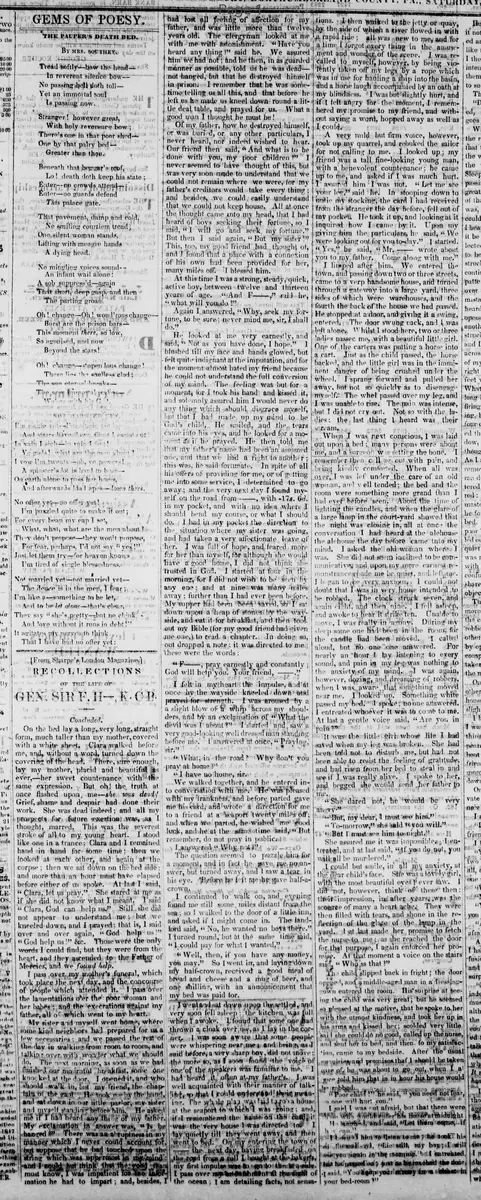
On the bed lay a long, very long, straight form, much taller than my mother, covered with a white sheet. Clara walked before me, and, without a word, turned down the covering of the head. There, sure enough, lay my mother, placid and beautiful as ever, her sweet countenance with the same expression. But oh! the truth at once flashed upon me—she was dead! Grief, shame and despair had done their work. She was dead indeed; and all my prospects for future exertion was, as I thought, marred. This was the severest stroke of all to my young heart. I stood like one in a trance: Clara and I remained hand in hand for some time: then we looked at each other, and again at the corpse; then we sat down on the bed side: and more than an hour must have elapsed before either of us spoke. At last I said, "Clara, let us pray." She stared at me as if she did not know what I meant. I said "Clara, God can help us." Still, she did not appear to understand me but we kneeled down, and I prayed; that is, I said over and over again, "God help us!" "God help us!" &c. Those were the only words I could find, but they were from the heart, and they ascended to the Father of Mercies, and we found help.
I pass over my mother's funeral, which took place the next day, and the concourse of people which attended it. I pass over the lamentations o'er the poor woman and her babes: and the execrations against my father, all of which went to my heart. My sister and myself went home, where some kind neighbors had prepared for us a few necessaries: and we passed the rest of the day in walking from room to room, and talking over, with wonder what we should do. The next morning, as soon as we had finished our mournful breakfast, some one knocked at the door. I opened it, and who should walk in, but my friend, the chaplain of the gaol. He took me by the hand, and sat down in our little parlor, my sister and myself standing before him. He asked me if I had heard any thing of my father. My exclamation in answer was, "Is he hanged?" There was an abruptness in my manner which I never could account for, but suppose that he had touched upon the string which was uppermost in my mind. and I could but think that the good man must know, I was impatient for the information he had to impart; and, besides, I had lost all feeling of affection for my father, and was little more than twelve years old! The clergyman looked at me with astonishment. "Have you heard any thing?" said he. We assured him we had not; and he then, in as guarded manner as possible, told us he was dead—not hanged, but that he destroyed himself in prison: I remember that he was some time telling us all this, and that before he left us he made us kneel down round a little deal table, and prayed for us. What a good man I thought he must be! Of my father, how he destroyed himself, or was buried, or any other particulars, I never heard, nor indeed wished to hear.
Our friend then said, "And what is to be done with you, my poor children?" I never seemed to have thought of this, but was very soon made to understand that we could not remain where we were, for my father's creditors would take every thing: and besides, we could easily understand that we could not keep house. All at once the thought came into my head, that I had heard of boys seeking their fortune, so I said, "I will go and seek my fortune." But then I said again, "But my sister!" This, too, my good friend had thought of. and I found that a place with a connexion of his own had been provided for her, many miles off. I blessed him.
At this time I was a strong, steady, quick, active boy, between twelve and thirteen years of age. "And I," said he, "what will you do?" Again I answered, "Why, seek my fortune, to be sure; never mind me, sir. I shall do." He looked at me very earnestly, and said, "Not as you have done, I hope." I blushed till my face and hands glowed, but felt quite indignant at the imputation, and for the moment almost hated my friend because he could not understand the full conversion of my mind. The feeling was but for a moment, for I took his hand and kissed it. and solemnly assured him I would never do any thing which should disgrace myself, but that I had made up my mind to be God's child. He smiled, and the tears came into his eyes, and he looked for a moment as if he prayed. He then told me that my father's name had been an assumed one, and that we had a right to another: this was, he said fortunate. In spite of all his offers of providing for me, or of getting me into some service, I determined to go away; and the very next day I found myself on the road from home, with 17s. 6d. in my pocket, and with no idea where I should bend my course, or what I should do. I had in my pocket the direction to the situation where my sister was going, and had taken a very affectionate leave of her. I was full of hope, and feared more for her than for myself, for although she would have a good home, I did not think she trusted in God. I started at four in the morning, for I did not wish to be seen by any one; and at nine was many miles away: further than I had ever been before. My supper had been saved, so I sat down upon a heap of stones by the way side and ate it for breakfast, and then took out my Bible (for my good friend had given me one,) to read a chapter. In doing so, out dropped a note; it was directed to me; these were the words:
"Pray earnestly and constantly; God will help you. Your friend."
I felt in my heart the impulse, and at once by the wayside kneeled down and prayed for strength. I was aroused by a slight blow of a whip across my shoulders, and by an exclamation of "What the devil are you about?" I started and saw a very good-looking well dressed man standing before me. I answered at once, "Praying, sir."
"What, in the road? Why don't you pray at home?"
"I have no home, sir."
We walked together, and he entered into conversation with me. He was pleased with my frankness, and before we parted gave me his card, and wrote a direction for me to a friend at a seaport twenty miles off: and when we parted, he wished me good luck, and at the same time said, "But remember, do not pray in public."
I answered "Why not?"
The question seemed to puzzle him for a moment, and in fact he gave me no answer, but turned away, and I saw a tear in his eye. Before he left me he gave half-a-crown. I continued to walk on, and evening found me still some miles distant from the sea: so I walked to the door of a little inn, and asked if I might come in. The landlord said, "No, he wanted no boys there." I turned round, but at the same time said, "I could pay for what I wanted."
"Well, then, if you have any money, you may." So I went in, and laying down my half-crown, received a good meal of bread and cheese and a mug of beer, and one shilling, with an announcement that my bed was paid for. I went and sat down upon the settle, and very soon fell asleep; the kitchen was full when I awoke. I found that some one had thrown a cloak over me, as I lay in the corner and was soon aware that some people were whispering near me and being, as I said before, a very sharp boy, did not move: the more so, as I soon found the voice of one of the speakers was familiar to me. I had heard it often at my father's. I was well acquainted with their manner of talking, so that I could understand their meaning. The whole plan was hid for a house at the seaport to which I was going; and, as I remembered the name on the card it was the very house I was directed to, I went to bed. On my entering the town of the next day, having breakfasted on the road from a roll I bought at the baker's, my first impulse was to go to this house. I pass over my astonishment at the sight of the ocean; I am detailing facts, not sensations. I then walked to the jetty or quay, by the side of which a river flowed in with a rapid tide; all was new to me and for a time I forgot every thing in the amusement and wonder of the scene. I was recalled to myself, however, by being violently taken off my legs by a rope which was in use for hauling a ship into the basin, and a horse laugh accompanied by an oath at my blindness. I was but slightly hurt, and if I felt angry for the moment, I remembered my promise to my friend, and without saying a word, hopped away as well as I could.
A very mild but firm voice, however, took up my quarrel, and rebuked the sailor for not calling to me. I looked up; my friend was a tall fine-looking young man, with a benevolent countenance: he came up to me, and asked if I was much hurt. I assured him I was not. "Let me see your leg," said he. In stooping down to untie my stocking the card I had received from the stranger the day before, fell out of my pocket. He took it up, and looking at it inquired how I came by it. Upon my giving him the particulars, he said, "We were looking out for you to-day." I started. "Yes," he said, "Mr. — wrote about you to my father." "Come along with me."
I limped after him. We entered the town, and passing down two or three streets, came to a very handsome house, and turned through a gateway into a large yard, three sides of which were warehouses, and the fourth the back of the house we had passed. He stopped at a door, and giving it a swing, entered. The door swung back, and I was left alone. Whilst I stood here, two or three ladies passed me, with a beautiful little girl. One of the carters was putting a horse into a cart. Just as the child passed, the horse backed, and the little girl was in the imminent danger of being crushed under the wheel. I sprang forward and pulled her away, but not so quickly as to disengage myself. The wheel passed over my leg, and I was unable to rise. The pain was intense, but I did not cry out. Not so with the ladies: the last thing I heard was their scream.
When I was next conscious, I was laid out upon a bed; many persons were about me, and a surgeon was setting the bone. I remember then calling out with pain, and being kindly comforted. When all was over, I was left under the care of an old woman, and well tended: the bed and the room were something more grand than I had ever before seen. About the time of lighting the candles, and when the glare of a large lamp in the court-yard showed that the night was closing in, all at once the conversation I had heard at the alehouse the day before came into my mind. I asked the old woman where I was. She did not seem inclined to be communicative; and upon my more earnest remonstrances bade me be quiet, and left the room. I began to be very anxious; I could not doubt that I was in very house intended to be robbed. The clock struck seven, and again eight, and then nine. I fell asleep, and awoke to hear it strike ten. Unable to move, I was really in agony. During my sleep some one had been in the room, for the candle had been moved. I called aloud, but no one answered. For nearly an hour I lay listening to every sound, and pain in my leg was nothing to the anxiety of my mind. I was again, however, dozing, and dreaming of robbers, when I was aware that something moved near me. I looked up. Something white passed my bed. I spoke; no one answered. I entreated whoever it was to come to me. At last a gentle voice said, "Are you in pain?" It was the little girl whose life I had saved when my leg was broken. She had been told not to disturb me, but had not been able to resist the feeling of gratitude, and had risen from her bed to steal in and see if I was really alive. I spoke to her, and begged she would send her father to me.
She dared not, he would be very angry. "But, my dear, I must see him." "To-morrow," she said "you will." "But I must see him to-night." She assured me it was impossible. I entreated, and at last said, "if you do not, you will all be murdered."
I could but smile, in all my anxiety, at the dear child's face. She was a lovely girl, with the most beautiful eyes I ever saw. I did not, however, think of these then: that impression, and after years was the source of many a heart ache. They were then filled with tears, and shone in the reflection of the glare of the lamp in the yard. I at last made her promise to fetch the nurse to me as she reached the door for that purpose, I again enforced her promise. At that moment a voice on the stairs said, "Who's that?" The child slipped back in fright; the door opened, and a middle-aged man in a dressing-gown entered the room. His surprise at seeing the child was very great; but he seemed so pleased at the motive, that he spoke to her with the utmost kindness, and took her up in his arms and kissed her; scolded very little, said she could do no good, called up the nurse, and sent her to bed, and then, to my satisfaction, came to my bedside. After the usual inquiry and promises that I should be taken care of, he was about to go. I told him that in an hour his house would be robbed. "Poor child!" he said, "you need not fear, no one will hurt you."
I said I was not afraid, but that there were four men lying in wait for his house at midnight. He laughed, and said, "Let them come, if they can." I entreated him to listen to me. He shook his head, "Listen still, my boy, I will see you again in the morning." I entreated. But he passed on; just as he reached the door I said, "You keep your money in a safe in your bed-room."
He stopped, and said, "What then?" "Is it not behind your bed's head?" He returned and put down the candle. "The key is like three keys." He came to my bedside. I then explained all I had heard, how they intended entering, and their number, six of them, and more, that they were determined to succeed, by fair or foul means. The clock struck eleven.
"Did you say twelve?" he said. I answered, "Before twelve, before the watchman goes his rounds."
What happened more, I know not. He left the room, and I remained in darkness, except that the lamp in the court yard flared with the wind, and that the rain battered against the window. My leg ached very much. Sleep I could not. I lay and listened for every passing sound. Tick, tick, tick, went the great clock, which was fixed outside the wall of that part of the house where my chamber was, and which between the gusts of wind I could distinctly hear. Once or twice I thought I heard whisperings on the staircase. Could it be the robbers? Had the gentleman neglected my warning? Oh, how I longed to be able to creep to the door! The clock struck twelve, but there was no noise but the continual tick, tick, tick of the clock, and the pattering of the rain. Could they have given over the attempt? I was sure I had not been mistaken in my information. All at once I heard, in the room over mine, the window opened, and a man step down upon the floor; another followed, another and another. They struck a light, the window was gently shut, and I could distinctly hear them walk lightly across the room, towards what by the shape of my chamber I conceived the door. I was right; the door opened, the sound of their feet was upon the stairs. I lay in agony. What would be the event? I did not wait long in suspense. A violent outcry and the firing of pistols succeeded—struggling, swearing, blows and screams. This lasted some four or five minutes. Presently some entered the room over head and opened the window, and then rushed back again. It must be thought I, that they had cut off his escape! As I afterwards learned, the ladder had been removed. He returned to the staircase and ran down. My door opened; some one entered and made for the window: it was barred: he had not much time to undo it. The master of the house and two others entered—he fought well, and once was nearly on the bed. I shrieked with apprehension for my poor leg. At last he was overpowered and led out of the room. There was no more quiet in the house that night. Every one was moving about. The court-yard sounded with the voices of many persons. All was confusion and uproar. I did not fail of my share of the attention; and soon found I was an object of no common feeling.
The surgeon came to me again in the morning, and the whole family visited me in the course of the day. I learned that one robber had been shot and badly wounded, another beaten almost to death; one escaped by opening the street door and joining some companions, who drove off in a cart; and one taken in my room. Such were the events of the night. One of the porters was much hurt, and another dislocated his wrist by a fall on the house and his son escaped with only a few slight bruises.
I lay some weeks by bed, during which I was furnished with books, and indeed every thing I could require; and at last, for it appeared a weary time, was permitted to go about upon a crutch. My little blue-eyed friend was all attention to me, and in a few more weeks I was well, and again wandered down to the quay and about the town. One day, the master called me into his private room, and said, "Well, Fritz, you are now well: What do you intend to do?" I answered, "I am sure I don't know."
"Perhaps," he said, "you will make a friend of me, and tell me your history?"
I hesitated. "Two services, and I never forget. Tell me all, candidly: you shall never repent it—no one shall ever know it from me."
"Not even my wife?"
"You will never speak to me again, when you know all."
"Again," said he "I tell you, not to be afraid."
And so I made a full confession; and when I had done, I looked up with shame and confusion, expecting to see him as an enemy, and to be turned out of his house. To my surprise, he took me by the hand, and said, "I thank you for this confidence, I had indeed expected as much, and I knew that you must have been in very bad company; for although you did not observe it, you told me the names of those men, whose voices you could only have heard when you were roused from sleep in the alehouse; and who talked with them in prison, and intimated that I had noticed their attempt, from one who knew them and their language, one said it must have been either the devil or that hang-dog of a murderer's son who told you?"
I felt as if I must sink in the earth. Though I told him all the very mention of it again from his lips seemed to paralyze me. But he reassured me, and offered me a situation in India, which he had procured for his sister's son who was dead—a clerk in a mercantile house, where, he said if I did well I might make only a fortune; and moreover that I should go out as captain's clerk in a ship of which a relation of his was captain, to fit me for my situation. His kindness did not stop here; he furnished me with every thing needful, and I sailed amidst the good wishes and the bounty of the whole family.
These particulars were told me by my friend, General Sir F. H., as we rolled along in his travelling chariot and four to his magnificent mansion in — Square.
"This," he said, "was my early history. You my dear Archibald, know how I sped in India—how, from the mercantile, I became a volunteer in the famous expedition under ; and how, by one stroke of what men call fortune, I rose above my fellows, and far above all expectation. I thank God—He has always been my God. He it is who has helped me. Trust in him. You are young yet but the mercies of the Almighty, through his blessed Son, are fortune enough for any—or all."
"And your sister, General?"
"She died young, I never saw her more. I have, indeed, been but once in England since that time. My benefactor was dead— my secret died with him—you are now its only depository. It was in that visit to England that I married: and—I will let you into one more piece of my history—Lady H. was the fair blue eyed daughter of my friend' the child I saved from the cart wheel at— nearly at the expense of my own life."
It was many years after this that I obtained permission to publish these particulars. The General's last words were—"I am wifeless and childless; you are the inheritor of my property, due to you as the preserver of my life in India. The history may do good —it can harm no one. Let the public have it after my decease."
Concluded.
On the bed lay a long, very long, straight form, much taller than my mother, covered with a white sheet. Clara walked before me, and, without a word, turned down the covering of the head. There, sure enough, lay my mother, placid and beautiful as ever, her sweet countenance with the same expression. But oh! the truth at once flashed upon me—she was dead! Grief, shame and despair had done their work. She was dead indeed; and all my prospects for future exertion was, as I thought, marred. This was the severest stroke of all to my young heart. I stood like one in a trance: Clara and I remained hand in hand for some time: then we looked at each other, and again at the corpse; then we sat down on the bed side: and more than an hour must have elapsed before either of us spoke. At last I said, "Clara, let us pray." She stared at me as if she did not know what I meant. I said "Clara, God can help us." Still, she did not appear to understand me but we kneeled down, and I prayed; that is, I said over and over again, "God help us!" "God help us!" &c. Those were the only words I could find, but they were from the heart, and they ascended to the Father of Mercies, and we found help.
I pass over my mother's funeral, which took place the next day, and the concourse of people which attended it. I pass over the lamentations o'er the poor woman and her babes: and the execrations against my father, all of which went to my heart. My sister and myself went home, where some kind neighbors had prepared for us a few necessaries: and we passed the rest of the day in walking from room to room, and talking over, with wonder what we should do. The next morning, as soon as we had finished our mournful breakfast, some one knocked at the door. I opened it, and who should walk in, but my friend, the chaplain of the gaol. He took me by the hand, and sat down in our little parlor, my sister and myself standing before him. He asked me if I had heard any thing of my father. My exclamation in answer was, "Is he hanged?" There was an abruptness in my manner which I never could account for, but suppose that he had touched upon the string which was uppermost in my mind. and I could but think that the good man must know, I was impatient for the information he had to impart; and, besides, I had lost all feeling of affection for my father, and was little more than twelve years old! The clergyman looked at me with astonishment. "Have you heard any thing?" said he. We assured him we had not; and he then, in as guarded manner as possible, told us he was dead—not hanged, but that he destroyed himself in prison: I remember that he was some time telling us all this, and that before he left us he made us kneel down round a little deal table, and prayed for us. What a good man I thought he must be! Of my father, how he destroyed himself, or was buried, or any other particulars, I never heard, nor indeed wished to hear.
Our friend then said, "And what is to be done with you, my poor children?" I never seemed to have thought of this, but was very soon made to understand that we could not remain where we were, for my father's creditors would take every thing: and besides, we could easily understand that we could not keep house. All at once the thought came into my head, that I had heard of boys seeking their fortune, so I said, "I will go and seek my fortune." But then I said again, "But my sister!" This, too, my good friend had thought of. and I found that a place with a connexion of his own had been provided for her, many miles off. I blessed him.
At this time I was a strong, steady, quick, active boy, between twelve and thirteen years of age. "And I," said he, "what will you do?" Again I answered, "Why, seek my fortune, to be sure; never mind me, sir. I shall do." He looked at me very earnestly, and said, "Not as you have done, I hope." I blushed till my face and hands glowed, but felt quite indignant at the imputation, and for the moment almost hated my friend because he could not understand the full conversion of my mind. The feeling was but for a moment, for I took his hand and kissed it. and solemnly assured him I would never do any thing which should disgrace myself, but that I had made up my mind to be God's child. He smiled, and the tears came into his eyes, and he looked for a moment as if he prayed. He then told me that my father's name had been an assumed one, and that we had a right to another: this was, he said fortunate. In spite of all his offers of providing for me, or of getting me into some service, I determined to go away; and the very next day I found myself on the road from home, with 17s. 6d. in my pocket, and with no idea where I should bend my course, or what I should do. I had in my pocket the direction to the situation where my sister was going, and had taken a very affectionate leave of her. I was full of hope, and feared more for her than for myself, for although she would have a good home, I did not think she trusted in God. I started at four in the morning, for I did not wish to be seen by any one; and at nine was many miles away: further than I had ever been before. My supper had been saved, so I sat down upon a heap of stones by the way side and ate it for breakfast, and then took out my Bible (for my good friend had given me one,) to read a chapter. In doing so, out dropped a note; it was directed to me; these were the words:
"Pray earnestly and constantly; God will help you. Your friend."
I felt in my heart the impulse, and at once by the wayside kneeled down and prayed for strength. I was aroused by a slight blow of a whip across my shoulders, and by an exclamation of "What the devil are you about?" I started and saw a very good-looking well dressed man standing before me. I answered at once, "Praying, sir."
"What, in the road? Why don't you pray at home?"
"I have no home, sir."
We walked together, and he entered into conversation with me. He was pleased with my frankness, and before we parted gave me his card, and wrote a direction for me to a friend at a seaport twenty miles off: and when we parted, he wished me good luck, and at the same time said, "But remember, do not pray in public."
I answered "Why not?"
The question seemed to puzzle him for a moment, and in fact he gave me no answer, but turned away, and I saw a tear in his eye. Before he left me he gave half-a-crown. I continued to walk on, and evening found me still some miles distant from the sea: so I walked to the door of a little inn, and asked if I might come in. The landlord said, "No, he wanted no boys there." I turned round, but at the same time said, "I could pay for what I wanted."
"Well, then, if you have any money, you may." So I went in, and laying down my half-crown, received a good meal of bread and cheese and a mug of beer, and one shilling, with an announcement that my bed was paid for. I went and sat down upon the settle, and very soon fell asleep; the kitchen was full when I awoke. I found that some one had thrown a cloak over me, as I lay in the corner and was soon aware that some people were whispering near me and being, as I said before, a very sharp boy, did not move: the more so, as I soon found the voice of one of the speakers was familiar to me. I had heard it often at my father's. I was well acquainted with their manner of talking, so that I could understand their meaning. The whole plan was hid for a house at the seaport to which I was going; and, as I remembered the name on the card it was the very house I was directed to, I went to bed. On my entering the town of the next day, having breakfasted on the road from a roll I bought at the baker's, my first impulse was to go to this house. I pass over my astonishment at the sight of the ocean; I am detailing facts, not sensations. I then walked to the jetty or quay, by the side of which a river flowed in with a rapid tide; all was new to me and for a time I forgot every thing in the amusement and wonder of the scene. I was recalled to myself, however, by being violently taken off my legs by a rope which was in use for hauling a ship into the basin, and a horse laugh accompanied by an oath at my blindness. I was but slightly hurt, and if I felt angry for the moment, I remembered my promise to my friend, and without saying a word, hopped away as well as I could.
A very mild but firm voice, however, took up my quarrel, and rebuked the sailor for not calling to me. I looked up; my friend was a tall fine-looking young man, with a benevolent countenance: he came up to me, and asked if I was much hurt. I assured him I was not. "Let me see your leg," said he. In stooping down to untie my stocking the card I had received from the stranger the day before, fell out of my pocket. He took it up, and looking at it inquired how I came by it. Upon my giving him the particulars, he said, "We were looking out for you to-day." I started. "Yes," he said, "Mr. — wrote about you to my father." "Come along with me."
I limped after him. We entered the town, and passing down two or three streets, came to a very handsome house, and turned through a gateway into a large yard, three sides of which were warehouses, and the fourth the back of the house we had passed. He stopped at a door, and giving it a swing, entered. The door swung back, and I was left alone. Whilst I stood here, two or three ladies passed me, with a beautiful little girl. One of the carters was putting a horse into a cart. Just as the child passed, the horse backed, and the little girl was in the imminent danger of being crushed under the wheel. I sprang forward and pulled her away, but not so quickly as to disengage myself. The wheel passed over my leg, and I was unable to rise. The pain was intense, but I did not cry out. Not so with the ladies: the last thing I heard was their scream.
When I was next conscious, I was laid out upon a bed; many persons were about me, and a surgeon was setting the bone. I remember then calling out with pain, and being kindly comforted. When all was over, I was left under the care of an old woman, and well tended: the bed and the room were something more grand than I had ever before seen. About the time of lighting the candles, and when the glare of a large lamp in the court-yard showed that the night was closing in, all at once the conversation I had heard at the alehouse the day before came into my mind. I asked the old woman where I was. She did not seem inclined to be communicative; and upon my more earnest remonstrances bade me be quiet, and left the room. I began to be very anxious; I could not doubt that I was in very house intended to be robbed. The clock struck seven, and again eight, and then nine. I fell asleep, and awoke to hear it strike ten. Unable to move, I was really in agony. During my sleep some one had been in the room, for the candle had been moved. I called aloud, but no one answered. For nearly an hour I lay listening to every sound, and pain in my leg was nothing to the anxiety of my mind. I was again, however, dozing, and dreaming of robbers, when I was aware that something moved near me. I looked up. Something white passed my bed. I spoke; no one answered. I entreated whoever it was to come to me. At last a gentle voice said, "Are you in pain?" It was the little girl whose life I had saved when my leg was broken. She had been told not to disturb me, but had not been able to resist the feeling of gratitude, and had risen from her bed to steal in and see if I was really alive. I spoke to her, and begged she would send her father to me.
She dared not, he would be very angry. "But, my dear, I must see him." "To-morrow," she said "you will." "But I must see him to-night." She assured me it was impossible. I entreated, and at last said, "if you do not, you will all be murdered."
I could but smile, in all my anxiety, at the dear child's face. She was a lovely girl, with the most beautiful eyes I ever saw. I did not, however, think of these then: that impression, and after years was the source of many a heart ache. They were then filled with tears, and shone in the reflection of the glare of the lamp in the yard. I at last made her promise to fetch the nurse to me as she reached the door for that purpose, I again enforced her promise. At that moment a voice on the stairs said, "Who's that?" The child slipped back in fright; the door opened, and a middle-aged man in a dressing-gown entered the room. His surprise at seeing the child was very great; but he seemed so pleased at the motive, that he spoke to her with the utmost kindness, and took her up in his arms and kissed her; scolded very little, said she could do no good, called up the nurse, and sent her to bed, and then, to my satisfaction, came to my bedside. After the usual inquiry and promises that I should be taken care of, he was about to go. I told him that in an hour his house would be robbed. "Poor child!" he said, "you need not fear, no one will hurt you."
I said I was not afraid, but that there were four men lying in wait for his house at midnight. He laughed, and said, "Let them come, if they can." I entreated him to listen to me. He shook his head, "Listen still, my boy, I will see you again in the morning." I entreated. But he passed on; just as he reached the door I said, "You keep your money in a safe in your bed-room."
He stopped, and said, "What then?" "Is it not behind your bed's head?" He returned and put down the candle. "The key is like three keys." He came to my bedside. I then explained all I had heard, how they intended entering, and their number, six of them, and more, that they were determined to succeed, by fair or foul means. The clock struck eleven.
"Did you say twelve?" he said. I answered, "Before twelve, before the watchman goes his rounds."
What happened more, I know not. He left the room, and I remained in darkness, except that the lamp in the court yard flared with the wind, and that the rain battered against the window. My leg ached very much. Sleep I could not. I lay and listened for every passing sound. Tick, tick, tick, went the great clock, which was fixed outside the wall of that part of the house where my chamber was, and which between the gusts of wind I could distinctly hear. Once or twice I thought I heard whisperings on the staircase. Could it be the robbers? Had the gentleman neglected my warning? Oh, how I longed to be able to creep to the door! The clock struck twelve, but there was no noise but the continual tick, tick, tick of the clock, and the pattering of the rain. Could they have given over the attempt? I was sure I had not been mistaken in my information. All at once I heard, in the room over mine, the window opened, and a man step down upon the floor; another followed, another and another. They struck a light, the window was gently shut, and I could distinctly hear them walk lightly across the room, towards what by the shape of my chamber I conceived the door. I was right; the door opened, the sound of their feet was upon the stairs. I lay in agony. What would be the event? I did not wait long in suspense. A violent outcry and the firing of pistols succeeded—struggling, swearing, blows and screams. This lasted some four or five minutes. Presently some entered the room over head and opened the window, and then rushed back again. It must be thought I, that they had cut off his escape! As I afterwards learned, the ladder had been removed. He returned to the staircase and ran down. My door opened; some one entered and made for the window: it was barred: he had not much time to undo it. The master of the house and two others entered—he fought well, and once was nearly on the bed. I shrieked with apprehension for my poor leg. At last he was overpowered and led out of the room. There was no more quiet in the house that night. Every one was moving about. The court-yard sounded with the voices of many persons. All was confusion and uproar. I did not fail of my share of the attention; and soon found I was an object of no common feeling.
The surgeon came to me again in the morning, and the whole family visited me in the course of the day. I learned that one robber had been shot and badly wounded, another beaten almost to death; one escaped by opening the street door and joining some companions, who drove off in a cart; and one taken in my room. Such were the events of the night. One of the porters was much hurt, and another dislocated his wrist by a fall on the house and his son escaped with only a few slight bruises.
I lay some weeks by bed, during which I was furnished with books, and indeed every thing I could require; and at last, for it appeared a weary time, was permitted to go about upon a crutch. My little blue-eyed friend was all attention to me, and in a few more weeks I was well, and again wandered down to the quay and about the town. One day, the master called me into his private room, and said, "Well, Fritz, you are now well: What do you intend to do?" I answered, "I am sure I don't know."
"Perhaps," he said, "you will make a friend of me, and tell me your history?"
I hesitated. "Two services, and I never forget. Tell me all, candidly: you shall never repent it—no one shall ever know it from me."
"Not even my wife?"
"You will never speak to me again, when you know all."
"Again," said he "I tell you, not to be afraid."
And so I made a full confession; and when I had done, I looked up with shame and confusion, expecting to see him as an enemy, and to be turned out of his house. To my surprise, he took me by the hand, and said, "I thank you for this confidence, I had indeed expected as much, and I knew that you must have been in very bad company; for although you did not observe it, you told me the names of those men, whose voices you could only have heard when you were roused from sleep in the alehouse; and who talked with them in prison, and intimated that I had noticed their attempt, from one who knew them and their language, one said it must have been either the devil or that hang-dog of a murderer's son who told you?"
I felt as if I must sink in the earth. Though I told him all the very mention of it again from his lips seemed to paralyze me. But he reassured me, and offered me a situation in India, which he had procured for his sister's son who was dead—a clerk in a mercantile house, where, he said if I did well I might make only a fortune; and moreover that I should go out as captain's clerk in a ship of which a relation of his was captain, to fit me for my situation. His kindness did not stop here; he furnished me with every thing needful, and I sailed amidst the good wishes and the bounty of the whole family.
These particulars were told me by my friend, General Sir F. H., as we rolled along in his travelling chariot and four to his magnificent mansion in — Square.
"This," he said, "was my early history. You my dear Archibald, know how I sped in India—how, from the mercantile, I became a volunteer in the famous expedition under ; and how, by one stroke of what men call fortune, I rose above my fellows, and far above all expectation. I thank God—He has always been my God. He it is who has helped me. Trust in him. You are young yet but the mercies of the Almighty, through his blessed Son, are fortune enough for any—or all."
"And your sister, General?"
"She died young, I never saw her more. I have, indeed, been but once in England since that time. My benefactor was dead— my secret died with him—you are now its only depository. It was in that visit to England that I married: and—I will let you into one more piece of my history—Lady H. was the fair blue eyed daughter of my friend' the child I saved from the cart wheel at— nearly at the expense of my own life."
It was many years after this that I obtained permission to publish these particulars. The General's last words were—"I am wifeless and childless; you are the inheritor of my property, due to you as the preserver of my life in India. The history may do good —it can harm no one. Let the public have it after my decease."
What sub-type of article is it?
Biography
Personal Triumph
Journey
What themes does it cover?
Fate Providence
Moral Virtue
Triumph
What keywords are associated?
Orphanhood
Suicide
Seeking Fortune
Foiled Robbery
Divine Providence
Rise To Success
Redemption
What entities or persons were involved?
General Sir F. H.
Mother
Clara
Father
Chaplain
Stranger
Benefactor
Little Girl
Archibald
Where did it happen?
Town With Gaol, Road, Seaport Town
Story Details
Key Persons
General Sir F. H.
Mother
Clara
Father
Chaplain
Stranger
Benefactor
Little Girl
Archibald
Location
Town With Gaol, Road, Seaport Town
Story Details
Orphaned boy after mother's death and father's suicide in prison seeks fortune, foils robbery at benefactor's house after saving child, gains employment in India, rises to general through providence and merit, marries benefactor's daughter.