Thank you for visiting SNEWPapers!
Sign up free
Story
February 27, 1830
Palladium Of Virginia And The Pacific Monitor
Lewisburg, Greenbrier County, West Virginia
What is this article about?
Mrs. S. C. Hall's tale illustrates Irish procrastination via farmer Philip Garraty, whose delays in business matters cause lost wheat sale, debts from assaulting the steward, and financial ruin, despite good intentions and family.
Clipping
OCR Quality
88%
Good
Full Text
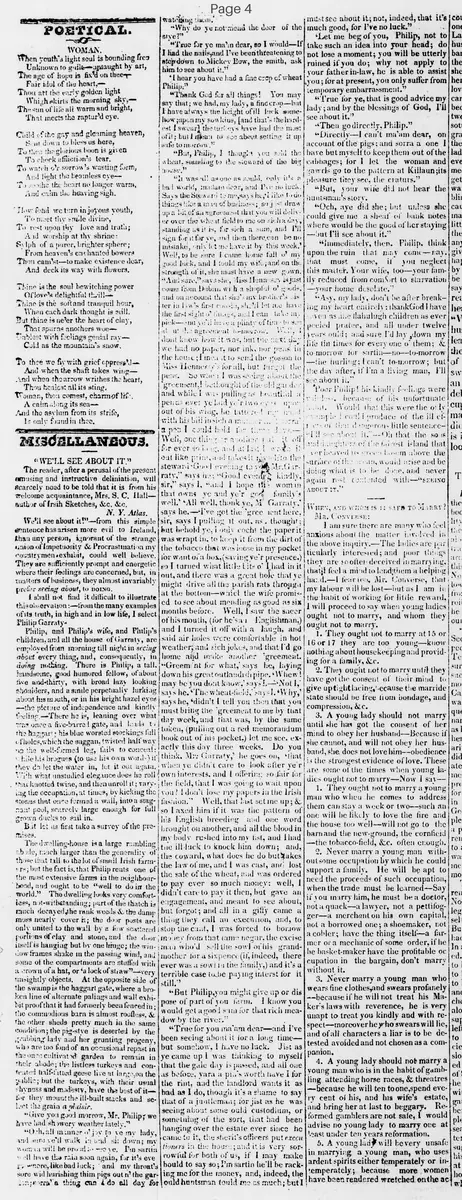
MISCELLANEOUS.
"WE'LL SEE ABOUT IT."
The reader, after a perusal of the present amusing and instructive delineation, will scarcely need to be told that it is from his welcome acquaintance, Mrs. S. C. Hall—author of Irish Sketches, &c. &c. N. Y. Atlas.
We'll see about it!"—from this simple sentence has arisen more evil to Ireland, than any person, ignorant of the strange union of impetuosity & procrastination my countrymen exhibit, could well believe. They are sufficiently prompt and energetic where their feelings are concerned, but, in matters of business, they almost invariably prefer seeing about, to DOING.
I shall not find it difficult to illustrate this observation: from the many examples of its truth, in high and in low life. I select Philip Garraty—
Philip, and Philip's wife, and Philip's children, and all the house of Garraty, are employed from morning till night in seeing about every thing, and, consequently, in doing nothing. There is Philip, a tall, handsome, good humored fellow, of about five and thirty, with broad lazy looking shoulders, and a smile perpetually lurking about his mouth, or in his bright hazel eyes—the picture of independence and kindly feeling.—There he is, leaning over what was once a five-barred gate, and leads to the haggard: his blue worsted stockings full of holes, which the suggan, twisted half way up the well-formed leg, fails to conceal; while his brogues (to use his own word) if they do let the water in, let it out again. In what unstudied elegance does he roll that knotted twine, and then unroll it; varying the occupation, at times, by kicking the stones that once formed a wall, into a stagnant pool, scarcely large enough for full grown ducks to sail in.
But let us first take a survey of the premises.
The dwelling-house is a large rambling abbey, much larger than the generality of those that fall to the lot of small Irish farmers; but the fact is, that Philip rents one of the most extensive farms in the neighbourhood, and ought to be "well to do in the world." The dwelling looks very comfortless, notwithstanding: part of the thatch is much decayed the rank weeds & the damp moss nearly cover it; the door posts are only united to the wall by a few scattered portions of clay and stone, and the door itself is hanging but by one hinge; the window frames shake in the passing wind, and some of the compartments are stuffed with a crown of a hat, or "a lock of straw"—very unsightly objects. At the opposite side of the swamp is the haggard gate, where a broken line of alternate palings and wall exhibit proof that it had formerly been fenced in; the commodious barn is almost roofless, & the other sheds pretty much in the same condition; the pig-stye is deserted by the grubbing lady and her grunting progeny, who are too fond of an occasional repast in the once cultivated garden to remain in their abode; the listless turkeys and contrated half-fitted geese live at large, on the aublic; but the turkeys, with their usual shyness and modesty, have the best of it—for they mount the ill-built stacks and select the grain a plaisir.
"Give you good morrow, Mr. Philip; we have had showery weather lately."
"Oh, all manner o' joy to ye my lady. And sure well walk in and sit down; my woman will be proud to see ye. But certain she'll have the rain soon again, for it's ever near, like bad luck; and my throat's sore wid hurrying thim pigs out n' the garden; sorra a thing can I do all day for waiting in."
"Why do ye not mend the door of the stye?"
"True for ye ma'am dear, so I would—If I had the nails, and I've been threatening to step down to Mickey Bow, the smith, ask him to see about it."
"I hear you have had a fine crop of wheat Philip."
"Thank God for all things! You may say that; we had, my lady, a fine croy—but I have always the height of ill luck somehow upon my sow kiss. [and that's the hardest I swear] the turkeys have had the most of it: but I mean to see about setting it up safe to morrow."
"But, Philip, I thought you sold the wheat standing to the steward of the big house."
"It was all as one as sold, only it's a bad world, madam dear, and Pezo luck. Says the Steward to me, says he, I like to do things like a man of business; so just draw up a bit of an agreement that you will deliver over the wheat field to me on sich a day, standing as it is, for sich a sum, and I'll sign for it for ye, and then there can be no mistake, only let me have it by this week.' Well, to be sure I came home fall o' my good luck, and I tould my wife, and on the strength of it, she must have a new gown.
"And sdre," says she, Miss Hennassy is just come from Dublin with a shopful o' goods, and on account that she's my brother's sister in law's first cousin, she'll let me have the first sight o' dhg, and I can take my pick—and well have plenty of time to see about the agreement to-morrow, Mr."
I don't know how it was, but the next day we had no paper, nor ink, nor pens in the house; I meant it to send the gosson to Miss Hennessey's for all, but furoot the pens. So while I was seeing about the agreement, I bethought of the ould gander and while I was pulling as beautiful a pen as ever ye had yer two eyes on out of his wing, he tuk fire! wr. m t with his bill in sich a manner, I orra a pen I coald hld f—t. ro: d ya—
Well, one thing or another put it off for ever so long, and at last I wro te it out like pi ad tekes it mail o fhe steward Good evening to vdA Mr. Garraty," says he; "Good evening kindly. sir," says I, "and I hope the woman that owns ye and yer good family 's all well.' "All well, thank ye, Mr. Garraty.' says he.—I've got the agreement here. sir, says I pulling it out, as I thought; but behold ye, I only cocht the paper it was wrapt in, to keep it from the dirt of the tobacco that was loose in my pocket for want of a box, (saving yer presence.) so I turned what little fits o' I had in it out, and there was a great hole that ye might drive all the parish rats througa at the bottom—which the wife promised to see about mending as good as six months before. Well, I saw the sneer of his mouth, (for he was an Englishman.) and I turned it off with a laugh, and said air holes were comfortable in hot weather, and sich jokes, and that I'd go home and make another agreement.
"Agreement for what, says he, laying down his great outlandish pipe. 'Whew may be you dout know.' says I.—'Not I,' says he. 'The wheat-field, says I.' 'Why,' says he, didn't I tell you then that you must bring the agreement to me by that day week, and that was, by the same token, (pulling out a red memorandum book out of his pocket.) let me see, exactly this day three weeks. Do you think, Mr. Garraty, he goes on, that when ye didn't care to look after yer own interests, and I offering so fair for the field, that I was going to wait upon you? I don't lose my papers in the Irish fashion.' Well, that last set me up; & so I axed him if it was the pattern of his English breeding and one word brought on another, and all the blood in my body rushed into my fist, and I had the ill luck to knock him down; and, the coward, what does he do but takes the law of me, and I was cast, and lost the sale of the wheat, and was ordered to pay ever so much money: well, I didn't care to pay it then, but gave an engagement, and meant to see about, but forgot: and all in a jiffy came a thing they call an execution, and, to stop the cant, I was forced to borrow money from that tame negar, the excise man who'd sell the sowl oi his grandmother for a sixpence (if, indeed, there ever was a sowl in the family.) and it's a terrible case to be paying interest for it still."
"But Philip, you might give up or dispose of part of your farm. I know you would get a good sum for that rich meadow by the river."
"True for you ma'am dear—and I've been seeing about it for a long time—but somehow, I have no luck. Jist as ye came up I was thinking to myself that the gale day is passed, and all one as before. Vara a p.'s worth have I for the rint, and the landlord wants it as bad as I do, though it's a shame to say that of a jintleman; for jist as he was seeing about some ould custodium, or something of the sort, that had been hanging over the estate ever since he came to it, the sherit's officers put receivers in the house and it is very sorrowful for both of us, if I may make bould to say so; I'm sartin he'll be racking me for the money, and, indeed, the ould huntsman tould me as much: but I must see about it; not, indeed, that it's much good, for I've no luck."
"Let me beg of you, Philip, not to take such an idea into your head; do not lose a moment; you will be utterly ruined if you do; why not apply to your father in-law, he is able to assist you; for at present, you only suffer from temporary embarrassment."
"True for ye, that is good advice my lady; and by the blessings of God, I'll see about it."
"Then go directly, Philip."
"Directly—I can't ma'am dear, on account of the pigs; and sorra a one I have but myself to keep them out of the cabbages; for I let the woman and gawrls go to the pattern at Killaun; its pleasure they see, the craturs."
"But, your wife did not hear the huntsman's story."
"Och, aye did she; but unless she could give me a sheaf of bank notes where would be the good of her staying—but I'll see about it."
"Immediately, then. Philip. think upon the ruin that may come—nay, that must come, if you neglect this matter. Your wife, too—your family reduced from comfort to starvation your home desolate."
"Asy, my lady. don't be after breaking my heart entirely: thank God I have ten as dacent dacent children as ever peeled pratee, and all under twelve years ould; and sure I'd lay down my life tin times for every one o' them; & to-morrow for sartin—lie—to-morrow—tine harling: I can't to-morrow; but the day after, if I'm a living man, I'll see about it."
Poor Philip! his kindly feelings were the bane—o' his unfortunate habit. "Would that this were the only example I could produce of the ill effects of that dangerous little sentence—I'll see about it.”—Oh that the sons and daughters of the fairest island that Providence has created above the surface of the earth, would arise and be doing what is to be done, and never again be content with—"seeing ABOUT IT."
"WE'LL SEE ABOUT IT."
The reader, after a perusal of the present amusing and instructive delineation, will scarcely need to be told that it is from his welcome acquaintance, Mrs. S. C. Hall—author of Irish Sketches, &c. &c. N. Y. Atlas.
We'll see about it!"—from this simple sentence has arisen more evil to Ireland, than any person, ignorant of the strange union of impetuosity & procrastination my countrymen exhibit, could well believe. They are sufficiently prompt and energetic where their feelings are concerned, but, in matters of business, they almost invariably prefer seeing about, to DOING.
I shall not find it difficult to illustrate this observation: from the many examples of its truth, in high and in low life. I select Philip Garraty—
Philip, and Philip's wife, and Philip's children, and all the house of Garraty, are employed from morning till night in seeing about every thing, and, consequently, in doing nothing. There is Philip, a tall, handsome, good humored fellow, of about five and thirty, with broad lazy looking shoulders, and a smile perpetually lurking about his mouth, or in his bright hazel eyes—the picture of independence and kindly feeling.—There he is, leaning over what was once a five-barred gate, and leads to the haggard: his blue worsted stockings full of holes, which the suggan, twisted half way up the well-formed leg, fails to conceal; while his brogues (to use his own word) if they do let the water in, let it out again. In what unstudied elegance does he roll that knotted twine, and then unroll it; varying the occupation, at times, by kicking the stones that once formed a wall, into a stagnant pool, scarcely large enough for full grown ducks to sail in.
But let us first take a survey of the premises.
The dwelling-house is a large rambling abbey, much larger than the generality of those that fall to the lot of small Irish farmers; but the fact is, that Philip rents one of the most extensive farms in the neighbourhood, and ought to be "well to do in the world." The dwelling looks very comfortless, notwithstanding: part of the thatch is much decayed the rank weeds & the damp moss nearly cover it; the door posts are only united to the wall by a few scattered portions of clay and stone, and the door itself is hanging but by one hinge; the window frames shake in the passing wind, and some of the compartments are stuffed with a crown of a hat, or "a lock of straw"—very unsightly objects. At the opposite side of the swamp is the haggard gate, where a broken line of alternate palings and wall exhibit proof that it had formerly been fenced in; the commodious barn is almost roofless, & the other sheds pretty much in the same condition; the pig-stye is deserted by the grubbing lady and her grunting progeny, who are too fond of an occasional repast in the once cultivated garden to remain in their abode; the listless turkeys and contrated half-fitted geese live at large, on the aublic; but the turkeys, with their usual shyness and modesty, have the best of it—for they mount the ill-built stacks and select the grain a plaisir.
"Give you good morrow, Mr. Philip; we have had showery weather lately."
"Oh, all manner o' joy to ye my lady. And sure well walk in and sit down; my woman will be proud to see ye. But certain she'll have the rain soon again, for it's ever near, like bad luck; and my throat's sore wid hurrying thim pigs out n' the garden; sorra a thing can I do all day for waiting in."
"Why do ye not mend the door of the stye?"
"True for ye ma'am dear, so I would—If I had the nails, and I've been threatening to step down to Mickey Bow, the smith, ask him to see about it."
"I hear you have had a fine crop of wheat Philip."
"Thank God for all things! You may say that; we had, my lady, a fine croy—but I have always the height of ill luck somehow upon my sow kiss. [and that's the hardest I swear] the turkeys have had the most of it: but I mean to see about setting it up safe to morrow."
"But, Philip, I thought you sold the wheat standing to the steward of the big house."
"It was all as one as sold, only it's a bad world, madam dear, and Pezo luck. Says the Steward to me, says he, I like to do things like a man of business; so just draw up a bit of an agreement that you will deliver over the wheat field to me on sich a day, standing as it is, for sich a sum, and I'll sign for it for ye, and then there can be no mistake, only let me have it by this week.' Well, to be sure I came home fall o' my good luck, and I tould my wife, and on the strength of it, she must have a new gown.
"And sdre," says she, Miss Hennassy is just come from Dublin with a shopful o' goods, and on account that she's my brother's sister in law's first cousin, she'll let me have the first sight o' dhg, and I can take my pick—and well have plenty of time to see about the agreement to-morrow, Mr."
I don't know how it was, but the next day we had no paper, nor ink, nor pens in the house; I meant it to send the gosson to Miss Hennessey's for all, but furoot the pens. So while I was seeing about the agreement, I bethought of the ould gander and while I was pulling as beautiful a pen as ever ye had yer two eyes on out of his wing, he tuk fire! wr. m t with his bill in sich a manner, I orra a pen I coald hld f—t. ro: d ya—
Well, one thing or another put it off for ever so long, and at last I wro te it out like pi ad tekes it mail o fhe steward Good evening to vdA Mr. Garraty," says he; "Good evening kindly. sir," says I, "and I hope the woman that owns ye and yer good family 's all well.' "All well, thank ye, Mr. Garraty.' says he.—I've got the agreement here. sir, says I pulling it out, as I thought; but behold ye, I only cocht the paper it was wrapt in, to keep it from the dirt of the tobacco that was loose in my pocket for want of a box, (saving yer presence.) so I turned what little fits o' I had in it out, and there was a great hole that ye might drive all the parish rats througa at the bottom—which the wife promised to see about mending as good as six months before. Well, I saw the sneer of his mouth, (for he was an Englishman.) and I turned it off with a laugh, and said air holes were comfortable in hot weather, and sich jokes, and that I'd go home and make another agreement.
"Agreement for what, says he, laying down his great outlandish pipe. 'Whew may be you dout know.' says I.—'Not I,' says he. 'The wheat-field, says I.' 'Why,' says he, didn't I tell you then that you must bring the agreement to me by that day week, and that was, by the same token, (pulling out a red memorandum book out of his pocket.) let me see, exactly this day three weeks. Do you think, Mr. Garraty, he goes on, that when ye didn't care to look after yer own interests, and I offering so fair for the field, that I was going to wait upon you? I don't lose my papers in the Irish fashion.' Well, that last set me up; & so I axed him if it was the pattern of his English breeding and one word brought on another, and all the blood in my body rushed into my fist, and I had the ill luck to knock him down; and, the coward, what does he do but takes the law of me, and I was cast, and lost the sale of the wheat, and was ordered to pay ever so much money: well, I didn't care to pay it then, but gave an engagement, and meant to see about, but forgot: and all in a jiffy came a thing they call an execution, and, to stop the cant, I was forced to borrow money from that tame negar, the excise man who'd sell the sowl oi his grandmother for a sixpence (if, indeed, there ever was a sowl in the family.) and it's a terrible case to be paying interest for it still."
"But Philip, you might give up or dispose of part of your farm. I know you would get a good sum for that rich meadow by the river."
"True for you ma'am dear—and I've been seeing about it for a long time—but somehow, I have no luck. Jist as ye came up I was thinking to myself that the gale day is passed, and all one as before. Vara a p.'s worth have I for the rint, and the landlord wants it as bad as I do, though it's a shame to say that of a jintleman; for jist as he was seeing about some ould custodium, or something of the sort, that had been hanging over the estate ever since he came to it, the sherit's officers put receivers in the house and it is very sorrowful for both of us, if I may make bould to say so; I'm sartin he'll be racking me for the money, and, indeed, the ould huntsman tould me as much: but I must see about it; not, indeed, that it's much good, for I've no luck."
"Let me beg of you, Philip, not to take such an idea into your head; do not lose a moment; you will be utterly ruined if you do; why not apply to your father in-law, he is able to assist you; for at present, you only suffer from temporary embarrassment."
"True for ye, that is good advice my lady; and by the blessings of God, I'll see about it."
"Then go directly, Philip."
"Directly—I can't ma'am dear, on account of the pigs; and sorra a one I have but myself to keep them out of the cabbages; for I let the woman and gawrls go to the pattern at Killaun; its pleasure they see, the craturs."
"But, your wife did not hear the huntsman's story."
"Och, aye did she; but unless she could give me a sheaf of bank notes where would be the good of her staying—but I'll see about it."
"Immediately, then. Philip. think upon the ruin that may come—nay, that must come, if you neglect this matter. Your wife, too—your family reduced from comfort to starvation your home desolate."
"Asy, my lady. don't be after breaking my heart entirely: thank God I have ten as dacent dacent children as ever peeled pratee, and all under twelve years ould; and sure I'd lay down my life tin times for every one o' them; & to-morrow for sartin—lie—to-morrow—tine harling: I can't to-morrow; but the day after, if I'm a living man, I'll see about it."
Poor Philip! his kindly feelings were the bane—o' his unfortunate habit. "Would that this were the only example I could produce of the ill effects of that dangerous little sentence—I'll see about it.”—Oh that the sons and daughters of the fairest island that Providence has created above the surface of the earth, would arise and be doing what is to be done, and never again be content with—"seeing ABOUT IT."
What sub-type of article is it?
Biography
Curiosity
What themes does it cover?
Social Manners
Misfortune
Moral Virtue
What keywords are associated?
Irish Procrastination
Farm Mishaps
Lost Wheat Sale
Moral Tale
Family Ruin
What entities or persons were involved?
Philip Garraty
Where did it happen?
Irish Farm
Story Details
Key Persons
Philip Garraty
Location
Irish Farm
Story Details
Philip Garraty, an Irish farmer, exemplifies procrastination by delaying a wheat sale agreement, leading to assault on the steward, lost sale, debts, and impending ruin despite advice to act promptly.