Thank you for visiting SNEWPapers!
Sign up free
Alexandria Daily Gazette, Commercial & Political
Alexandria, Virginia
What is this article about?
British Foreign Secretary Canning disavows Ambassador Erskine's agreement with the US on the Chesapeake affair reparations, recalls Erskine, and appoints Jackson as replacement. Erskine's extract details negotiations with US Secretary Smith, securing reparation without further punishment for Admiral Berkeley.
Clipping
OCR Quality
Full Text
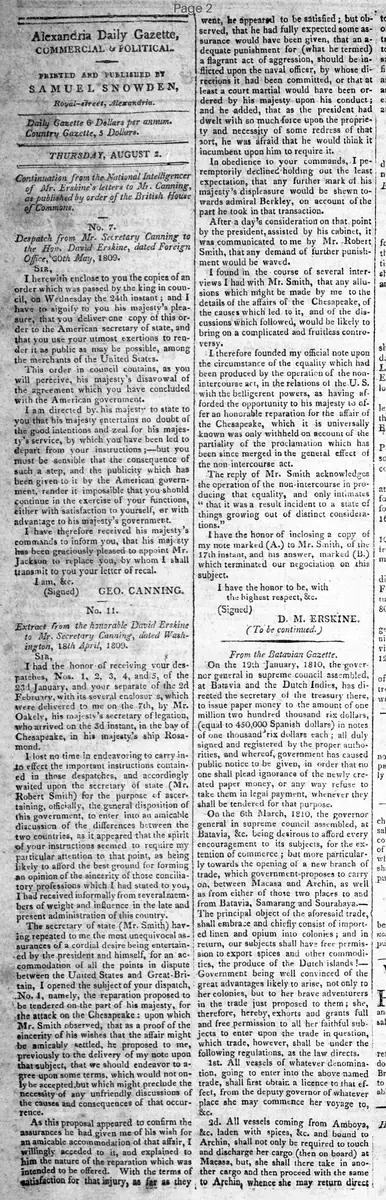
No. 7.
Despatch from Mr. Secretary Canning to the Hon. David Erskine, dated Foreign Office, 30th May, 1809.
SIR,
I herewith enclose to you the copies of an order which was passed by the king in council, on Wednesday the 24th instant; and I have to signify to you his majesty's pleasure, that you deliver one copy of this order to the American secretary of state, and that you use your utmost exertions to render it as public as may be possible, among the merchants of the United States.
This order in council contains, as you will perceive, his majesty's disavowal of the agreement which you have concluded with the American government.
I am directed by his majesty to state to you that his majesty entertains no doubt of the good intentions and zeal for his majesty's service, by which you have been led to depart from your instructions; but you must be sensible that the consequence of such a step, and the publicity which has been given to it by the American government, render it impossible that you should continue in the exercise of your functions, either with satisfaction to yourself, or with advantage to his majesty's government.
I have therefore received his majesty's commands to inform you, that his majesty has been graciously pleased to appoint Mr. Jackson to replace you, by whom I shall transmit to you your letter of recall.
I am, &c.
(Signed)
GEO. CANNING.
No. 11.
Extract From the honorable David Erskine to Mr. Secretary Canning, dated Washington, 18th April, 1809.
SIR,
I had the honor of receiving your despatches, Nos. 1, 2, 3, 4, and 5, of the 23d January, and your separate of the 2d February, with its several enclosures, which were delivered to me on the 7th, by Mr. Oakely, his majesty's secretary of legation, who arrived on the 3d instant, in the bay of Chesapeake, in his majesty's ship Rosamond.
I lost no time in endeavoring to carry into effect the important instructions contained in those despatches, and accordingly waited upon the secretary of state (Mr. Robert Smith) for the purpose of ascertaining, officially, the general disposition of this government, to enter into an amicable discussion of the differences between the two countries, as it appeared that the spirit of your instructions seemed to require my particular attention to that point, as being likely to afford the best ground for forming an opinion of the sincerity of those conciliatory professions which I had stated to you, I had received informally from several members of weight and influence in the late and present administration of this country.
The secretary of state (Mr. Smith) having repeated to me the most unequivocal assurances of a cordial desire being entertained by the president and himself, for an accommodation of all the points in dispute between the United States and Great Britain, I opened the subject of your dispatch, No. 1, namely, the reparation proposed to be tendered on the part of his majesty, for the attack on the Chesapeake: upon which Mr. Smith observed, that as a proof of the sincerity of his wishes that the affair might be amicably settled, he proposed to me, previously to the delivery of my note upon that subject, that we should endeavor to agree upon some terms, which would not only be accepted, but which might preclude the necessity of any unfriendly discussions of the causes and consequences of that occurrence.
As this proposal appeared to confirm the assurances he had given me of his wish for an amicable accommodation of that affair, I willingly acceded to it, and explained to him the nature of the reparation which was intended to be offered. With the terms of satisfaction for that injury, as far as they went, he appeared to be satisfied; but observed, that he had fully expected some assurance would have been given, that an adequate punishment for (what he termed) a flagrant act of aggression, should be inflicted upon the naval officer, by whose directions it had been committed, or that at least a court martial would have been ordered by his majesty upon his conduct: and he added, that as the president had dwelt with so much force upon the propriety and necessity of some redress of that sort, he was afraid that he would think it incumbent upon him to require it.
In obedience to your commands, I peremptorily declined holding out the least expectation, that any further mark of his majesty's displeasure would be shewn towards admiral Berkeley, on account of the part he took in that transaction.
After a day's consideration on that point by the president, assisted by his cabinet, it was communicated to me by Mr. Robert Smith, that any demand of further punishment would be waved.
I found in the course of several interviews I had with Mr. Smith, that any allusions which might be made by me to the details of the affairs of the Chesapeake, of the causes which led to it, and of the discussions which followed, would be likely to bring on a complicated and fruitless controversy.
I therefore founded my official note upon the circumstance of the equality which had been produced by the operation of the non-intercourse act, in the relations of the U. S. with the belligerent powers, as having afforded the opportunity to his majesty to offer an honorable reparation for the affair of the Chesapeake, which it is universally known was only withheld on account of the partiality of the proclamation which has been since merged in the general effect of the non-intercourse act.
The reply of Mr. Smith acknowledges the operation of the non-intercourse in producing that equality, and only intimates 'that it was a result incident to a state of things growing out of distinct considerations.'
I have the honor of inclosing a copy of my note marked (A.) to Mr. Smith, of the 17th instant, and his answer, marked (B.) which terminated our negociation on this subject.
I have the honor to be, with the highest respect, &c.
(Signed)
D. M. ERSKINE.
(To be continued.)
What sub-type of article is it?
What keywords are associated?
What entities or persons were involved?
Where did it happen?
Foreign News Details
Primary Location
Washington
Event Date
18th April 1809 To 30th May 1809
Key Persons
Outcome
disavowal of erskine's agreement with us; erskine recalled and replaced by jackson; reparation for chesapeake attack offered without further punishment for admiral berkeley; negotiations on chesapeake affair concluded amicably.
Event Details
Canning's despatch informs Erskine of the King's disavowal of his agreement with the US government on Chesapeake reparations, leading to Erskine's recall and Jackson's appointment. Erskine's extract describes receiving instructions, negotiating with US Secretary Smith on Chesapeake reparation, declining further punishment for Berkeley, and basing the note on the non-intercourse act's effects, resulting in a satisfactory exchange of notes.