Thank you for visiting SNEWPapers!
Sign up free
The Liberator
Boston, Suffolk County, Massachusetts
What is this article about?
A letter criticizes Rev. Mr. Curtis, chaplain of the Massachusetts State Prison, for excluding religious books of Roman Catholics, Universalists, and Unitarians from prisoners, arguing this violates constitutional religious freedom and obstructs moral reform. It calls for examination of clerical overreach in government institutions.
Clipping
OCR Quality
Full Text
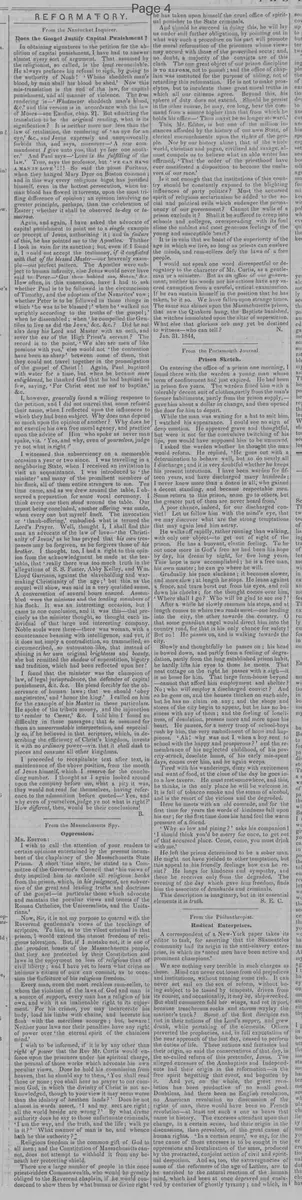
Oppression.
MR. EDITOR:
I wish to call the attention of your readers to certain opinions entertained by the present incumbent of the chaplaincy of the Massachusetts State Prison. A short time since, he stated to a Committee of the Governor's Council that 'his views of duty impelled him to exclude all religious books from the prison, which, in his judgment, are subversive of the great and leading truths and doctrines of the gospel—in particular those which advocate and maintain the peculiar views and tenets of the Roman Catholics, the Universalists, and the Unitarians.'
Now, Sir, it is not my purpose to quarrel with the Reverend gentleman's views of the teachings of scripture. To him, as to the vilest criminal in that prison, I would extend the utmost freedom of religious toleration. But, if I mistake not, it is one of the proudest boasts of the Massachusetts people, that they are protected by their Constitution and laws in the enjoyment no less of religious than of civil liberty; and I have yet to learn what crime so heinous a citizen of ours can commit, as to occasion the forfeiture of his religious freedom.
Every man, even the most reckless rum-seller, to whom the violation of the laws of God and man is a source of support, every man has a religion of his own, and with it an inalienable right to its enjoyment. For his crimes, you may incarcerate his body, load his limbs with chains, and lacerate his flesh with the merciless scourge; but, beware! Neither your laws nor their penalties have any right of power over 'the eternal spirit of the chainless mind.'
I wish to be informed, if it is by any other than right of power that the Rev. Mr. Curtis would enforce upon the prisoners under his spiritual charge, the perusal of those works which advocate his own peculiar views. Does he hold his commission from heaven, that he should say to them, 'You shall read these or none; you shall hear no prayer to our common God, in which the divinity of Christ is not acknowledged, though to your view it may seem worse than the idolatry of heathen lands?' Does he not almost in words assert, 'I and my sect are right; all the world beside are wrong?' By what divine authority does he say to those unfortunate criminals, 'I am the way, and the truth, and the life; walk ye in it?' What manner of man is he, and whence hath he this authority?
Religious freedom is the common gift of God to all men; and the Constitution of Massachusetts cannot, does not attempt to withhold it from any beneath her protecting shield.
There are a large number of people in this once priest-ridden Commonwealth, who would be greatly obliged to the Reverend chaplain, if he would condescend to show them by what human or divine right he has taken upon himself the cruel office of spiritual punisher to the State criminals. And should he succeed in doing this, he will lay us under still further obligations, by pointing out in what way such a procedure on his part will promote the moral reformation of the prisoners whose views may accord with those of the proscribed sects; and, no doubt, a majority of the convicts are of this class. The one great object of our prison discipline is To REFORM, not to punish; and the office of chaplain was instituted for the purpose of aiding, not of retarding this reformation. He is not to make proselytes, but to inculcate those great moral truths in which all our citizens agree. Beyond this, his sphere of duty does not extend. Should he persist in the other course, he may, ere long, hear the command from a source higher than that from which he holds his office—'Thou mayst be no longer steward.'
This, Mr. Editor, is but one of the million instances afforded by the history of our own State, of clerical encroachments upon the rights of the people. Nor by our history alone; that of the whole world, christian and pagan, civilized and savage, almost compels us to believe what an able writer has affirmed, 'That the order of the priesthood have ever manifested a disposition to become the enslavers of our race.'
Is it not enough that the institutions of this country should be constantly exposed to the blighting influences of party politics? Must the accursed spirit of religious sectarianism be added to the social and political evils which endanger the permanency of our government? Cannot the walls of a prison exclude it? Shall it be suffered to creep into schools and colleges, overspreading with its foul slime the noblest and most generous feelings of the young and susceptible heart?
It is in vain that we boast of the superiority of the age in which we live, so long as priests can enslave the minds, and rum-sellers defy the laws of a free people.
I would not speak one word disrespectful or derogatory to the character of Mr. Curtis, as a gentleman or a minister. But as an officer of our government, neither his words nor his actions have any sacred exemption from a careful, critical examination. If he can sustain himself in the position that he has taken, be it so. We have fallen upon strange times. The same sun shines upon the Massachusetts prison, that saw the Quakers hung, the Baptists banished, the witches immolated upon the altar of superstition. What else that glorious orb may yet be destined to witness—who can tell?
N.
Jan. 31, 1844.
What sub-type of article is it?
What themes does it cover?
What keywords are associated?
What entities or persons were involved?
Letter to Editor Details
Author
N.
Recipient
Mr. Editor
Main Argument
the chaplain rev. mr. curtis's exclusion of religious books from roman catholics, universalists, and unitarians violates prisoners' constitutional right to religious freedom, which cannot be forfeited even by crime, and hinders the prison's reformative purpose by imposing sectarian views.
Notable Details