Thank you for visiting SNEWPapers!
Sign up free
Letter to Editor
November 24, 1847
The Daily Union
Washington, District Of Columbia
What is this article about?
New York correspondence from Nov. 22, 1847, highlights economic growth under the new tariff, including a massive manufacturing project in Lewiston, rising imports and duties, and counters Whig ruin predictions; also covers political notes, English finance, shipping, and weather.
Clipping
OCR Quality
95%
Excellent
Full Text
EDITOR'S CORRESPONDENCE.
New
York, Nov. 22, 1847.
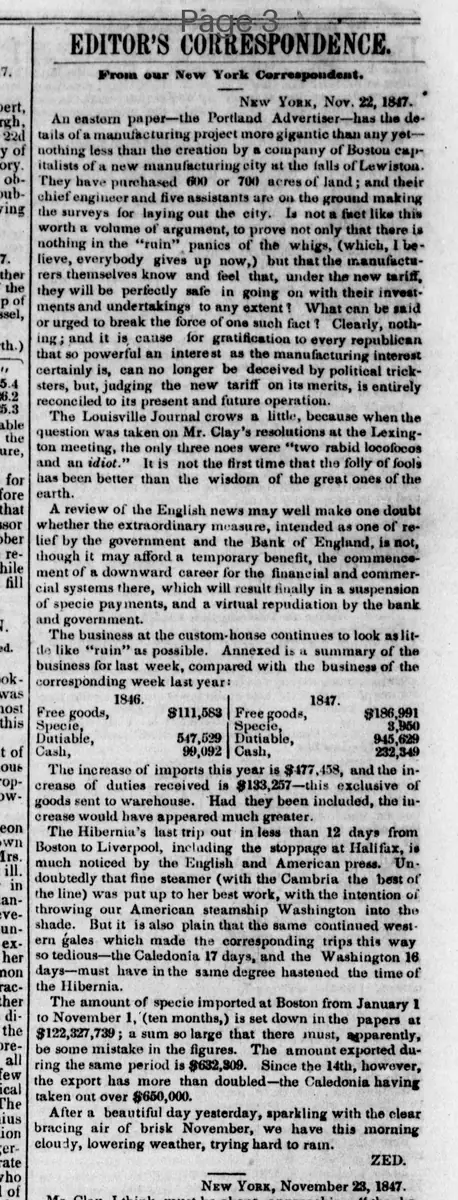
An eastern paper-the Portland Advertiser-has the details of a manufacturing project more gigantic than any yet—nothing less than the creation by a company of Boston capitalists of a new manufacturing city at the falls of Lewiston. They have purchased 600 or 700 acres of land; and their chief engineer and five assistants are on the ground making the surveys or laying out the city. Is not a fact like this worth a volume of argument, to prove not only that there is nothing in the "ruin" panics of the whigs, (which, I believe, everybody gives up now,) but that the manufacturers themselves know and feel that, under the new tariff, they will be perfectly safe in going on with their investments and undertakings to any extent! What can be said or urged to break the force of one such fact? Clearly, nothing; and it is cause of gratification to every republican that so powerful an interest as the manufacturing interest certainly is, can no longer be deceived by political tricksters, but, judging the new tariff on its merits, is entirely reconciled to its present and future operation.
The Louisville Journal crows a little, because when the question was taken on Mr. Clay's resolutions at the Lexington meeting, the only three noes were "two rabid locofocos and an idiot." It is not the first time that the folly of fools has been better than the wisdom of the great ones of the earth.
A review of the English news may well make one doubt whether the extraordinary measure, intended as one of relief by the government and the Bank of England, is not, though it may afford a temporary benefit, the commencement of a downward career for the financial and commercial systems there, which will result finally in a suspension of specie payments, and a virtual repudiation by the bank and government.
The business at the custom-house continues to look as little like "ruin" as possible. Annexed is a summary of the business for last week, compared with the business of the corresponding week last year:
1846
1847
The increase of imports this year is $177,458, and the increase of duties received is $133,257-this exclusive of goods sent to warehouse. Had they been included, the increase would have appeared much greater.
The Hibernia's last trip out in less than 12 days from Boston to Liverpool, including the stoppage at Halifax, is much noticed by the English and American press. Undoubtedly that fine steamer (with the Cambria the best of the line) was put up to her best work, with the intention of throwing our American steamship Washington into the shade. But it is also plain that the same continued western gales which made the corresponding trips this way so tedious-the Caledonia 17 days, and the Washington 16 days-must have in the same degree hastened the time of the Hibernia.
The amount of specie imported at Boston from January 1 to November 1, (ten months,) is set down in the papers at $22,327,739; a sum so large that there must, apparently, be some mistake in the figures. The amount exported during the same period is $632,809. Since the 14th, however, the export has more than doubled-the Caledonia having taken out over $650,000.
After a beautiful day yesterday, sparkling with the clear bracing air of brisk November, we have this morning cloudy, lowering weather, trying hard to rain.
ZED.
New
York, Nov. 22, 1847.
An eastern paper-the Portland Advertiser-has the details of a manufacturing project more gigantic than any yet—nothing less than the creation by a company of Boston capitalists of a new manufacturing city at the falls of Lewiston. They have purchased 600 or 700 acres of land; and their chief engineer and five assistants are on the ground making the surveys or laying out the city. Is not a fact like this worth a volume of argument, to prove not only that there is nothing in the "ruin" panics of the whigs, (which, I believe, everybody gives up now,) but that the manufacturers themselves know and feel that, under the new tariff, they will be perfectly safe in going on with their investments and undertakings to any extent! What can be said or urged to break the force of one such fact? Clearly, nothing; and it is cause of gratification to every republican that so powerful an interest as the manufacturing interest certainly is, can no longer be deceived by political tricksters, but, judging the new tariff on its merits, is entirely reconciled to its present and future operation.
The Louisville Journal crows a little, because when the question was taken on Mr. Clay's resolutions at the Lexington meeting, the only three noes were "two rabid locofocos and an idiot." It is not the first time that the folly of fools has been better than the wisdom of the great ones of the earth.
A review of the English news may well make one doubt whether the extraordinary measure, intended as one of relief by the government and the Bank of England, is not, though it may afford a temporary benefit, the commencement of a downward career for the financial and commercial systems there, which will result finally in a suspension of specie payments, and a virtual repudiation by the bank and government.
The business at the custom-house continues to look as little like "ruin" as possible. Annexed is a summary of the business for last week, compared with the business of the corresponding week last year:
1846
1847
The increase of imports this year is $177,458, and the increase of duties received is $133,257-this exclusive of goods sent to warehouse. Had they been included, the increase would have appeared much greater.
The Hibernia's last trip out in less than 12 days from Boston to Liverpool, including the stoppage at Halifax, is much noticed by the English and American press. Undoubtedly that fine steamer (with the Cambria the best of the line) was put up to her best work, with the intention of throwing our American steamship Washington into the shade. But it is also plain that the same continued western gales which made the corresponding trips this way so tedious-the Caledonia 17 days, and the Washington 16 days-must have in the same degree hastened the time of the Hibernia.
The amount of specie imported at Boston from January 1 to November 1, (ten months,) is set down in the papers at $22,327,739; a sum so large that there must, apparently, be some mistake in the figures. The amount exported during the same period is $632,809. Since the 14th, however, the export has more than doubled-the Caledonia having taken out over $650,000.
After a beautiful day yesterday, sparkling with the clear bracing air of brisk November, we have this morning cloudy, lowering weather, trying hard to rain.
ZED.
What sub-type of article is it?
Informative
Political
Persuasive
What themes does it cover?
Economic Policy
Politics
Commerce Trade
What keywords are associated?
New Tariff
Manufacturing City
Whig Panics
Custom House Imports
Specie Payments
English News
Hibernia Steamer
What entities or persons were involved?
Zed.
Editor
Letter to Editor Details
Author
Zed.
Recipient
Editor
Main Argument
under the new tariff, the economy is thriving, as evidenced by major manufacturing investments and increased imports and duties, disproving whig claims of ruin and showing manufacturers' confidence in the policy.
Notable Details
Portland Advertiser Reports Boston Capitalists Purchasing 600 700 Acres At Lewiston Falls For New Manufacturing City
Louisville Journal On Lexington Meeting Votes
Review Of English Financial Measures Potentially Leading To Suspension Of Specie Payments
Custom House Business Summary Showing Increases In Imports ($177,458) And Duties ($133,257) For 1847 Vs 1846
Hibernia Steamer Trip In Under 12 Days
Specie Imported At Boston $22,327,739 From Jan 1 To Nov 1, 1847
Weather Report: Beautiful Day Followed By Cloudy Weather