Thank you for visiting SNEWPapers!
Sign up free
Wausau Pilot
Wausau, Marathon County, Wisconsin
What is this article about?
Alvin Hartlett of the 107th Engineers shares his WWI experiences: light fighting in Alsace-Lorraine, battles at Chateau-Thierry and Fismes where he was wounded by shrapnel and mustard gas, building a bridge at Sassy and recapturing ambulances from Germans, and serving in the occupation of Germany beyond the Rhine.
Clipping
OCR Quality
Full Text
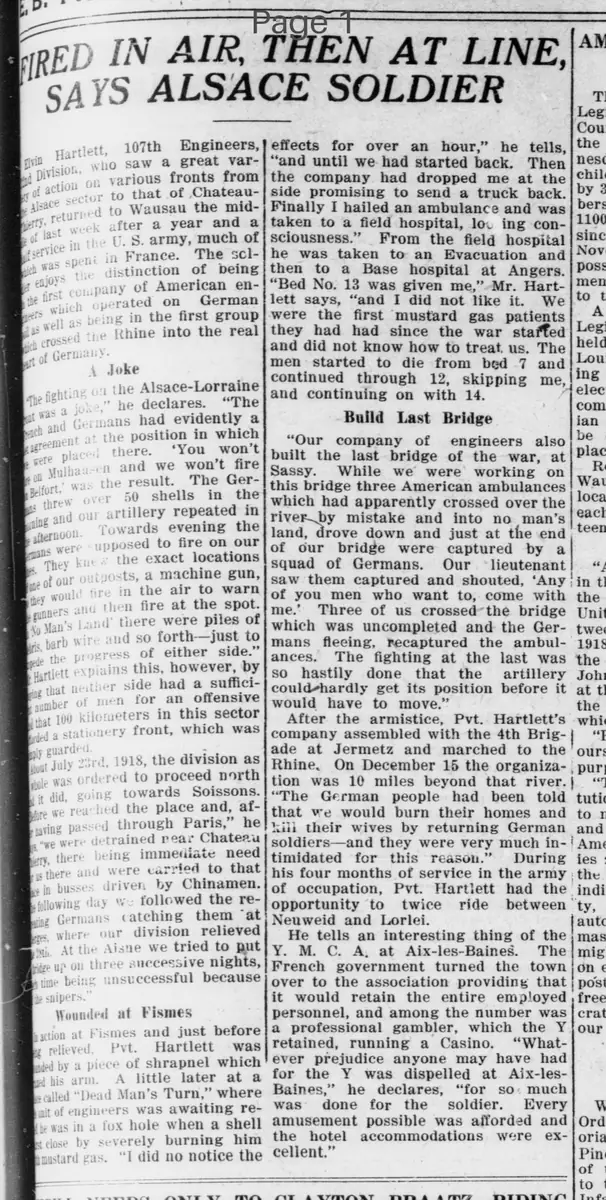
SAYS ALSACE SOLDIER
Alvin Hartlett, 107th Engineers, 32nd Division, who saw a great variety of action on various fronts from Chateau-Thierry, returned to Wausau the middle of last week after a year and a half's service in the U.S. army, much of which was spent in France.
The 107th enjoys the distinction of being the first company of American engineers which operated on German soil as well as being in the first group when crossed the Rhine into the heart of Germany.
A Joke
The fighting the Alsace-Lorraine was a joke, he declares.
"The French and Germans had evidently a agreement as to the position in which they were placed there.
'You won't fire on Mulhausen and we won't fire on Belfort.' was the result.
The Germans threw over artillery repeated in over 50 shells in the afternoon.
Towards evening the Germans were supposed to fire on our some of our outposts, a machine gun,
They but the exact locations they would be in the air to warn gunners and then fire at the spot.
So in No Man's Land there were piles of tins barb wire and so forth—just to impede the progress of either side."
Hartlett explains this, however, by saying that neither side had a sufficient number of men for an offensive that 100 kilometers in this sector guarded a stationary front, which was lightly guarded.
About July 23rd, 1918, the division as a whole was ordered to proceed north it did, going towards Soissons.
Before we reached the place and, after we were detrained near Chateau-Thierry, having passed through Paris," he says, "there being immediate need in busses driven by Chinamen.
It is there and were carried to that chasing Germans catching them at following day we followed the re- treat where our division relieved some being unsuccessful because hnidge uf on three successive nights,
At the Aisne we tried to put te snipers.
Wounded at Fismes
In action at Fismes and just before relleved.
Pvt. Hartlett was hit by a piece of shrapnel which did his arm. A little later at a called "Dead Man's Turn," where mit of engineers was awaiting re- t was in a fox hole when a shell s close by severely burning him mustard gas. "I did no notice the effects for over an hour," he tells.
"and until we had started back. Then the company had dropped me at the side promising to send a truck back.
Finally I hailed an ambulance and was taken to a field hospital, loc ing con- sciousness." From the field hospital he was taken to an Evacuation and then to a Base hospital at Angers.
"Bed No. 13 was given me." Mr. Hart- lett says, "and I did not like it. We were the first mustard gas patients they had had since the war started and did not know how to treat, us. The men started to die from bed 7 and continued through 12, skipping me, and continuing on with 14.
Build Last Bridge
"Our company of engineers also built the last bridge of the war, at Sassy. While we were working on this bridge three American ambulances which had apparently crossed over the river by mistake and into no man's land, drove down and just at the end of our bridge were captured by a squad of Germans. Our lieutenant saw them captured and shouted, 'Any of you men who want to, come with me.' Three of us crossed the bridge which was uncompleted and the Ger- mans fleeing, recaptured the ambul- ances. The fighting at the last was so hastily done that the artillery could hardly get its position before it would have to move."
After the armistice, Pvt. Hartlett's company assembled with the 4th Brig- ade at Jermetz and marched to the Rhine. On December 15 the organiza- tion was 10 miles beyond that river.
"The German people had been told that we would burn their homes and kill their wives by returning German soldiers—and they were very much in- timidated for this reason." During his four months of service in the army of occupation, Pvt. Hartlett had the opportunity to twice ride between Neuweid and Lorlei.
He tells an interesting thing of the Y. M. C. A. at Aix-les-Baines. The French government turned the town over to the association providing that it would retain the entire employed personnel, and among the number was a professional gambler, which the Y retained, running a Casino. "What- ever prejudice anyone may have had for the Y was dispelled at Aix-les- Baines," he declares, "for so much was done for the soldier. Every amusement possible was afforded and the hotel accommodations were ex- cellent."
What sub-type of article is it?
What themes does it cover?
What keywords are associated?
What entities or persons were involved?
Where did it happen?
Story Details
Key Persons
Location
France (Chateau Thierry, Soissons, Fismes, Aisne, Sassy, Angers, Aix Les Baines); Germany (Rhine, Neuweid, Lorlei, Mulhausen, Belfort); Alsace Lorraine
Event Date
1918 (July 23rd Onwards); Armistice; December 15, 1918
Story Details
Alvin Hartlett recounts his service with the 107th Engineers in WWI, including light action in Alsace-Lorraine, advance to Chateau-Thierry and Soissons, injury by shrapnel and mustard gas at Fismes, building the last bridge at Sassy with a heroic recapture of captured ambulances, and occupation duties beyond the Rhine.