Thank you for visiting SNEWPapers!
Sign up free
Editorial
September 27, 1936
Mcallen Daily Monitor
Mcallen, Brownsville, Harlingen, Hidalgo County, Cameron County, Texas
What is this article about?
Editorial criticizes Mexico's proposed passport requirement for Texans within 20 miles of the border, arguing it would harm trade, deter tourists, and disrupt harmonious border relations without justification, potentially leading to reciprocal US measures.
Clipping
OCR Quality
98%
Excellent
Full Text
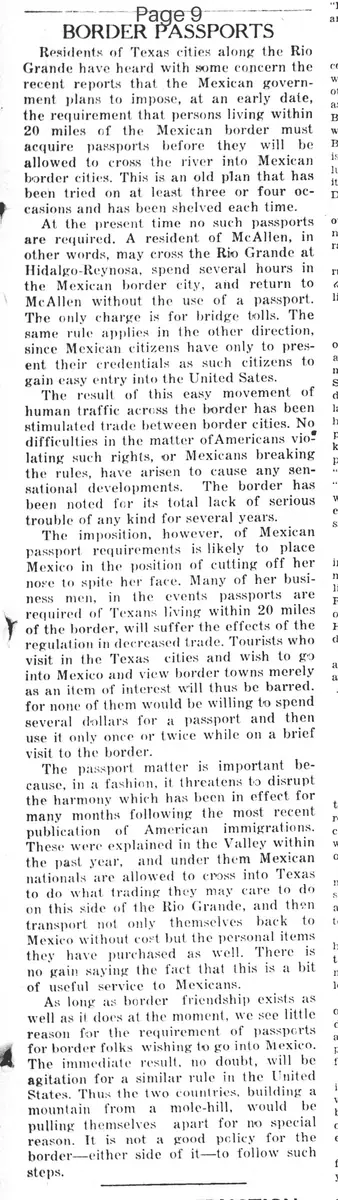
BORDER PASSPORTS
Residents of Texas cities along the Rio Grande have heard with some concern the recent reports that the Mexican government plans to impose, at an early date, the requirement that persons living within 20 miles of the Mexican border must acquire passports before they will be allowed to cross the river into Mexican border cities. This is an old plan that has been tried on at least three or four occasions and has been shelved each time.
At the present time no such passports are required. A resident of McAllen, in other words, may cross the Rio Grande at Hidalgo-Reynosa, spend several hours in the Mexican border city, and return to McAllen without the use of a passport.
The only charge is for bridge tolls. The same rule applies in the other direction, since Mexican citizens have only to present their credentials as such citizens to gain easy entry into the United States.
The result of this easy movement of human traffic across the border has been stimulated trade between border cities. No difficulties in the matter of Americans violating such rights, or Mexicans breaking the rules, have arisen to cause any sensational developments. The border has been noted for its total lack of serious trouble of any kind for several years.
The imposition, however, of Mexican passport requirements is likely to place Mexico in the position of cutting off her nose to spite her face. Many of her business men, in the event passports are required of Texans living within 20 miles of the border, will suffer the effects of the regulation in decreased trade. Tourists who visit in the Texas cities and wish to go into Mexico and view border towns merely as an item of interest will thus be barred, for none of them would be willing to spend several dollars for a passport and then use it only once or twice while on a brief visit to the border.
The passport matter is important because, in a fashion, it threatens to disrupt the harmony which has been in effect for many months following the most recent publication of American immigrations. These were explained in the Valley within the past year, and under them Mexican nationals are allowed to cross into Texas to do what trading they may care to do on this side of the Rio Grande, and then transport not only themselves back to Mexico without cost but the personal items they have purchased as well. There is no gainsaying the fact that this is a bit of useful service to Mexicans.
As long as border friendship exists as well as it does at the moment, we see little reason for the requirement of passports for border folks wishing to go into Mexico. The immediate result, no doubt, will be agitation for a similar rule in the United States. Thus the two countries, building a mountain from a mole-hill, would be pulling themselves apart for no special reason. It is not a good policy for the border--either side of it--to follow such steps.
Residents of Texas cities along the Rio Grande have heard with some concern the recent reports that the Mexican government plans to impose, at an early date, the requirement that persons living within 20 miles of the Mexican border must acquire passports before they will be allowed to cross the river into Mexican border cities. This is an old plan that has been tried on at least three or four occasions and has been shelved each time.
At the present time no such passports are required. A resident of McAllen, in other words, may cross the Rio Grande at Hidalgo-Reynosa, spend several hours in the Mexican border city, and return to McAllen without the use of a passport.
The only charge is for bridge tolls. The same rule applies in the other direction, since Mexican citizens have only to present their credentials as such citizens to gain easy entry into the United States.
The result of this easy movement of human traffic across the border has been stimulated trade between border cities. No difficulties in the matter of Americans violating such rights, or Mexicans breaking the rules, have arisen to cause any sensational developments. The border has been noted for its total lack of serious trouble of any kind for several years.
The imposition, however, of Mexican passport requirements is likely to place Mexico in the position of cutting off her nose to spite her face. Many of her business men, in the event passports are required of Texans living within 20 miles of the border, will suffer the effects of the regulation in decreased trade. Tourists who visit in the Texas cities and wish to go into Mexico and view border towns merely as an item of interest will thus be barred, for none of them would be willing to spend several dollars for a passport and then use it only once or twice while on a brief visit to the border.
The passport matter is important because, in a fashion, it threatens to disrupt the harmony which has been in effect for many months following the most recent publication of American immigrations. These were explained in the Valley within the past year, and under them Mexican nationals are allowed to cross into Texas to do what trading they may care to do on this side of the Rio Grande, and then transport not only themselves back to Mexico without cost but the personal items they have purchased as well. There is no gainsaying the fact that this is a bit of useful service to Mexicans.
As long as border friendship exists as well as it does at the moment, we see little reason for the requirement of passports for border folks wishing to go into Mexico. The immediate result, no doubt, will be agitation for a similar rule in the United States. Thus the two countries, building a mountain from a mole-hill, would be pulling themselves apart for no special reason. It is not a good policy for the border--either side of it--to follow such steps.
What sub-type of article is it?
Foreign Affairs
Immigration
Trade Or Commerce
What keywords are associated?
Border Passports
Rio Grande Crossings
Mexico Texas Border
Immigration Policy
Cross Border Trade
Passport Requirements
What entities or persons were involved?
Mexican Government
Texas Residents
Mexican Business Men
Tourists
American Immigration Authorities
Editorial Details
Primary Topic
Opposition To Mexican Passport Requirements For Border Crossings
Stance / Tone
Critical Of The Plan Advocating Continued Easy Border Movement
Key Figures
Mexican Government
Texas Residents
Mexican Business Men
Tourists
American Immigration Authorities
Key Arguments
The Plan Has Been Tried And Shelved Multiple Times Previously
Current Easy Crossing Without Passports Stimulates Trade Between Border Cities
Passport Requirement Would Decrease Trade And Hurt Mexican Businesses
It Would Deter Tourists From Brief Visits To Mexico
Threatens Existing Border Harmony And Reciprocal Immigration Policies
Could Lead To Reciprocal Us Requirements Disrupting Relations