Thank you for visiting SNEWPapers!
Sign up free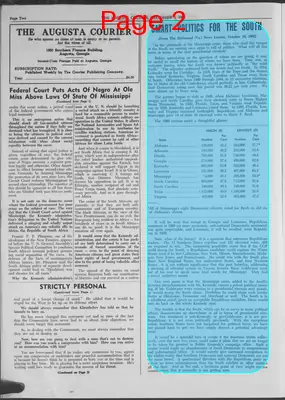
Editorial
December 3, 1962
The Augusta Courier
Augusta, Richmond County, Georgia
What is this article about?
Editorial from Richmond News Leader analyzes Southern U.S. political shifts post-1960 election, highlighting historical Democratic loyalty, 1960 results via table, growing anti-Kennedy sentiment, and potential Republican sweep with Goldwater, urging strategic independence in presidential voting.
Merged-components note: Table of 1960 election results in southern states is referenced and integral to the editorial on southern politics.
Clipping
OCR Quality
75%
Good
Full Text
| State | NIXON (R) | KENNEDY (D) | |
| Per | Per | ||
| Number | Cent | Number | |
| Alabama | 238,000 | 42.3 | 324,000 |
| Arkansas | 185,000 | 46.2 | 215,000 |
| Florida | 795,000 | 51.5 | 749,000 |
| Georgia | 274,000 | 37.4 | 459,000 |
| Kentucky | 603,000 | 53.6 | 522,000 |
| Louisiana | 231,000 | 36.2 | 407,000 |
| Mississippi | 74,000 | 40.1 | 108,000 |
| North Carolina | 655,000 | 47.8 | 713,000 |
| South Carolina | 186,000 | 48.4 | 198,000 |
| Texas | 1,122,000 | 49.0 | 1,168,000 |
| Virginia | 405,000 | 52.8 | 362,000 |
SMART POLITICS FOR THE SOUTH
(From The Richmond (Va.) News Leader, October 10, 1962)
In the aftermath of the Mississippi crisis, those who read the temper of the South are turning once again to talk of politics. What will all this mean in terms of the next presidential election?
Before speculating on the question of where we are going, it may be useful to recall the history of where we have been. Time was, as everyone knows, when the South was known politically as "the solid South." The adjective embraced both our hearts and our heads. In 1924, Kentucky went for Coolidge. In 1928, fears of the Pope and the demon rum turned Kentucky, Virginia, North Carolina and Texas away from Al Smith. Otherwise, from 1900 through 1944, in 12 successive elections, the 11 States of the old Confederacy stayed perfectly in line. Collectively, their Democratic rating over this period was 96.22 per cent pure. We were almost up to Ivory soap.
The pattern began to shift in 1948, when Alabama, Louisiana, Mississippi and South Carolina gave their electoral votes to States Righter Strom Thurmond. In 1952, Florida, Texas, and Virginia went Republican; in 1956, Kentucky and Louisiana joined them. In 1960, Florida, Kentucky and Virginia remained forthrightly Republican, and Alabama and Mississippi gave 14 of their 19 electoral votes to Harry F. Byrd.
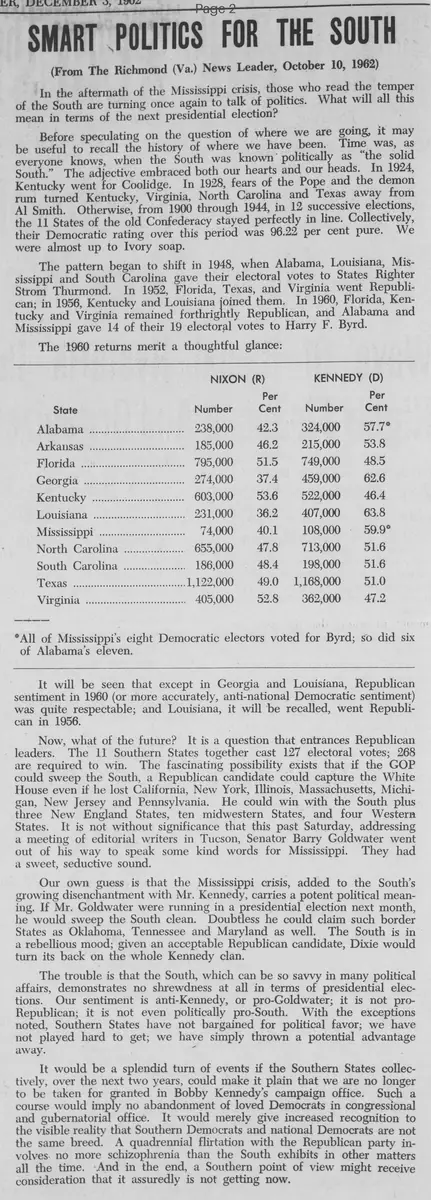
The 1960 returns merit a thoughtful glance:
All of Mississippi's eight Democratic electors voted for Byrd; so did six of Alabama's eleven.
It will be seen that except in Georgia and Louisiana, Republican sentiment in 1960 (or more accurately, anti-national Democratic sentiment) was quite respectable; and Louisiana, it will be recalled, went Republican in 1956.
Now, what of the future? It is a question that entrances Republican leaders. The 11 Southern States together cast 127 electoral votes; 268 are required to win. The fascinating possibility exists that if the GOP could sweep the South, a Republican candidate could capture the White House even if he lost California, New York, Illinois, Massachusetts, Michigan, New Jersey and Pennsylvania. He could win with the South plus three New England States, ten midwestern States, and four Western States. It is not without significance that this past Saturday, addressing a meeting of editorial writers in Tucson, Senator Barry Goldwater went out of his way to speak some kind words for Mississippi. They had a sweet, seductive sound.
Our own guess is that the Mississippi crisis, added to the South's growing disenchantment with Mr. Kennedy, carries a potent political meaning. If Mr. Goldwater were running in a presidential election next month, he would sweep the South clean. Doubtless he could claim such border States as Oklahoma, Tennessee and Maryland as well. The South is in a rebellious mood; given an acceptable Republican candidate, Dixie would turn its back on the whole Kennedy clan.
The trouble is that the South, which can be so savvy in many political affairs, demonstrates no shrewdness at all in terms of presidential elections.
Our sentiment is anti-Kennedy, or pro-Goldwater; it is not pro-Republican; it is not even politically pro-South. With the exceptions noted, Southern States have not bargained for political favor; we have not played hard to get; we have simply thrown a potential advantage away.
It would be a splendid turn of events if the Southern States collectively, over the next two years, could make it plain that we are no longer to be taken for granted in Bobby Kennedy's campaign office. Such a course would imply no abandonment of loved Democrats in congressional and gubernatorial office. It would merely give increased recognition to the visible reality that Southern Democrats and national Democrats are not the same breed. A quadrennial flirtation with the Republican party involves no more schizophrenia than the South exhibits in other matters all the time. And in the end, a Southern point of view might receive consideration that it assuredly is not getting now.
What sub-type of article is it?
Partisan Politics
What keywords are associated?
Southern Politics
Presidential Elections
Republican South
Kennedy Opposition
Goldwater Support
Mississippi Crisis
Solid South
What entities or persons were involved?
Richard Nixon
John F. Kennedy
Barry Goldwater
Harry F. Byrd
Strom Thurmond
Southern States
Mississippi
Alabama
Editorial Details
Primary Topic
Southern Strategy In Presidential Elections Against Kennedy
Stance / Tone
Anti Kennedy, Pro Strategic Republican Flirtation For Southern Interests
Key Figures
Richard Nixon
John F. Kennedy
Barry Goldwater
Harry F. Byrd
Strom Thurmond
Southern States
Mississippi
Alabama
Key Arguments
Historical 'Solid South' Democratic Loyalty Shifted Starting 1948
1960 Election Showed Strong Republican Or Anti National Democratic Sentiment In Most Southern States
Gop Could Win Presidency By Sweeping South Plus Other Regions
Mississippi Crisis And Disenchantment With Kennedy Boost Republican Prospects
South Should Bargain Politically Instead Of Being Taken For Granted By National Democrats