Thank you for visiting SNEWPapers!
Sign up free
The New Hampshire Gazette And Historical Chronicle
Portsmouth, Greenland, Rockingham County, New Hampshire
What is this article about?
In March 1770, the Livery of London's Remonstrance was presented to King George III amid tensions, involving a grand procession by the Lord Mayor and officials to St. James's Palace. Sheriffs faced inquiries from Lords Denbigh, Weymouth, and others about its authentication; the King agreed to receive it on March 14 and consider the response.
Merged-components note: Continuation of the detailed account of the London Remonstrance and related political events, within the same page and sequential reading order.
Clipping
OCR Quality
Full Text
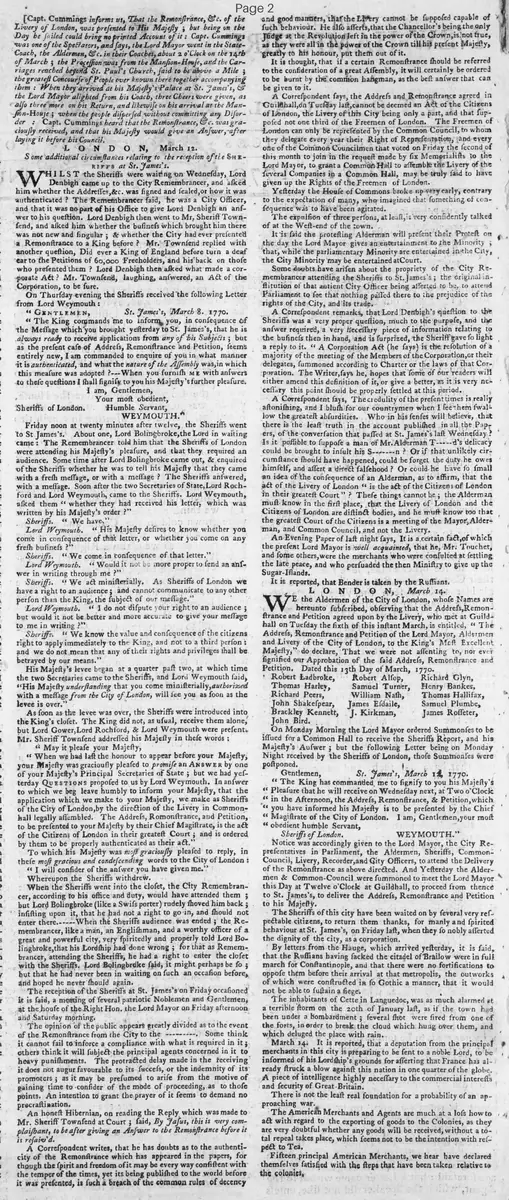
L O N D O N, March 12.
Some additional circumstances relating to the reception of the Sheriffs at St. James's.
X H I L S T the Sheriffs were waiting on Wednesday, Lord Denbigh came up to the City Remembrancer, and asked him whether the Address,&c. was signed and sealed,or how it was authenticated ? The Remembrancer said, he was a City Officer, and that it was no-part of his Office to give Lord Denbigh an answer to his question. Lord Denbigh then went to Mr, Sheriff Townsend, and asked him whether the business which brought him there was not new and singular ; & whether the City had ever presented a Remonstrance to a King before ? Mr. Townsend replied with another question, Did ever a King of England before turn a deaf ear to the Petitions of 60,000 Freeholders, and his back on those who presented them ? Lord Denbigh then asked what made a corporate Act? Mr. Townsend, laughing, answered, an Act of the Corporation, to be sure.
On Thursday evening the Sheriffs received the following Letter from Lord Weymouth :
" GENTLEMEN,
St. James's, March 8. 1770.
" The King commands me to inform you, in consequence of the Message which you brought yesterday to St. James's, that he is always ready to receive applications from any of his Subjects ; but as the present case of Address, Remonstrance and Petition, seems entirely new, I am commanded to enquire of you in what manner it is authenticated, and what the nature of the Assembly was,in which this measure was adopted ?-- When you furnish me with answers to these questions I shall signify to you his Majesty's further pleasure.
I am, Gentlemen,
Your most obedient,
Humble Servant,
WEYMOUTH.
Sheriffs of London."
Friday noon at twenty minutes after twelve, the Sheriffs went to St James's. About one, Lord Bolingbroke,the Lord in waiting came: The Remembrancer told him that the Sheriffs of London were attending his Majesty's pleasure, and that they required an audience. Some time after Lord Bolingbroke came out, & enquired of the Sheriffs whether he was to tell his Majesty that they came with a fresh message, or with a message ? The Sheriffs answered, with a message. Soon after the two Secretaries of State,Lord Rochford and Lord Weymouth, came to the Sheriffs. Lord Weymouth, asked them " whether they had received his letter, which was written by his Majesty's order ?"
Sheriffs. " We have."
Lord Weymouth. " His Majesty desires to know whether you come in consequence of that letter, or whether you come on any fresh business ?"
Sheriffs. " We come in consequence of that letter."
Lord Weymouth. " Would it not be more proper to send an answer in writing through me ?"
Sheriffs. " We act ministerially. As Sheriffs of London we have a right to an audience; and cannot communicate to any other person than the King, the subject of our message."
Lord Weymouth. " I do not dispute your right to an audience ; but would it not be better and more accurate to give your message to me in writing ?"
Sheriffs. " We know the value and consequence of the citizens right to apply immediately to the King, and not to a third person : and we do not mean that any of their rights and privileges shall be betrayed by our means."
His Majesty's levee began at a quarter past two, at which time the two Secretaries came to the Sheriffs, and Lord Weymouth said, "His Majesty understanding that you come ministerially,authorized with a message from the City of London, will see you as soon as the levee is over."
As soon as the levee was over, the Sheriffs were introduced into the King's closet. The King did not, as usual, receive them alone, but Lord Gower,Lord Rochford, & Lord Weymouth were present.
Mr. Sheriff Townsend addressed his Majesty in these words :
"May it please your Majesty,
" When we had last the honour to appear before your Majesty, your Majesty was graciously pleased to promise an Answer by one of your Majesty's Principal Secretaries of State ; but we had yesterday Questions proposed to us by Lord Weymouth. In answer to which we beg leave humbly to inform your Majesty, that the application which we make to your Majesty, we make as Sheriffs of the City of London,by the direction of the Livery in Common-Hall legally assembled. The Address, Remonstrance, and Petition, to be presented to your Majesty by their Chief Magistrate, is the act of the Citizens of London in their greatest Court ; and is ordered by them to be properly authenticated as their act."
To which his Majesty was most graciously pleased to reply, in these most gracious and condescending words to the City of London :
" I will consider of the answer you have given me."
Whereupon the Sheriffs withdrew.
- When the Sheriffs went into the closet, the City Remembrancer, according to his office and duty, would have attended them ; but Lord Bolingbroke (like a Swiss porter) rudely shoved him back ; insisting upon it, that he had not a right to go in, and should not enter there.--.-When the Sheriffs audience was ended ; the Remembrancer, like a man, an Englishman, and a worthy officer of a great and powerful city, very spiritedly and properly told Lord Bolingbroke,that his Lordship had done wrong ; for that as Remembrancer, attending the Sheriffs, he had a right to enter the closet with the Sheriffs. Lord Bolingbroke said, it might perhaps be so ; but that he had never been in waiting on such an occasion before, and hoped he never should again.
The reception of the Sheriffs at St. James's'on Friday occasioned it is said, a meeting of several patriotic Noblemen and Gentlemen, at the house of the Right Hon. the Lord Mayor on Friday afternoon and Saturday morning.
The opinion of the public appears greatly divided as to the event of the Remonstrance from the City to the ---------. Some think it cannot fail to enforce a compliance with what is required in it ; others think it will subject the principal agents concerned in it to heavy punishments. The protracted delay made in the receiving it does not augur favourable to its success, or the indemnity of its promoters; as it may be presumed to arise from the motive of gaining time to·consider of the mode of proceeding, as to those points. An intention to grant the prayer of it seems to demand no procrastination.
An honest Hibernian, on reading the Reply which was made to Mr. Sheriff Townsend at Court ; said, By Jaus, this is very complaisant, to be after giving an Answer to the Remonstrance before it is receiv'd.
A Correspondent writes, that he has doubts as to the authenticity of the Remonstrance which has appeared in the papers, for though the spirit and freedom ofit may be every way consistent with the temper of the times, yet its being published to the world before it was presented, is such a breach of the common rules of decency
and good manners, that the Livery cannot be supposed capable of such behaviour. He also asserts, that the Chancellor's being the only Judge at the Revolution left in the power of the Crown, is not true, as they were all in the power of the Crown till his present Majesty, greatly to his honour, put them out of it.
It is thought, that if a certain Remonstrance should be referred to the consideration of a great Assembly, it will certainly be ordered to be burnt by the common hangman, as the best answer that can be given to it.
A Correspondent says, the Address and Remonstrance agreed in Guildhall,on Tuesday last,cannot be deemed an Act of the Citizens of London, the Livery of this City being only a part, and that supposed not one third of the Freemen of London. The Freemen of London can only be represented by the Common Council, to whom they delegate every year their Right of Representation, and every one of the Common Councilmen that voted on Friday the second of this month to join in the request made by six Memorialists to the Lord Mayor, to grant a Common Hall to assemble the Livery of the several Companies in a Common Hall, may be truly said to have given up the Rights of the Freemen of London.
Yesterday the House of Commons broke up very early, contrary to the expectation of many, who imagined that something of consequence was to have been agitated.
The expulsion of three persons, at least, is very confidently talked of at the West-end of the town.
It is said the protesting Alderman will present their Protest on the day the Lord Mayor gives an entertainment to the Minority ; that, while the parliamentary Minority are entertained in the City, the City Minority may be entertained at Court.
Some doubts have arisen about the propriety of the City Remembrancer attending the Sheriffs to St. James's; the original institution of that ancient City Officer being asserted to be, to attend Parliament to see that nothing passed there to the prejudice of the rights of the City, and its trade..
A Correspondent remarks, that Lord Denbigh's question to the Sheriffs was a very proper question, much to the purpose, and the answer required, a very necessary piece of information relating to the business then in hand, and is surprised, the Sheriff gave so light a reply to it. " A Corporation Act (he says) is the resolution of a majority of the meeting of the Members of the Corporation,or their delegates, summoned according to Charter or the laws of that Corporation. The Writer,says he, hopes that some of our readers will either amend this definition of it, or give a better, as it is very necessary this point should be properly settled at this period.
A Correspondent says, The credulity of the present times is really astonishing, and I blush for our countrymen when I see them swallow the greatest absurdities. Who in his senses will believe, that there is the least truth in the account published in all the Papers, of the conversation that passed at St. James's last Wednesday ? Is it possible to suppose a man of Mr.Alderman T--..--d's delicacy could be brought to insult his S--r----n ? Or if that unlikely circumstance should have happened, could be forget the duty he owes himself, and assert a direct falsehood ? Or could.he have so small an idea of the consequence of an Alderman, as to affirm, that the act of the Livery of London " is the act of the Citizens of London in their greatest Court " ? These things cannot be; the Alderman must know in the first place, that the Livery of London and the Citizens of London are distinct bodies. and he must know too that the greatest Court of the Citizens is a meeting of the Mayor, Alderman, and Common Council, and not the Livery.
An Evening Paper of last night says, It is a certain fact,of which the present Lord Mayor is well acquainted, that he, Mr: Touchet, and some others,were the merchants who were consulted at settling the late peace, and who persuaded the then Ministry to give up the Sugar-Islands.
It is reported, that Bender is taken by the Russians.
We the Aldermen and Common Council Men whose names are hereunto subscribed, observing that the Address,Remon-strance and Petition agreed upon by the Livery, who met at Guild-hall on Tuesday the sixth of this instant March, is entitled, " The Address, Remonstrance and Petition of the Lord Mayor, Aldermen and Livery of the City of London, to the King's Most Excellent Majesty," do declare, That we were not assenting to, nor ever signified our Approbation of the said Address, Remonstrance and Petition. Dated this 13th Day of March, 1770.
Robert Ladbroke,
Robert Alsop,
Richard Glyn,
Thomas Harley,
Samuel Turner,
Henry Bankes,
Richard Peers,
William Nash,
Thomas Hallifax,
John Shakespeare,
James Esdaile,
Samuel Plumbe,
Brackley Kennett,
J. Kirkman,
James Roseter,
John Bird.
On Monday Morning the Lord Mayor ordered Summons to be issued for a Common Hall to receive the Sheriffs Report, and his Majesty's·Answer ; but the following Letter being on Monday Night received by the Sheriffs of London, those Summons were postponed.
Gentlemen,
St. James's, March 14, 1770.
" The King has commanded me to signify to you his Majesty's
" Pleasure that he will receive on Wednesday next, at Two o'Clock
" in the Afternoon, the Address, Remonstrance, & Petition,which
" you have informed his Majesty is to be presented by the Chief
" Magistrate of the City of London. I am, Gentlemen,your most
" obedient humble Servant,
WEYMOUTH."
Sheriffs of London.
Notice was accordingly given to the Lord Mayor, the City Representatives in Parliament, the Aldermen, Sheriffs, Common-Council, Livery, Recorder,and City Officers, to attend the Delivery of the Remonstrance as above directed. And Yesterday the Aldermen & Common-Council were summoned to meet the Lord Mayor this Day at Twelve o'Clock at Guildhall, to proceed from thence to St. James's, to deliver the Address, Remonstrance and Petition to his Majesty.
The Sheriffs of this city have been waited on by several very respectable citizens, to return them thanks, for manly and spirited behaviour at St. James's, on Friday last, when they so nobly asserted
What sub-type of article is it?
What keywords are associated?
What entities or persons were involved?
Where did it happen?
Foreign News Details
Primary Location
London
Event Date
March 1770
Key Persons
Outcome
the remonstrance was graciously received; his majesty will consider the answer after laying it before his council; scheduled for formal presentation on march 14, 1770.
Event Details
The Livery of London's Remonstrance was presented via a procession from Mansion-House to St. James's Palace on March 14, 1770, led by the Lord Mayor in state coach with aldermen and a large crowd. Sheriffs interacted with court officials including Lords Denbigh, Weymouth, Bolingbroke, Rochford, and Gower, asserting rights to audience. King received explanation from Sheriff Townsend and replied he would consider it. Some aldermen and common councilmen disavowed the document. Public opinions divided on its success and promoters' fate.