Thank you for visiting SNEWPapers!
Sign up free
The Cadiz Sentinel
Cadiz, Harrison County, Ohio
What is this article about?
On July 24, 1866, President Andrew Johnson approved a congressional resolution restoring Tennessee's relations to the Union post-Civil War, criticizing Radical Republicans and questioning the state's ratification of the 14th Amendment, while urging admission of loyal representatives.
Clipping
OCR Quality
Full Text
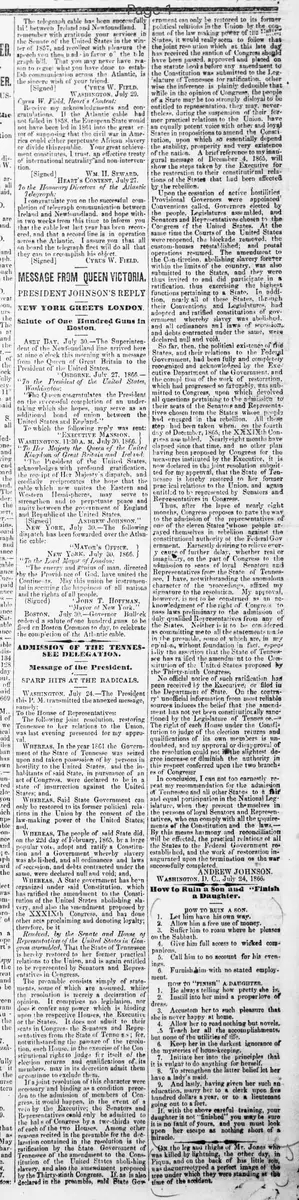
Message of the President.
SHARP HITS AT THE RADICALS.
WASHINGTON, July 24.—The President this P. M. transmitted the annexed message, namely:
To the House of Representatives:
The following joint resolution, restoring Tennessee to her relations to the Union, was last evening presented for my appro- val.
WHEREAS, In the year 1861 the Govern- ment of the State of Tennessee was seized upon and taken possession of by persons in hostility to the United States, and the in- habitants of said State, in pursuance of an act of Congress, were declared to be in a state of insurrection against the United States: and,
WHEREAS, Said State Government can only be restored to its former political rela- tions in the Union by the consent of the law-making power of the United States: and,
WHEREAS, The people of said State did on the 22d day of February, 1865, by a large popular vote, adopt and ratify a Consti- tution and a Government whereby slavery was abolished, and all ordinances and laws of secession, and debts contracted under the same, were declared null and void; and,
WHEREAS, A State government has been organized under said Constitution, which has ratified the amendment to the Consti- tution of the United States abolishing sla- very, and also the amendment proposed by the XXXIXth Congress, and has done other acts proclaiming and denoting loyalty there- fore, be it
Resolved, by the Senate and House of Representatives of the United States in Con- gress assembled, That the State of Tennessee is hereby restored to her former practical relations to the Union, and is again entitled to be represented by Senators and Repres- entatives in Congress.
The preamble consists simply of state- ments, some of which are assumed, while the resolution is merely a declaration of opinion. It comprises no legislation, nor does it confer any power which is binding upon the respective Houses, the Executive or the States. It does not admit to their seats in Congress the Senators and Repre- sentatives from the State of Tennessee; for, notwithstanding the passage of the resolu- tion, each House, in the exercise of the Con- stitutional right to judge for itself of the election returns and qualifications of its members, may in its discretion admit them or continue to exclude them.
If a joint resolution of this character were necessary and binding as a condition prece- dent to the admission of members of Con- gress, it would happen, in the event of a veto by the Executive, the Senators and Representatives could only be admitted to the halls of Congress by a two-thirds vote of each of the two Houses. Among other reasons recited in the preamble for the dec- laration contained in the resolution is the ratification by the State Government of Tennessee of the amendment to the Con- stitution of the United States abolishing slavery, and also the amendment proposed by the Thirty-ninth Congress.
If, as is also declared in the preamble, said State Gov- ernment can only be restored to its former political relations in the Union by the con- sent of the law-making power of the United States, it would really seem to follow that the joint resolution which at this late day has received the sanction of Congress should have been passed, approved and placed on the statute books before any amendment to the Constitution was submitted to the Leg- islature of Tennessee for ratification, other- wise the inference is plainly deducible that while in the opinion of Congress, the people of a State may be too strongly disloyal to be entitled to representation, they may, never- theless, during the suspension of their for- mer practical relations to the Union, have an equally potent voice with other and loyal States in propositions to amend the Consti- tution, upon which so essentially depend the stability, prosperity and very existence of the nation. A brief reference to my inau- gural message of December 4, 1865, will show the steps taken by the Executive for the restoration to their constitutional rela- tions of the States that had been affected by the rebellion.
Upon the cessation of active hostilities Provisional Governors were appointed Conventions called, Governors elected by the people, Legislatures assembled, and Senators and Representatives chosen to the Congress of the United States. At the same time the Courts of the United States were reopened, the blockade removed, the custom-houses reestablished, and postal operations resumed. The amendment to the Constitution, abolishing slavery forever within the limits of the country, was also submitted to the States, and they were thus invited to and did participate in a ratification, thus exercising the highest functions pertaining to a State. In addi- tion, nearly all of these States, through their Conventions and Legislatures, had adopted and ratified constitutions of gov- ernment whereby slavery was abolished, and all ordinances and laws of secession, and debts contracted under the same, were declared null and void.
So far, then, the political existence of the States, and their relations to the Federal Government, had been fully and completely recognized and acknowledged by the Exe- cutive Department of the Government, and the completion of the work of restoration, which had progressed so favorably, was sub- mitted to Congress, upon which devolved all questions pertaining to the admission to their seats of the Senators and Representa- tives chosen from the States whose people had engaged in the rebellion. All these steps had been taken when, on the fourth day of December, 1865, the XXXIXth Con- gress assembled. Nearly eight months have elapsed since that time, and no other plan having been proposed by Congress for the measures instituted by the Executive, it is now declared in the joint resolution sub- mitted for my approval, that the State of Ten- nessee is hereby restored to her former practical relations to the Union, and again entitled to be represented by Senators and Representatives in Congress.
Thus, after the lapse of nearly eight months, Congress proposes to pave the way to the admission of the representatives of one of the eleven States whose people ar- rayed themselves in rebellion against the constitutional authority of the Federal Gov- ernment. Earnestly desiring to relieve ever- y cause of further delay, whether real or imaginary, on the part of Congress to the admission to seats of loyal Senators and Representatives from the State of Tennes- see, I have, notwithstanding the anomalous character of the proceedings, affixed my signature to the resolution. My approval, however, is not to be construed as an ac- knowledgment of the right of Congress to pass laws preliminary to the admission of duly qualified Representatives from any of the States. Neither is it to be considered as committing me to all the statements made in the preamble, some of which are, in my opinion, without foundation in fact, espec- ially the assertion that the State of Tennes- see has ratified the amendment to the Con- stitution of the United States proposed by the Thirty-ninth Congress.
No official notice of such ratification has been received by the Executive; or filed in the Department of State. On the contra- ry, unofficial information from most reliable sources induces the belief that the amend- ment has not yet been constitutionally sanc- tioned by the Legislature of Tennessee.
The right of each House under the Consti- tution to judge of the election returns and qualifications of its own members is un- doubted, and my approval or disapproval of the resolution could not in the slightest de- gree increase or diminish the authority in this respect conferred upon the two branch- es of Congress.
In conclusion, I can not too earnestly re- peat my recommendation for the admission of Tennessee and all other States to a full and equal participation in the National Leg- islature, when they present themselves in the persons of loyal Senators and Represen- tatives, who can comply with all the require- ments of the Constitution and the laws.—By this means harmony and reconciliation will be effected, the practical relations of all the States to the Federal Government re- established, and the work of restoration in- augurated upon the termination of the war successfully completed.
ANDREW JOHNSON
WASHINGTON, D. C., July 24, 1866.
What sub-type of article is it?
What keywords are associated?
What entities or persons were involved?
Where did it happen?
Domestic News Details
Primary Location
Washington, D.C.
Event Date
July 24, 1866
Key Persons
Outcome
the president affixed his signature to the joint resolution restoring tennessee to the union, despite reservations about its necessity and some preamble statements, recommending admission of loyal representatives.
Event Details
President Andrew Johnson transmitted a message to the House of Representatives approving a joint resolution that restores Tennessee to her former practical relations to the Union following the Civil War. The message critiques the resolution's preamble and implications regarding constitutional amendments, references prior executive actions for restoration, and urges Congress to admit loyal Senators and Representatives from Tennessee and other states.