Thank you for visiting SNEWPapers!
Sign up free
The Northwest Enterprise
Seattle, King County, Washington
What is this article about?
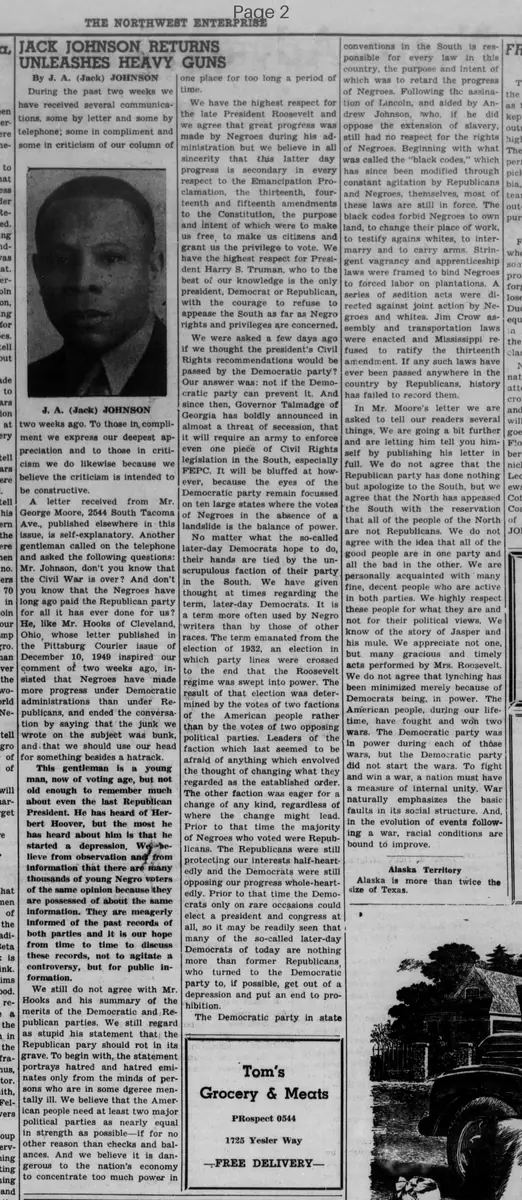
In this column, J.A. Johnson responds to criticisms of his prior piece on Republican and Democratic parties' records on Negro rights. He defends the GOP's historical contributions like emancipation and amendments, critiques Southern Democrats' opposition via black codes and Jim Crow, praises FDR and Truman's progress, and stresses the need for balanced parties.
Merged-components note: Merged section title, accompanying image, and text of Jack Johnson's political column into a single editorial component.
Clipping
OCR Quality
Full Text
ENTERPRISE
JACK
JOHNSON
RETURNS
UNLEASHES
HEAVY
GUNS
By J. A. (Jack) JOHNSON
During the past two weeks we
have received several communica-
tions, some by letter and some by
telephone; some in compliment and
some in criticism of our column of
two weeks ago. To those in compli-
ment we express our deepest ap-
preciation and to those in criti-
cism we do likewise because we
believe the criticism is intended to
be constructive.
A letter received from Mr.
George Moore, 2544 South Tacoma
Ave., published elsewhere in this
issue, is self-explanatory. Another
gentleman called on the telephone
and asked the following questions:
Mr. Johnson, don't you know that
the Civil War is over? And don't
you know that the Negroes have
long ago paid the Republican party
for all it has ever done for us?
He, like Mr. Hooks of Cleveland.
Ohio, whose letter published in
the Pittsburg Courier issue of
December 10, 1949 inspired our
comment of two weeks ago, in-
sisted that Negroes have made
more progress under Democratic
administrations than under Re-
publicans, and ended the con-
versation by saying that the junk we
wrote on the subject was bunk,
and that we should use our head
for something besides a hatrack.
This gentleman is a young
man, now of voting age, but not
old enough to remember much
about even the last Republican
President. He has heard of Her-
bert Hoover, but the most he
has heard about him is that he
started a depression. We be-
lieve from observation and from
information that there are many
thousands of young Negro voters
of the same opinion because they
are possessed of about the same
information. They are meagerly
informed of the past records of
both parties and it is our hope
from time to time to discuss
these records, not to agitate a
controversy, but for public in-
formation.
We still do not agree with Mr.
Hooks and his summary of the
merits of the Democratic and Re-
publican parties. We still regard
as stupid his statement that the
Republican party should rot in its
grave. To begin with, the statement
portrays hatred and hatred ema-
nates only from the minds of per-
sons who are in some degree men-
tally ill. We believe that the Amer-
ican people need at least two major
political parties as nearly equal
in strength as possible--if for no
other reason than checks and bal-
ances. And we believe it is dan-
gerous to the nation's economy
to concentrate too much power in
one place for too long a period of
time.
We have the highest respect for
the late President Roosevelt and
we agree that great progress was
made by Negroes during his ad-
ministration but we believe in all
sincerity that this latter day
progress is secondary in every
respect to the Emancipation Pro-
clamation, the thirteenth, four-
teenth and fifteenth amendments
to the Constitution, the purpose
and intent of which were to make
us free, to make us citizens and
grant us the privilege to vote. We
have the highest respect for Presi-
dent Harry S. Truman, who to the
best of our knowledge is the only
president, Democrat or Republican,
with the courage to refuse to
appease the South as far as Negro
rights and privileges are concerned.
We were asked a few days ago
if we thought the president's Civil
Rights recommendations would be
passed by the Democratic party?
Our answer was: not if the Demo-
cratic party can prevent it. And
since then, Governor Talmadge of
Georgia has boldly announced in
almost a threat of secession, that
it will require an army to enforce
even one piece of Civil Rights
legislation in the South, especially
FEPC. It will be bluffed how-
ever, because the eyes of the
Democratic party remain focussed
on ten large states where the votes
of Negroes in the absence of a
landslide is the balance of power.
No matter what the so-called
later-day Democrats hope to do,
their hands are tied by the un-
scrupulous faction of their party
in the South. We have given
thought at times regarding the
term, later-day Democrats. It is
a term more often used by Negro
writers than by those of other
races. The term emanated from the
election of 1932, an election in
which party lines were crossed
to the end that the Roosevelt
regime was swept into power. The
result of that election was deter-
mined by the votes of two factions
of the American people rather
than by the votes of two opposing
political parties. Leaders of the
faction which last seemed to be
afraid of anything which involved
the thought of changing what they
regarded as the established order.
The other faction was eager for a
change of any kind, regardless of
where the change might lead.
Prior to that time the majority
of Negroes who voted were Repub-
licans. The Republicans were still
protecting our interests half-heart-
edly and the Democrats were still
opposing our progress whole-heart-
edly. Prior to that time the Demo-
crats only on rare occasions could
elect a president and congress at
all, so it may be readily seen that
many of the so-called later-day
Democrats of today are nothing
more than former Republicans
who turned to the Democratic
party to, if possible, get out of a
depression and put an end to pro-
hibition.
The Democratic party in state
conventions in the South is res-
ponsible for every law in this
country, the purpose and intent of
which was to retard the progress
of Negroes. Following the assina-
tion of Lincoln, and aided by An-
drew Johnson, who, if he did
oppose the extension of slavery,
still had no respect for the rights
of Negroes. Beginning with what
was called the "black codes," which
has since been modified through
constant agitation by Republicans
and Negroes, themselves, most of
these laws are still in force. The
black codes forbid Negroes to own
land, to change their place of work,
to testify against whites, to inter-
marry and to carry arms. Strin-
gent vagrancy and apprenticeship
laws were framed to bind Negroes
to forced labor on plantations. A
series of sedition acts were di-
rected against joint action by Ne-
groes and whites. Jim Crow as-
embly and transportation laws
were enacted and Mississippi re-
fused to ratify the thirteenth
amendment. If any such laws have
ever been passed anywhere in the
country by Republicans, history
has failed to record them.
In Mr. Moore's letter we are
asked to tell our readers several
things. We are going a bit further
and are letting him tell you him-
self by publishing his letter in
full. We do not agree that the
Republican party has done nothing
but apologize to the South, but we
agree that the North has appeased
the South with the reservation
that all of the people of the North
are not Republicans. We do not
agree with the idea that all of the
good people are in one party and
all the bad in the other. We are
personally acquainted with many
fine, decent people who are active
in both parties. We highly respect
these people for what they are and
not for their political views. We
know of the story of Jasper and
his mule. We appreciate not one,
but many gracious and timely
acts performed by Mrs. Roosevelt.
We do not agree that lynching has
been minimized merely because of
Democrats being in power. The
American people, during our life-
time, have fought and won two
wars. The Democratic party was
in power during each of those
wars, but the Democratic party
did not start the wars. To fight
and win a war, a nation must have
a measure of internal unity. War
naturally emphasizes the basic
faults in its social structure. And,
in the evolution of events follow-
ing a war, racial conditions are
bound to improve.
What sub-type of article is it?
What keywords are associated?
What entities or persons were involved?
Editorial Details
Primary Topic
Republican Party's Historical Role In Negro Rights Versus Democratic Opposition
Stance / Tone
Defensive Of Republicans, Critical Of Southern Democrats, Respectful Of Fdr And Truman
Key Figures
Key Arguments