Thank you for visiting SNEWPapers!
Sign up free
Richmond Enquirer
Richmond, Richmond County, Virginia
What is this article about?
On April 17, 1820, King Louis XVIII in Paris issues an ordinance withdrawing a prior election law proposal and enacting a new system of departmental and district electoral colleges for nominating and electing French deputies, based on taxation and domicile.
Clipping
OCR Quality
Full Text
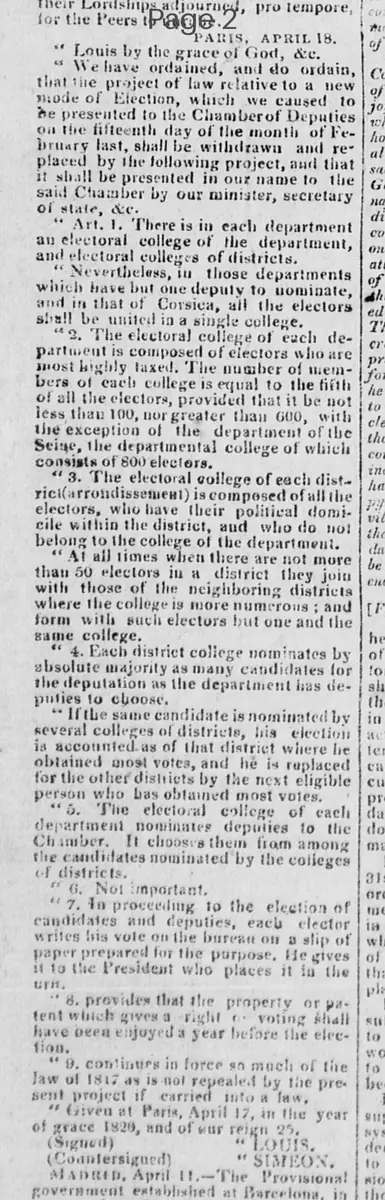
"Louis by the grace of God, &c.
"We have ordained, and do ordain, that the project of law relative to a new mode of Election, which we caused to be presented to the Chamber of Deputies on the fifteenth day of the month of February last, shall be withdrawn and replaced by the following project, and that it shall be presented in our name to the said Chamber by our minister, secretary of state, &c.
"Art. 1. There is in each department an electoral college of the department, and electoral colleges of districts.
"Nevertheless, in those departments which have but one deputy to nominate, and in that of Corsica, all the electors shall be united in a single college.
"2. The electoral college of each department is composed of electors who are most highly taxed. The number of members of each college is equal to the fifth of all the electors, provided that it be not less than 100, nor greater than 600, with the exception of the department of the Seine, the departmental college of which consists of 500 electors.
"3. The electoral college of each district (arrondissement) is composed of all the electors, who have their political domicile within the district, and who do not belong to the college of the department.
"At all times when there are not more than 50 electors in a district they join with those of the neighboring districts where the college is more numerous; and form with such electors but one and the same college.
"4. Each district college nominates by absolute majority as many candidates for the deputations as the department has deputies to choose.
"If the same candidate is nominated by several colleges of districts, his election is accounted as of that district where he obtained most votes, and he is replaced for the other districts by the next eligible person who has obtained most votes.
"5. The electoral college of each department nominates deputies to the Chamber. It chooses them from among the candidates nominated by the colleges of districts.
"6. Not important.
"7. In proceeding to the election of candidates and deputies, each elector writes his vote on the bureau on a slip of paper prepared for the purpose. He gives it to the President who places it in the urn.
"8. provides that the property or patent which gives a right of voting shall have been enjoyed a year before the election.
"9. continues in force so much of the law of 1817 as is not repealed by the present project if carried into a law.
"Given at Paris, April 17, in the year of grace 1820, and of our reign 25.
(Signed)
"LOUIS.
(Countersigned)
"SIMEON.
What sub-type of article is it?
What keywords are associated?
What entities or persons were involved?
Where did it happen?
Foreign News Details
Primary Location
Paris
Event Date
April 17, 1820
Key Persons
Outcome
withdrawal of previous election law project and introduction of new mode of election establishing departmental and district electoral colleges.
Event Details
King Louis ordains withdrawal of the February 15 election law project and replacement with a new one presented to the Chamber of Deputies. The new project creates electoral colleges in each department (composed of most highly taxed electors, 100-600 members) and districts (remaining electors). District colleges nominate candidates equal to the number of deputies; departmental colleges elect deputies from those candidates. Voting by secret ballot on prepared slips. Property qualification must be held for one year prior. Retains parts of 1817 law not repealed.